Have you ever felt super proud after finally solving a tough puzzle, making a basket, or playing a song you practiced for weeks? 🎉 That strong, good feeling inside is connected to something important: self-confidence. In this lesson, you will see how your choices—how hard you try, how you use what people tell you, and how you keep going when it's hard—can actually build your self-confidence over time.
Self-confidence is the belief that you can handle challenges, learn new things, and make good choices. It does not mean you think you are perfect or better than everyone else. It means you trust that, with effort, you can improve and do well enough.
You use self-confidence every day, for example:
When your self-confidence is healthy, you are more willing to try, to practice, and to keep going. When it is very low, you might think, "Why bother? I'll just fail," and you stop yourself before you even start.
Self-confidence is your belief in your own ability to learn, solve problems, and handle challenges.
Effort is the energy and focus you choose to use when you are working on something.
Feedback is information you get about how you are doing, from yourself, other people, or results.
Persistence is continuing to work toward a goal, even when it feels difficult or takes a long time.
Self-confidence is part of knowing yourself. It connects to your self-awareness, your individuality, and your personal growth. As you learn what helps your confidence grow, you can make smarter choices about how you act and how you talk to yourself.
Your self-confidence is not something you are just born with and stuck with forever. It changes over time. Many things affect it:
For example, if you used to think you were "bad at reading," but you found books you liked and practiced every day, your reading probably improved. As you noticed improvement, your belief about yourself also changed.
That belief—your self-confidence—gets shaped by three main choices you control: how much effort you give, how you use feedback, and how much persistence you show when things are tough.
Sometimes people say, "She's just naturally smart," or "He's just a born athlete." But research shows that effort—what you do over time—matters a lot more than talent alone.
Effort is not just working hard for one minute. It is choosing to:
Effort and the growth mindset
A growth mindset is the belief that your brain and skills can grow when you practice and learn from mistakes. When you have a growth mindset, you think, "I can't do this yet," instead of "I'll never be able to do this." Effort is the main way you turn that belief into reality.
Imagine two students learning long division in math:
Student B uses effort. Over time, Student B's math skills improve, and so does their confidence. Student A's skills stay about the same, and confidence may drop because they never give effort a chance to work.
So effort does two things at once:
When you remember times effort helped you, you start to believe, "If I try and stick with it, I can grow." That belief is a powerful part of self-confidence.
As you work and practice, you constantly receive feedback. Feedback is any information that tells you how you are doing. It can come from people around you or from the results you get.
Some types of feedback include:
Feedback can be:
Helpful feedback tells you what to change. Unhelpful feedback attacks who you are.
Example: Using feedback in writing
Imagine you write a story and your teacher says, "Your ending is exciting, but the middle feels confusing. Try adding two more details so the reader understands what happens."
Step 1: Listen for the useful part.
The feedback is about the middle of the story needing more details.
Step 2: Decide what effort to make.
You choose to reread the middle and add two clear events that lead to the ending.
Step 3: Notice what happens next.
After you revise, your story makes more sense. Your teacher says, "Now your story flows nicely." You feel more confident about your writing.
By using the feedback instead of taking it personally, you improved your skill and your self-confidence at the same time.
Sometimes feedback feels uncomfortable, especially when it points out a mistake. But if you remember that feedback is information, not an insult, you can use it to guide your next effort. That is a key part of personal growth.
When someone gives feedback that sounds mean, you can still look for any small piece that is useful, and then choose to ignore the hurtful part. You can also ask for clearer feedback, such as, "Can you tell me one thing I did well and one thing I could fix?"
Even with strong effort and good feedback, some goals take a long time. That is where persistence comes in.
Persistence means:
Think about learning to ride a bike, swim, or play an instrument. Almost nobody gets it perfect the first time. You wobble, splash, or play the wrong notes. If you stopped forever the first time you failed, you would never learn. But by being persistent, you give yourself many chances to improve.
Some scientists call persistence and long-term effort grit. Students with more grit often reach their goals, not because they never fail, but because they don't let failure be the final word.
Persistence shapes your self-confidence because it teaches you this message: "Mistakes are not the end. I can keep going." When you believe that, you feel braver about trying new things. You know that even if you mess up, you won't just quit.
Here is a simple story to see how persistence works with confidence:
Your confidence changed because you chose to keep trying, used feedback, and stuck with it over time.
These three ideas—effort, feedback, and persistence—are like parts of a machine that builds self-confidence. They are connected in a cycle, as shown in [Figure 1].
Here is how the cycle works:
Then the cycle starts again with the next challenge. 🌱 Each time you go around the cycle, your skills and confidence can grow a little more.
This cycle is part of executive functioning, because it includes planning (deciding to practice), monitoring (noticing feedback), and adjusting strategies (changing what you do next). It also connects to interpersonal skills, because you often need to ask others for feedback, listen respectfully, and share how you feel.
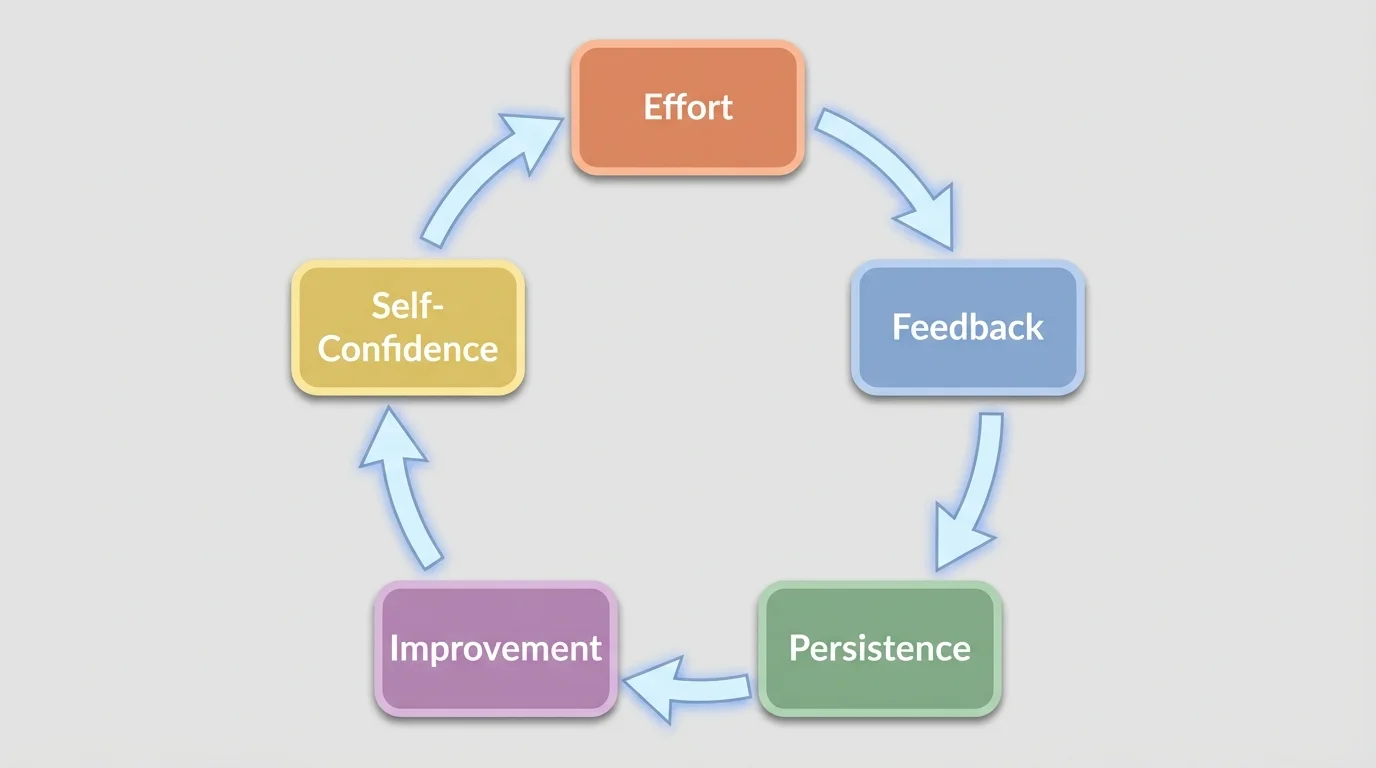
Later, when you face a big challenge—like a long project or a conflict with a friend—you can remember this cycle. Just like the loop in [Figure 1], you can keep moving forward by choosing effort, listening to feedback, and not giving up.
Not all self-confidence looks the same. You can picture three different students with different levels of confidence, as in [Figure 2].
| Type of confidence | What they might think | What they might do |
|---|---|---|
| Low confidence | "I'm terrible at this. I can't do anything right." | Doesn't try, hides work, avoids new challenges. |
| Healthy confidence | "This is hard, but I can improve if I work at it." | Tries, asks for help, uses feedback, keeps going. |
| Overconfidence | "I'm already the best. I don't need to practice." | Brags, ignores feedback, may blame others for mistakes. |
Table 1. Comparison of low, healthy, and overconfidence.
Healthy self-confidence does not mean you always feel awesome. It means you:
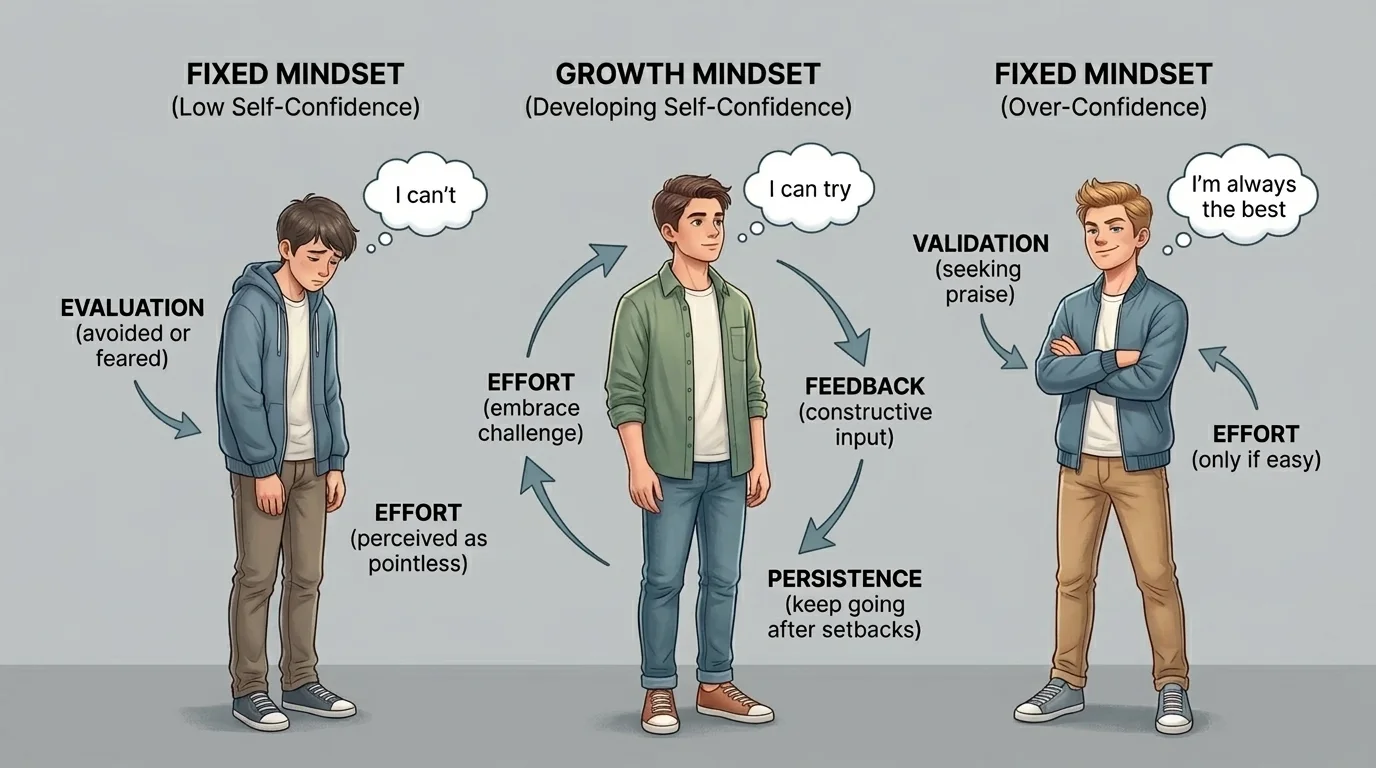
When you look at the three types of confidence, like the students in [Figure 2], you can ask yourself: Which one do I act like most of the time? Which one do I want to be more like?
Using effort, feedback, and persistence helps move you toward healthy confidence. For example, if you notice you often say, "I'm just bad at this," you can switch to, "I'm not good at this yet, but I can work on it." That small change in thinking can change how you feel and what you choose to do.
Here are some clear ways you can use effort, feedback, and persistence to shape your self-confidence in everyday life.
1. Set small, realistic goals
Instead of saying, "I will get 100% on every test," you might set a goal like:
Small goals are easier to reach. When you reach them, your confidence grows, and you are ready for bigger goals.
2. Notice and track your effort 🤔
You can keep a simple notebook or chart where you write what effort you used each day. For example:
When you see your effort written down, you remember that you are someone who tries. That picture of yourself increases your self-confidence.
3. Ask for clear, kind feedback
You can ask people questions like:
This helps you get specific information that you can actually use. It also shows you care about growing, not just about looking perfect.
4. Practice helpful self-talk 😊
Self-talk is what you say to yourself in your mind. It can be:
You can't always control what happens outside you, but you can choose kinder, stronger words inside your mind. Over time, these words shape your self-confidence.
5. Celebrate progress, not just perfection 🌟
Notice when you improve, even a little:
When you celebrate progress, you remind yourself that growth is possible. That belief makes you braver the next time you face something hard.
"Success is the sum of small efforts, repeated day in and day out."
— Robert Collier
Your self-confidence is not a fixed number. It is something you are building, piece by piece, with every choice you make—every time you put in effort, listen to feedback, and keep going when it's hard. As you grow, you also learn to respect that other people are on their own journeys with confidence, effort, and persistence, too. That understanding makes you kinder to others and to yourself. 💛
