At 17, you may be close to signing your first lease, choosing a college or job, or making your own medical choices. These decisions can affect years of your life—yet nobody hands you a "readiness certificate" when it is time. 🤔 So how do you actually know if you are ready to decide for yourself in adult settings?
Independent decision-making is not the same as doing whatever you want or rejecting all advice from others. It is the ability to choose a course of action based on your own understanding, values, and goals—while accepting responsibility for the consequences.
Everyday decisions, like what to wear, usually have low stakes and short-term effects. In contrast, adult-setting decisions often involve larger consequences, more complex information, and legal or financial commitments. Examples include:
Being ready for these decisions means you can:
Readiness is not one single trait. It is a combination of mental skills, emotional maturity, and interpersonal awareness that work together. Four major components are:
For example, you might be academically strong but struggle with delaying gratification. Or you might be emotionally steady but not yet experienced in reading financial documents. Readiness is uneven; part of growing up is recognizing where you are already strong and where you still need support.
Self-awareness, executive functioning, emotional regulation, and values are key foundations of independent decision-making. They shape how well you can understand situations, manage impulses, and choose options that fit who you want to be.
As you explore these foundations, notice where you feel confident and where you are uncertain. That honest noticing is the starting point of real independence.
One sign of readiness is the ability to describe yourself realistically. This includes your skills, emotional triggers, needs, and limits. Someone with strong self-awareness can say things like, "I am good at planning ahead but I get overwhelmed by conflict," or "I tend to agree too quickly when I feel pressured."
Self-awareness has several layers:
For instance, if you know you procrastinate, you can plan extra time before a deadline instead of pretending you will "suddenly change this time." If you know you dislike confrontation, you can practice scripts for saying "no" or asking for more time instead of agreeing to things you do not want.
Human brain regions involved in planning and self-control, especially the prefrontal cortex, typically continue developing into the mid-20s, which helps explain why decision-making can feel harder as a teen than it may feel later.
Self-awareness also includes recognizing your current level of knowledge. If you are choosing between health insurance plans and you realize, "I barely understand any of these terms," that is not failure. It is useful information. It tells you that an important part of readiness is to seek explanation, do research, or consult someone trustworthy.
Without self-awareness, independence can become risky: you might jump into decisions you are not prepared for, or refuse help when you truly need it.
Even if you understand yourself well, you still need mental tools for handling complex choices. These tools are often grouped under executive functioning. They include:
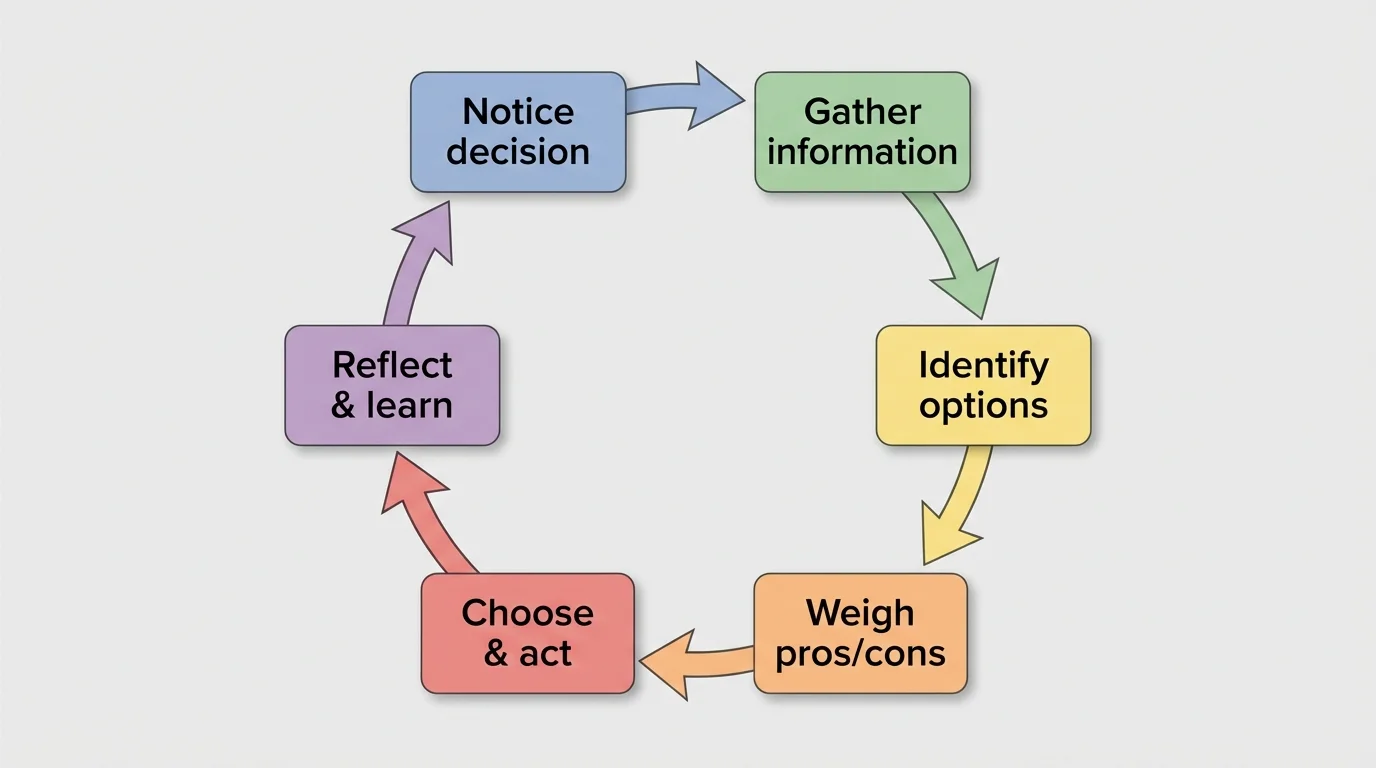
When you make an important decision, you are basically running through a mental process, as the cycle in [Figure 1] shows in visual form. Skilled decision-makers do this more deliberately; unready decision-makers rush or skip steps.
A basic decision-making cycle
One useful way to think about decisions is as a loop:
Each time you complete this cycle thoughtfully, you strengthen your ability to handle future decisions with more confidence and clarity.
For example, suppose you are offered a part-time job with long evening hours. A rushed response might be, "Yes, more money!" A more prepared response would involve checking transportation, impact on sleep and school, employer reputation, and your own limits.
Emotional regulation supports this cycle. When you are extremely angry, anxious, or excited, it becomes harder to weigh information realistically. Readiness does not mean never having strong feelings; it means noticing them, slowing down, and making space for your thinking skills to work.
No important life decision happens in a vacuum. Your family, friends, teachers, employers, and partners influence what you see as normal, possible, or expected. These influences can be supportive or harmful.
Healthy independence means being able to listen to others, ask for advice, and consider different views, while still making a choice that is genuinely yours. It is different from simply doing what others say, and it is also different from stubbornly rejecting all input.
Consider the difference between peer pressure and healthy guidance:
| Type of influence | Typical signs | Effect on your independence |
|---|---|---|
| Healthy guidance | Explains reasons; respects your final choice; encourages questions. | Supports your learning and growth; you still own the decision. |
| Peer pressure | Uses shame, fear of exclusion, or flattery; dismisses your concerns. | Pushes you to ignore your values or limits; weakens true independence. |
| Controlling influence | Makes threats, withholds affection or support if you disagree. | Prevents you from making free choices; may be a warning sign of unhealthy relationships. |
Communication skills are part of readiness. Being able to say, "I need more time to think," or "Thank you for your advice, but this choice is mine," protects your independence while maintaining relationships.
Sometimes, the bravest independent decision is to admit, "I am not ready to decide this alone yet," and to seek help from a trusted adult, counselor, or professional. That, too, is using your autonomy responsibly.
Not all decisions require the same level of readiness. Some choices are relatively simple; others demand more information, more self-control, or more long-term thinking. It is helpful to notice the different decision domains you will face in adulthood, as summarized in [Figure 2].
Here are five common domains, with examples of what "readiness" might look like in each:
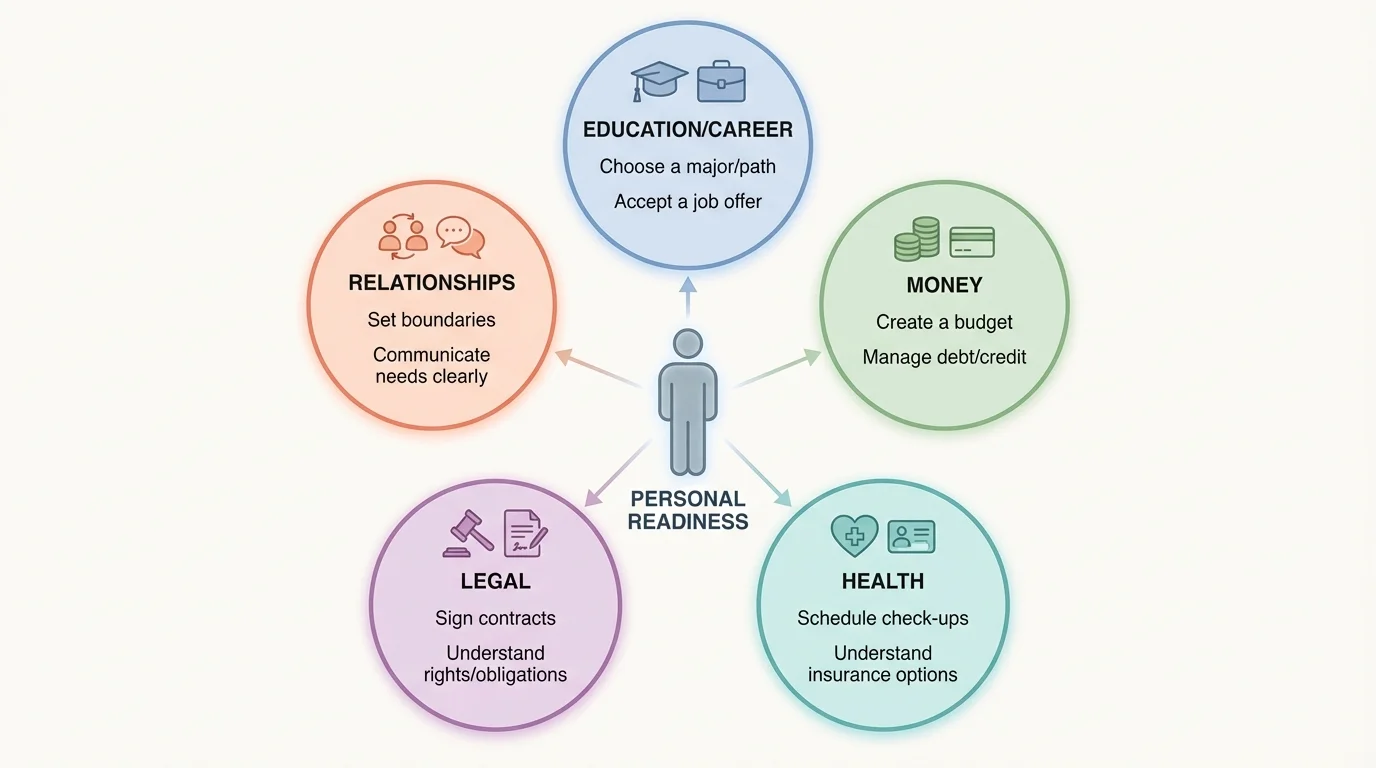
For example, in the money domain, a key readiness skill is understanding that if you use a credit card to buy something, you must repay the amount later, sometimes with added interest. Choosing to delay a purchase until you are sure you can afford it shows more readiness than buying immediately because "everyone else has one."
In the health domain, readiness might look like saying to a doctor, "I do not fully understand this procedure. Can you explain the benefits and risks again, and maybe give me written information to read?" This shows both self-awareness and responsible independence.
To decide whether you are ready to make an important choice on your own, you can use a short self-check. One simple framework is to ask four questions:
Example: Assessing readiness before signing a gym contract
Scenario: You are offered a discounted 12‑month gym membership if you sign today.
Step 1: Check understanding
Ask yourself: "Do I know the total cost, payment schedule, cancellation policy, and any extra fees?" If the contract language is confusing, recognize that your understanding is incomplete.
Step 2: Consider consequences
Think through: "If I sign, can I afford the monthly payments for 12 months? What happens if I move or get injured? What if my income changes?"
Step 3: Notice emotions and pressure
You might feel excitement about getting fit and fear of missing the "limited-time offer." Notice if the salesperson is urging you to decide immediately. Ask, "Is this pressure affecting my judgment?"
Step 4: Decide what support you need
If you cannot answer your own questions, a readiness move could be to ask for a copy of the contract to show a parent, teacher, or another trusted adult, or to research online reviews of the gym.
If you realize that you do not fully understand the contract or cannot reliably afford it, choosing not to sign today is an independent, responsible decision—not a sign of weakness.
Using such a framework repeatedly builds stronger decision habits over time. It also trains you to pause before committing, rather than reacting to pressure or emotion alone.
Everyone makes mistakes. The issue is not whether you ever choose poorly, but whether you can recognize patterns that put you or others at risk. Some warning signs that you may not be ready to make a certain decision alone include:
"You are free to choose, but you are not free from the consequences of your choices."
— Common principle about responsibility
If you notice these warning signs, it does not mean you are doomed to fail. It means you have discovered an area where you can grow your executive skills, self-awareness, or boundaries. That realization itself is a sign of increasing maturity. 🌱
Pay special attention to decisions that affect your safety, legal record, or long-term finances. In such cases, ignoring warning signs can lead to consequences that are hard to reverse, like debt, legal trouble, or damaged relationships.
Readiness is not fixed. You can actively strengthen your capacity to make sound decisions in adult settings. Some practical strategies include:
Example: Growing readiness over time
Imagine a student, Maya, who often agrees to extra commitments (clubs, shifts at work, favors for friends) and then feels overwhelmed. She notices a pattern: she says "yes" quickly to avoid disappointing people.
Step 1: Self-awareness
Maya starts writing down decisions she regrets. She realizes most of them involve saying "yes" without thinking through her schedule.
Step 2: Simple rule
She creates a personal rule: "I will not give an answer about new commitments immediately; I will check my calendar first."
Step 3: Communication skill
She practices a sentence: "Thanks for asking me. I need to check my schedule, and I will let you know tomorrow."
Step 4: Reflection
After a month, Maya notices she is less stressed and her grades are more stable. She still helps others, but now chooses when and how much.
Through this process, Maya becomes more ready to make adult decisions about time, work, and commitments. Her independence has grown because she understands herself better and uses that understanding in practice. 💡
Ideas about independence vary across families and cultures. In some cultures, major decisions (like education, marriage, or living arrangements) are usually made in close consultation with parents or elders. In others, individual choice is emphasized more strongly and earlier.
Assessing your readiness should respect both your personal growth and your cultural context. You can value your family's input and still develop your own voice. The goal is not to copy someone else's version of independence, but to become a responsible decision-maker within your community and values.
In formal adult settings—such as hospitals, banks, or schools—you will also encounter concepts like informed consent. This means you have been given understandable information about a decision (like a medical procedure or research participation), and you voluntarily agree. Being truly ready requires that you ask questions until you understand enough to consent responsibly.
Whether you are deciding about a job contract, a serious relationship, or a medical treatment, ethical readiness includes considering not only "What do I want?" but also "Is this fair? Does it respect others' rights and wellbeing?"
