Have you ever wondered why one person thinks it's totally fine to copy homework, while another person feels sick just thinking about it? Or why one classmate always stands up for others, even when it's hard, and someone else just laughs along with a mean joke? Those differences often come from something powerful inside us: our values.
Values quietly shape many choices every day: who you sit with at lunch, whether you join the soccer team or the art club, and how you handle chores or homework. When you understand your values, it becomes easier to make choices that you feel proud of, even when life is confusing or friends are pressuring you.
We use the word "values" a lot, but what does it really mean? In simple words, values are the important ideas and beliefs that guide how you think, feel, and act. They are like your inner rules about what is "good," "right," or "important."
Values are the deep beliefs that help you decide what matters most, how you want to behave, and what kind of person you want to be.
Some common values for people your age include:
Your values are not the same as your favorite things. Liking pizza or a particular video game is a preference. Believing that people should not be judged by their appearance is a value.
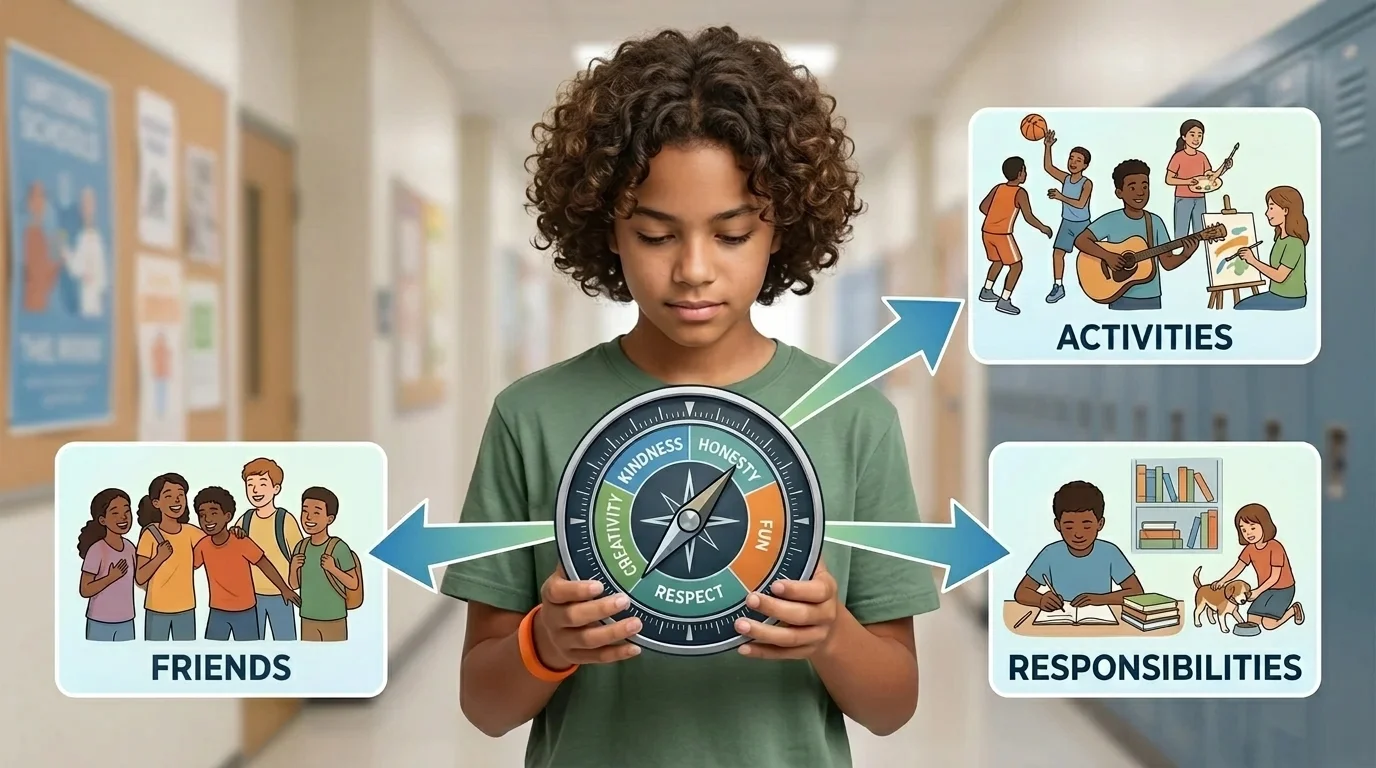
Values act like a personal compass, quietly pointing you in a direction. When you feel confused about what to do, your values can help you find your way, just like a compass helps a hiker in the forest.
Sometimes you notice your values most clearly when someone breaks them. If honesty is important to you, watching someone cheat on a test might really bother you. That uncomfortable feeling can be a clue: "Wow, honesty is a big value for me."
Values do not just appear out of nowhere. Over time, many things shape what you believe is right, important, or respectful. Some of the biggest influences are:
Your values can also change as you grow. Something you cared a lot about in 3rd grade might not feel as important now. And something you hardly noticed before—like justice or mental health—may suddenly matter a lot in middle school.
Values and Identity
Your values are a big part of your identity—the story you tell yourself about who you are. As you get older, you have more chances to choose your own values, not just follow what everyone else believes. This is an important part of personal growth.
Even if you grew up in the same house as a sibling, you might not have the exact same values. You are a unique person, and your mind notices and cares about different things.
Think about how you pick friends. It might seem like it is all about who is fun, who likes the same games as you, or who is in your classes. But under the surface, your values are doing a lot of the work. They help you decide who feels "right" to be around. This is the idea shown in [Figure 2], where a student compares different possible friends based on what matters to them.
For example, you might value:
Sometimes different values pull you in different directions. Imagine these two classmates:
| Friend A | Friend B |
|---|---|
| Always kind, even to people outside the friend group | Makes hilarious jokes, but sometimes they are mean |
| Does not cheat on schoolwork | Shares answers and expects you to do the same |
| Listens when you talk | Talks over people to get laughs |
Table 1. Comparing two potential friends based on behavior and values.
If you strongly value kindness and honesty, you will probably feel more comfortable with Friend A, even if Friend B is more "popular." On the other hand, if your top value is being liked by the "cool group," you might be tempted to choose Friend B, even if you feel uneasy sometimes.
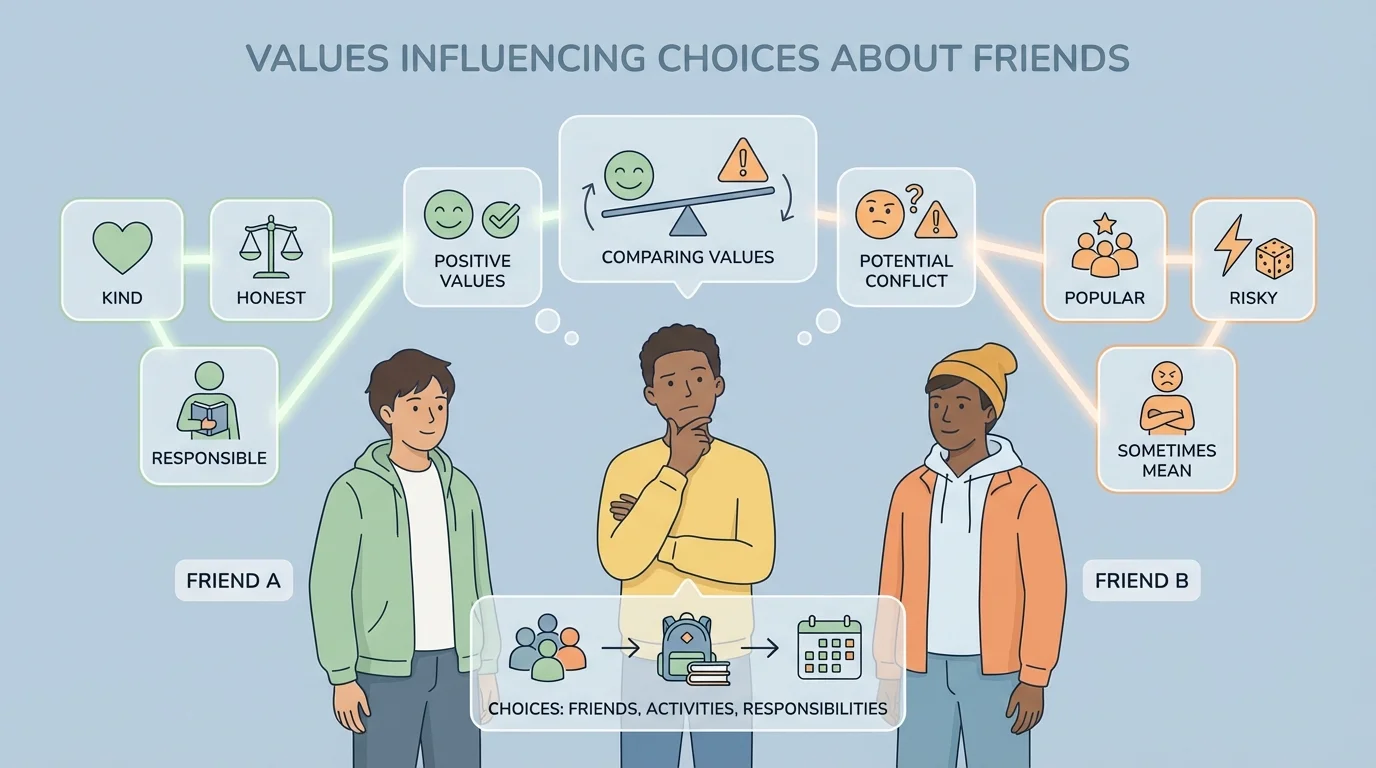
Over time, friendships where your main values and the other person's behavior match tend to feel safer and more peaceful. Friendships where your values and their actions constantly clash can feel stressful or confusing.
As you think about your friendships, you can ask yourself:
If the answer is often "no," that is a sign your values and this friendship do not fit well together.
Your values also guide what you choose to do with your time: sports, clubs, online activities, and hobbies. Different activities match different values.
Here are some examples:
| Value | Possible Matching Activities |
|---|---|
| Teamwork | Basketball, soccer, robotics team, group projects |
| Creativity | Art club, writing stories, music, coding games |
| Helping others | Volunteering, tutoring younger students, community cleanups |
| Competition | Chess club, math competitions, esports tournaments |
| Adventure | Hiking, scouting, trying new clubs or activities |
Table 2. Examples of how certain values can connect to different activities.
When you choose activities that match your values, you are more likely to feel motivated and proud, even when things get challenging. If you join a club just because your friends are in it—but it does not fit your values—you might get bored, stressed, or uncomfortable.
Values can also help you balance short-term fun and long-term goals. For example:
Sometimes you might feel a tug-of-war inside: "I want to scroll on my phone" vs. "I also want to keep my grades up." That feeling often means two values (fun and responsibility) are arguing in your mind.
People who regularly choose activities that match their values often feel more confident and less stressed, because their actions line up with who they want to be.
When you notice that an activity keeps pushing you to break your values—for example, a group chat where people always gossip or make fun of others—that is a sign you might need to step back or change how you participate.
You already have many responsibilities: doing homework, helping at home, following classroom rules, maybe looking after siblings or pets. How you handle these responsibilities depends a lot on your values.
Some important values related to responsibilities are:
For example:
Sometimes responsibilities feel annoying or boring. But when you connect them to a value you care about, they can feel more meaningful. Doing your chores might connect to values like helping your family or being independent as you grow up.
Balancing responsibilities and fun is an important part of becoming more mature. You do not have to give up all fun to be "responsible," but your values can help you choose what to do first and what to do later.
Life is not always simple. Sometimes values crash into each other and create hard choices. This is called a values conflict.
Here are some examples of values conflicts:
Values can also clash between people:
When values clash, you might feel stressed, guilty, or confused. That does not mean your values are wrong. It means you care about more than one important thing at the same time.
You can use a simple decision process—like using your "values compass" from [Figure 1]—to help in these moments:
This does not guarantee an easy choice, but it helps you make a thoughtful one.
To let your values guide you, you first need to know what they are. This is called self-awareness—understanding your own thoughts, feelings, and actions.
Self-Awareness and Executive Functioning
Self-awareness is part of your brain's executive functioning—the mental skills that help you plan, focus, remember instructions, and control impulses. When you know your values, it becomes easier to use these skills to make choices that match who you want to be.
Here are some ways to grow your self-awareness about values:
As you become more self-aware, you can catch yourself in the middle of a choice and think, "Does this match my values?" That pause is a powerful skill.
Knowing your values is helpful only if you actually use them. Here is a simple way to let your values guide choices about friends, activities, and responsibilities:
Some mini examples:
When your choices line up with your values, you build something very important: integrity—being the same person on the inside and the outside. Over time, this helps other people trust you, and it helps you trust yourself.
"You are what you do, not what you say you'll do."
— Often attributed to Carl Jung
Every day, you get many chances to practice: at lunch, in group work, in text chats, in your family, and even when no one is watching. Your values are always there, like a quiet voice or a compass in your pocket, ready to guide you if you stop and listen.
