Plenty of people make major life choices with surprisingly little self-knowledge. They pick a job because it sounds impressive, say yes to plans that drain them, or jump into adult responsibilities without understanding how they actually function under pressure. That usually creates stress, wasted time, and avoidable setbacks. The good news is that you do not need to guess your way into adulthood. You can build a clear picture of who you are, what helps you succeed, and what kind of future fits you best.
A strong self-understanding profile is not a personality quiz result or a list of labels. It is a practical tool you can use when you are planning your next steps. It helps you explain what you do well, where you need structure, what matters to you, and what kind of support helps you stay healthy and productive. That matters whether you are thinking about college, trade training, a job, volunteering, independent living, or a mix of several paths.
Adult transitions usually bring more freedom, but they also bring more responsibility. You may need to manage your own schedule, communicate professionally, make appointments, meet deadlines, keep track of money, handle transportation, and solve problems without someone reminding you every step. If you understand your patterns ahead of time, you can prepare instead of reacting.
For example, maybe you are highly creative, work best in focused bursts, and do excellent work when expectations are clear. That can be a real strength. But if you also tend to underestimate how long tasks take, avoid emails when stressed, or lose motivation when directions are vague, those patterns matter too. Knowing both sides helps you choose systems that actually work for you.
Self-understanding also protects your individuality. Adult planning should not force you into someone else's definition of success. A future that fits you may include part-time work while building a business, community college before transferring, an apprenticeship instead of a four-year degree, living with family for a period, or needing ongoing support in some areas while being highly independent in others.
Self-understanding profile is a clear, organized description of your strengths, challenges, values, interests, habits, support needs, and goals. It is meant to help you make decisions, communicate your needs, and plan realistic next steps.
A useful profile is specific. "I'm bad at time management" is too vague to help. "I start strong, but when a task has more than three steps, I often stall unless I write a checklist and set two alarms" is much more useful. Specific self-knowledge leads to better choices.
Your self-advocacy gets stronger when your profile is organized into clear categories, as shown in [Figure 1]. Instead of one giant paragraph about yourself, break your profile into parts you can actually use during planning conversations, applications, interviews, or personal decision-making.
Start with your strengths. These might include persistence, empathy, creativity, reliability, problem-solving, humor, technical ability, attention to detail, leadership, or the ability to learn quickly through observation. Strengths are not just things you enjoy. They are patterns that help you function well.
Then identify your growth areas or support needs. These are not proof that you are failing. They are areas where you may need tools, routines, accommodations, coaching, or extra practice. Common examples include task initiation, organization, emotional regulation, planning ahead, asking for help, reading social cues, managing anxiety, or handling transitions.
Your values matter too. Values are the principles that shape what feels meaningful and acceptable to you. Maybe you value stability, creativity, service, independence, financial security, flexibility, learning, family responsibility, faith, justice, or privacy. If your future plan conflicts with your values, it will be harder to sustain.
Interests and preferences also belong in the profile. What kind of work keeps your attention? Do you prefer quiet or active environments? Do you like hands-on tasks, digital work, helping people, working alone, or collaborating? What schedule feels realistic for your energy level? These details can prevent a mismatch between you and your next step.
Finally, include your goals and the supports that help you move toward them. A profile should not only describe who you are now. It should also help you think about where you are going.
Many adults make better career and life decisions after realizing that the issue was never a lack of ability. The issue was a poor fit between their needs and their environment.
You do not need to be perfect in every area to have a strong future. You need a realistic understanding of yourself and a plan that matches it.
Executive functioning is the set of mental skills that helps you manage yourself in everyday life, and [Figure 2] lays out that process from noticing a task to reviewing the result. These skills affect how you begin tasks, plan steps, estimate time, stay organized, shift when plans change, and finish what you start. In adult life, these skills show up everywhere: replying to a manager, paying a bill on time, getting to an appointment, completing an online application, or remembering to refill medication.
One major area is task initiation. This is your ability to begin. Some students know exactly what they need to do but still freeze, avoid it, or wait until the last minute. If that happens often, your profile should say so honestly and describe what helps. Maybe you start faster when you break a task into tiny steps, use a timer for the first five minutes, or text someone your start time for accountability.
Another area is organization. This includes tracking materials, digital files, deadlines, passwords, documents, and routines. In adult life, poor organization can lead to missed opportunities. For example, losing a tax form, forgetting your login for a job portal, or missing an email about an interview can create real consequences.
Time management is also essential. Some people overestimate how much they can do in a day. Others avoid planning because planning feels stressful. A simple strategy is to compare your guess with reality. If you think an application will take 20 minutes but it actually takes 55 minutes, that is useful information. Over time, your estimates become more accurate.
Emotional regulation matters just as much as calendars and reminders. If frustration, anxiety, or disappointment quickly knocks you off track, that belongs in your profile. This is not about judging yourself. It is about knowing what helps you recover. You might need short breaks, grounding techniques, a script for difficult emails, or time to process before responding.
Cognitive flexibility is your ability to adjust when plans change. Adult life changes constantly. A manager shifts a schedule. A class gets canceled. A ride falls through. If change is especially hard for you, planning ahead for backup options can make a huge difference.
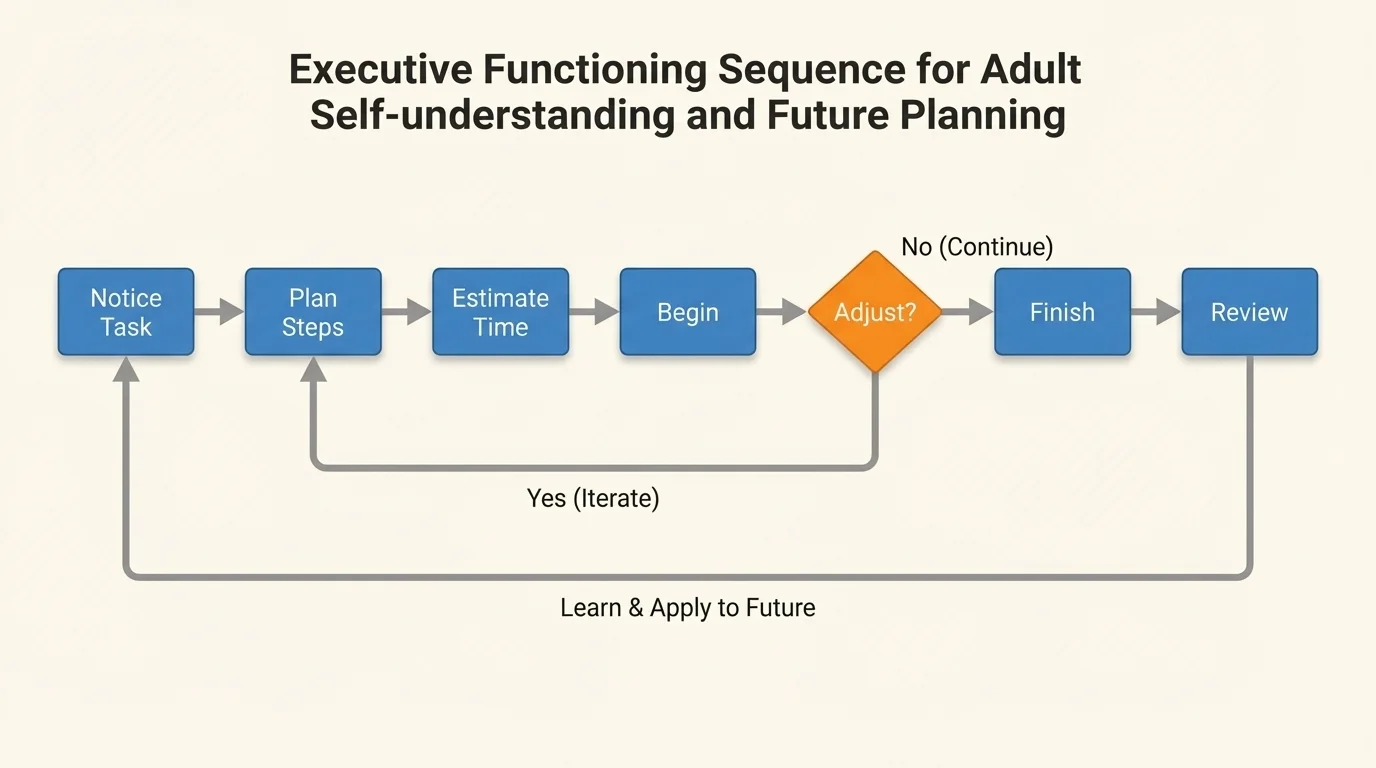
When you write these patterns in your profile, focus on observable behavior. Instead of "I'm lazy," write "I often delay starting tasks that feel unclear or overwhelming, but I do better when I have a written checklist and one short deadline at a time." That language is accurate, respectful, and useful.
Example: turning a vague weakness into a useful profile statement
Step 1: Start with the vague statement.
"I'm terrible at getting things done."
Step 2: Identify the actual pattern.
"I delay starting multi-step tasks, especially when I am not sure how long they will take."
Step 3: Add what helps.
"I do better when I list the first three steps, estimate time, and start with a 10-minute timer."
Step 4: Turn it into a profile statement.
"I need structure to begin complex tasks. Written steps and short timed work sessions help me follow through."
That kind of statement can help you explain yourself in a much stronger way during future planning.
Your future choices are not only shaped by how you manage tasks. They are also shaped by how you interact with people and how you understand yourself. Interpersonal skills affect work, friendships, roommates, customer service, teamwork, online communication, conflict, and boundaries.
Think about your communication style. Are you direct, cautious, expressive, quiet, thoughtful, or fast-paced? Do you communicate better in writing than on the spot during a video call? Do you need time to think before answering? These patterns are important. For instance, someone who writes clear, thoughtful messages but struggles with spontaneous speaking may do well with interviews if they practice common questions in advance.
Boundaries are another key part of self-understanding. A boundary is a limit that protects your time, energy, privacy, safety, or well-being. If you tend to say yes to everything and then burn out, that matters. If you shut down when someone is critical, that matters too. Good future planning includes knowing what kind of treatment, workload, and social demand is healthy for you.
Your identity also belongs in your profile. This can include culture, language, family responsibilities, disability, gender identity, beliefs, personality, and life experiences. These are not side notes. They shape what support you need, what environments feel safe, and what goals matter most.
Individuality is not an obstacle to planning
The point of future planning is not to become a generic "successful adult." It is to build a life that respects your strengths, needs, values, and identity. The more honestly you understand yourself, the easier it is to choose settings where you can function well and grow.
You should also think about your support network. Who can you ask for advice? Who helps you stay calm, organized, or motivated? Support can come from family, mentors, counselors, community leaders, coaches, employers, therapists, or trusted adults in your life. Independence does not mean doing everything alone. Often, it means knowing when and how to use support well.
There is a practical way to do this. You do not need to wait for a perfect moment or complete life clarity. You build your profile by collecting evidence from real situations.
Step 1: Review your recent experiences. Look at the last year of your life: school tasks, volunteer work, hobbies, jobs, online groups, family responsibilities, appointments, and stressful situations. Ask yourself: What went well? What kept repeating? Where did I succeed naturally? Where did I need more structure?
Step 2: Look for patterns, not one-time events. If you missed one deadline because of a family emergency, that is not necessarily a personal pattern. But if you repeatedly lose track of deadlines unless you use a calendar, that is a real pattern.
Step 3: Gather outside feedback. Ask trusted people what they notice. You might ask: "What do you see me doing well?" "When do I seem most stressed?" "What support seems to help me?" Sometimes other people notice strengths that you overlook.
Step 4: Separate facts from self-criticism. "I am irresponsible" is a judgment. "I forget appointments unless I put them in my phone immediately" is a fact-based observation. Facts help you plan. Harsh labels usually do not.
Step 5: Write profile statements that include both patterns and supports. For example: "I communicate best when expectations are clear and I have time to prepare." Or: "I work well independently for about 45 minutes at a time, then I need a short reset break."
Step 6: Keep it balanced. A realistic profile includes strengths, needs, interests, values, and goals. If it only lists problems, it becomes discouraging and incomplete. If it only lists strengths, it becomes unrealistic.
Sample self-understanding profile excerpt
Strengths: I am dependable, calm in emergencies, and good at learning software by exploring it on my own.
Support needs: I lose track of multi-step deadlines unless I enter them into a digital calendar with reminders.
Communication: I express myself best in writing and do better in meetings when I know the topic ahead of time.
Values: I care about stability, meaningful work, and having time for family responsibilities.
Goals: I want to begin with part-time employment or community college while improving my time management and transportation skills.
A profile like that is short, clear, and usable. It can guide decisions and help you explain your needs without oversharing.
Future planning works best when you match who you are with environments that fit, and [Figure 3] shows how profile traits can connect to choices in education, work, housing, and support. This is one of the biggest benefits of self-understanding. You stop asking only, "What should I do next?" and start asking, "What setting gives me the best chance to function well, grow, and stay healthy?"
For example, if your profile shows that you need predictable routines and clear expectations, a structured training program or steady entry-level job may fit better than a chaotic environment with constant last-minute changes. If your profile shows strong curiosity and self-direction, you may thrive in a program that allows more independence.
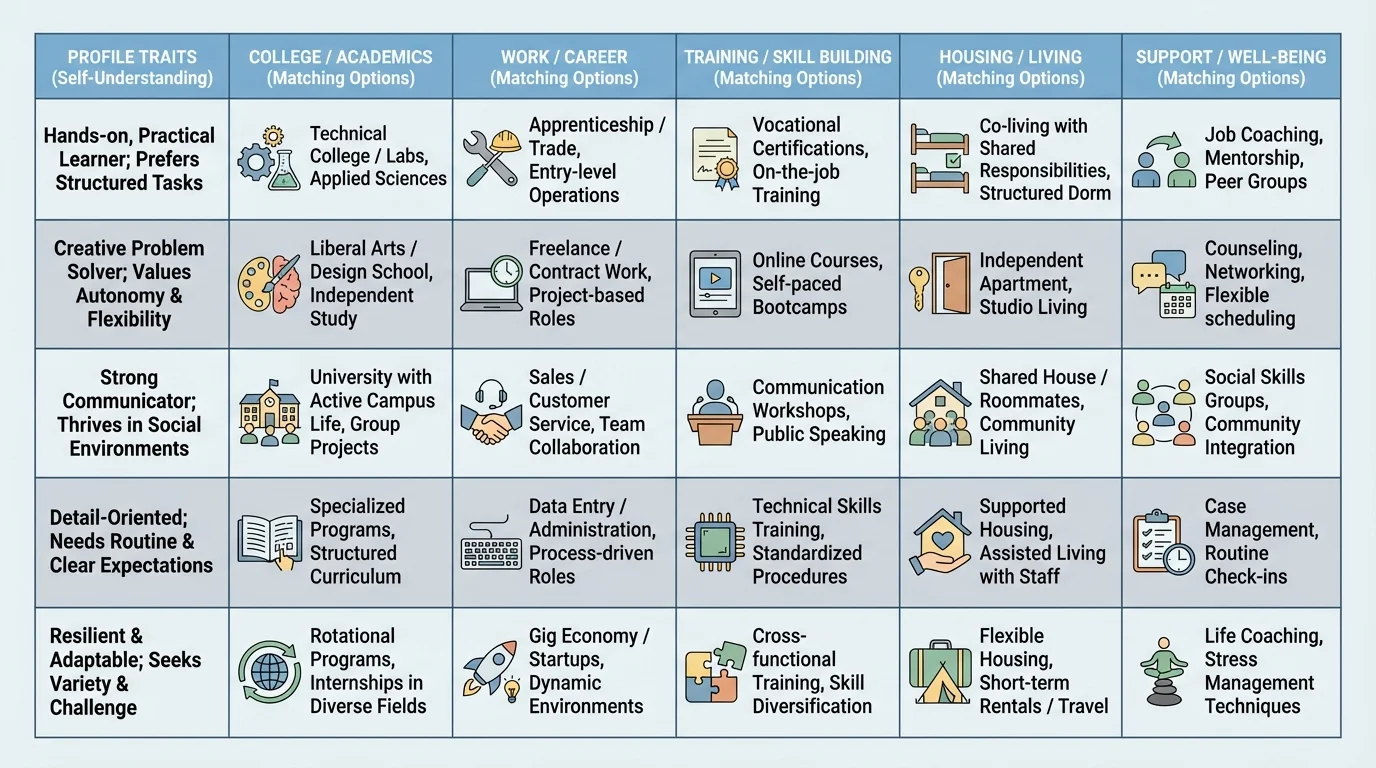
You can use your profile to think through several adult-life areas at once.
| Life Area | Questions to Ask Yourself | Profile Clues That Help |
|---|---|---|
| Education or training | Do I learn best through lectures, hands-on practice, or independent study? | Attention span, study habits, need for structure, learning preferences |
| Work | Do I prefer people-focused, technical, creative, routine, or physical tasks? | Strengths, interests, communication style, stress triggers |
| Living situation | Do I manage routines well on my own, or do I need shared support? | Daily living skills, organization, emotional regulation, safety awareness |
| Transportation | Can I reliably manage travel time, directions, and backup plans? | Planning, punctuality, flexibility, confidence |
| Health and support | What helps me stay regulated, healthy, and consistent? | Coping strategies, support network, accommodation needs |
Table 1. Questions and profile clues that help connect self-understanding to adult planning decisions.
Suppose you are deciding between two options. Option A is a full-time college schedule with long reading assignments, independent deadlines, and little built-in accountability. Option B is a part-time certificate program plus a job with consistent hours. If your profile shows strong hands-on learning, a need for external structure, and frequent overwhelm when juggling too many deadlines, Option B may be the smarter starting point. That is not "thinking small." That is planning intelligently.
Your profile can also help with accommodation decisions. An accommodation is a change or support that helps you access a task or environment more effectively. Examples might include written instructions, extra processing time, quiet workspaces, reminder systems, or flexible communication formats. Asking for support is easier when you can clearly explain what you need and why it helps.
"Self-knowledge turns a vague future into a plan."
That is true because clear planning is rarely about predicting everything. It is about making your next decision with better information.
You can use your profile in everyday situations without reading it word for word to other people. Instead, use it to create short explanations of your strengths and needs.
In a job interview, you might say, "One of my strengths is that I am reliable and detail-focused. I do my best work when expectations are clear, and I use reminders and checklists to stay organized." That sounds confident because it is both honest and practical.
In an email to request support, you might write, "I process information best when I have written instructions after a meeting. That helps me follow through accurately." This is a form of transition planning in action because you are using self-knowledge to make adult settings more manageable.
When making personal decisions, your profile can keep you from committing to situations that are a poor fit. If you know that your energy drops sharply after intense social interaction, then accepting a role that requires nonstop customer contact without breaks may lead to burnout. As we saw earlier in [Figure 3], the best choice is often the one that matches your actual profile, not the one that looks most impressive from the outside.
Try This: Write three short statements you could use in real life: one about a strength, one about a support need, and one about a future goal. Keep them clear enough to use in an interview, application, or conversation with a trusted adult.
Your self-understanding profile is not a one-time document. It is an ongoing cycle of trying, reflecting, adjusting, and growing. You will learn more about yourself through experience. A job may reveal that you handle pressure better than you thought. A new routine may reveal that you need more sleep, more structure, or a quieter environment than you realized.
A good habit is to review your profile every few months or after a major experience. Ask: What did I learn? What worked? What drained me? What support helped? What do I want to change next?
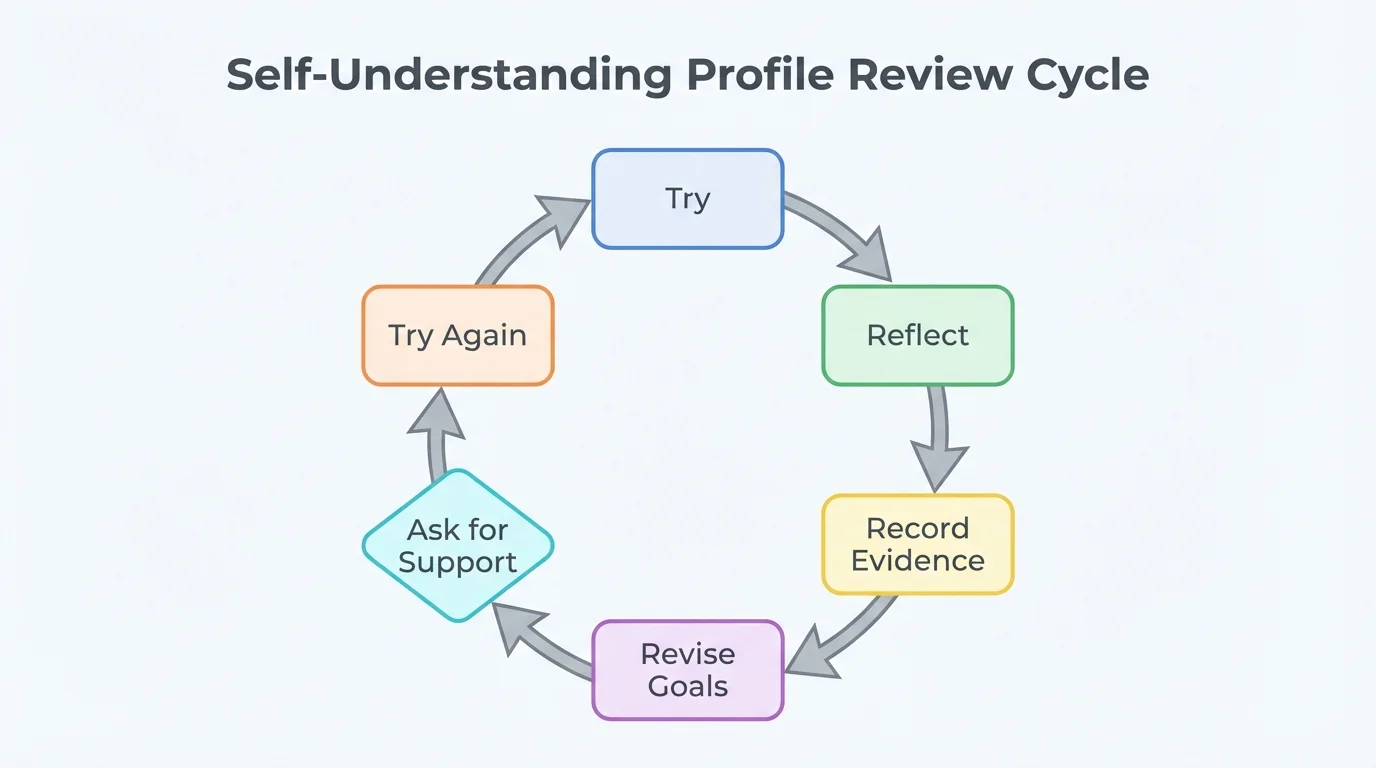
Growth does not mean your earlier profile was wrong. It means you have better evidence now. Maybe you used to think you were bad at leadership, but then you successfully organized a community event online. Maybe you thought you could handle an overloaded schedule, but experience showed that your best performance happens when you focus on fewer commitments at once.
Updating your profile also helps prevent shame. Instead of saying, "I should be able to handle this by now," you can say, "I learned that this setup is not working for me, so I need a better strategy." That shift matters. It keeps you focused on problem-solving instead of self-blame.
Knowing yourself is not the same as limiting yourself. A profile should help you grow with realistic supports, not trap you in one fixed identity.
Over time, your profile becomes something powerful: a tool for decision-making, communication, confidence, and self-respect. It helps you notice where you thrive, where you struggle, and what kind of future makes sense for the person you actually are.
