Turning 18 does not magically make every decision easier. In fact, adulthood often starts with choices that feel bigger than you expected: whether to accept a job offer, sign up for a payment plan, lend money to a friend, share personal information online, or agree to something in a relationship before you feel fully ready. The real skill is not just "making your own choices." It is knowing when you are ready to decide independently, how to decide well, and when you need more information or support.
Independent decision-making is a major part of adult life because your choices affect your time, money, safety, reputation, health, and future options. When you make decisions carefully, you build trust in yourself. When you rush, ignore warning signs, or let other people push you, the consequences can follow you for months or years. That is why personal readiness matters. Readiness is not about being perfect. It is about being honest with yourself.
At your age, you are likely entering situations where adults are expected to manage themselves. A manager may expect you to read a schedule correctly and speak up if there is a conflict. A bank or payment app may expect you to understand what you are agreeing to. A doctor may ask you direct questions about your health habits. A landlord, coach, community leader, or employer may not remind you of every detail. In adult settings, people often assume you will ask questions, notice risks, and take responsibility.
This can feel empowering, but it can also feel intense. One reason some people struggle is that they confuse independence with isolation. Healthy independence does not mean doing everything alone. It means taking ownership of your decisions while also using good judgment about when to pause, research, or ask for advice.
Personal readiness is your current ability to make a choice responsibly based on self-awareness, clear thinking, emotional control, relevant knowledge, and willingness to accept the consequences. Independent decision-making means making a choice for yourself without depending on someone else to decide for you, while still gathering advice when needed. Adult settings are situations where your choices carry real responsibilities, such as work, finances, healthcare, transportation, housing, relationships, and online agreements.
If you want a simple truth, here it is: being ready to decide is sometimes more important than deciding quickly. A rushed "yes" can create more problems than a delayed answer.
Readiness is a combination of inner and outer factors. Internally, it includes your values, emotions, stress level, confidence, and ability to think clearly. Externally, it includes whether you have enough information, enough time, enough resources, and a safe environment for making the choice. A person can be mature in one area and unready in another. For example, you may be ready to manage your weekly schedule but not ready to sign a phone contract you do not fully understand.
One useful word here is self-awareness. Self-awareness means knowing how you typically think, feel, react, and behave. If you know that you say yes when you feel pressured, avoid conflict, overspend when stressed, or shut down when overwhelmed, that knowledge helps protect you. You cannot manage patterns you refuse to notice.
Another important part of readiness is judgment. Judgment is your ability to evaluate options and choose reasonably, not just emotionally. Good judgment does not mean you never feel strong emotions. It means your emotions do not fully control the outcome.
Before you evaluate the decision itself, evaluate yourself in this moment. Ask: What matters most to me here? What am I afraid of? Am I trying to impress someone? Am I tired, angry, embarrassed, lonely, or rushed? Would I make the same choice if I were calm?
Your values matter because they act like an internal compass. If you value honesty, stability, safety, respect, or long-term growth, your decisions should line up with those values. If a choice pulls you away from what matters most just to get short-term approval, that is a warning sign.
Your limits matter too. You may be smart and capable, but still not have enough experience for a specific decision. That is normal. For example, if you are asked to co-sign for someone, invest money in something you do not understand, or share private photos in a relationship, the issue is not whether you are "mature enough." The issue is whether you understand the risks and can live with the consequences.
Self-awareness is not self-doubt
Some people think admitting limits means they are weak. Actually, the opposite is true. A self-aware person can say, "I am not ready to answer that yet," "I need more information," or "I need to think before I agree." That kind of honesty protects your future. Overconfidence often leads to avoidable mistakes, while realistic confidence leads to better decisions.
It also helps to know your triggers. A trigger is something that causes a strong emotional reaction or pushes you toward an unhealthy habit. Maybe you spend impulsively when you feel left out. Maybe you agree too quickly when someone threatens to leave, criticizes you, or says "If you trusted me, you would." Knowing your triggers gives you a chance to slow down.
Before you say yes, no, or maybe, use a quick personal check, as [Figure 1] shows. This is especially helpful when a decision involves money, safety, relationships, privacy, transportation, work, or legal responsibility. A readiness check prevents you from confusing pressure with preparedness.
Ask yourself these questions:
Do I understand the facts? If you cannot explain what you are agreeing to in clear language, you are probably not ready yet.
Do I understand the possible consequences? Think beyond the next hour. What could happen tomorrow, next month, or next year?
Am I emotionally steady enough to decide? If you are panicking, furious, heartbroken, or desperate, your thinking may be narrowed.
Am I being pressured? Pressure can come from friends, romantic partners, adults, online messages, deadlines, or fear of missing out.
Do I have the resources to follow through? Time, transportation, money, energy, internet access, and documents all matter.
Is this safe? Emotional, physical, digital, and financial safety all count.
Am I willing to take responsibility for the result? If the plan only works when everything goes perfectly, it is probably not a strong plan.
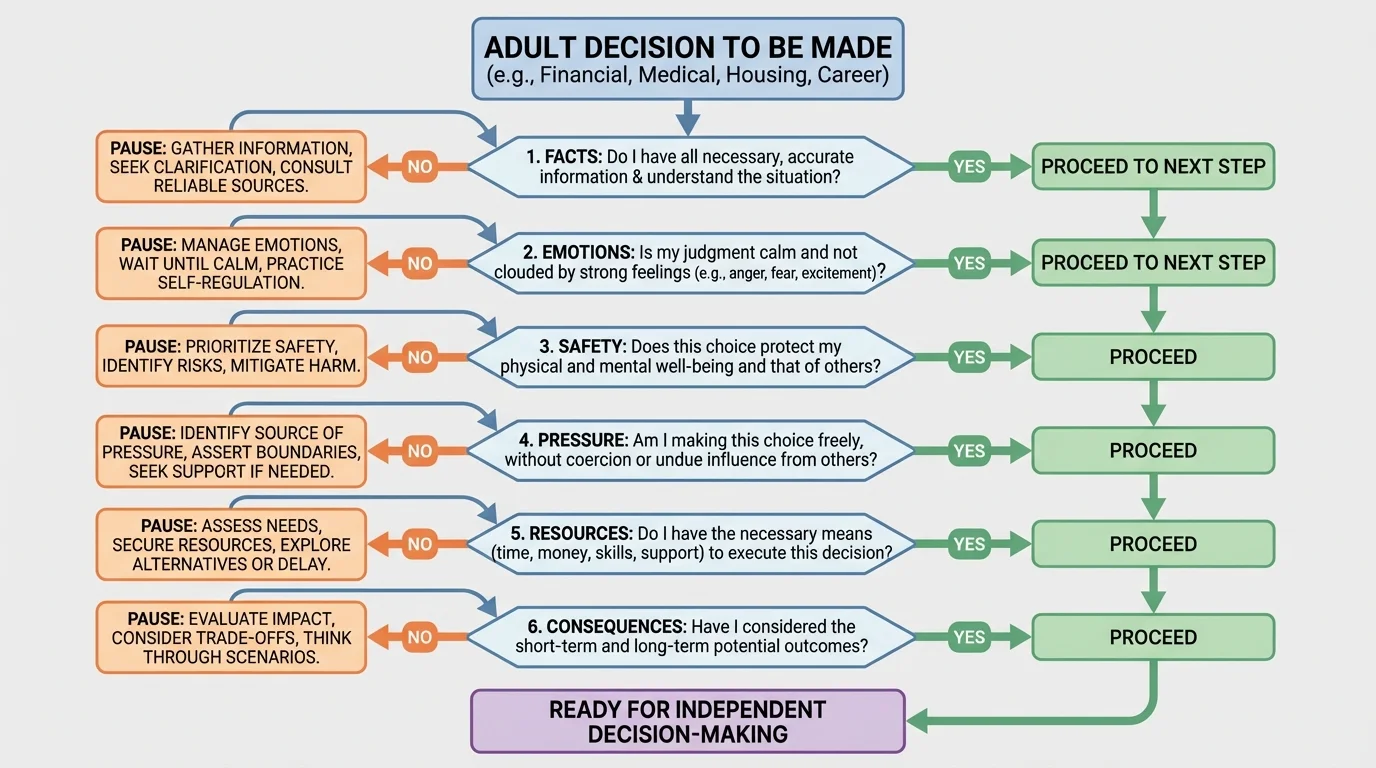
Notice that this checklist does not ask only, "Do I want this?" Wanting something matters, but it is not enough. Adult choices require more than desire. They require understanding, stability, and ownership.
Here is a practical example. Suppose a friend asks to borrow $80 and promises to repay you next week. Wanting to help is one part of the situation. But readiness questions matter too: Do you actually have that money available? What happens if they do not repay you? Will this damage the friendship? Are you feeling guilty and saying yes to avoid discomfort? The checklist in [Figure 1] helps you separate kindness from pressure.
Readiness check in a real situation
You are offered extra hours at a part-time job, but the schedule overlaps with family responsibilities and your study time.
Step 1: Check the facts.
How many hours are being added? Is the schedule fixed or flexible? What is the pay? How long will the arrangement last?
Step 2: Check your capacity.
Can you reliably wake up, travel, complete the shifts, and still manage your responsibilities without constant exhaustion?
Step 3: Check the consequences.
More income might help now, but sleep loss, missed deadlines, or family conflict may create bigger problems.
Step 4: Decide responsibly.
You might accept all the hours, ask for fewer shifts, or decline. A mature choice is the one you can realistically sustain.
Being ready sometimes means saying no to a good opportunity because it is not a good fit right now.
A repeatable process reduces impulsive choices. You do not need a complicated system. You need one that is simple enough to use under real-life pressure, as [Figure 2] illustrates.
Step 1: Name the decision clearly. Say exactly what you are deciding. "Should I take this job?" is more useful than "I do not know what to do."
Step 2: Gather the facts. Find out the details, not just the sales pitch or someone else's opinion.
Step 3: List your options. Adult decisions are rarely just yes or no. Sometimes the best option is "not yet," "with conditions," or "after I get advice."
Step 4: Weigh short-term and long-term outcomes. A good decision often feels harder now and better later. A bad decision often feels easier now and worse later.
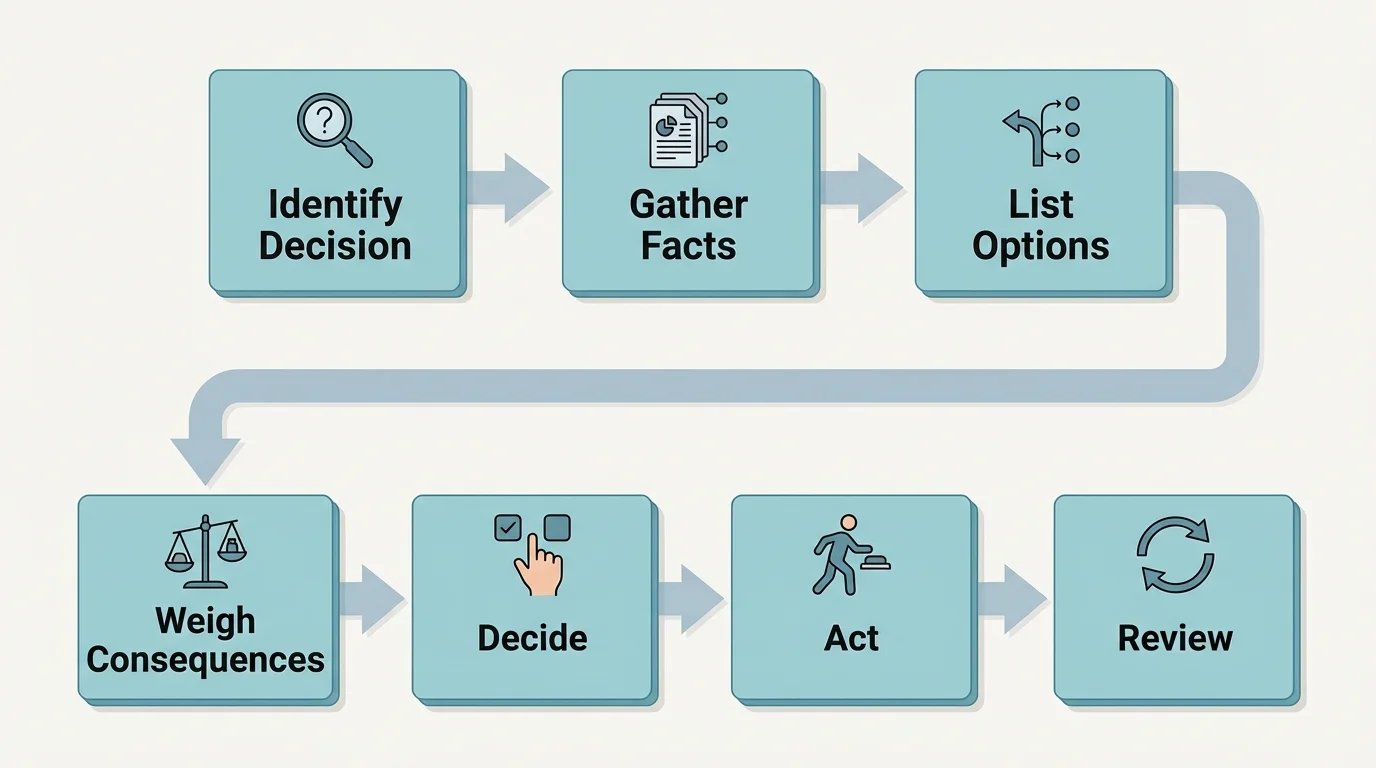
Step 5: Check your readiness. Use the checklist from earlier. If you do not understand the choice or feel heavily pressured, pause.
Step 6: Make the decision and communicate it clearly. Avoid vague language when the choice matters. "I can work Saturdays but not Sundays" is clearer than "I will try."
Step 7: Review what happened. Reflection turns experience into skill. Ask: Did I overlook anything? Did I communicate clearly? What would I do differently next time?
This review step is where reflection becomes powerful. Reflection means thinking carefully about your actions and outcomes so you can improve. Without reflection, mistakes repeat. With reflection, even a poor decision can become valuable experience.
"You do not have to decide fast to decide well."
— Practical rule for adult choices
One more important detail: some decisions feel urgent because another person wants an answer right away. That does not always mean the decision is truly urgent. If someone says, "Answer right now or the offer is gone," ask yourself whether the pressure is part of the risk.
There are times when the smartest independent choice is to get support before deciding. This is not giving up your independence. It is using it wisely. You should strongly consider support when a decision involves contracts, debt, medical treatment, legal issues, unsafe situations, threats, harassment, sexual pressure, addiction, housing, or anything you do not fully understand.
This is where risk assessment matters. Risk assessment means identifying possible harm, estimating how serious it could be, and deciding how to reduce it. In everyday life, that might mean asking: What is the worst realistic outcome? How likely is it? What can I do to lower the risk?
For example, if someone asks you to send money, share your passwords, meet privately in an unfamiliar place, or sign something without reading it, pause. These are not situations where confidence alone protects you. Good decisions require caution.
Many scams work not because people are unintelligent, but because pressure, urgency, fear, and trust can temporarily weaken judgment. Scam messages often try to create panic so you act before thinking.
You should also seek support if your ability to choose freely is being affected by coercion. Coercion is pressure, threats, manipulation, or intimidation used to make someone do something they would not freely choose. In relationships, coercion can sound like guilt, emotional blackmail, repeated pressure, or attempts to isolate you from other people's advice.
If your answer would change the moment you felt safe, calm, and unpressured, then the situation may not be truly voluntary.
Different adult settings require slightly different forms of readiness, as [Figure 3] highlights. The basic skills stay the same, but the details change depending on the situation.
Work: Are you ready to manage time, communicate professionally, ask questions, and follow through? If you accept a shift, can you realistically get there and complete it?
Money: Are you spending based on a plan or a feeling? Can you tell the difference between a need, a want, and a pressure purchase?
Health: Do you understand instructions, side effects, and privacy issues? Are you asking questions when something is unclear?
Relationships: Are your choices based on respect and genuine willingness, or on fear, guilt, loneliness, or pressure?
Housing and transportation: Have you checked cost, safety, timing, and backup plans?
Online activity: Do you know what happens to your data, images, messages, or payment details after you hit send?
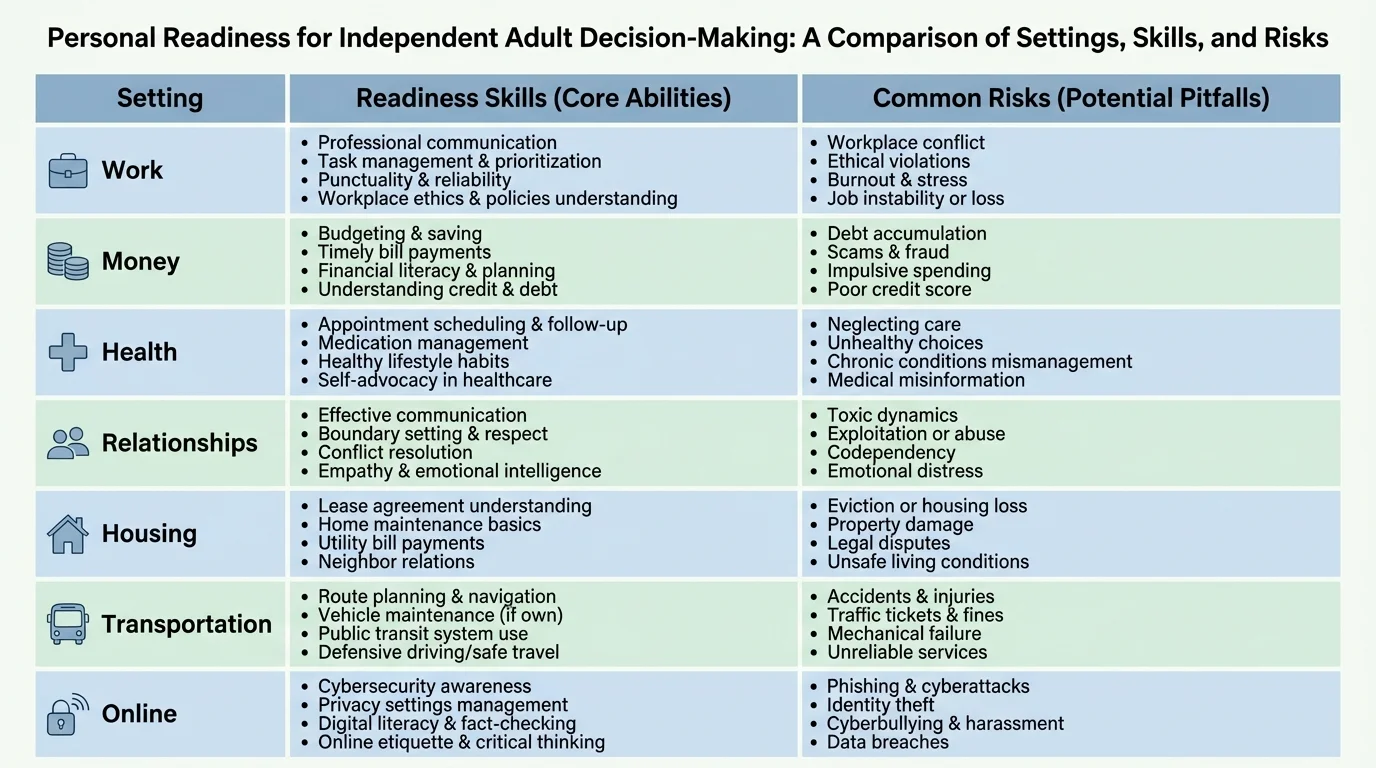
These areas often overlap. A transportation problem can affect your job. A money problem can affect your housing options. A relationship decision can affect your emotional focus and safety. That is why mature decision-making looks at the bigger picture rather than treating each choice as separate.
| Setting | Question to Ask Yourself | Common Warning Sign |
|---|---|---|
| Work | Can I reliably meet the expectation? | Saying yes before checking schedule or transportation |
| Money | Can I afford this without harming essentials? | Buying under pressure or to impress others |
| Health | Do I fully understand the information? | Agreeing while confused or embarrassed to ask |
| Relationships | Is this freely chosen and respectful? | Guilt, threats, repeated pressure |
| Online | Would I still be okay with this later? | Oversharing, fast trust, false urgency |
Table 1. Common adult settings, useful self-check questions, and warning signs that suggest you should slow down.
Later, when you are making choices in any of these areas, the comparison in [Figure 3] helps you spot which readiness skill matters most in that moment.
You can make a wise decision in your head and still end up in trouble if you communicate it poorly. Adult decision-making depends heavily on assertive communication. Assertive communication means expressing your needs, limits, or decisions clearly and respectfully without becoming passive or aggressive.
For example, compare these responses:
Passive: "Um, maybe, I guess that is okay."
Assertive: "I am not ready to agree to that."
Aggressive: "Back off. You are ridiculous."
The assertive version protects your boundary while keeping control. Boundaries are especially important in friendships, dating, work, and online communication. You are allowed to ask for time, ask questions, request details in writing, or say no without giving a long defense.
Useful scripts for adult situations
Asking for time: "I need time to think about this. I will respond tomorrow."
Asking for clarity: "Can you explain the terms before I agree?"
Setting a boundary: "I am not comfortable with that."
Declining respectfully: "I cannot commit to this right now."
Documenting an agreement: "Please send that in a message so I can review it."
Notice how these statements are calm, direct, and specific. They reduce confusion and give you space to think. This supports the decision process shown in [Figure 2] because communication is part of carrying out a good choice, not just making one internally.
No one becomes excellent at adult decision-making in one month. Readiness grows through smaller choices practiced consistently. Start by taking ownership of manageable decisions: planning your week, tracking spending, confirming appointments, reading terms before clicking agree, asking one extra question when something is unclear, and pausing when emotions run high.
Another useful habit is creating a personal rule for high-pressure situations. For example: "I do not make money decisions immediately," or "I do not share personal information when I feel rushed," or "I wait at least one night before agreeing to something major." These rules help protect you when your brain is tired or your emotions are intense.
You can also use a short personal check-in after important choices:
What helped me decide well?
What made the decision harder?
What signs did I notice too late?
What will I do next time?
That simple habit strengthens self-awareness, judgment, and confidence. Over time, you become better at recognizing when you are truly ready and when you need more information, more time, or more support.
Growing up does not remove uncertainty. It increases responsibility. A mature person is not someone who always feels sure. A mature person is someone who can pause, assess, decide carefully, and own the result.
One of the strongest signs of readiness is consistency. If you regularly follow through, regulate your emotions, ask questions, notice pressure, and accept consequences, you are building the habits that independent adult decision-making requires.
