Freedom sounds exciting until it starts coming with due dates, dishes, deadlines, texts you need to answer, appointments you cannot forget, and choices nobody else will make for you. Becoming more independent is not just about getting more control over your life. It is also about learning how to manage that life without burning out. That is where a solid self-management plan matters.
Self-management is the ability to guide your actions, emotions, attention, and habits so you can handle real responsibilities. It is not about being perfect, constantly productive, or calm all the time. It is about building a system that helps you stay functional, responsible, and steady when life gets demanding.
At your age, adult responsibilities may already be showing up in different forms: finishing online coursework on time, helping at home, managing your sleep, showing up for a part-time job, responding professionally to emails, keeping track of money, scheduling appointments, or making decisions about college, work, training, or transportation. The way you manage these now will shape how confident and capable you feel later.
Self-management plan means a practical plan for how you will handle your responsibilities, organize your time, regulate stress, and stay accountable. Executive functioning refers to the mental skills used for planning, prioritizing, remembering, and following through. Emotional regulation is the ability to notice, understand, and manage feelings without letting them completely take over your decisions. Resilience is the ability to recover, adapt, and keep going after setbacks or stress.
A good plan gives you structure without trapping you. It helps you know what matters, what needs to happen next, and what to do when things stop going smoothly. That last part is important, because life rarely stays neat for long.
When people struggle with adult responsibilities, the problem is often not laziness. It is usually a weak system. If you rely only on memory, motivation, or last-minute effort, small tasks pile up. One missed deadline turns into several. Stress builds. Then everyday tasks start feeling huge.
On the other hand, when you use strong self-management habits, life gets more stable. Bills are paid on time. Deadlines are less surprising. You sleep better because fewer things are hanging over your head. You communicate more clearly because you are not constantly in panic mode. Independence becomes more enjoyable when it is supported by routines and decision-making skills.
Stress often feels like a time problem, but it is frequently a planning problem. When your brain has to remember everything at once, even simple responsibilities can feel overwhelming.
Doing this well does not mean your life becomes easy. It means you become more prepared. That difference matters.
A useful plan usually includes five parts: your responsibilities, your daily and weekly systems, your stress-management tools, your support network, and your review process. If one part is missing, the plan gets weaker.
For example, you might know your responsibilities but have no calendar system. Or you might have a schedule but no strategy for what to do when you feel overloaded. Or you may be very independent but refuse support until a small issue becomes a crisis. A strong plan covers all of those areas.
| Part of the Plan | What It Answers | Example |
|---|---|---|
| Responsibilities | What do I need to manage? | Course deadlines, chores, job shifts, exercise, sleep |
| Systems | How will I keep track of things? | Calendar, to-do list, alarms, routines |
| Stress tools | What will I do when pressure rises? | Breathing, walk, pause script, reaching out |
| Support network | Who can help when needed? | Parent, mentor, supervisor, counselor, friend |
| Review process | How will I improve the plan? | Weekly check-in every Sunday evening |
Table 1. Core parts of an effective self-management plan.
If your plan answers these questions clearly, you are much more likely to stay steady when life gets busy.
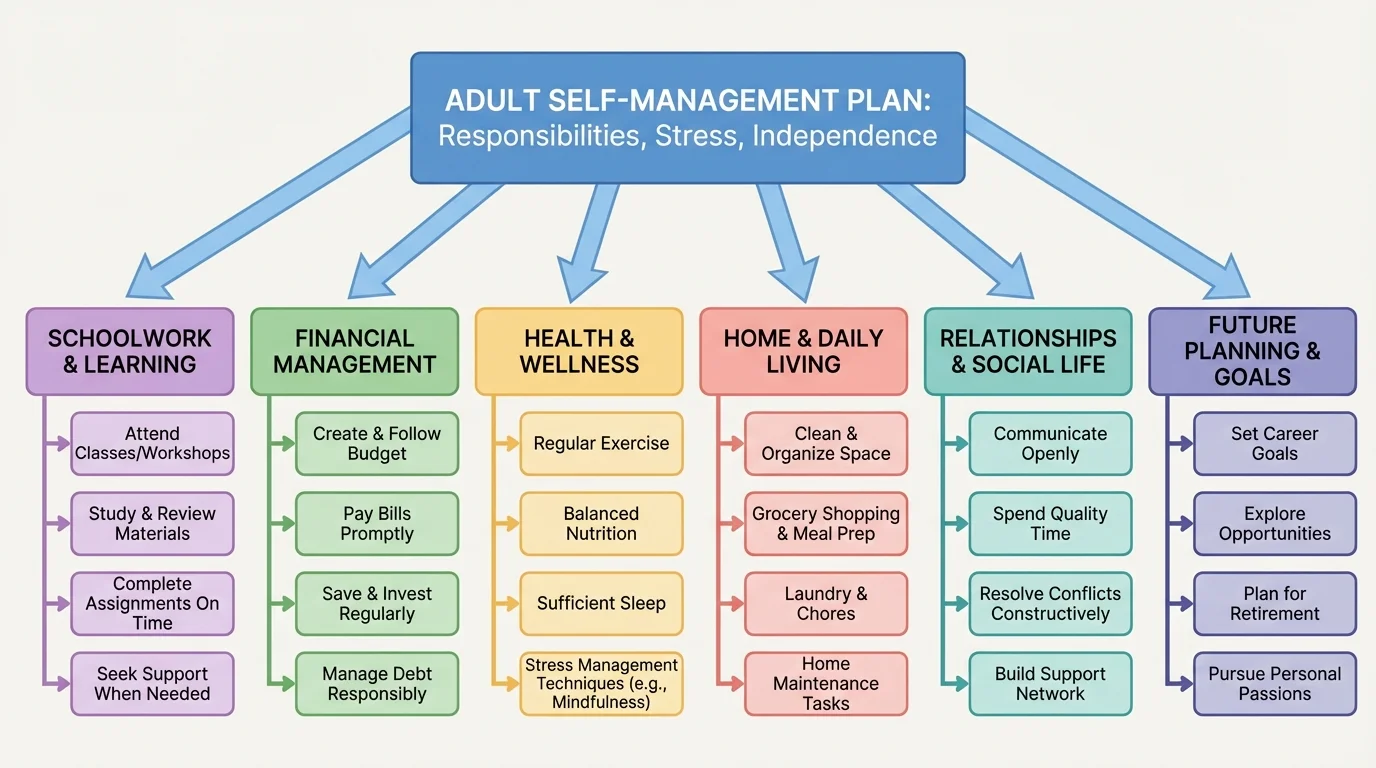
Your first job is to name what you are actually responsible for. Many people feel stressed because they are trying to manage a vague cloud of obligations. It becomes easier when you sort them into categories, as [Figure 1] shows. A clear list turns pressure into something visible and manageable.
Start by dividing your life into areas: school, home, health, money, relationships, transportation, work, and future planning. Then list the specific tasks in each area. Under school, that might include checking your online platform daily, completing assignments, and emailing teachers when needed. Under health, it could include sleep, meals, exercise, medication, or appointments.
Next, separate your responsibilities into three groups: daily, weekly, and occasional. Daily tasks are things like checking deadlines, eating regular meals, or maintaining hygiene. Weekly tasks may include laundry, cleaning, planning meals, or reviewing finances. Occasional tasks include renewing documents, attending interviews, or preparing applications.
Then ask two questions about each task: How important is this? and What happens if I ignore it? This helps you prioritize. For example, skipping one sink of dishes may be inconvenient, but missing a job interview or failing to submit coursework has bigger consequences.
One useful method is the priority check: urgent, important, or optional. Urgent tasks need attention soon. Important tasks matter a lot even if they are not immediate. Optional tasks can wait. A lot of stress comes from treating everything like it is equally urgent when it is not.
Example: turning vague stress into a responsibility list
Step 1: Write the vague stress thought.
"I have too much going on."
Step 2: Break it into actual tasks.
Finish two assignments, clean room, text supervisor back, refill prescription, and help cook dinner on Tuesday.
Step 3: Sort by urgency and importance.
Text supervisor back today. Refill prescription today. Schedule assignment time for tonight and tomorrow. Clean room on Saturday.
The stress drops because the brain no longer has to hold everything as one giant undefined problem.
Later, when you feel overloaded, return to the categories in [Figure 1]. They help you check whether the problem is truly "too much" or whether one life area is simply being ignored until it becomes urgent.
Good intentions are not enough. Memory fails. Motivation changes. Energy drops. A dependable routine matters because it reduces how many decisions you have to make in the moment. A simple planning system, as [Figure 2] illustrates, catches tasks before they become emergencies.
Your system does not need to be complicated. In fact, simpler is better. Most students do well with four tools: one calendar, one task list, one reminder method, and one daily check-in. The calendar holds appointments and deadlines. The task list holds actions you need to complete. Reminders alert you before important events. The daily check-in is the moment when you look at everything and decide what matters today.
These tools work best when they connect. If a task has a deadline, it belongs on the calendar. If a deadline matters, it should have a reminder before it. If a reminder appears, you need a next action ready to go. Systems reduce stress because they move responsibility out of your memory and into a structure you can trust.
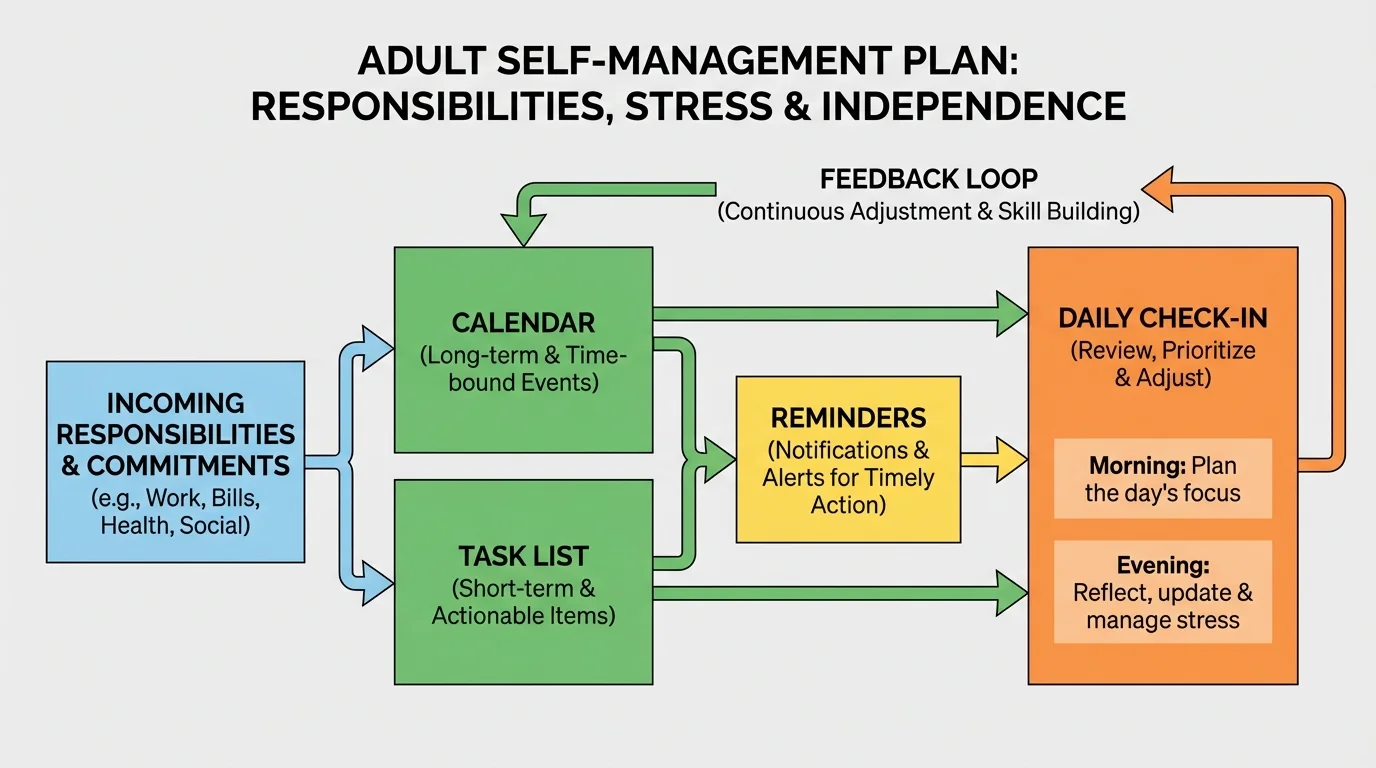
Try setting up your system with these steps. Step 1: Choose one digital or paper calendar. Step 2: Enter fixed commitments first, such as work shifts, appointments, assignment due dates, and family responsibilities. Step 3: Create a task list for actions that are not tied to exact times. Step 4: Set reminders for anything that would create real consequences if forgotten. Step 5: Spend five to ten minutes each day reviewing the plan.
You can also use time blocking, which means assigning chunks of time to important tasks instead of hoping they fit in somehow. For example, instead of saying "I will do history later," you place coursework from 1:00 to 2:00 p.m. on your calendar. That makes the task real.
Another strategy is habit stacking, where you attach a new habit to an existing habit. After breakfast, check your course dashboard. After brushing your teeth at night, review tomorrow's plan. This works because it connects new behavior to an existing pattern.
Why systems work better than motivation
Motivation is unreliable because it changes with sleep, mood, stress, and distractions. Systems protect you on low-energy days. If your assignments, reminders, and routines are already set up, you do not have to rebuild your life from scratch every morning.
Much later, when your schedule starts feeling crowded, look back at the structure in [Figure 2]. If something keeps slipping, the problem may not be you. The problem may be that one part of the system is missing.
Stress is easier to manage when you recognize the pattern early, and [Figure 3] organizes that pattern into something practical: trigger, warning sign, immediate action, and recovery. If you wait until you are already overwhelmed, your thinking gets narrower and your decisions get worse.
Start by identifying your common stress triggers. These might include too many deadlines at once, family conflict, uncertainty about the future, money worries, lack of sleep, social pressure online, or feeling behind. Then notice your warning signs. Do you procrastinate more? Get irritable? Shut down? Scroll for hours? Skip meals? Feel tightness in your chest or shoulders?
This is where coping strategies matter. A coping strategy is a healthy action that helps you reduce stress or handle emotions without making the problem worse. Good strategies can be physical, mental, social, or practical.
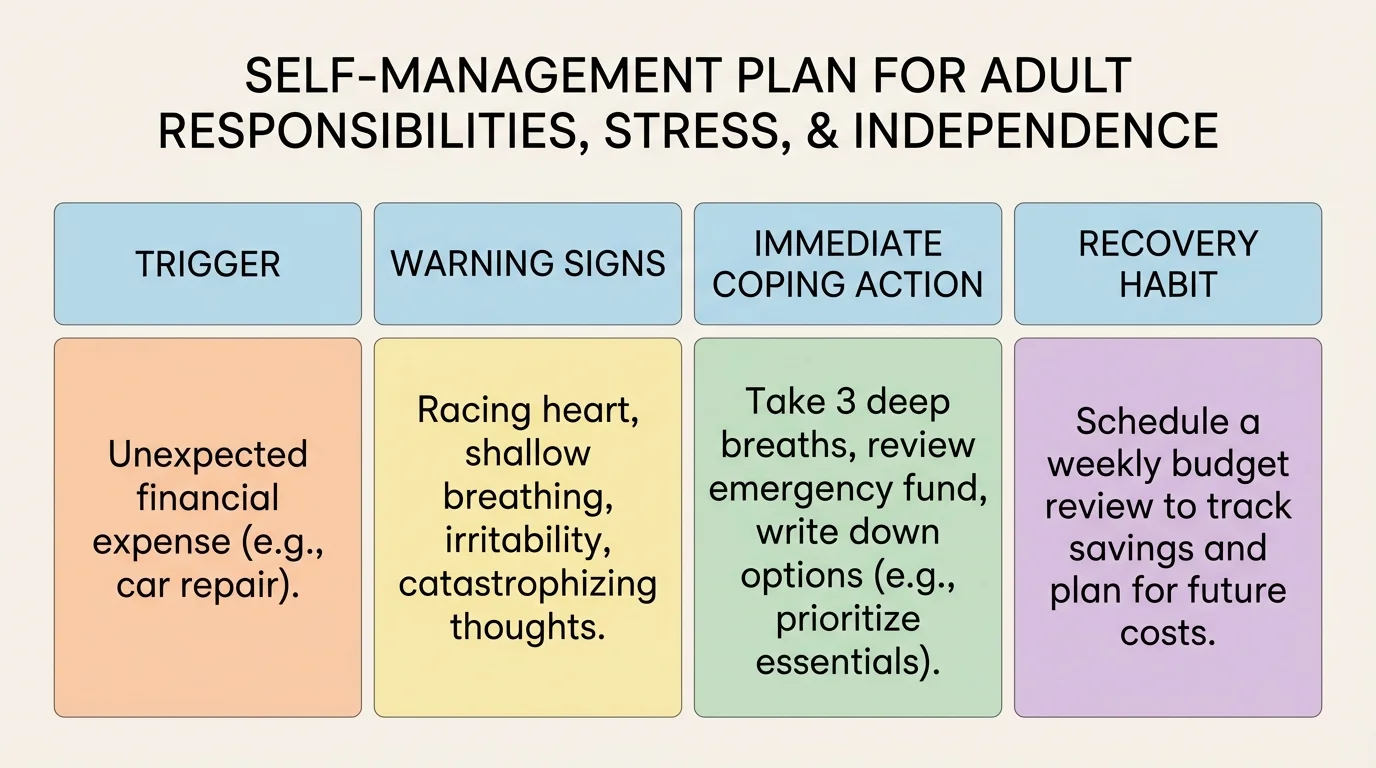
Immediate coping actions are short-term tools for calming your body and mind enough to think clearly. These may include taking ten slow breaths, walking outside for ten minutes, drinking water, putting your phone in another room, or breaking one giant task into the smallest possible first step. Recovery habits are the bigger habits that make stress less intense overall, such as sleeping consistently, eating regularly, moving your body, and limiting constant digital stimulation.
One powerful self-management skill is learning the difference between escape and recovery. Escape avoids the problem without restoring you. For example, ignoring messages, sleeping all day, or scrolling for three hours may feel like relief, but the original problem is still there. Recovery actually helps you come back stronger. A short nap, a walk, journaling, or a supportive conversation can restore you enough to act.
Example: a personal stress response plan
Step 1: Name the trigger.
Three assignments are due in the same week, and a work shift was added.
Step 2: Notice warning signs.
You feel frozen, keep checking your phone, and start telling yourself you will never catch up.
Step 3: Use one immediate coping action.
Set a timer for ten minutes, put the phone away, and list the first action for each assignment.
Step 4: Add a recovery habit.
Go to bed on time, eat breakfast, and message your supervisor if you need schedule clarity.
The goal is not to erase stress completely. The goal is to stop stress from taking over your choices.
As your plan develops, the pattern in [Figure 3] helps you respond faster. When you can say, "I know my trigger, I know my warning sign, and I know my next move," you gain real control.
Independence does not mean doing everything alone. It means taking responsibility while also knowing when to ask for help. A mature person can say, "I need support with this," before the situation gets worse.
This matters in adult life because many responsibilities involve other people. You may need to email an instructor, clarify a work schedule, ask a family member to switch chores, call a clinic, or set a boundary with someone who drains your energy. These tasks require boundaries and communication, not just personal discipline.
A boundary is a clear limit that protects your time, energy, safety, or focus. For example, if a friend messages constantly while you are trying to work, a boundary could be: "I am offline until 4:00 p.m. because I need to finish my assignments. I'll reply after that." That is respectful and clear.
"You do not rise to the level of your goals. You fall to the level of your systems."
— James Clear
You also need a support list. Write down a few people you can contact for different needs: one person for practical help, one for emotional support, one for professional guidance, and one backup option. If you are stressed, tired, or upset, it is much harder to think of who to contact in the moment.
Healthy independence sounds like this: "I keep track of my responsibilities. I communicate early. I ask for help when needed. I do not wait for a crisis to start acting." That is far stronger than pretending you can handle everything alone.
A weekly plan helps you see whether your responsibilities actually fit into real time. Many people overcommit because they think in vague intentions rather than hours and energy. A visual schedule, as [Figure 4] shows, makes the week concrete.
Start with non-negotiables. These are tasks or commitments that must happen: online classes or coursework blocks, work shifts, appointments, family responsibilities, sleep, meals, and transportation time if needed. Put those into your week first.
Then add important flexible tasks such as studying, exercise, errands, room cleaning, and personal admin. Leave some open space. If every hour is packed, your plan is fragile. Real life includes delays, low-energy days, and unexpected changes.
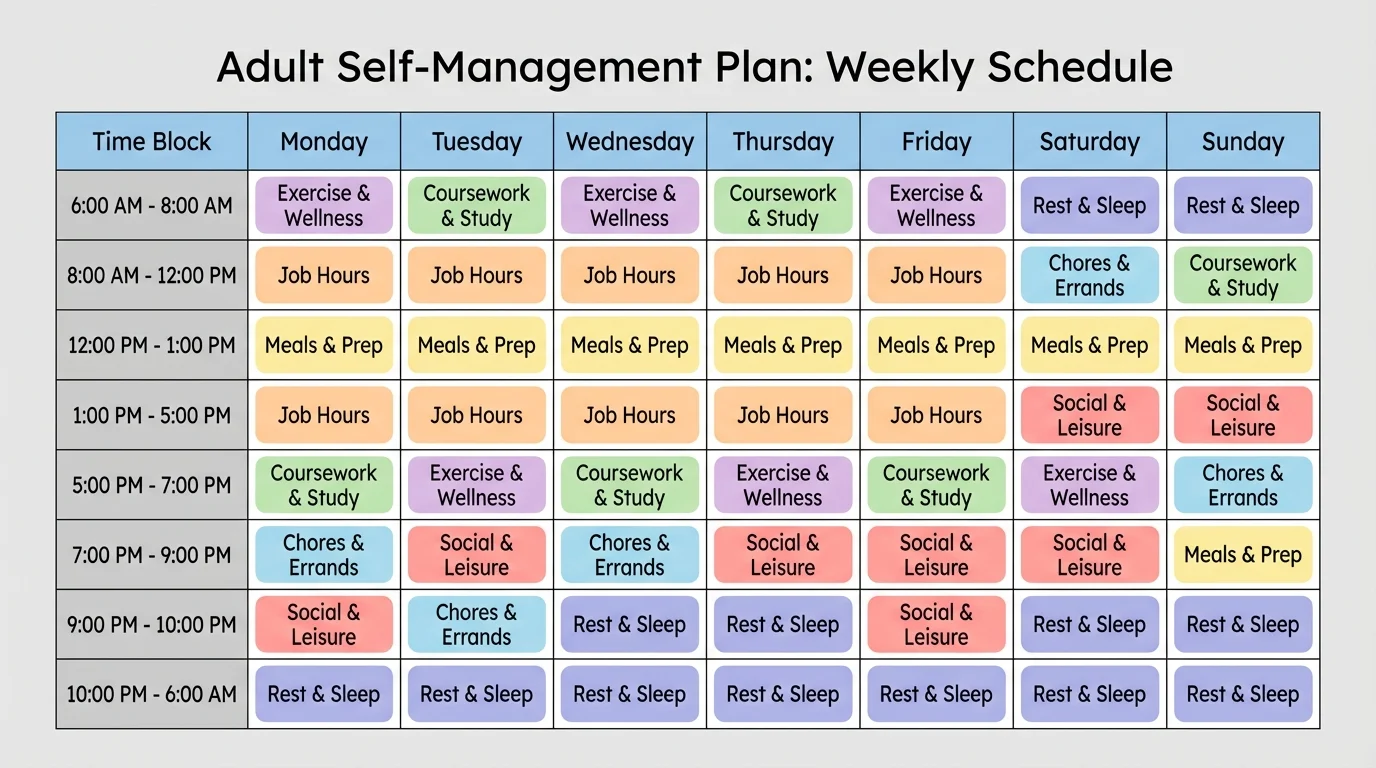
Use time blocks that are realistic. If your concentration usually lasts about one hour, do not schedule four straight hours of difficult work without a break. If family responsibilities interrupt your afternoon, plan around that instead of pretending it will not happen. A useful schedule matches your real life, not your fantasy life.
Here is a simple method for building the week. Step 1: list all deadlines and commitments. Step 2: estimate how long major tasks will take. Step 3: place fixed items on the calendar first. Step 4: assign time blocks for important tasks. Step 5: protect sleep, meals, and at least some recovery time. Step 6: review the plan each evening and adjust as needed.
If you work a part-time job for 12 hours per week, spend about 20 hours on coursework, sleep 8 hours per night, and have 7 hours of household responsibilities, your fixed and important time already adds up to a lot. Sleep alone is \(8 \times 7 = 56\) hours. Add work and household tasks and you get \(56 + 12 + 7 = 75\) hours. If coursework is about 20 hours, the total becomes \(75 + 20 = 95\) hours. Since one week has \(24 \times 7 = 168\) hours, that leaves \(168 - 95 = 73\) hours for meals, hygiene, social time, exercise, transitions, and unexpected events. This is why planning matters: time feels unlimited until you actually count it.
Example: building a manageable week
Step 1: Place fixed commitments.
Work shifts on Tuesday and Thursday evening, telehealth appointment Wednesday, assignment due Friday.
Step 2: Protect basics.
Sleep from 11:00 p.m. to 7:00 a.m., meals at regular times, daily shower, and short walks.
Step 3: Schedule deep-focus work.
Two 90-minute coursework blocks on Monday, one on Wednesday, and one on Friday morning.
Step 4: Add maintenance tasks.
Laundry Saturday morning, room reset Sunday, grocery list Friday afternoon.
Step 5: Leave recovery space.
Free hour after work shifts and relaxed Sunday evening planning time.
This plan works because it includes both productivity and recovery.
When you review your calendar later, [Figure 4] remains a useful model: a good week is not one where every minute is filled. It is one where your most important responsibilities are covered without exhausting you.
Problem: You procrastinate until tasks become urgent. Fix: make the first step smaller. Instead of "write essay," start with "open document and write three bullet points." Action reduces anxiety better than overthinking.
Problem: You overcommit because you do not want to disappoint people. Fix: pause before agreeing. Say, "Let me check my schedule and get back to you." That gives you time to make a responsible decision.
Problem: You create a perfect plan and then quit when you cannot follow it exactly. Fix: replace perfection with adjustment. Missing one block does not ruin the week. Re-enter the plan at the next available point.
Problem: Your phone keeps destroying your focus. Fix: remove temptation during important tasks. Put it in another room, use app limits, or log out of distracting platforms until your work block ends.
Problem: Stress makes you shut down. Fix: use a reset sequence: breathe, drink water, stand up, identify the next smallest action, and contact support if needed. Keep the sequence written somewhere visible.
A student named Maya is balancing online school, helping with younger siblings, and working weekend shifts at a café. She feels constantly behind and keeps telling herself she needs to "try harder." But the real issue is not effort. She has no system.
Once Maya lists her responsibilities, she notices that her biggest pressure points are Thursday and Sunday. Thursday is crowded with coursework and house tasks. Sunday feels stressful because she leaves all planning for Monday at the last second. She creates a weekly review on Sunday afternoon instead, schedules two coursework blocks before the busiest family hours, and sets reminders for assignment deadlines 48 hours early.
When you feel overwhelmed, go back to basics: name the task, choose the next step, and use your system. Clarity usually comes before motivation, not after it.
She also notices that when she is stressed, she scrolls late at night and loses sleep. So she adds a boundary: phone charges across the room after 10:30 p.m. The result is not a perfect life. She still has busy days. But she feels more stable, misses fewer deadlines, and argues less with family because she communicates earlier.
That is what a self-management plan is supposed to do. It does not remove responsibility. It helps you carry it better.
Your plan should be reviewed weekly and adjusted monthly. Life changes. Work hours shift. New goals appear. Stress levels rise and fall. A plan that worked in September may need changes by November.
Ask yourself these review questions: What worked this week? What kept slipping? What stress trigger showed up most often? Did I protect sleep, food, and recovery? Did I ask for help early enough? What one change would make next week easier?
This kind of review builds resilience. Resilience is not toughness without emotion. It is the ability to recover, learn, and adapt. Every time you adjust your system instead of giving up, you strengthen that skill.
The strongest self-management plans are realistic, compassionate, and honest. They respect the fact that you are human. They expect effort, but they also include recovery. They support independence, but they also leave room for help. That balance is what makes adulthood manageable.
