One small choice can change your whole day. Saying yes to a group chat, agreeing to help at home, joining an activity, or spending time with a certain friend may seem small in the moment. But those choices shape your stress level, your reputation, your free time, and even how you feel about yourself. That is why it helps to know what matters to you before you are put on the spot.
Every day, you make choices about who you spend time with, what you do after your schoolwork is finished, and whether you follow through on jobs people are counting on you to do. These choices are not random. They are influenced by your values, which are the beliefs and qualities that matter most to you.
If you value kindness, you may choose friends who are caring instead of mean. If you value honesty, you may avoid activities that involve lying or hiding things. If you value responsibility, you may finish your chores or feed a pet before starting a game. When your actions match your values, you usually feel more confident and steady. When they do not match, you may feel guilty, worried, or pulled in too many directions.
Values are the beliefs, qualities, or principles that guide what you think is important. They act like an inner compass, helping you decide what kind of person you want to be and how you want to treat others.
Values are personal, but they are not just about what feels fun in the moment. They help you think past the next five minutes. A choice can be exciting now and still be a bad fit for your values. A different choice can feel harder now and still be the better one because it protects trust, safety, or your goals.
You can think of values as your inner rules for living. They are not the same as moods. A mood changes fast. You might feel annoyed one minute and cheerful the next. Values stay more stable. For example, even if you are frustrated, you can still value respect. Even if you are tired, you can still value keeping your word.
Your values grow over time. Family, culture, faith, community, experiences, and role models can all influence them. You also build your own values by noticing what makes you feel proud, what makes you uncomfortable, and what kind of person you want to become.
Your brain gets stronger at decision-making when you practice stopping, thinking, and choosing on purpose instead of reacting right away.
This matters because the middle school years are often a time when choices become more independent. You may decide how to spend more of your time online, how to reply to messages, whether to join clubs or teams, and how seriously to take family responsibilities. The better you know your values, the easier these choices become.
Many values are important, but some show up again and again in daily life. Kindness means treating people with care. Honesty means telling the truth and being genuine. Respect means treating yourself and others like they matter. Responsibility means doing what you said you would do. Safety means protecting your body, mind, information, and future.
Other values include loyalty, fairness, self-respect, growth, and balance. Loyalty can be a good value, but it should not be used as an excuse to keep harmful secrets. Balance matters because a choice that takes over all your time can push out sleep, family responsibilities, or healthy activities. Growth matters because some activities and friendships help you improve, while others keep you stuck.
Different values can matter at the same time. For example, you can value fun and still value responsibility. You can value loyalty and still value honesty. Life often becomes tricky when two values seem to pull in different directions. That is why it helps to think clearly instead of choosing only based on pressure or feelings in the moment.
Friends influence your choices a lot. They affect how you speak, what you do for fun, and what behavior starts to feel normal. Healthy friendships have patterns, and those patterns usually match values like respect, honesty, and safety. Unhealthy friendships often push against those same values.
[Figure 1] A good friend does not have to be perfect. Everyone makes mistakes. But a strong friendship usually includes trust, kindness, listening, encouragement, and boundaries. A friend who respects you does not pressure you to break rules, lie for them, share private information, or ignore your responsibilities. They understand that you may need to log off, help your family, finish your work, or say no.
In online spaces, these friendship signs matter even more because messages can spread quickly and tone can be misunderstood. If someone keeps demanding instant replies, makes fun of others in group chats, shares screenshots to embarrass people, or tries to control who you talk to, those are warning signs. Those behaviors clash with values like respect and safety.
Sometimes the hardest part is wanting to belong. There is a big difference between belonging and fitting in. Belonging means you can be yourself and still be accepted. Fitting in means you feel pressure to change who you are so others will approve. If you have to act rude, hide your real opinions, or ignore your responsibilities just to stay included, the friendship may not fit your values.
Friend choice example
You are in a group chat. A friend wants everyone to make jokes about another kid from an online gaming group.
Step 1: Notice the value being challenged.
This situation challenges kindness, respect, and honesty.
Step 2: Predict the result of joining in.
You might get temporary approval, but someone gets hurt, and others may stop trusting you.
Step 3: Choose an action that matches your values.
You could stay out of the joke, change the subject, privately tell the friend it is not okay, or leave the chat for a while.
A value-based choice protects both other people and your own self-respect.
Later, if you start doubting yourself, think back to the patterns in [Figure 1]. Friendships that are built on pressure, gossip, or fear usually become exhausting. Friendships built on respect are much safer and stronger.
Activities take time, energy, and attention. That means every yes is also a no to something else. If you say yes to hours of scrolling, that may mean no to sleep. If you say yes to a team, club, music lesson, art project, volunteer role, or community event, that may mean you need a plan for homework and chores too.
Good activities usually connect to your values in some way. If you value growth, you may choose something that helps you improve a skill. If you value teamwork, you may enjoy a group activity. If you value creativity, you may like drawing, coding, music, writing, or making videos. If you value health, you may prefer active hobbies that help you move your body and build routines.
Not every fun activity is a bad choice, and not every productive activity is the best one. The key question is whether the activity fits your priorities and leaves room for your responsibilities. For example, gaming with friends can be a great way to connect and relax, but if it regularly causes you to ignore sleep, chores, or promises, then the way you are doing it no longer matches values like balance and responsibility.
Ask, "What does this activity grow in me?" Some activities grow skill, confidence, health, friendship, or creativity. Others mainly grow distraction, stress, or conflict. This question helps you look deeper than whether something is just fun or popular.
A helpful way to judge an activity is to look at its consequences. Consequences are what happen because of a choice. Some are immediate, like losing track of time. Others come later, like a missed deadline, less trust from a parent, or feeling proud that you stuck with a commitment. Looking at consequences does not mean expecting disaster every time. It means thinking ahead.
Responsibilities are tasks or duties that people count on you to do. These might include taking care of a pet, cleaning up after yourself, helping with siblings, logging in on time, replying respectfully, or completing work by a deadline. Responsibilities may not always feel exciting, but they are one of the clearest ways your values show up in real life.
When you follow through, people learn they can trust you. Trust grows slowly and can shrink quickly. If you keep forgetting chores, skipping commitments, or making excuses, people may stop depending on you. But when you are consistent, you build a strong reputation. That matters at home, in community groups, on teams, and in future jobs.
Responsibility also includes digital life. If you promise to join a meeting on time, share a file, help with a project, or use technology respectfully, those are real responsibilities too. Being online does not make a promise less important.
Responsibility example
You want to watch a live stream, but you also promised to walk the dog and unload the dishwasher.
Step 1: Name the conflict.
You want fun now, but responsibility and trust are involved.
Step 2: Put values in order.
If responsibility and keeping your word matter most, those come first.
Step 3: Make the practical choice.
Finish the jobs first, then enjoy the stream if time remains. If timing is impossible, communicate early instead of disappearing.
This does not mean fun never matters. It means fun works better when it fits around what you already agreed to do.
Responsibilities can also teach integrity. Integrity means doing what is right even when nobody is watching. It is easy to seem responsible when someone is checking. Real growth happens when you make good choices on your own.
When a choice feels confusing, use a simple process. It works like a map, helping you slow down before you act. You do not need a complicated system. You just need a few strong questions.
[Figure 2] The goal is not to become perfect. The goal is to become more intentional. Intentional means you choose on purpose instead of drifting into choices because of pressure, boredom, or habit.
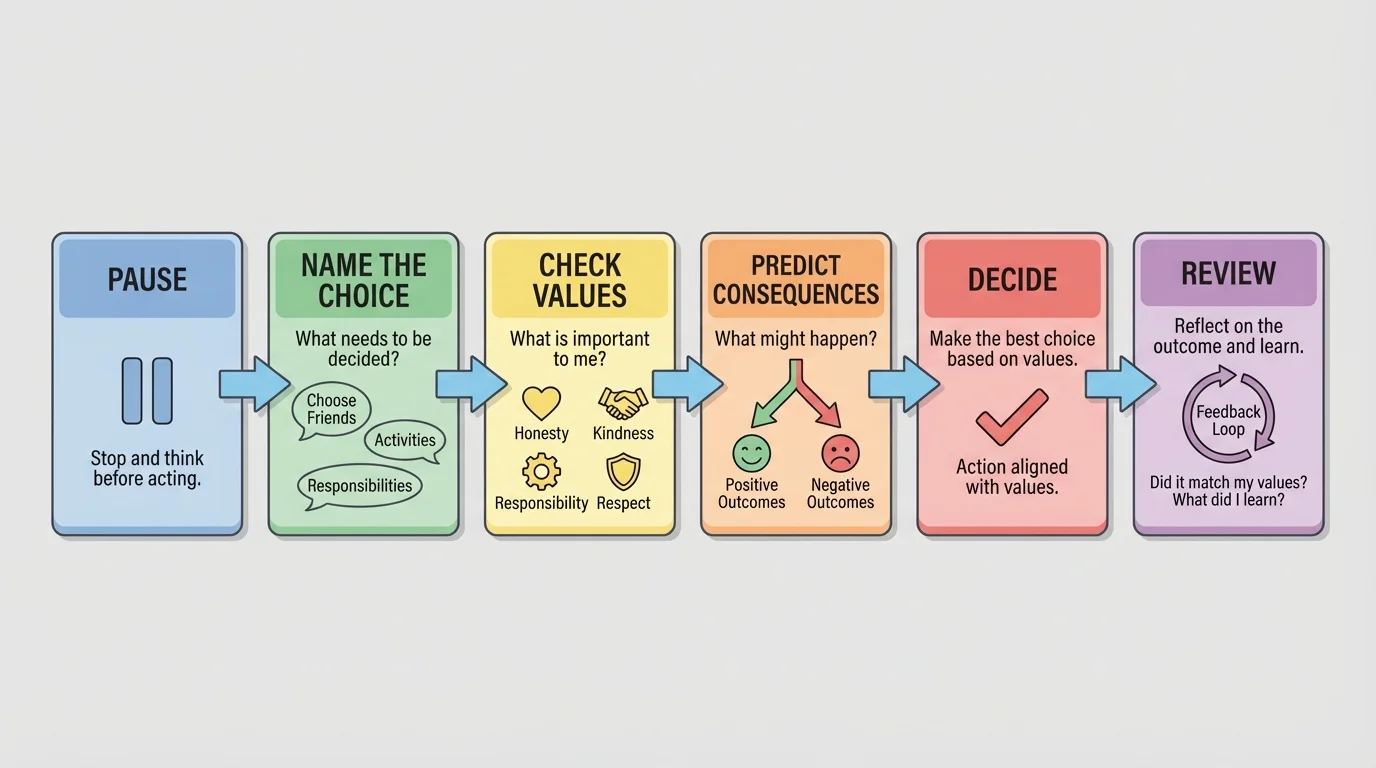
Step 1: Pause. If possible, do not answer right away. A short pause can protect you from a fast regret.
Step 2: Name the choice. Be clear about what you are deciding. Are you choosing a friend group, an activity, a response in a message, or whether to finish a responsibility now or later?
Step 3: Ask which values are involved. Is this about honesty, respect, safety, kindness, loyalty, growth, or responsibility?
Step 4: Predict the likely consequences. What happens today? What happens tomorrow? Who could be helped or hurt?
Step 5: Decide and act. Choose the option that best matches your values, even if it is not the easiest in the moment.
Step 6: Review afterward. Ask yourself whether the choice brought peace, trust, and progress or stress, guilt, and problems.
This kind of decision-making gets easier with practice. Over time, your pause gets stronger, your thinking gets clearer, and your choices line up with your goals more often. The flow in [Figure 2] is especially useful when you feel rushed or pressured.
Sometimes two good things seem to conflict. You may want to be loyal to a friend, but also honest with an adult. You may want to help your family, but also need time to rest. You may want to join an activity, but also need to protect your schedule. In these moments, ask which choice protects people, trust, and long-term well-being best.
Peer pressure can make value conflicts feel stronger. Pressure does not always sound mean. It can sound like, "Come on, it is not a big deal," or "If you were a real friend, you would do it." That kind of message tries to push you past your own judgment. A healthy friend may feel disappointed by your no, but they should still respect it.
"You do not have to set yourself on fire to keep other people warm."
— Common saying about boundaries
Boundaries are limits that protect your time, energy, safety, and values. You can say, "I cannot do that," "I need to log off now," "That does not feel right to me," or "I already said I would help at home." Clear, calm words are often stronger than long excuses.
If you feel torn, remember that discomfort is not always a sign that you made the wrong choice. Sometimes discomfort just means you chose courage instead of convenience. Saying no can feel awkward at first, but it often prevents much bigger problems later.
Knowing your values is helpful. Living them daily is even better. The strongest values show up in habits. A habit is a repeated action that becomes more automatic over time. For example, if you value responsibility, you might create a habit of checking your tasks before opening a game or social app. If you value kindness, you might pause before posting or replying when upset.
You can build these habits with small actions. Keep a short list of your top values somewhere private. Before agreeing to something, glance at the list. Notice when a choice feels off. Pay attention to who brings out your best self and who pushes you away from it. Small patterns matter a lot.
Try This
Pick your top three values for this month. Examples: kindness, responsibility, honesty, safety, growth, or respect. Then use them as a quick check before saying yes to a friend, an activity, or a new commitment.
You can ask yourself: "Does this match who I want to be?" "Will I feel okay about this later?" and "Does this choice protect trust?"
You are still learning, so you will not get every choice right. That is normal. Self-awareness grows when you notice your patterns without giving up. If you make a choice that does not fit your values, the next step is not to hide it. The next step is to learn from it, fix what you can, and choose better next time.
Over time, value-based choices shape your identity. People begin to know you as someone who is trustworthy, respectful, thoughtful, and strong enough to make wise decisions. More importantly, you begin to know that about yourself.
