One message, one click, one choice can change a lot. Saying yes to a risky online challenge, spending all your money on something you want right now, or posting when you are angry might feel small in the moment. But strong decision-making is not about being perfect. It is about learning how to slow down, think clearly, and choose in a way that protects your future.
Every day, you make decisions about how to use your time, who to trust, what to share online, how to handle pressure, and whether to act now or wait. Some choices are low-stakes, like what snack to eat. Others can affect your safety, relationships, reputation, money, or goals.
A good decision is not always the easiest choice or the fastest one. Sometimes the best choice feels less exciting at first because it requires patience, honesty, or self-control. What makes it a strong choice is that it takes the whole picture into account, not just what feels good for the next five minutes.
Risk is the chance that a choice could lead to harm, loss, or another negative result.
Responsibility means understanding that your choices affect both you and other people, and accepting ownership of the results.
Long-term impact is the effect a decision can have over time, including how it shapes habits, trust, health, money, and future opportunities.
When you evaluate a decision well, you ask questions like: What could go wrong? Who could be affected? What happens next week, next month, or next year if I keep making this kind of choice?
A strong decision usually has four parts. First, it is informed. You know enough facts to choose wisely. Second, it is careful. You stop and think instead of reacting instantly. Third, it is responsible. You consider how your action affects others. Fourth, it is future-aware. You look past the short-term reward.
This does not mean you need to overthink every little thing. It means you need a reliable way to sort important choices. That matters most when feelings are intense, when someone is pressuring you, or when the decision includes safety, money, trust, or your digital footprint.
Many poor decisions are not caused by lack of intelligence. They happen because people are rushed, emotional, distracted, or focused only on immediate rewards.
[Figure 1] If you can learn to pause before acting, you already improve your decision-making. That pause gives your brain time to move from reaction to evaluation.
A practical decision-making framework helps when emotions are high. Instead of guessing, you follow clear steps that make your thinking stronger.
Step 1: Pause. If the decision feels urgent, emotional, or pressured, stop for a moment. Take a breath. If possible, give yourself time. A rushed choice is more likely to ignore consequences.
Step 2: Define the real choice. Be specific. The choice is not just "Should I do this?" It may be "Should I share my password with a friend?" or "Should I spend $25 now or save it for concert tickets later?" Clear questions lead to clearer thinking.
Step 3: List your options. Most people think there are only two choices: yes or no. Often there are more. You might wait, ask an adult, gather more information, set a limit, or choose a safer version.
Step 4: Check the risks. Ask what negative outcomes are possible, how serious they would be, and how likely they are.
Step 5: Check your responsibilities. Ask who could be affected, what rules or promises apply, and whether your choice is fair and honest.
Step 6: Think long-term. Ask what this choice could lead to if you repeat it. One decision can become a habit.
Step 7: Choose and review. Make the best decision you can, then later look back. Reviewing helps you improve next time.
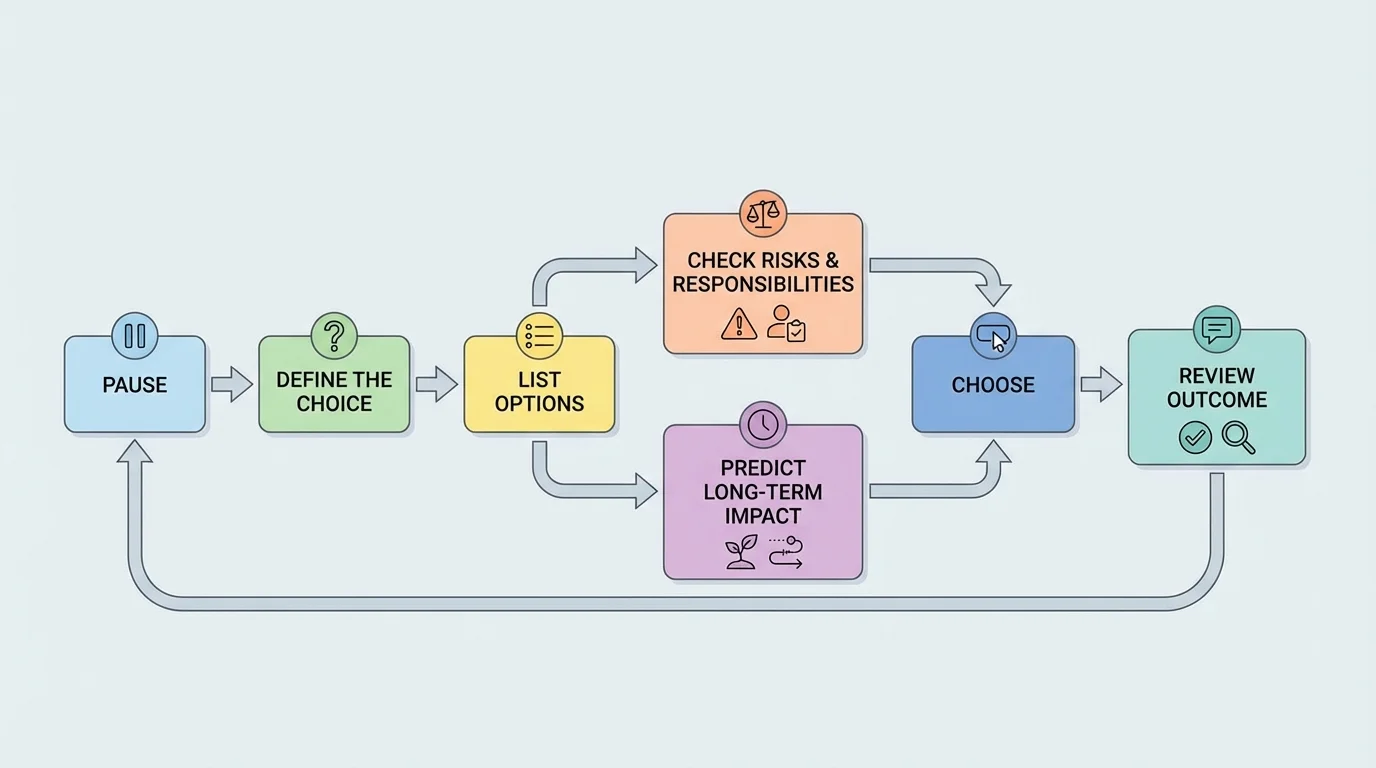
This process is useful in everyday situations: accepting an invite from someone you do not know well, deciding whether to post something personal, choosing how to use your free time, or figuring out what to do with money you received as a gift.
Case study: A pressure-filled online decision
You are in a group chat. Someone dares you to post an embarrassing photo of another person "as a joke."
Step 1: Pause instead of reacting to the group.
You do not need to answer immediately.
Step 2: Define the real choice.
The real choice is whether to harm someone for attention or approval.
Step 3: Check risks and responsibility.
The other person could feel hurt or humiliated. You could damage trust, get reported, or leave a permanent digital record.
Step 4: Think long-term.
A quick laugh could become a long-term reputation problem.
The strongest decision is to refuse, avoid sharing the image, and if needed leave the chat or tell a trusted adult.
Notice that the best option here is not just "what keeps me out of trouble." It is also what protects another person. Good decision-making includes character, not just self-protection.
Risk assessment means judging both the chance that something bad may happen and how serious the harm could be. A smart decision-maker looks at both parts.
[Figure 2] Some risks are low risk. For example, trying a new recipe might fail, but the outcome is usually minor. Some risks are high risk. Sharing your home address publicly, getting into a car with an unsafe driver, or doing a dangerous stunt for a video can lead to serious harm.
A useful way to think about risk is to ask two questions: How likely is it? and How bad would it be? A choice can be dangerous either because the bad result is very likely, or because the possible harm is severe even if it is less likely.
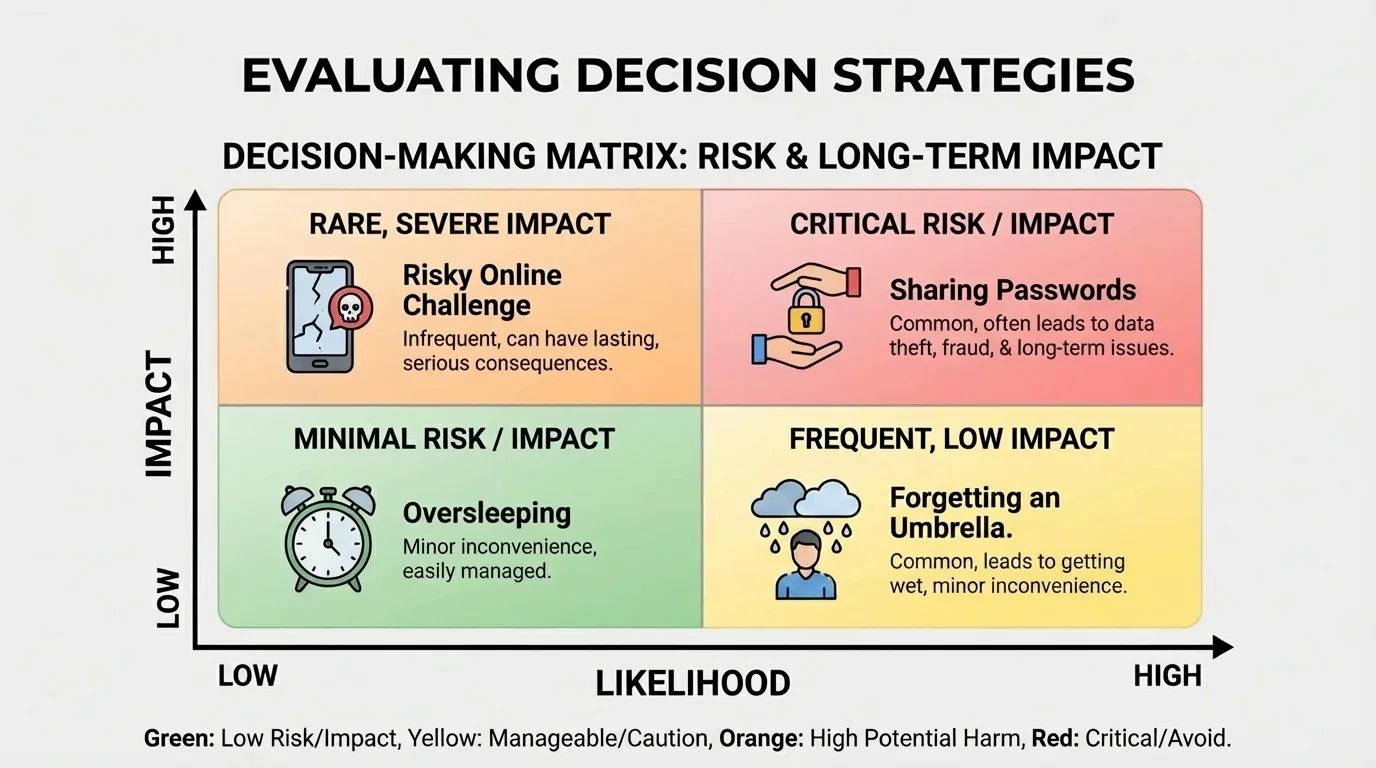
For example, forgetting to charge your device before an online club meeting might be fairly likely, but the harm is usually small. Giving a stranger private information might happen only once, but the harm can be serious. This is why severe outcomes deserve extra caution even when they seem unlikely.
Risk is not only physical. There is also emotional risk, social risk, digital risk, and financial risk. Posting something private can risk embarrassment or loss of privacy. Lending money to someone who never repays others creates financial and relationship risk. Staying up too late every night to watch videos creates health and schoolwork-related risk over time.
| Type of risk | Example | Possible result |
|---|---|---|
| Physical | Ignoring safety gear | Injury |
| Digital | Sharing passwords | Account loss or privacy breach |
| Social | Joining cruel behavior online | Broken trust or conflict |
| Financial | Spending all your money impulsively | No savings for later needs |
| Emotional | Answering in anger | Regret and damaged relationships |
Table 1. Different types of risk and the kinds of consequences they can create.
Severity and likelihood work together. A low-likelihood event can still deserve serious attention if the harm would be major. That is why strong decisions are not based only on "It probably won't happen." They also ask, "If it did happen, how serious would it be?"
As you saw in [Figure 2], high-likelihood and high-impact choices deserve the most caution. A useful rule is this: if a choice could seriously harm your safety, privacy, future, or another person, do not treat it like a casual decision.
Responsibility means your decision is not just about what you want. It is also about what you owe to yourself and others. That includes honesty, safety, respect, and following through on commitments.
Start with personal responsibility. This means taking care of your own health, time, money, and goals. If you choose to procrastinate repeatedly, skip sleep, or spend without thinking, you are the first person affected.
Then consider social responsibility. Your behavior can affect family members, friends, teammates, neighbors, and people you interact with online. If you agree to help with something and then disappear, other people may be left stressed or disappointed.
There is also digital responsibility. Online choices can spread fast and stay visible. Forwarding a rumor, posting private screenshots, or joining harassment can hurt real people in real ways. Being behind a screen does not remove responsibility.
"Freedom means being able to choose, and maturity means being willing to own the results of that choice."
[Figure 3] A helpful test is to ask: Would I still do this if my parent, coach, or future self saw it? Another useful question is: If everyone acted this way, would it make things better or worse?
Your long-term impact matters because choices create ripples. A decision might feel tiny today but shape your habits, trust, money, health, and opportunities over time.
This is especially true for repeated choices. One late night might not matter much. But staying up too late every night can affect your sleep, mood, focus, and self-control. One impulse buy might be small. But making the same kind of purchase again and again can leave you with no savings when something important comes up.
Long-term thinking asks, "What pattern am I creating?" That question is powerful because patterns become habits, and habits are easier to continue than to undo.
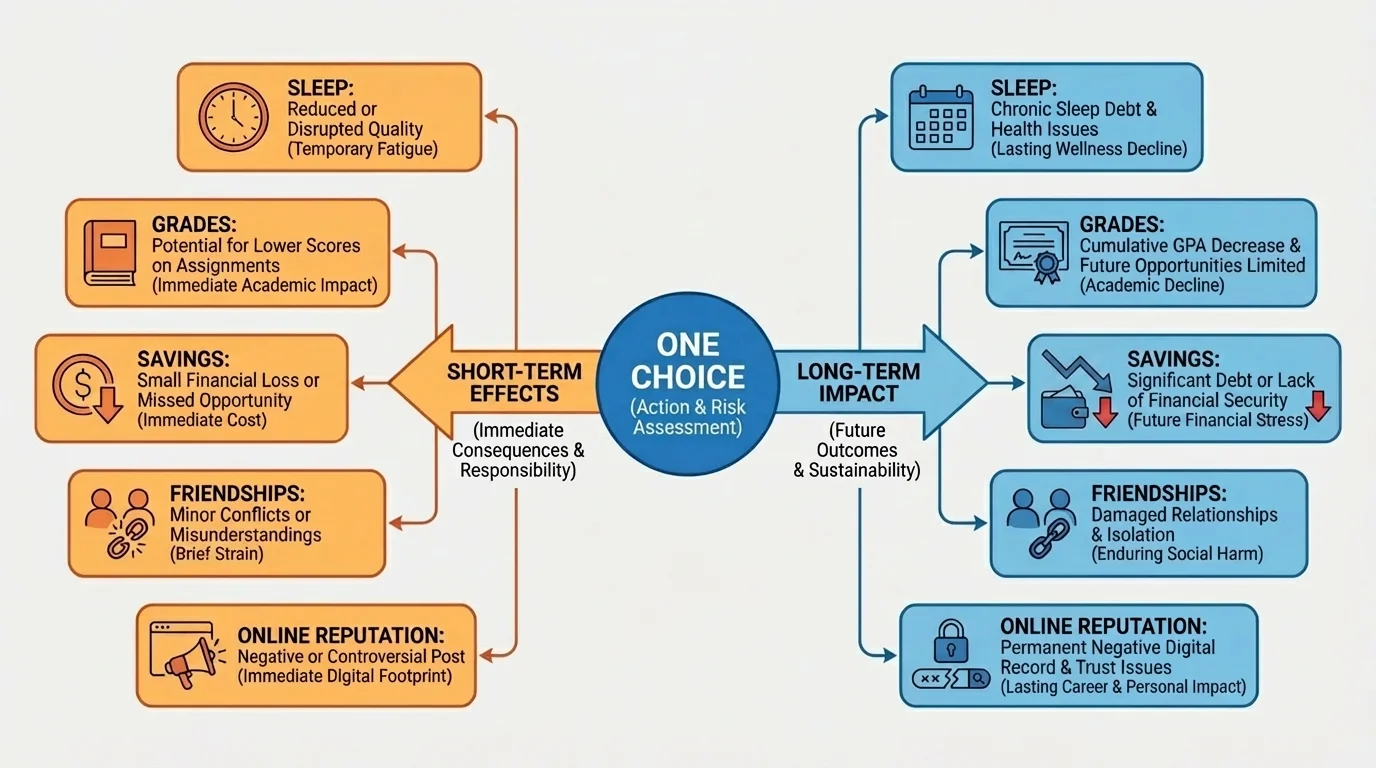
Long-term impact also includes reputation. Reputation is what people learn to expect from you based on repeated actions. If you are reliable, honest, and respectful, people trust you more. If you are careless, unkind, or irresponsible, people remember that too.
The same is true for money. Suppose you get $10 each week and decide whether to spend or save it. Saving for six weeks gives you $60. Spending all $10 each week gives you nothing set aside later. The math is simple, but the life skill is bigger: repeated small choices build future freedom. In arithmetic, this looks like \(10 + 10 + 10 + 10 + 10 + 10 = 60\), but in real life it means being prepared.
As you think back to [Figure 3], the strongest decisions are often the ones that protect future options instead of limiting them.
When you have several choices, compare them directly instead of deciding from emotion alone. You can make a quick mental chart: option, short-term benefit, short-term risk, long-term result, and effect on others.
For example, suppose you have $30. You can buy a game accessory now, save for a larger goal, or split the money between spending and saving. None of these options is automatically right or wrong. The better choice depends on your goals and whether you have thought ahead.
Case study: Choosing what to do with money
You have $30 from doing chores.
Step 1: Identify options.
Option A: spend all $30 now. Option B: save all $30. Option C: spend $10 and save $20.
Step 2: Evaluate short-term and long-term effects.
Option A gives immediate enjoyment but no savings. Option B gives the most future flexibility. Option C balances both.
Step 3: Match the choice to your goals.
If you are saving for something important, Option B or C is better than an impulse purchase.
The best decision is the one that fits your priorities without ignoring future needs.
Now think about a time decision. You have one free hour. You could scroll social media, finish a task you promised to do, practice a skill, or rest because you are tired. A strong choice depends on what is most responsible and useful right now. Rest may be wise if you truly need it. Practicing may be wise if you have a goal. Finishing the promised task may be wisest if other people are counting on you.
Decision-making is not about choosing the hardest option every time. It is about choosing the option that makes sense when you weigh risk, responsibility, and long-term impact together.
Some choices go wrong in predictable ways. If you know the traps, you can catch them earlier.
Impulse. You act based on a feeling of the moment. Anger, excitement, boredom, and curiosity can all lead to poor choices if they take over your thinking.
Peer pressure. You do something because you want approval, want to fit in, or do not want to seem afraid. This can happen in person, in group chats, on social media, or in gaming spaces.
Short-term thinking. You focus only on what feels good now. This ignores future costs.
Overconfidence. You think, "Nothing bad will happen to me," even when the risk is real. That kind of thinking often appears in unsafe online sharing, risky dares, and careless financial decisions.
Avoidance. You refuse to decide, hoping the problem disappears. But not choosing is still a choice. Ignoring a message, deadline, or conflict can create bigger problems later.
Strong critical thinking includes checking your own assumptions. If you catch yourself saying "It will probably be fine" without evidence, that is a sign to slow down and evaluate more carefully.
One of the best ways to avoid these traps is to have a personal rule ready before the pressure happens. For example: "I do not share passwords," "I do not post when angry," or "I wait one day before spending money on non-essentials."
Good decision-making gets easier with practice. You do not have to become perfect overnight. You just need habits that make wise choices more likely.
Use a pause phrase. Try saying, "Let me think about it," or "I will answer later." This protects you from pressure.
Ask three quick questions. What could go wrong? Who could be affected? Will this still seem smart tomorrow?
Look for a trusted outside view. If the choice involves safety, money, secrets, or something that feels uncomfortable, talk to a trusted adult.
Notice patterns. If you keep making the same kind of regretted choice, do not just focus on the latest mistake. Look for the habit underneath it.
Review without excuses. After a decision, ask what worked and what did not. Honest reflection helps you improve faster than pretending nothing happened.
Try This: A 30-second decision check
Step 1: Pause for one full breath before answering or clicking.
Step 2: Name the choice clearly in one sentence.
Step 3: Check risk, responsibility, and long-term impact.
Step 4: If the choice could seriously affect safety, privacy, trust, or money, wait and get advice.
This short routine can prevent a lot of avoidable problems.
The goal is not to remove all risk from life. Some risks are healthy, like trying a new activity, speaking up respectfully, or learning a challenging skill. The goal is to tell the difference between a thoughtful risk that helps you grow and a careless risk that can harm you or others.
When you evaluate decisions well, you become more independent in the best way: not by doing whatever you want, but by making choices you can stand behind.
