One of the fastest ways to damage a relationship is not necessarily a huge fight. Often, it is something smaller and more common: ignoring a limit, pressuring someone after they hesitate, or refusing to own a mistake. The opposite is also true. Some of the strongest relationships are built not on being perfect, but on three everyday skills: respect for limits, respect for choices, and responsibility when things go wrong.
Relationships include friendships, family connections, teammates in activities, gaming groups, clubs, and people you talk with online. In all of these, you want to feel safe, heard, and respected. That is where boundaries, consent, and accountability matter. They help people know what is okay, what is not okay, and what to do after a mistake.
When these skills are missing, problems show up quickly. Someone may keep messaging after being asked to stop. A friend may share a private screenshot without permission. A person may say, "I was joking," instead of admitting they hurt someone. These actions can make others feel stressed, unsafe, angry, or unsure whether they can trust that person again.
Boundaries are limits you set to protect your time, space, feelings, energy, and privacy.
Consent means giving clear permission for something to happen. Real consent is freely given, informed, and can be changed at any time.
Accountability means taking responsibility for your choices, being honest about harm, and working to repair it.
When these three are present, relationships usually feel calmer and stronger. You know where the lines are. You know that your choices matter. And you know that if someone messes up, they can respond in a respectful, responsible way instead of making things worse.
Think of healthy relationships like a strong three-part support system. Boundaries create the lines of respect. Consent protects choice. Accountability repairs damage and rebuilds trust. If one part is missing, the relationship can become confusing or unsafe.
For example, a friendship may have kindness but weak boundaries. That can lead to constant interruptions, oversharing, or pressure to always be available. Another relationship may have boundaries but no accountability. That means problems never get fixed because one person always avoids responsibility. A healthy relationship needs all three, working together.
Why these skills strengthen trust
Trust is not built by mind-reading or by "just knowing" what another person wants. Trust grows when people communicate clearly, respect each other's choices, and respond honestly when they make mistakes. That makes relationships feel predictable in a good way: people know they will be treated with respect.
These skills are especially important online because digital communication can blur lines. Messages arrive at all hours. Photos can be shared instantly. Tone is easy to misunderstand. That means being clear and respectful matters even more.
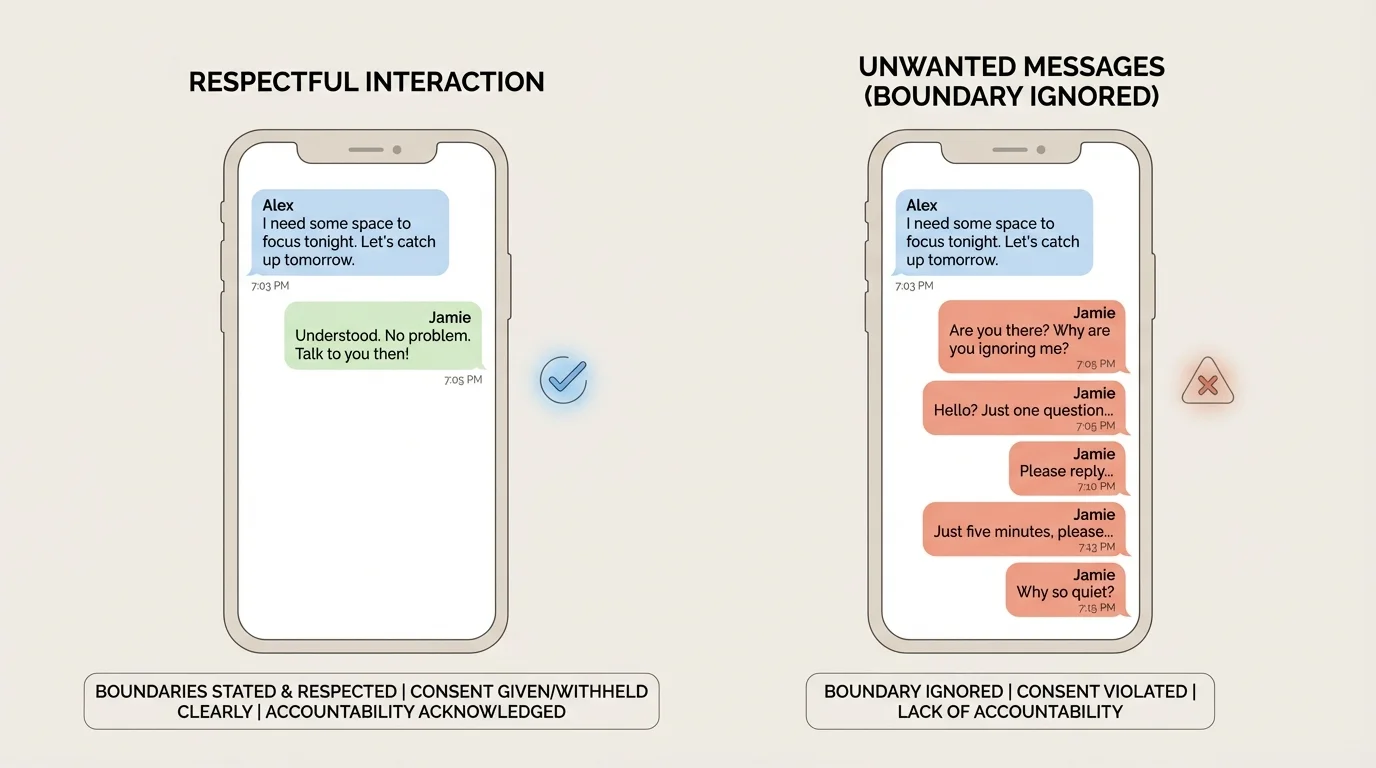
A personal boundary is not about controlling someone else. It is about clearly saying what you will and will not accept, as [Figure 1] illustrates in digital conversations. Boundaries protect your time, energy, privacy, values, and emotional comfort.
Some boundaries are about communication. You might decide, "I do not answer non-urgent messages late at night," or "I am not okay with being spammed if I do not reply right away." Some are about privacy: "Please do not post pictures of me without asking." Others are about emotional space: "I want to support you, but I cannot handle being in the middle of your argument with someone else."
Boundaries are healthiest when they are clear, calm, and specific. Saying "Stop being annoying" is vague and likely to start a fight. Saying "Please stop sending repeated messages when I have not answered yet" is much clearer. A boundary does not need to be rude to be firm.
Setting a boundary can feel awkward at first, especially if you worry about disappointing someone. But discomfort does not mean the boundary is wrong. In fact, people who respect you may not love every limit you set, but they will still listen and adjust.
Here is a practical way to set a boundary:
Step 1: Name the behavior. Say exactly what is happening.
Step 2: State your limit. Say what you need or what is not okay.
Step 3: Add what you will do if needed. This is not a threat; it is your action plan.
For example: "Please do not share my messages with other people. If it keeps happening, I will stop telling you private things." That is clear, respectful, and focused on your choices.
Example: Setting a boundary with a friend online
A friend keeps calling during times when you are helping at home, even after you miss the call.
Step 1: Say what is happening.
"I've noticed you call several times in a row when I don't answer."
Step 2: State your boundary.
"If I miss a call, please wait for me to reply when I'm free."
Step 3: Explain your action if needed.
"If the repeated calling continues, I'll mute my phone and respond later."
This protects your time without insulting the other person.
Later, when you compare respectful and disrespectful digital behavior, [Figure 1] stays useful because it shows a simple truth: the problem is not just the message itself. The problem is ignoring a clearly stated limit.
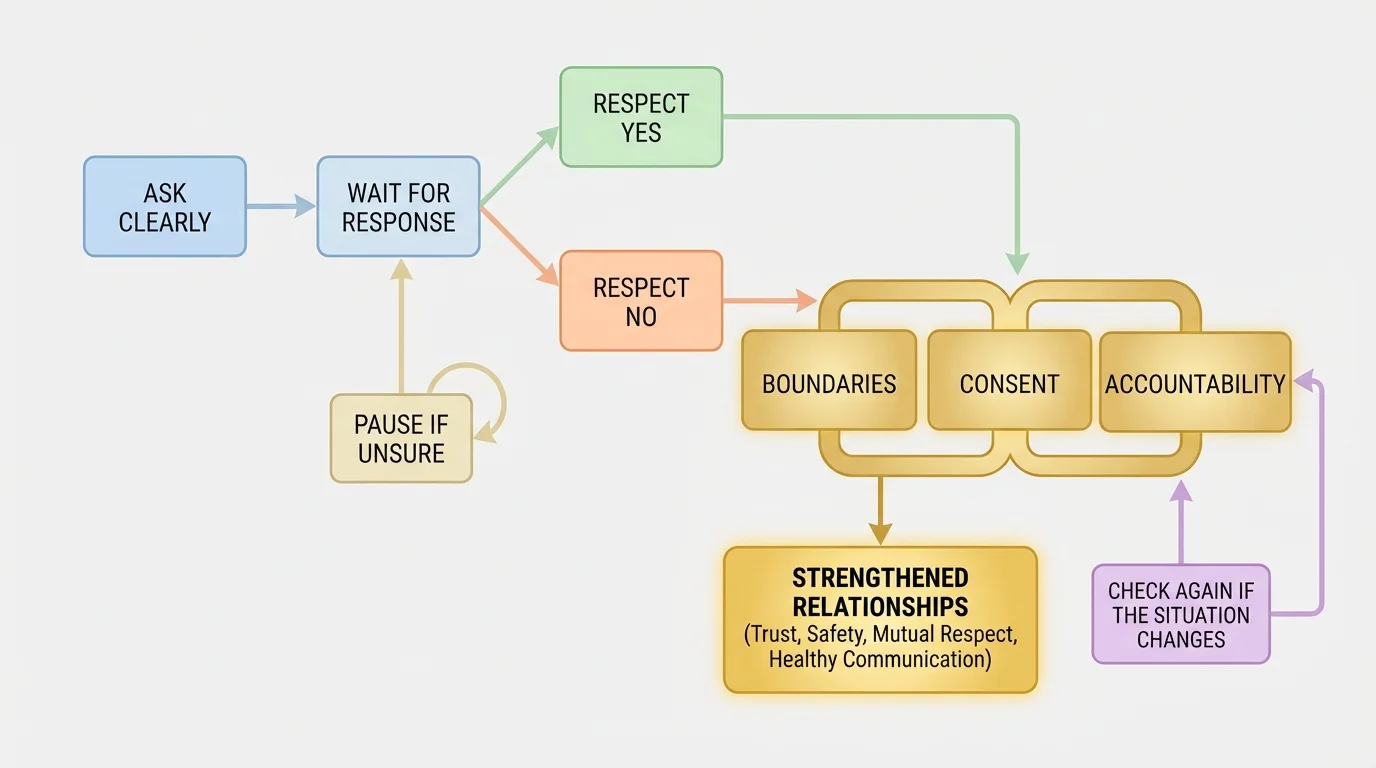
Consent is about choice, and it works like a decision path, as [Figure 2] shows. It means checking first, listening to the answer, and respecting it. Consent is not only about physical contact. It also matters when sharing photos, posting someone's information, joining private conversations, borrowing items, or adding someone to a group chat.
Real consent is clear, freely given, and ongoing. Clear means the answer is understandable, not guessed. Freely given means the person is not being pressured, tricked, or made to feel guilty. Ongoing means a yes at one moment does not mean yes forever. People can change their minds.
If someone seems unsure, silent, uncomfortable, or pressured, that is not solid consent. If you have to convince, pressure, or wear someone down, you are not respecting their choice. A respectful person can hear "no," "not now," or even "I'm not sure," and stop there.
Consent matters in everyday situations. Before reposting a funny picture of a friend, ask. Before telling another person's private story, ask. Before turning on your camera and recording during a group video call, ask. Before hugging a younger sibling who looks upset, check whether they want that comfort or need space.
A helpful rule is this: if the action affects another person's body, privacy, image, belongings, or personal information, check first. Asking can be simple: "Are you okay with this?" "Can I share this?" "Do you want advice, or do you just want me to listen?"
Many conflicts happen not because a person wanted to be harmful, but because they assumed instead of asking. A quick check-in often prevents a much bigger problem later.
Consent also applies to conversations. If a friend starts venting about a serious problem, it is okay to check whether you have the energy and time to listen. You can say, "I care about you, but I can't handle a heavy conversation right now. Can we talk later?" That combines your boundary with honest communication.
As relationships continue, the idea in [Figure 2] still matters: ask, listen, respect the answer, and check again if the situation changes. Consent is not a one-time pass. It is an ongoing habit of respect.
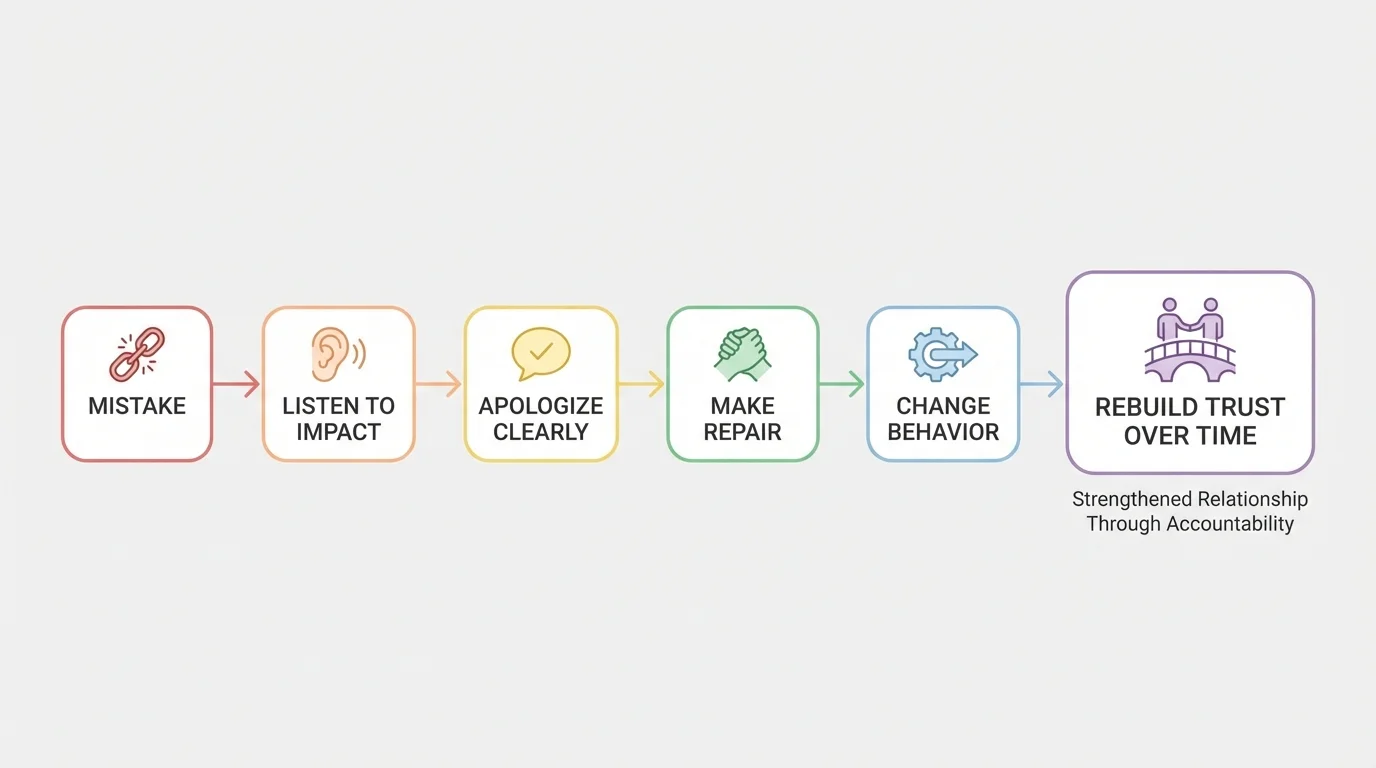
Accountability is the skill of saying, "I did this, it affected you, and I need to make it right," as [Figure 3] shows through a repair process. Everyone makes mistakes. Strong relationships are not built by never messing up. They are built by handling mistakes honestly.
Accountability is different from excuses. An excuse tries to escape responsibility: "You're too sensitive," "I was just kidding," or "I only did it because everyone else was doing it." Accountability sounds different: "I shared your message without asking. That was wrong. I understand why you're upset."
A real apology has several parts. First, name what you did. Second, show that you understand the impact. Third, say you are sorry without making the other person comfort you. Fourth, repair what you can. Fifth, change your behavior so the apology means something.
Trust often rebuilds slowly. That can feel frustrating, but it is fair. If you break trust quickly, you may have to rebuild it over time through consistent action. Saying "sorry" once is a start, not a finish line.
Here is what accountability can look like in practice:
Step 1: Stop defending yourself for a moment and listen.
Step 2: Admit the behavior clearly.
Step 3: Apologize without adding blame.
Step 4: Ask what repair is possible.
Step 5: Follow through and do better next time.
Example: Repairing harm after crossing a line
You share a private screenshot from a chat because you think it is funny. Your friend finds out and feels embarrassed.
Step 1: Admit it directly.
"I shared your screenshot without permission."
Step 2: Acknowledge the impact.
"That was a violation of your privacy, and I get why you feel hurt."
Step 3: Apologize and repair.
"I'm sorry. I deleted it, asked others to delete it, and I won't share private messages again."
This kind of response gives the friendship a real chance to heal.
When you think about broken trust later, [Figure 3] remains a useful reminder that accountability is a process. The order matters: listen, admit, repair, and change.
These three ideas are strongest when used together. Suppose a friend asks for your password "just to prove you trust them." Your boundary might be, "I don't share passwords." Consent matters because your digital privacy is yours to control. Accountability matters if that friend pressures you and later realizes they were wrong. A healthy response would be, "I shouldn't have pushed you. That was unfair."
Or picture a group chat planning a weekend event. One person wants to post everyone's location and photos live. Boundaries help people say what they are comfortable with. Consent means nobody's information or image is shared without permission. Accountability means that if someone posts something they should not have, they remove it, apologize, and do better next time.
Healthy relationships are not control contests
Boundaries are not weapons. Consent is not a trick to get the answer you want. Accountability is not saying sorry just to make conflict disappear. These skills work best when your goal is mutual respect, not winning.
This is why healthy relationships often feel steady. You do not have to guess constantly. You know you can speak up, say no, and expect honesty if a problem happens.
It helps to notice patterns. One awkward moment does not always define a whole relationship, but repeated behavior tells you a lot.
| Green Flags | Warning Signs |
|---|---|
| Listens when you say you are uncomfortable | Pushes after you say no or hesitate |
| Asks before sharing photos or private information | Shares your information and says it is "not a big deal" afterward |
| Accepts your response without guilt trips | Uses pressure, teasing, or threats to get their way |
| Apologizes specifically and changes behavior | Blames you, jokes about the harm, or repeats it |
| Respects your time and space | Acts entitled to your constant attention |
Table 1. Comparison of respectful relationship behaviors and behaviors that weaken trust.
A big warning sign is when someone treats your boundary like a challenge. Another is when they act as if your discomfort is the problem instead of their behavior. In healthy relationships, people may not always agree, but they still respect limits.
"No is a complete sentence, and responsibility is part of respect."
Also pay attention to how you respond when other people set limits. It is easy to think about your own rights and forget that others have the same rights too. Respect goes both ways.
Sometimes the hardest part is finding words in the moment. You do not need a perfect speech. Short, clear sentences are often best.
For boundaries: "I'm not comfortable with that." "Please don't message me repeatedly if I haven't answered." "I need some time to cool off before we talk." "Do not share that about me."
For consent: "Can I post this photo?" "Are you okay with me telling them?" "Do you want advice or just someone to listen?" "Is this still okay with you?"
For accountability: "I was wrong." "I understand how that affected you." "I'm sorry, and I'm going to fix what I can." "I will not do that again."
Try This
Choose one script you are most likely to need this week and rewrite it in your own natural words. The goal is to make respectful language feel normal, not robotic.
Practicing these lines ahead of time makes it easier to use them when emotions are high. Clear language lowers confusion and helps you act with confidence instead of reacting in panic.
Whether you are texting a friend, talking with family, working with teammates in an activity, or spending time in your community, the same principles apply. Respect people's limits. Ask before acting when something affects them. Own mistakes fully.
You also need to respect your own needs. Being kind does not mean saying yes to everything. Being loyal does not mean keeping harmful secrets. Being sorry does not mean accepting repeated disrespect. Healthy relationships have room for honesty, limits, and repair.
Communication skills are strongest when they are both clear and respectful. You can be firm without being cruel, and you can disagree without disrespecting the other person's dignity.
If a relationship repeatedly ignores your boundaries, dismisses consent, or avoids accountability, that is important information. You may need support from a trusted adult, family member, coach, mentor, or counselor outside of school. Strong relationships do not require you to shrink, stay silent, or accept pressure just to keep the peace.
The goal is not to control every interaction. The goal is to build relationships where trust can grow because people feel safe, respected, and responsible for their actions. That kind of relationship is not weak or fragile. It is strong because everyone in it knows that respect is not optional.
