Many arguments do not start because someone is truly mean. They start because a message sounded rude, someone felt left out, a deadline was missed, or a joke landed badly. In online life, where you may text, post, comment, game, or work with others through shared documents and video calls, small misunderstandings can grow fast. Learning how to handle conflict well is not about "winning." It is about protecting your relationships, your peace of mind, and your reputation.
Conflict is a normal part of life. If you have friends, work with a team, or spend time online, you will eventually disagree with someone. The goal is not to avoid every conflict. The real skill is learning how to respond in a way that is honest, calm, safe, and effective.
Conflict happens when people have different needs, feelings, opinions, expectations, or interpretations of what happened. Sometimes the issue is big, like broken trust. Sometimes it is small, like being ignored in a group chat. What matters is that the situation creates tension.
Many conflicts begin with a trigger, which is something that sets off a strong reaction. A trigger might be feeling embarrassed, excluded, disrespected, or blamed. For example, if a friend posts pictures from an outing and you were not invited, the photos might trigger hurt feelings. If a teammate keeps editing your work without asking, that might trigger frustration.
Conflict resolution means using respectful strategies to understand a problem, reduce tension, and work toward a solution. It does not always mean everyone gets exactly what they want. It means handling the disagreement in a healthy way.
Boundary means a limit you set to protect your time, energy, privacy, or emotional well-being.
Compromise means each side gives up something small so both sides can move forward.
When conflict is handled poorly, the problem usually spreads. One rude message turns into five. A private issue becomes public. A team task stalls because people stop communicating. A friendship weakens because nobody says what they actually mean. When conflict is handled well, people understand each other better, trust can grow, and problems get solved faster.
Good conflict resolution does not mean you stay quiet to keep the peace. It means you speak up in a respectful way. It also does not mean the other person has to agree with you immediately. Sometimes success looks like clearing up a misunderstanding. Sometimes it looks like agreeing on a new plan. Sometimes it means deciding to step back from a relationship that is unhealthy.
Strong conflict-resolution skills include staying calm, listening carefully, being clear about the real problem, avoiding insults, and focusing on solutions instead of revenge. Another important skill is de-escalation, which means lowering the emotional intensity of a situation so it does not get worse.
Conflict is a skill moment
A disagreement can reveal a lot: how well you manage emotions, whether you respect other people, and whether you can solve problems under pressure. Every conflict gives you a choice. You can react quickly and make the situation bigger, or you can respond thoughtfully and improve the outcome.
You do not need perfect words. You need a clear process you can rely on when emotions are high.
A simple process helps because emotions can make thinking messy. The sequence in [Figure 1] shows a practical order you can follow: pause, identify the issue, listen, explain your view, choose a solution, and follow up. If you skip straight to blaming or defending yourself, the conflict usually becomes harder to solve.
Step 1: Pause before reacting. If you feel angry, embarrassed, or panicked, do not answer immediately. Take a breath. Put the phone down. Drink water. Walk for a minute. A short pause can prevent a long problem.
Step 2: Name the real issue. Ask yourself, "What am I actually upset about?" Is it the message itself? Being left out? Feeling disrespected? Worry that something is unfair? If you do not know the real issue, your response may miss the point.
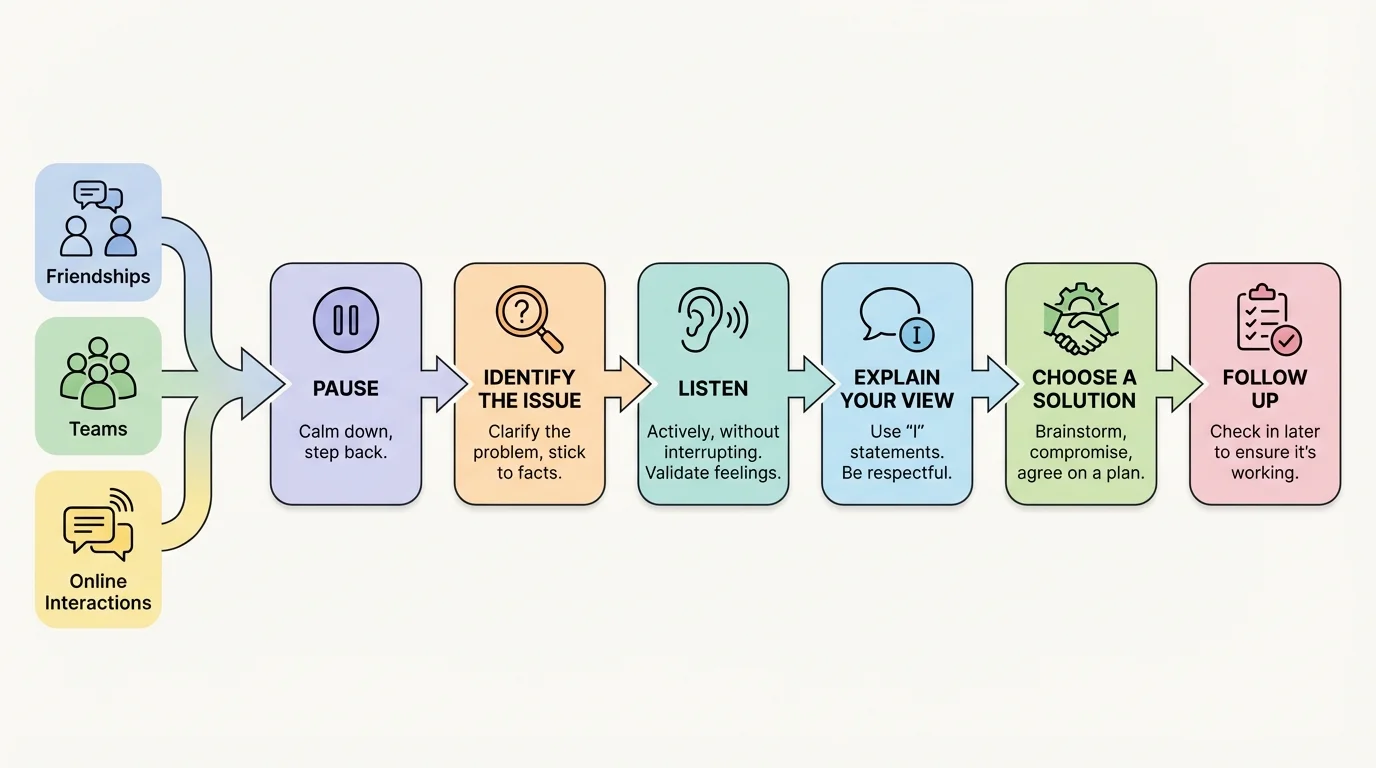
Step 3: Get information before assuming. Misunderstandings happen all the time online because tone is hard to read. Ask a calm question first: "What did you mean by that?" or "Can we clear this up?"
Step 4: Use "I" statements. Instead of accusing, describe your experience. Say, "I felt frustrated when the plan changed and I didn't know," instead of "You always ruin everything." Active listening matters here too. That means listening to understand, not just waiting for your turn to talk.
Step 5: Focus on solutions. Ask, "What can we do next?" Good solutions are specific. "Let's update the group before making changes," is better than "Let's just do better."
Step 6: Follow up. If the issue mattered, check in later. A short message like "Are we good now?" or "Is this plan working?" can prevent the same problem from returning.
Example: A conflict about a group chat
You notice your friends made plans in a chat without including you. You feel hurt and angry.
Step 1: Pause before responding.
Instead of sending "Wow, thanks for leaving me out," wait until you can think clearly.
Step 2: Identify the issue.
The deeper issue is not only the event. It is the feeling of being excluded.
Step 3: Ask directly but calmly.
Send: "I saw the plan and felt left out. Was it meant to be a small hangout, or was I accidentally missed?"
Step 4: Respond to the answer.
If it was a misunderstanding, you can say: "Thanks for explaining. Please tell me directly next time." If it was intentional and hurtful, you may need a stronger boundary.
This approach protects your dignity and gives you real information before you decide what to do next.
Notice that this method does not guarantee the other person will respond well. But it gives you the best chance of handling the situation in a mature way. It also helps you avoid saying something you regret. That is one reason the flow in [Figure 1] is useful: it keeps you from reacting emotionally and making the situation worse.
Friendship conflicts often involve feelings more than facts. You may be upset about being ignored, teased, left out, copied, lied to, or pressured. Because feelings are strong, it helps to be specific. Vague statements like "You've been weird lately" usually make the other person defensive. Specific statements like "When you joked about me in the chat yesterday, I felt embarrassed," are easier to understand and respond to.
One helpful strategy is to address the problem early. Small issues usually get bigger when they are ignored. If a friend keeps canceling plans at the last minute, it is better to talk after the second or third time than after months of resentment. Another strategy is to separate the person from the behavior. You can care about someone and still say that a certain action was not okay.
You already know that respect matters in communication. Conflict resolution builds on that idea: respect does not disappear just because you are upset.
Trust is also a major part of friendship. If trust is broken, repair takes more than a quick "sorry." A real apology should name the action, show understanding of the impact, and include changed behavior. "I'm sorry you got upset" is weak because it avoids responsibility. "I'm sorry I shared your message without asking. That was private, and I understand why that hurt you. I won't do that again," is much stronger.
Sometimes friendship conflict is about different needs, not bad intentions. Maybe one friend wants constant texting and the other wants more space. That is where a boundary becomes important. A healthy boundary might sound like, "I care about you, but I can't text late every night," or "Please don't post pictures of me unless you ask first." Boundaries are not punishments. They are clear limits.
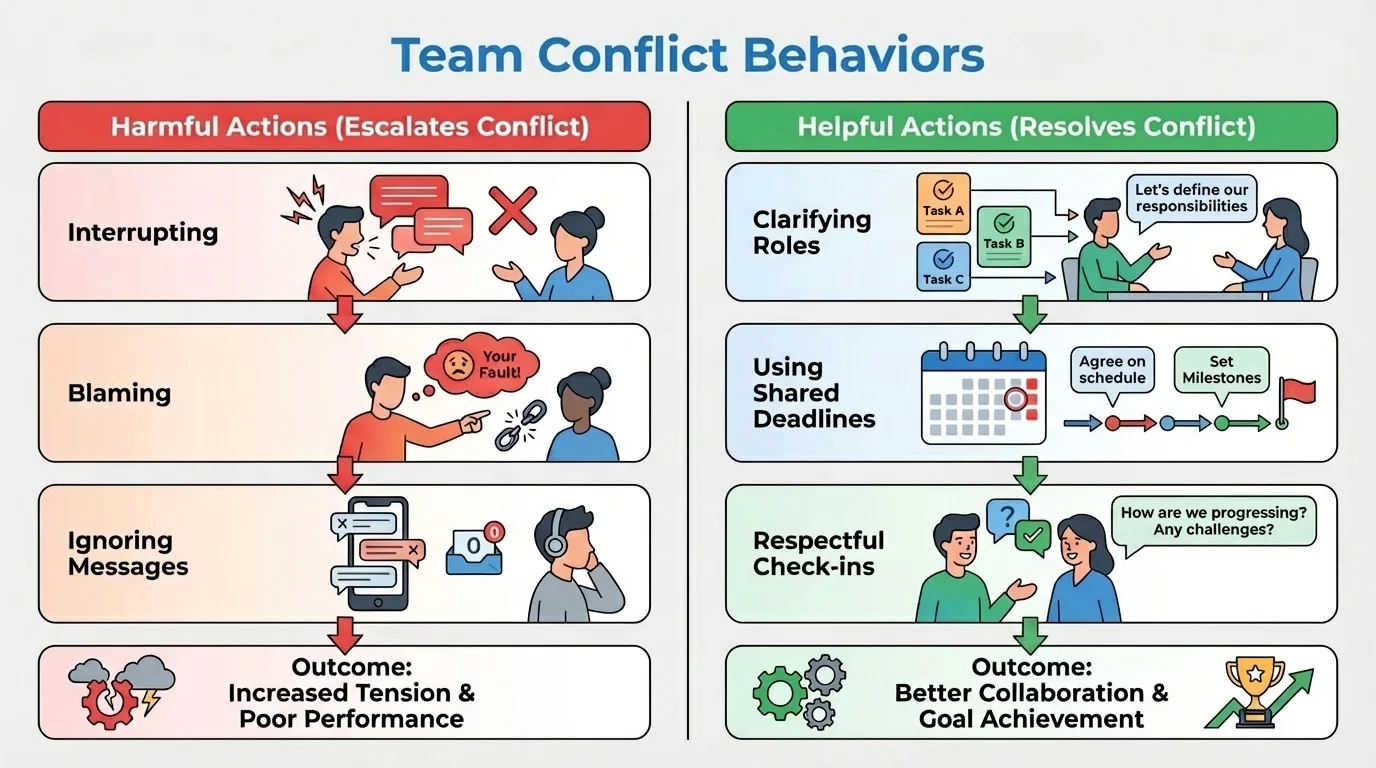
Team conflict is common because people have different work styles, schedules, and levels of responsibility. In online school, community groups, sports planning chats, gaming teams, volunteer projects, or creative collaborations, problems often come from missed messages, uneven effort, or unclear roles. The comparison in [Figure 2] makes it easier to spot which habits make team conflict worse and which habits help solve it.
When you are part of a team, focus on the task and the process. Ask: Who is doing what? By when? How will updates be shared? What happens if someone is behind? Clear answers reduce conflict before it starts.
If conflict appears, avoid public embarrassment. Instead of posting in a shared space, "You never do your part," try a direct message first: "I noticed your section isn't done yet. Are you stuck, or do you need help finishing it?" This keeps the conversation focused and gives the other person a chance to explain.
Another key strategy is to use facts, not exaggeration. "The document still needs your two slides, and the deadline is tonight," works better than "You are always lazy." Facts keep the issue solvable. Exaggeration turns it into a personal attack.
| Team problem | Unhelpful response | Helpful response |
|---|---|---|
| Someone misses a deadline | Blame them in the group chat | Ask privately what happened and reset the plan |
| One person does most of the work | Stay silent and become resentful | List tasks clearly and divide them fairly |
| People interrupt on a video call | Talk louder to compete | Use turns, chat notes, or a speaker order |
| Work gets changed without permission | Delete other people's edits | Ask for reasons and agree on editing rules |
Table 1. Common team conflicts and more effective ways to respond.
Good teams also know when to compromise and when to hold a firm standard. You can compromise on which design to use. You should not compromise on respectful behavior or basic fairness. Looking back at [Figure 2], notice that productive responses are specific, respectful, and organized rather than dramatic.
Example: Uneven effort in a team task
You and two others are creating a presentation for a community club. One person has not finished their part.
Step 1: Check facts first.
Review the shared document and deadline so you know exactly what is missing.
Step 2: Message privately.
Say: "Your section looks incomplete. Are you having trouble with it?"
Step 3: Offer a solution.
Try: "If you can finish the outline by tonight, I can help with formatting tomorrow."
Step 4: Escalate only if needed.
If the person does not respond and the task affects the whole group, share the situation calmly with the group leader or adult organizer.
This keeps the focus on completing the task, not attacking the person.
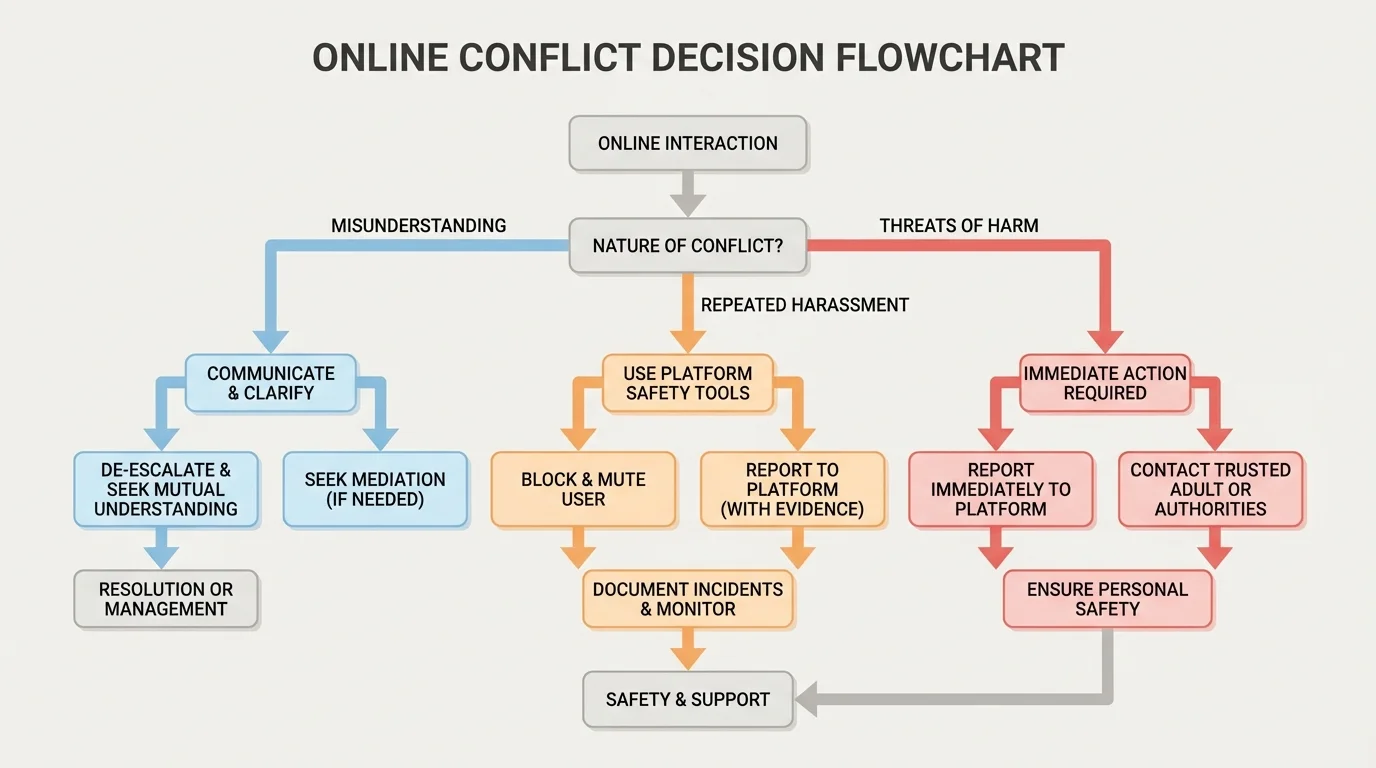
Online conflict needs special care because written words spread fast, tone is easy to misread, and posts can be copied or shared. The decision path in [Figure 3] helps you choose whether to reply, pause, move the conversation private, mute, block, report, or get adult help. Online spaces are real spaces, and your choices there have real consequences.
Start by asking what kind of problem you are dealing with. Is it a misunderstanding? A rude comment? Repeated harassment? A threat? The right response depends on the level of harm. Not every mean comment needs a long argument. Sometimes the smartest move is not to continue.
If the issue seems small and fixable, use a calm private message. Public arguments often become performances, where people care more about looking right than solving the problem. A private message like "I think your comment came across harshly. Can we clear it up?" is often more effective than replying in front of everyone.
If someone is repeatedly insulting, targeting, or scaring you, that may be cyberbullying. Do not try to handle serious harassment alone. Save evidence, such as screenshots, and use platform tools like mute, block, or report. Then tell a trusted adult. The same is true for threats, blackmail, pressure to share private images, or someone pretending to be you.
Many online conflicts get worse because people respond while upset and in public. A message typed in ten seconds can be screenshotted and remembered for much longer.
Your digital footprint matters here. That means the record of what you post, share, comment on, or send online. Even if you delete something later, someone may have saved it. Before posting in anger, ask yourself, "Would I be okay with this being seen later by a parent, coach, mentor, or future employer?"
As [Figure 3] shows, not every online conflict should be solved through more conversation. If a person is unsafe, manipulative, or repeatedly harmful, protection matters more than continuing the discussion.
Conflict resolution is much harder when your body is in stress mode. Your heart may beat faster, your muscles tense up, and your thoughts race. That is why self-control is not just a "nice extra." It is part of the skill.
Self-regulation means managing your emotions, behavior, and attention so you can respond wisely instead of reacting impulsively. You can build self-regulation with simple habits: slow breathing, stepping away from the screen, writing your thoughts before sending them, or asking to continue the conversation later.
Cool down to think clearly
When you are flooded with emotion, your first reaction often aims to protect your pride, not solve the problem. Cooling down gives your brain time to separate feeling from action. That does not make your feelings less real. It makes your response more effective.
Timing matters too. If someone is already angry, trying to solve everything immediately may fail. It is okay to say, "I want to talk about this, but I need a little time first," as long as you really come back to it later.
Some conflicts should not be handled alone. Get help from a trusted adult if there are threats, repeated harassment, stalking, blackmail, pressure for private information or images, discrimination, or fear for your safety. Also get help if a conflict is affecting your sleep, mood, focus, or mental health.
It is not "dramatic" to ask for help when a situation is unsafe or too big for you to manage alone. Strong people use support wisely. If you are unsure whether something is serious, that is a good reason to ask.
"Calm is not weakness. It is control."
Another sign that you need support is when the same conflict keeps repeating even after you tried to solve it respectfully. If someone ignores your boundaries again and again, the problem may not be communication. It may be their refusal to respect you.
Having words ready can make a big difference when emotions are high. Here are some phrases that help in different situations.
To clarify: "Can you explain what you meant?" "I may have misunderstood that message." "Before I react, I want to make sure I understand."
To express your feelings: "I felt hurt when that happened." "I was frustrated because I didn't know the plan changed." "I felt left out when I saw that post."
To set a boundary: "Please don't joke about me like that online." "I'm not okay with you sharing my messages." "I need you to ask before posting pictures of me."
To solve the problem: "What would be a fair way to fix this?" "How can we make a better plan next time?" "Let's agree on who is doing what."
To pause without avoiding: "I need a little time to think, but I do want to talk about this." "I'm too upset to answer well right now. Let's come back to it later today."
To apologize: "I was wrong to say that." "I understand how my action affected you." "I'm sorry, and here's what I'll do differently."
Try one small habit this week: before you send a message while upset, wait two minutes and reread it as if you were the other person. That tiny pause can change the entire outcome.
Try keeping a short mental checklist: pause, check facts, use "I" statements, choose private over public when possible, focus on the next step, and get help if safety is involved.
The more you practice these moves in smaller conflicts, the more ready you will be when a bigger one happens. Conflict-resolution skills are not just for arguments. They help you build trust, protect your well-being, and become someone others can count on during difficult moments.
