Some study habits feel productive because they keep you busy, but busy is not the same as prepared. You can spend an hour highlighting, copying notes, and flipping through slides, then freeze when a quiz asks you to explain an idea without looking. Strong studying is not about doing the most work. It is about doing the kind of work that helps your brain pay attention, hold on to information, and use it when you need it.
That matters even more in online school. At home, you are often in the same place that you use to relax, watch videos, text friends, or play games. Your brain has to switch from "this is where I chill" to "this is where I focus." If you do not set up study habits on purpose, distractions will make your choices for you.
Attention is your ability to focus on the task in front of you without getting pulled away too often. Retention means how well you keep information in memory over time. Exam readiness means being prepared to recall, apply, and explain what you learned under test conditions.
When you evaluate a study strategy, ask three questions: Does it help me focus now? Will I still remember this later? Will I be able to use it on a quiz or test without help? A good strategy usually supports all three.
Many students choose study methods that feel comfortable instead of methods that actually build memory. Reading the same page again feels familiar. Highlighting a lot of text feels organized. Watching a review video feels easy. But familiarity is not proof of learning. Sometimes your brain says, "I recognize this," when what you really need is, "I can explain this on my own."
Think about practicing for a sport or learning a song. If you only watch someone else do it, you may understand what it should look or sound like, but that does not mean you can perform it yourself. Studying works the same way. You need practice that makes your brain retrieve, organize, and apply information.
Your brain often mistakes repeated exposure for mastery. That is why rereading can make you feel more confident even when your test performance does not improve much.
This does not mean rereading is always useless. It can help when you are first trying to understand difficult material. But if rereading is your only strategy, it usually does not prepare you well for exams. Strong learning happens when you move from looking at information to pulling it out of memory.
Attention management is not just "trying harder." It is about making it easier to do the right thing. In online learning, attention improves when you reduce the number of decisions your brain has to make, as [Figure 1] shows through a study space with fewer distractions and a clearer task setup. If your phone is next to you, six tabs are open, and your snacks, messages, and music keep interrupting you, your brain has to keep restarting.
A better setup is simple: one task, one tab if possible, needed materials nearby, and a clear time limit. You do not need a perfect room. You need a study environment that supports focus. That could mean turning off notifications, using full-screen mode, putting your phone across the room, wearing headphones, or writing down exactly what you will do for the next 20 to 30 minutes.
There is also a difference between deep focus and light review. Deep focus is for harder tasks like solving problems, writing responses, or learning new concepts. Light review is for simpler tasks like checking flashcards, reviewing a short outline, or organizing notes. If you try to do deep work while half-distracted, you will usually need more time and remember less.
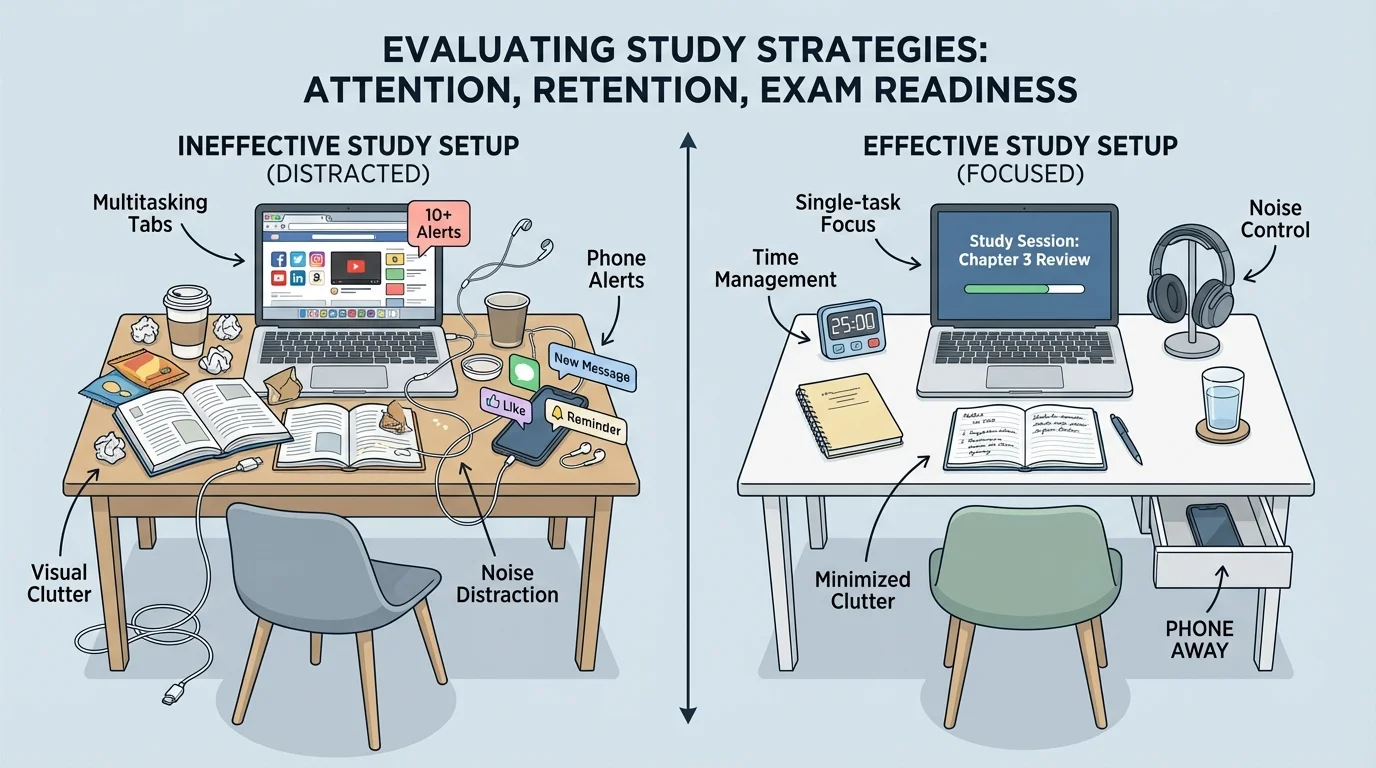
One helpful method is a short focus cycle. Study for a set amount of time, such as 25 minutes, then take a brief break of about 5 minutes. During the focus time, do only the planned task. During the break, stand up, stretch, get water, or rest your eyes. The point is not the exact numbers. The point is working in a way your brain can repeat.
Another key part of attention is matching the strategy to your energy level. If you are tired, passive work like watching videos may feel easier, but it often leads to weak retention. Sometimes the smarter move is to do a shorter, more active study session, then rest and return later. Quality beats pretending to study for a long time.
Example: Improving focus during an evening study session
You need to review science and language arts after dinner, but you keep checking messages and drifting to other apps.
Step 1: Choose one subject for the first focus block.
Pick science only, not both subjects at once.
Step 2: Remove easy distractions.
Put your phone across the room, close unrelated tabs, and keep only your assignment page and notes open.
Step 3: Set a short timer.
Work for 25 minutes on one goal: answer review questions from memory.
Step 4: Take a real break.
Stand up for 5 minutes instead of opening social media.
Step 5: Recheck results.
If you completed the goal and remember more without looking, the strategy worked better than a longer distracted session.
Notice that this example does not require more motivation. It requires fewer distractions and a clearer plan. That is a major idea in executive functioning: set up your environment so good choices are easier.
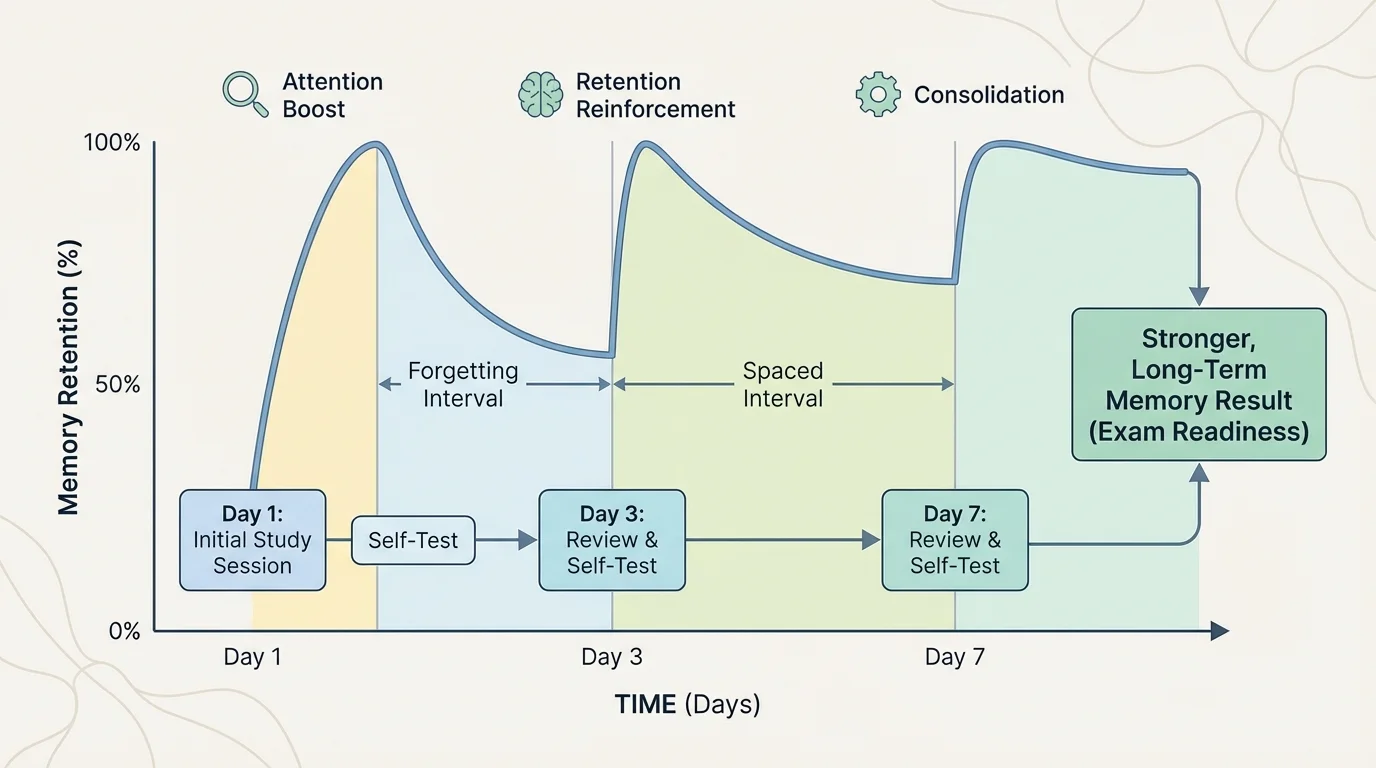
Active recall is one of the strongest study strategies because it makes your brain pull information out of memory instead of just looking at it. Retention gets stronger when you retrieve information, check what you got right or wrong, and return to it later over time, as [Figure 2] illustrates. This process feels harder than rereading, but that difficulty is often a sign that real learning is happening.
Here are some active recall methods you can use right away: cover your notes and explain the idea out loud, answer questions without looking, make digital or paper flashcards, write everything you remember from a topic on a blank page, or pause a video and predict the next answer before it is explained.
Spaced practice means reviewing material across several days instead of in one huge session. If you study a topic on Monday, review it briefly on Wednesday, then test yourself again on Friday, your memory usually becomes more stable than if you did all the same work in one night. Spacing helps because forgetting a little, then retrieving again, strengthens the memory pathway.
Interleaving means mixing related topics or question types instead of doing one exact kind of task over and over. For example, if you study math, you might mix fractions, equations, and word problems instead of doing 20 nearly identical questions in a row. In other subjects, interleaving could mean switching between vocabulary, reading response, and concept review. This builds flexibility because you must decide which idea to use, not just repeat a pattern.
A fourth strategy is using your notes wisely. Notes are useful when they help you understand and organize information, but copying notes word for word is often too passive. Better note use includes making short summaries, turning notes into questions, creating a checklist of weak topics, or writing one-sentence explanations in your own words.
Teaching someone else, even if it is just explaining to a family member or speaking to your camera, can also improve retention. If you cannot explain a concept clearly, that is useful information. It shows where your understanding is still shaky.
Why "harder" can be better
Some study strategies feel harder because they force your brain to work more actively. A quick self-test, a blank-page summary, or a mixed review set often feels less smooth than rereading. But that extra mental effort usually leads to stronger retention because you are practicing the same kind of recall you will need later.
As you continue studying, the pattern from [Figure 2] still matters: review, retrieve, check, and revisit later. A strategy is strong if it helps you remember after a gap, not just right after you saw the information.
Not every good-sounding tip is good for you in every situation. That is why evaluating study strategies matters. Instead of asking, "Did I study a lot?" ask, "What result did this strategy produce?"
Here are useful signs to watch for:
You can track this with a simple study log. After each session, rate the strategy on a scale from 1 to 5 for focus and memory. Then write one sentence: "Next time I should keep this, change this, or stop this." Over a week or two, patterns become clear.
| Strategy | Feels Easy? | Helps Focus? | Helps Long-Term Memory? | Good for Exam Prep? |
|---|---|---|---|---|
| Rereading only | Usually yes | Sometimes | Usually weak | Limited |
| Highlighting only | Yes | Sometimes | Weak if used alone | Limited |
| Active recall | No, often harder | Yes, because it gives a task | Strong | Strong |
| Spaced practice | Moderate | Yes, with planning | Strong | Strong |
| Practice test | Can feel challenging | Yes | Strong | Very strong |
| Interleaving | Moderate to hard | Yes | Strong | Strong |
Table 1. Comparison of common study strategies for attention, retention, and exam readiness.
One weak session does not mean a strategy is bad. Maybe you were tired, hungry, stressed, or rushing. But if a strategy repeatedly gives you low focus, poor memory, and panic before tests, it needs to change.
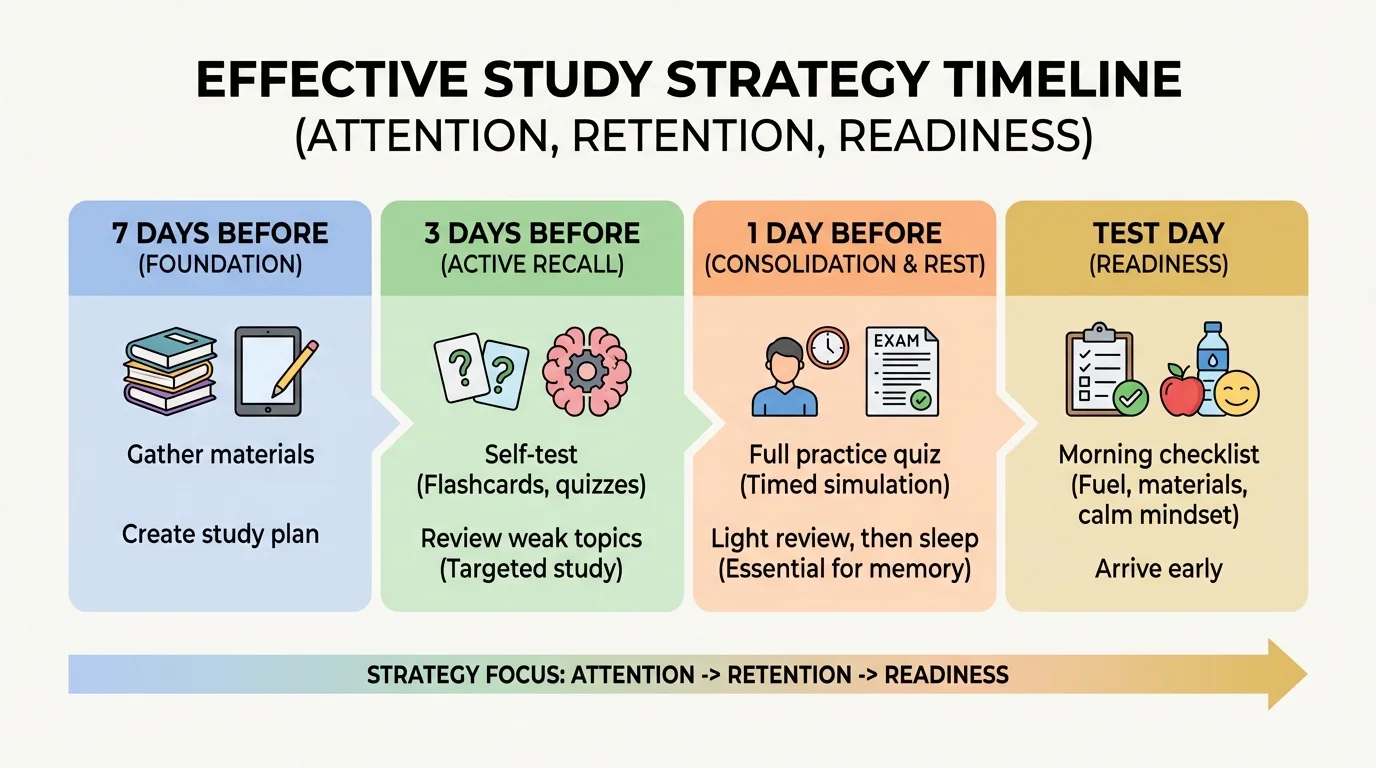
Practice test work is one of the best ways to build exam readiness because it asks you to do what the exam will ask you to do: recall, choose, solve, and explain. Real readiness grows over time, not in one late-night rush, and [Figure 3] shows how a short countdown plan can spread the work into manageable steps.
A strong exam plan often starts about a week before the test, if possible. First, gather what you need: class notes, assignments, review guides, past quizzes, and any study resources from your online platform. Next, divide the material into smaller parts. Instead of saying, "Study history," break it into sections like causes, vocabulary, people, and key events.
Then decide what kind of review each part needs. Some topics need memory practice, like terms and definitions. Others need skill practice, like solving problems or writing short explanations. Your strategy should match the challenge. If the exam asks for written responses, only reviewing flashcards is not enough. You need to practice writing answers too.
One powerful tool is an error log. This is a simple list of mistakes you made on practice questions, plus the reason for each mistake. For example: "Mixed up two vocabulary terms," "forgot to show steps," or "read the question too fast." Reviewing your errors helps you fix patterns instead of repeating them.
Sleep also matters. Cramming very late may feel responsible, but when sleep drops, memory, attention, and decision-making drop too. If you study until you are exhausted, you may lose some of the benefit of that extra time. A shorter review plus solid sleep is often more effective than an all-night cram session.
Example: A realistic exam-prep sequence
You have a social studies test on Friday and four main topics to review.
Step 1: On Monday, list the four topics.
Mark each one as strong, okay, or weak.
Step 2: On Tuesday, use active recall for two weak topics.
Cover notes and answer review questions from memory.
Step 3: On Wednesday, do a mixed review.
Interleave all four topics so you practice switching between them.
Step 4: On Thursday, do a short practice test.
Check errors, update your error log, and review only the weak spots.
Step 5: On Friday morning, do a light refresh.
Look over key terms and examples briefly, then go into the test well rested.
This kind of plan reduces panic because you already know where your weak spots are. It also makes your studying more efficient. Instead of reviewing everything equally, you spend more time where you need it most.
Not every subject or assignment needs the exact same method. Good studying is flexible. You evaluate what the task demands, then choose a strategy that fits.
For reading-heavy topics, try reading in short chunks and pausing to summarize from memory. For vocabulary-heavy topics, flashcards and quick self-quizzes work well, especially with spaced practice. For skill-based subjects, practice problems, explaining steps, and correcting errors matter more than just reviewing notes.
If an assignment involves writing, prepare by practicing short written answers, not just thinking about what you would say. If a quiz may include mixed question types, interleaving is especially useful because it trains you to shift between ideas, much like a real assessment.
Strong study habits are part of executive functioning. That means planning ahead, managing distractions, tracking progress, and adjusting when something is not working. Studying is not just about content; it is also about how you manage yourself.
The home environment in online school makes this extra important. No one is standing beside you reminding you to restart after you drift off. Building systems for yourself is a real-life skill that will help with school, jobs, hobbies, and any goal that requires follow-through.
A lot of study problems come from habits that seem harmless but quietly lower attention and retention. Here are some common ones and better replacements.
These replacements work because they turn studying from passive exposure into active performance. You are no longer just seeing information. You are using it.
"Don't judge your studying by how full your page looks. Judge it by what your brain can do without the page."
That idea is especially important when you feel tempted to choose the easiest-looking method. The best strategy is not always the most comfortable one in the moment. It is the one that helps future-you perform well later.
You do not need a perfect color-coded system or expensive tools. You need a repeatable routine. Start small and keep it realistic.
Here is one simple system you can adapt: before a study session, write one goal. During the session, use one active strategy. After the session, do one quick check. For example: "Goal: learn the causes of a historical event. Strategy: cover notes and explain the causes from memory. Check: write three facts without looking."
At the end of the week, review what worked. Did your focus improve in a cleaner workspace like the one in [Figure 1]? Did spaced review and self-testing help you remember more, like the pattern in [Figure 2]? Did your exam plan match the timeline habits shown in [Figure 3]? Those questions help you become your own coach.
Over time, evaluating study strategies helps you build independence. You stop copying random tips from other people and start using methods that actually work for your attention, memory, and test performance. That is the real goal: not studying more, but studying smarter.
Try this: for your next study session, choose just one change. Remove one distraction, use one active recall strategy, and do one short self-test at the end. Small changes are easier to repeat, and repeated smart choices create strong habits.
