Some adults end up in careers they never expected when they were thirteen. That is not a failure. It is actually normal. Early career planning is not about locking yourself into one job forever. It is about learning how to make smart choices now so that later, you have more options, more confidence, and fewer regrets.
If you do this well, you begin to notice patterns: what you enjoy, what you are good at, what kind of life you want, and what opportunities are already around you. If you ignore it completely, you may drift into decisions based only on what friends say, what looks cool online, or what seems easiest in the moment. Career planning helps you take control of your future a little at a time.
At your age, you are not expected to have your whole future figured out. What matters is starting early enough to explore. A student who starts thinking about careers in grade 8 has time to test interests, build useful habits, and notice opportunities before big decisions arrive.
For example, if you think you might enjoy working with animals, technology, design, healthcare, construction, business, or teaching, you can begin learning about those areas now. You can watch job interviews online, ask adults questions on video calls, volunteer in safe community settings, or try beginner projects at home. These small actions help you learn what feels exciting, boring, difficult, or meaningful.
Starting early also lowers pressure. You do not need a perfect answer. You just need a direction to explore. A direction is easier to change than a rushed decision made years later.
Career planning means thinking ahead about the kind of work you may want to do, the skills you will need, and the steps you can take now to prepare. Goals are specific things you want to achieve. Opportunities are chances to learn, practice, or connect with people and experiences that help you move forward.
One useful way to think about career planning is this: you are building a map, not writing a contract. Maps can be updated. Roads can change. You can change too.
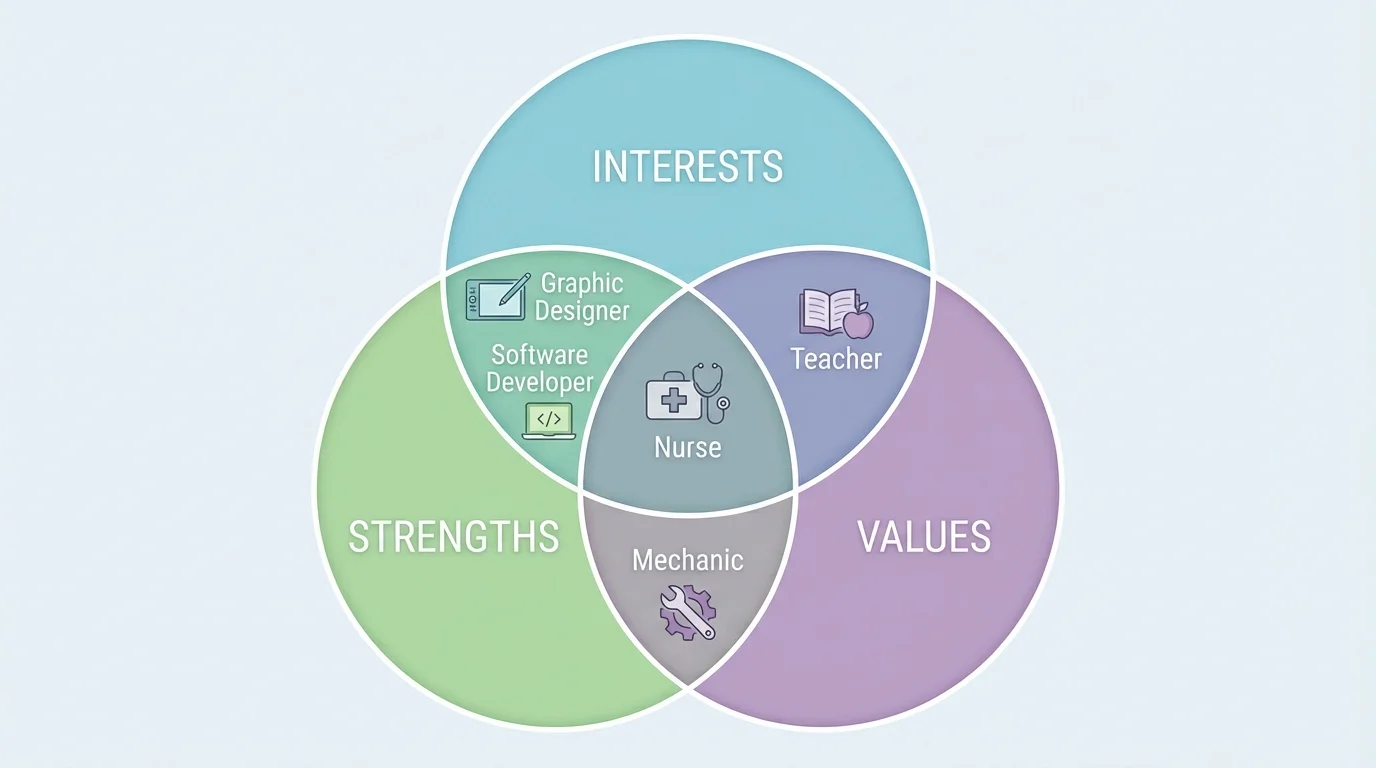
A strong career idea usually sits where your interests, abilities, and priorities meet, as shown in [Figure 1]. If you only choose something because it pays well, you might get bored or unhappy. If you only choose something because it seems fun, you might ignore whether it fits your skills or future needs.
Your interests are the topics and activities that naturally grab your attention. Maybe you like editing videos, solving problems, helping younger kids, baking, coding, drawing, fixing things, organizing events, or learning how the body works. Interests matter because they can keep you motivated when work becomes challenging.
Your strengths are the things you do well right now or learn quickly. Maybe you explain ideas clearly, stay calm in stressful situations, notice details, work well independently, or keep trying when others give up. Strengths matter because careers often feel easier and more rewarding when you use skills that come naturally or that you enjoy improving.
Your values are the things that matter most to you in life and work. Some people value helping others. Some want creativity. Some want stability, adventure, teamwork, independence, or a good balance between work and personal life. Values matter because a career that clashes with your values may not feel right, even if you are good at it.
Here is a simple check-in you can do. Ask yourself: What do I like doing? What am I good at? What matters to me? The answers do not need to be perfect. You are looking for clues.
For example, suppose a student likes technology and art, is strong at problem-solving and detail work, and values creativity. That student might explore graphic design, game design, web design, animation, or digital marketing. Another student may enjoy helping people, be strong at listening, and value service. That student might explore healthcare, counseling, teaching, social work, or community leadership later on.
Many adults discover their best-fit career by noticing patterns in what they already liked doing as teenagers. Early clues often show up in hobbies, side projects, volunteer work, and the problems you enjoy solving.
You do not need a test to tell you who you are, but simple career interest surveys can help organize your thoughts. Use them as tools, not as final answers. If a survey suggests a career you dislike, that is still useful information because it helps you rule something out.
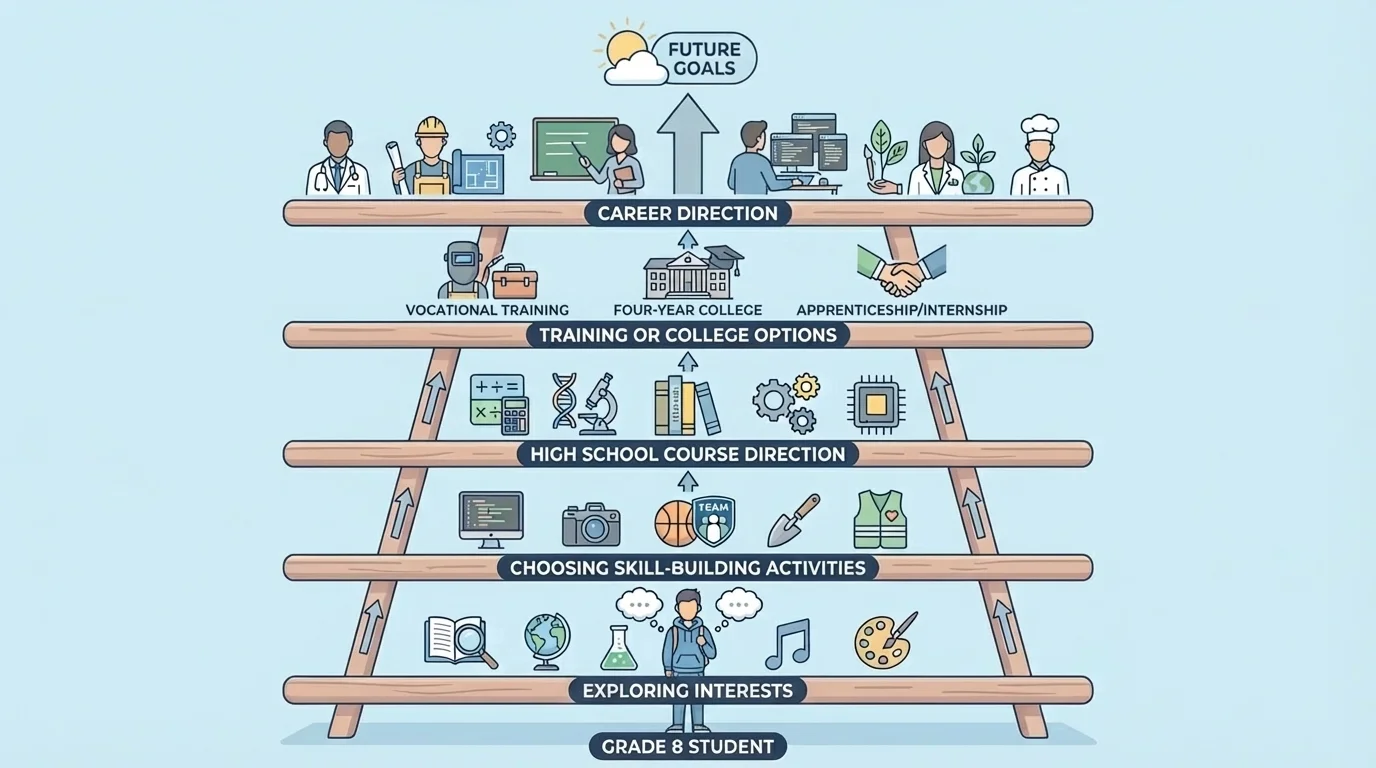
Career planning works best when you break a big future idea into smaller steps, as [Figure 2] shows. Saying "I want a great job someday" is too vague. A goal should tell you what action to take next.
A short-term goal is something you can work on soon, such as this week, this month, or this school year. A long-term goal takes more time, often years. Early career planning uses both kinds together.
For example, if you are curious about healthcare, a long-term goal might be to explore jobs in medicine and decide which health careers interest you most before high school ends. A short-term goal could be to watch two career videos about healthcare jobs this month and write down what sounds interesting about each one.
Good goals are clear enough that you can tell whether you actually did them. Compare these two examples:
| Weak goal | Better goal |
|---|---|
| I want to learn about business. | I will interview one small business owner by video call or message this month and list three things I learned. |
| I need to get better at technology. | I will complete one beginner spreadsheet or coding tutorial by the end of this month. |
| I might want to help people. | I will volunteer for one community event this season to see whether I enjoy service work. |
Table 1. Examples comparing vague career goals with clearer, action-based goals.
Use this simple method to build goals:
Step 1: Choose one career area to explore, not ten at once.
Step 2: Decide what you want to learn about it. Do you want to know what the job is like, what skills it needs, or how people get started?
Step 3: Pick one action you can complete soon.
Step 4: Set a time limit.
Step 5: After you finish, reflect. Did this career area become more interesting, less interesting, or still uncertain?
Example: turning a career idea into goals
Jordan thinks video production sounds interesting but is not sure whether it is just a hobby or something bigger.
Step 1: Name the career area
Jordan chooses media production.
Step 2: Set a short-term goal
Jordan decides to edit one short video this month using free software and learn three new editing tools.
Step 3: Add a second short-term goal
Jordan plans to watch two interviews with video editors and compare what they say about daily work.
Step 4: Create a longer goal
By the end of the year, Jordan wants to build a small portfolio with three finished projects.
Now Jordan has a path instead of just a vague idea.
When you use smaller goals, your future feels less overwhelming. You also get feedback faster, which helps you adjust your plan instead of guessing for years.
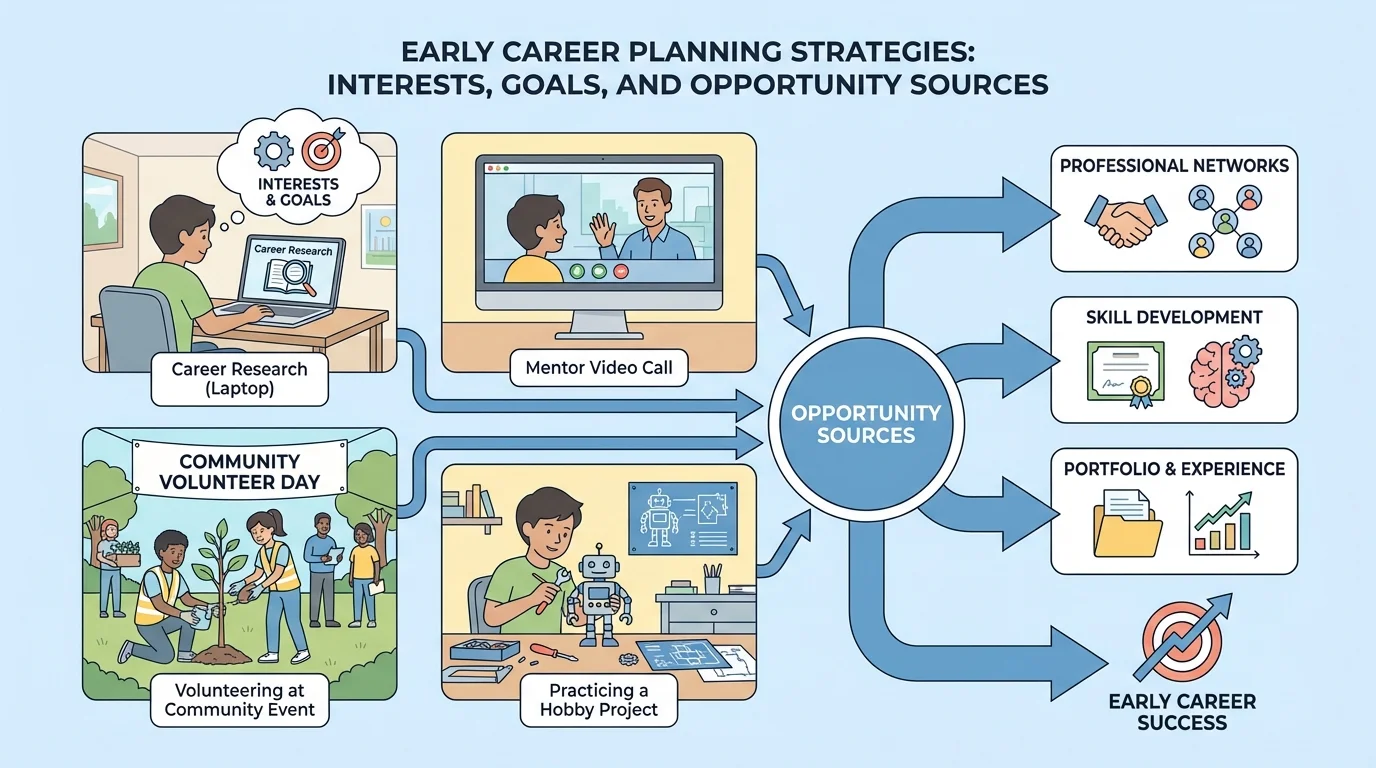
Opportunities are not just job openings for adults. At your age, an opportunity is any safe, realistic chance to learn, practice, or connect. They can come from many places, as [Figure 3] illustrates: your home life, community groups, online programs, hobbies, family friends, volunteer events, competitions, clubs outside school, and local organizations.
One big mistake students make is waiting for an opportunity to appear perfectly. In real life, many opportunities are small and easy to miss. A neighbor who repairs cars, an aunt who works in healthcare, a local library workshop, a community sports team, a coding website, a pet shelter, or a small online business project can all teach you something useful.
You can explore opportunities in practical ways:
Online research: Look up real job descriptions, day-in-the-life videos, and beginner skill tutorials.
Informational conversations: Ask an adult what their job is really like. You are not asking for a job. You are asking to learn.
Volunteer work: Helping at community events builds responsibility and shows you what environments you enjoy.
Hobbies and projects: A hobby can become experience. Baking, editing videos, coding, pet care, repairing bikes, or making crafts can all develop job-related skills.
Community programs: Libraries, recreation centers, youth groups, nonprofits, and local businesses may offer workshops or beginner experiences.
When you find an opportunity, ask three questions: What can I learn here? What skill can I practice? Who can I meet or observe? Even if the experience is not your dream career, it may still teach something valuable.
For instance, helping at a community event may not reveal your forever career, but it can strengthen communication, punctuality, teamwork, and confidence. Those skills matter in almost every job. This is one reason the range of opportunities shown in [Figure 3] matters: one experience can lead to several benefits at once.
Opportunity thinking means training yourself to notice chances to grow instead of waiting for a perfect path. A student who practices opportunity thinking asks, "How can I use this?" A student who does not may overlook useful experiences because they do not look impressive at first.
Be careful online. If you reach out to adults for career information, do it safely and with parent or guardian awareness when needed. Use trusted platforms, avoid sharing private information, and focus on learning, not trying to impress strangers.
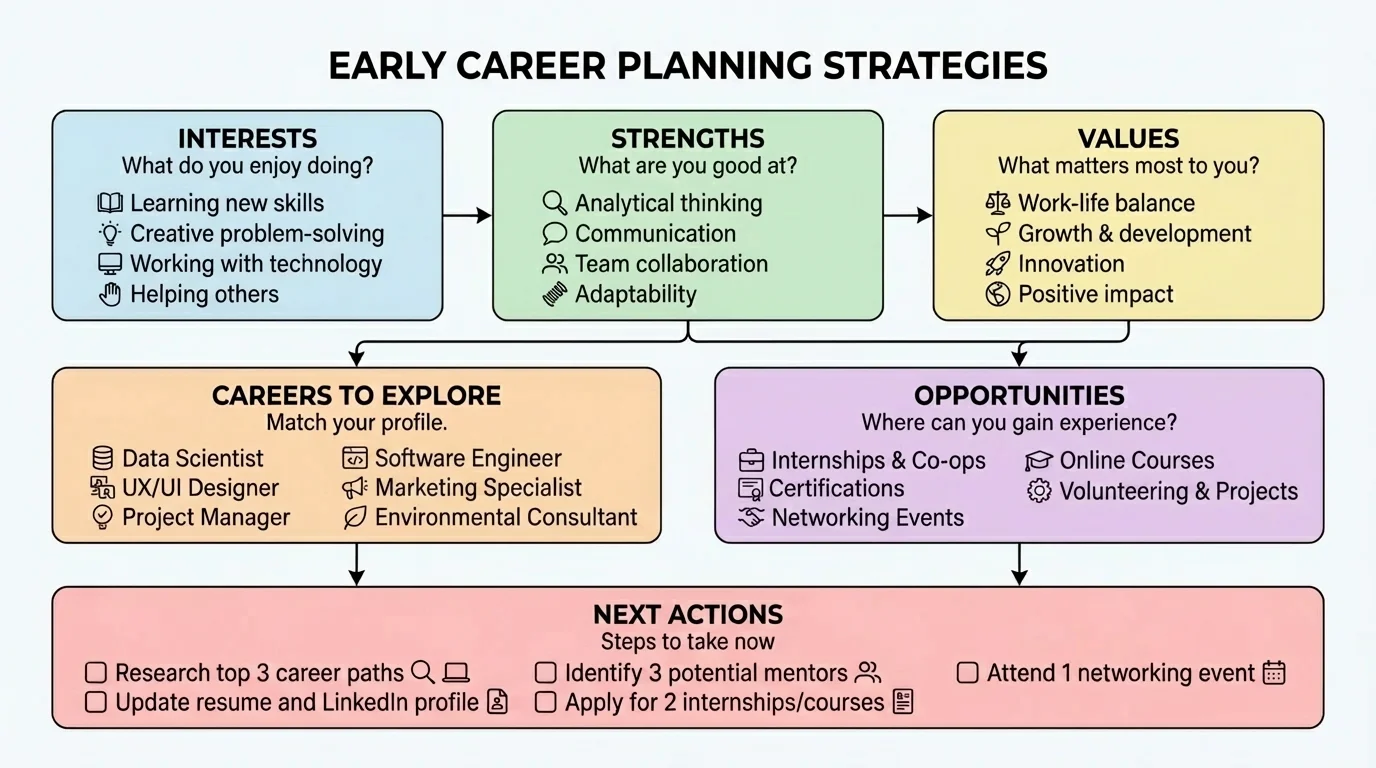
A career plan does not have to be complicated. In fact, a simple plan is usually better because you are more likely to use it, as [Figure 4] shows. One page is enough to get started.
Your plan can have five parts: interests, strengths, values, careers to explore, and next actions. That is it. You can type it in a document, keep it in a notes app, or write it neatly in a journal.
Here is a practical format you can copy:
Part 1: Interests — List activities, subjects, or problems you enjoy.
Part 2: Strengths — List skills, habits, or personal qualities you already show.
Part 3: Values — Write what matters most to you in work and life.
Part 4: Careers to explore — Choose two or three career areas, not too many.
Part 5: Next actions — Write the next few things you will do, such as research, a conversation, a project, or volunteering.
Sample early career plan
Leah enjoys organizing events, creating social media graphics, and helping people stay informed. She is strong at planning and communication. She values creativity and teamwork.
Step 1: Interests
Leah writes: design, communication, planning, helping groups stay organized.
Step 2: Strengths
Leah writes: meets deadlines, explains ideas clearly, notices what needs to be done.
Step 3: Career areas to explore
Leah chooses marketing, event planning, and public relations.
Step 4: Next actions
She plans to design a flyer for a community event, research one marketing job, and ask an adult how event planners manage deadlines.
Leah does not need a final answer yet. She needs a useful direction.
A plan only works if you actually revisit it. Set a reminder every few months to update it. Add new interests. Remove careers that no longer fit. Notice what experiences changed your thinking.
As the worksheet in [Figure 4] makes clear, career planning is really a cycle: learn about yourself, explore options, try something small, reflect, and update your plan.
Some skills are useful in almost every field. These are often called transferable skills because they transfer from one situation to another. Even if your career direction changes, these skills still matter.
Communication: Can you explain your ideas clearly in writing, messages, video calls, or presentations?
Time management: Can you plan your tasks and finish by the deadline?
Reliability: Do you follow through when you say you will do something?
Problem-solving: Can you stay calm and think through what to do next?
Digital responsibility: Do you use technology wisely and create a positive online presence?
Teamwork: Can you cooperate respectfully, even when people think differently?
These skills grow through ordinary life. Babysitting a younger sibling responsibly can build patience and planning. Helping with a family schedule can build organization. Running a small craft sale can build customer communication. Managing your own homework calendar can build discipline. The same habits that help you now can later help you in a job.
Think about goals you have reached before, even outside career planning. You probably succeeded because you used habits like persistence, organization, or asking for help. Those same habits are part of career readiness.
Your online presence matters too. If you post carelessly, speak disrespectfully, or act irresponsibly online, that can affect future opportunities. A good digital reputation does not mean acting fake. It means using judgment. Before posting, ask whether the content shows respect, maturity, and good decision-making.
One common mistake is believing that if you do not know your career now, you are behind. You are not. Grade 8 is a time for exploring, not finalizing.
Another mistake is copying someone else's plan without thinking. A friend may want to become a nurse, engineer, mechanic, entrepreneur, or influencer. That does not mean the same path fits you. Use other people for ideas, not for automatic decisions.
A third mistake is assuming opportunities have to be huge to count. They do not. The student who interviews one adult, tries one project, or volunteers once is learning more than the student who only says, "I'll figure it out later."
A fourth mistake is giving up too quickly. Sometimes you dislike a career because you truly are not interested. Other times you dislike it because the first try felt awkward or difficult. Reflection helps you tell the difference. Ask: Did I dislike the career itself, or did I just dislike being new at it?
"You do not have to see the whole staircase, just take the first step."
— Martin Luther King Jr.
That quote fits career planning well. You do not need every answer. You need the next sensible step.
As you grow, your interests may change. That is normal. A student who loves gaming at thirteen may later become interested in software design, digital art, storytelling, psychology, or business. Another student may start with a love of animals and later discover an interest in biology, veterinary care, wildlife photography, or environmental science.
Flexibility is not the same as aimlessness. Being flexible means paying attention and adjusting based on real experience. The overlap model from [Figure 1] still helps here: when your interests, strengths, or values shift, your best-fit career ideas may shift too.
You can update your plan by asking yourself these questions every few months:
If you keep asking questions, taking small actions, and reflecting honestly, you will build something powerful: self-knowledge. Self-knowledge makes career decisions smarter because they are based on real evidence from your life, not random guesses.
That is the real goal of early career planning. It is not to predict your exact future. It is to help you become the kind of person who can explore wisely, choose carefully, and adapt when life changes.
Try This: Make a short list of three interests, three strengths, and three values. Then choose two career areas that connect to at least one item from each list.
Try This: Set one short-term career exploration goal you can finish within the next two weeks, such as researching a job, practicing a skill, or talking with a trusted adult.
Try This: Look around your community and online world for one real opportunity you can use safely, even if it seems small. Small experiences often lead to bigger ones.
