Some of the biggest decisions that shape your life do not feel big at all. Going to bed later than you planned, skipping water, staying glued to a screen when you are already stressed, or ignoring a problem because you feel overwhelmed can seem small in the moment. But those choices add up. They affect how clearly you think, how safely you act, how fast you recover from hard days, and how healthy you feel over time.
Many people hear the words self-care and think of fancy products, relaxing music, or a "treat yourself" day. Real self-care is much more practical. It is the everyday choices that help your body and mind work well. Good self-care helps you stay steady when life is annoying, disappointing, stressful, or unpredictable. Poor self-care can make small problems feel huge.
Think about two versions of the same day. In one version, you slept enough, ate breakfast, drank water, took a short break from screens, and told someone when you felt stressed. In the other version, you stayed up late, skipped meals, ignored your feelings, and kept scrolling even though it made you feel worse. The same homework, same family situation, or same online drama will usually feel very different depending on which version of you is dealing with it.
Self-care means the habits and choices you use to take care of your physical, mental, emotional, and social well-being.
Resilience is the ability to recover, adapt, and keep going after stress, mistakes, setbacks, or challenges.
Safety means protecting yourself from harm, including physical danger, emotional harm, and unsafe online situations.
Long-term wellness means your overall health and well-being over months and years, not just how you feel today.
These ideas are connected. When you take care of yourself, you are often more patient, more alert, and more likely to make smart decisions. That strengthens resilience, improves safety, and supports wellness far into the future.
Self-care is not about being perfect. It is about noticing what helps you function well and what pulls you off track. Some self-care choices support your body, like sleep, food, movement, and hygiene. Some support your emotions, like journaling, taking breaks, or talking to a trusted adult. Some support your relationships, like setting boundaries or stepping away from toxic group chats.
A useful way to think about self-care is this: Does this choice help me feel stronger, safer, steadier, or healthier later? If the answer is yes, it is probably helping. If the choice gives quick relief but creates bigger problems later, it may not be true self-care.
Short-term comfort vs. long-term support
Not every habit that feels good in the moment is good for you. For example, avoiding sleep to keep gaming or scrolling might feel fun right now, but it can lead to exhaustion, irritability, and bad decisions tomorrow. Real self-care sometimes feels easy and pleasant, but sometimes it means doing the responsible thing before you feel like doing it.
You do not need a perfect routine. You need habits that are regular enough to support you when life gets harder.
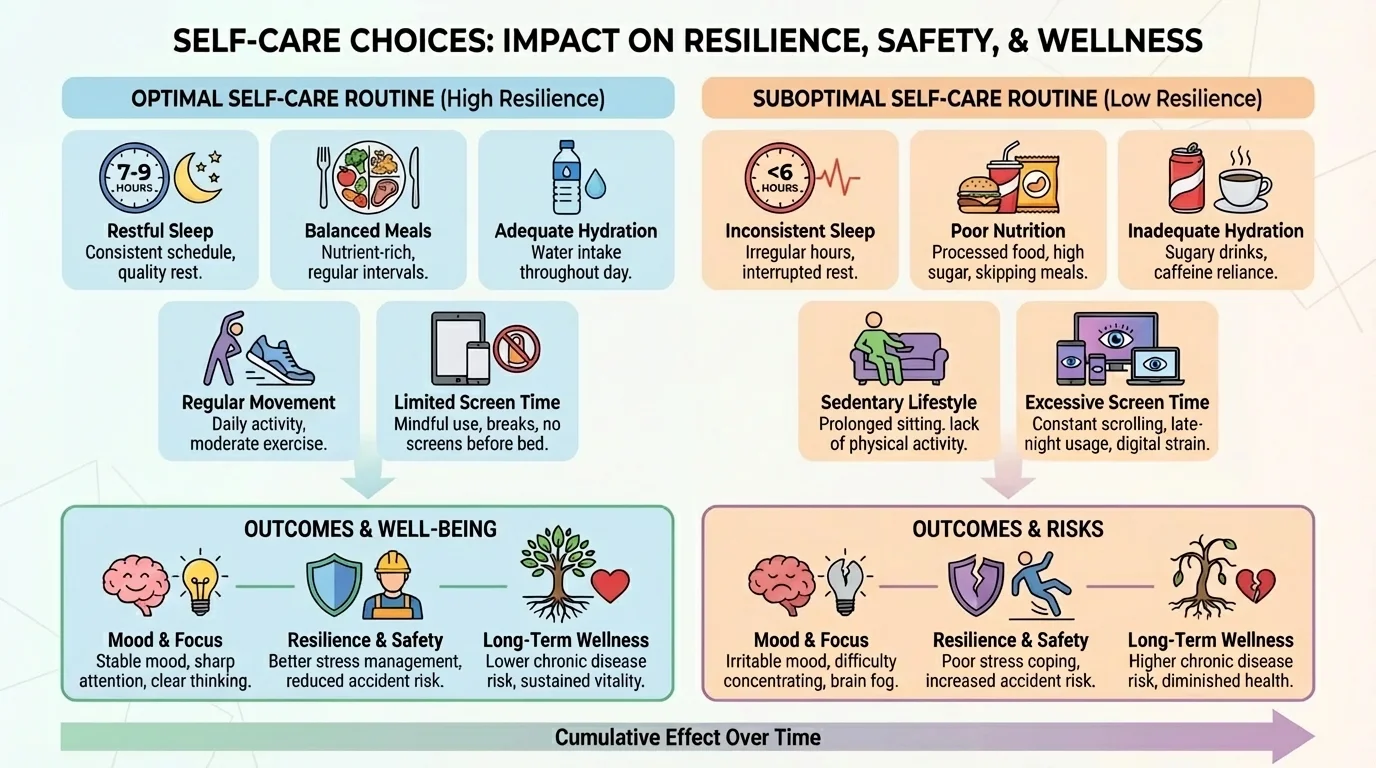
Your body and mind work like a system. Habits affect each other, as [Figure 1] shows in a day-by-day comparison of supportive and draining routines. If you are tired, you may be more likely to skip movement. If you skip movement, your stress may build. If your stress builds, you might snap at someone or make a risky choice online. One habit can start a chain reaction.
The opposite is also true. Sleeping enough can improve focus. Drinking water can help you feel less foggy. Eating regular meals can help your mood stay steadier. Taking a short walk or stretching can lower stress. Washing up, brushing your teeth, and keeping your space reasonably clean can make daily life feel more manageable.
Here are some of the most important daily self-care choices:
| Habit | When it helps | When it hurts |
|---|---|---|
| Sleep | You can focus, regulate emotions, and react calmly. | You feel irritable, distracted, and less able to handle stress. |
| Nutrition | Regular meals give energy and help steady your mood. | Skipping meals can lead to low energy and stronger emotional reactions. |
| Hydration | Water helps thinking, energy, and physical comfort. | Dehydration can make you feel tired, foggy, or headachy. |
| Movement | Activity supports mood, sleep, and stress relief. | Too little movement can leave you tense and sluggish. |
| Screen habits | Healthy limits protect sleep, focus, and mood. | Endless scrolling can increase stress, comparison, and lost time. |
| Hygiene | Basic care protects health and helps confidence. | Ignoring hygiene can affect health, comfort, and self-respect. |
Table 1. Everyday self-care habits and how they can support or weaken well-being.
Notice that none of these habits needs to be extreme. You do not have to become a perfect athlete, eat perfectly, or never use a screen. Practical self-care is about balance and consistency. A ten-minute reset can matter. So can going to bed even thirty minutes earlier, drinking one more glass of water, or taking a break before replying to a stressful message.
As you saw earlier in [Figure 1], strong days are often built from ordinary decisions, not dramatic ones. That is good news, because ordinary decisions are the ones you can control most often.
Your brain and body do not separate "school stress," "online stress," and "physical stress" as neatly as people sometimes think. Lack of sleep, hunger, and emotional stress can all lower patience and make problem-solving harder.
That is why self-care is not extra. It is part of how you stay ready for life.
Resilience does not mean never feeling upset. It means you can recover, learn, and keep going. People who are resilient still have bad days. The difference is that they have tools and habits that help them bounce back.
Self-care supports resilience before, during, and after stress. Before stress, routines build strength. During stress, they help you slow down and think clearly. After stress, they help you recover instead of staying stuck.
Suppose you get left out of an online group chat, do badly on a quiz, or argue with someone at home. If you are already exhausted, hungry, and overwhelmed, you may react fast and regret it later. You might post something angry, isolate yourself, or tell yourself the situation is hopeless. But if you have some self-care habits in place, you are more likely to pause, breathe, eat something, talk it through, and decide what to do next.
Real-life case study: Handling a rough day better
A student has a stressful afternoon: a low grade, a rude message online, and a headache from too much screen time.
Step 1: Notice the warning signs
The student realizes, "I am upset, tense, and not thinking clearly."
Step 2: Meet basic needs first
They drink water, eat a snack, and step away from the screen for fifteen minutes.
Step 3: Use a calming strategy
They take slow breaths, stretch, or write down what happened instead of reacting immediately.
Step 4: Choose a smart next action
They message a trusted adult, ask for help with the grade, and avoid sending an angry reply.
The problem does not disappear instantly, but the student handles it with less damage and recovers faster.
That is resilience in action. The goal is not to avoid every problem. The goal is to respond in a way that protects your future self.
Self-care also affects personal safety. As [Figure 2] shows, when you are exhausted, emotionally overloaded, or desperate for approval, it is easier to ignore warning signs. A simple safety process helps when stress makes clear thinking harder. Taking care of yourself improves your ability to notice risk, trust your instincts, and ask for help.
Safety is not only about dangerous places. It also includes unsafe conversations, pressure from other people, harmful dares, sharing private information, and staying in online spaces that are damaging your mental health.
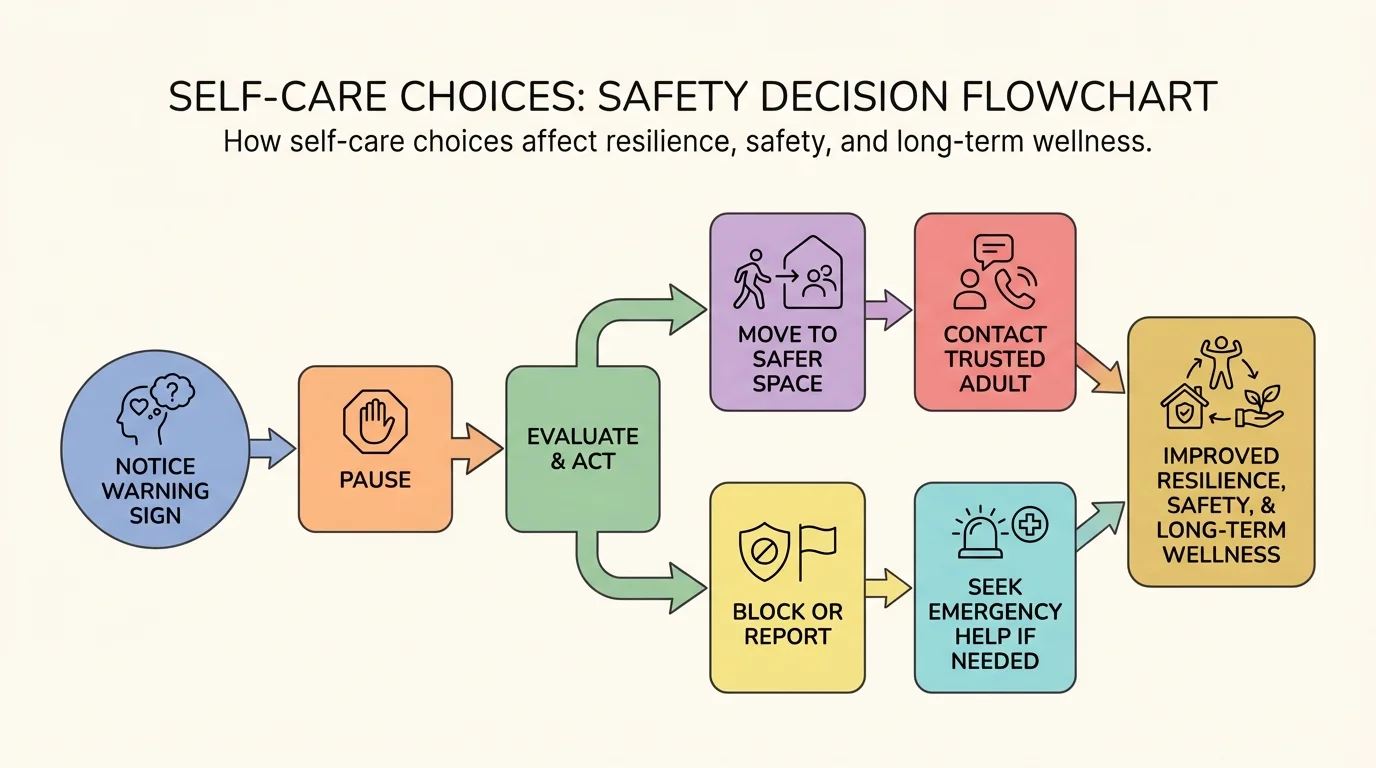
Warning signs can include feeling pressured to keep a secret, being asked for private photos or personal information, feeling scared to say no, noticing that someone keeps crossing boundaries, or feeling so upset that you want to act without thinking. In those moments, self-care means protecting yourself, not "handling it alone."
Here is a practical safety check you can use:
Pause. Do not answer immediately if something feels wrong.
Check your body. Are you shaky, panicked, angry, or confused? Strong emotions can be warning signs.
Create space. Put down the device, leave the chat, or move closer to a trusted adult or safe person.
Get support. Tell a parent, guardian, counselor, coach, or other trusted adult what is happening.
Protect your information. Do not share passwords, location, school details, or photos you cannot take back.
Use safety tools. Block, mute, report, save evidence, and ask for help if someone is threatening or harassing you.
Notice how many of these steps are really self-care choices. You are caring for your mind, your privacy, your body, and your future. Later, when you build routines, the clear sequence remains useful because safety gets harder when you are tired or emotionally flooded.
"Protecting your peace is not rude. It is responsible."
That includes boundaries. You are allowed to log off, say no, ask questions, or leave a conversation that feels wrong.
Long-term wellness is built through repetition. One healthy meal will not transform your life, and one bad night of sleep will not ruin it. What matters most is the pattern. A pattern of helpful habits usually supports energy, emotional balance, and health. A pattern of neglect can wear you down.
This is why self-care is sometimes described as an investment. You may not notice the full result right away, but over weeks and months, your choices shape your body and mind. Regular sleep can support growth, attention, and emotional regulation. Basic movement can help your heart, muscles, and stress level. Good hygiene can prevent illness. Talking about emotions instead of burying them can protect mental health.
Cumulative effect
The cumulative effect means small actions build up over time. A healthy choice repeated often can create strong benefits. An unhealthy choice repeated often can create problems. This is why "just this once" matters less than the pattern you repeat most days.
Think of it like charging a device. If you recharge it regularly, it works when you need it. If you ignore the battery over and over, it dies at the worst time. People are more complex than devices, of course, but the idea fits: maintenance matters.
Long-term wellness also includes mental and social health. If your self-talk is constantly harsh, if you never rest, or if your online spaces are full of drama and comparison, those patterns can wear down your confidence and peace over time. Healthy self-care includes choosing supportive environments when possible.
When you are not sure whether something counts as good self-care, ask yourself a few practical questions. This is where evaluate really matters. To evaluate a choice means to look at it carefully and judge its effects, not just its immediate appeal.
Use this quick decision guide:
Question 1: How do I feel right now?
Are you tired, angry, lonely, stressed, hungry, or overstimulated? Naming the state helps you choose the right support.
Question 2: What do I actually need?
Do you need rest, food, water, movement, quiet, support, or distance from a problem?
Question 3: What happens next if I choose this?
Will this action help tomorrow, or only distract me for ten minutes and create more stress later?
Question 4: Does this increase my safety or reduce it?
If a choice makes you more secretive, impulsive, isolated, or exposed, that is a warning sign.
Question 5: Would I recommend this choice to a friend?
This question helps you step back and think clearly.
Example: Evaluating a common choice
You are upset after reading mean comments online and want to stay up late watching videos to avoid thinking about it.
Step 1: Name the need
You may need comfort, support, and emotional distance from the comments.
Step 2: Predict the result
Staying up very late might distract you now, but tomorrow you may feel worse, more tired, and less able to cope.
Step 3: Find a better option
You could block the account, tell a trusted adult, put the phone away, and do a calming activity before sleep.
The better self-care choice is the one that protects both your present and your future.
Sometimes the best choice is not the easiest one. That does not make it a punishment. It makes it protective.
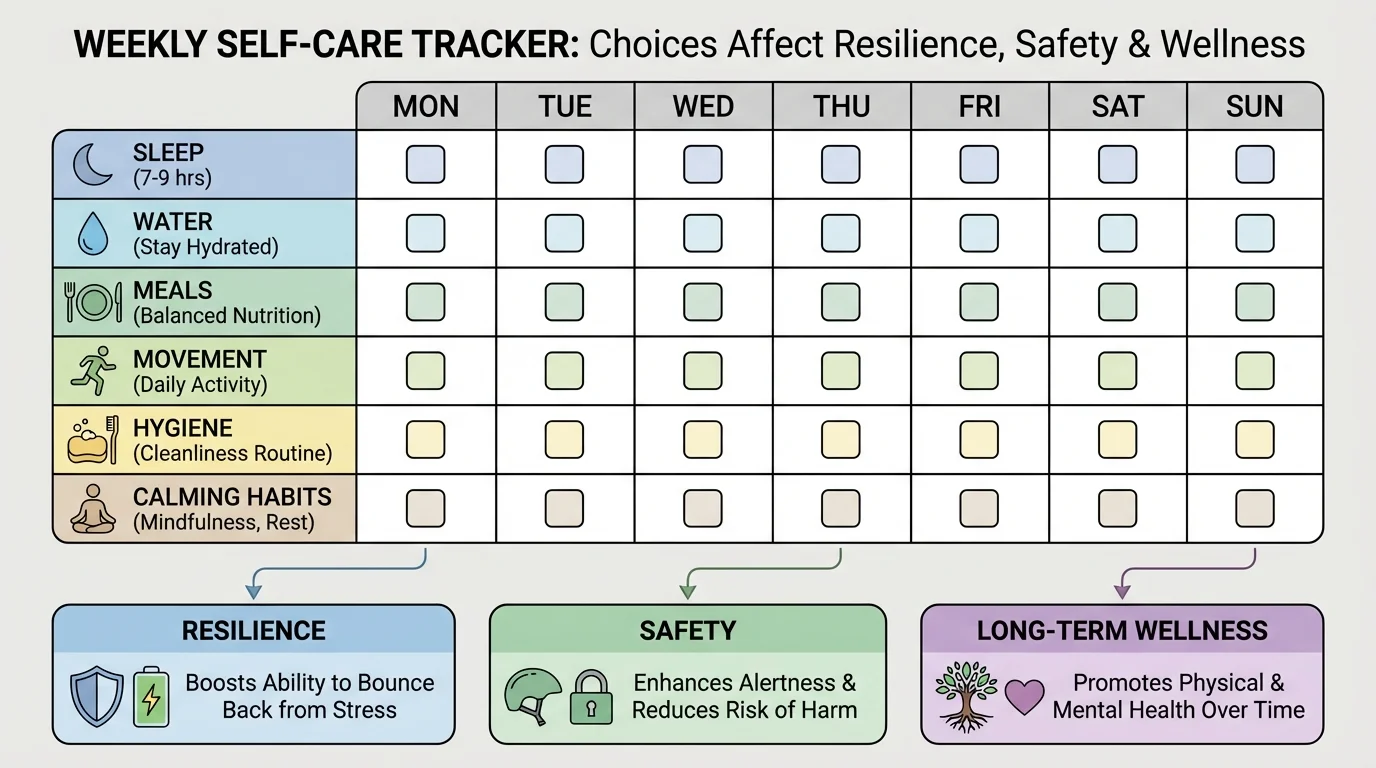
Good plans are simple enough to repeat. A visible routine can make healthy choices easier to remember, as [Figure 3] shows with a weekly tracker. Instead of trying to fix everything at once, focus on a few actions you can actually do most days.
A realistic plan includes basic care, stress tools, and support people. It also leaves room for imperfect days. You are not trying to create a robot schedule. You are building a safety net.
Try building your plan around these categories:
| Category | Simple action | Why it matters |
|---|---|---|
| Sleep | Set a bedtime routine | Helps energy, mood, and focus |
| Food and water | Eat regular meals and keep water nearby | Supports thinking and emotional balance |
| Movement | Walk, stretch, dance, or exercise for a short time | Releases stress and supports health |
| Hygiene | Brush teeth, shower, wash face, wear clean clothes | Protects health and self-respect |
| Calming habits | Breathe, journal, draw, pray, listen to music, or sit quietly | Helps you reset during stress |
| Support | Know who to contact when things feel too big | Prevents isolation and unsafe choices |
Table 2. A simple self-care plan organized by category, action, and purpose.
Try This: Pick one habit from the table that feels easiest to improve this week. Then pick one habit that would make the biggest difference if it got a little better. Start there.
Try This: Make a short "bad day list" for yourself. Include three calming actions, one trusted adult, and one reminder such as "Pause before reacting." That way, when stress hits, you do not have to invent a plan from scratch.
Try This: Use a checklist for a week. As shown earlier in [Figure 3], tracking simple habits can help you notice patterns. You might realize that your worst days follow a lack of sleep, too much screen time, or not eating enough.
One of the smartest things you can learn at your age is this: caring for yourself is not selfish. It is a skill. It helps you stay steady under pressure, make safer choices, and protect your future health. When you evaluate your habits honestly, you gain control over more of your life.
