Many emergencies do not start with something dramatic. They start with a person saying, "I feel weird," a small cut that will not stop bleeding, or someone who suddenly drops to the ground. In those first few minutes, what you do matters. You are not expected to be a doctor, but you are old enough to learn how to respond safely, get help fast, and use a few basic first-aid skills that can make a real difference.
First aid is the immediate care given to a person who is hurt or suddenly sick before professional medical help takes over. Good first aid can slow bleeding, reduce pain, protect breathing, and stop a situation from getting worse. Poor decisions, such as moving someone carelessly or waiting too long to get help, can make injuries more serious.
If your younger sibling cuts a hand while opening a package, quick pressure on the wound may stop heavy bleeding. If a friend on a neighborhood basketball court faints and hits their head, your job is not to "fix" everything. Your job is to notice the danger, get an adult, call for help if needed, and keep the person as safe as possible until trained help arrives.
Emergency means a situation where someone could be in serious danger and needs immediate help. Adult intervention means getting a trusted adult involved right away because the situation is too serious, too risky, or too complicated for you to handle alone. Emergency services are professional responders such as paramedics, firefighters, or police who are called when fast professional help is needed.
One important rule can guide almost everything in this lesson: if you are unsure whether it is serious, treat it like it might be serious and get help. It is better to call a trusted adult too early than too late.
Before you help anyone, check whether the scene is safe. This matters because the first job in an emergency is not to rush in blindly. It is to avoid becoming a second injured person, as [Figure 1] shows through common hazards such as electricity, fire, traffic, and sharp objects. If the area is dangerous, your safest action may be to stay back and call for help immediately.
Ask yourself simple questions. Is there fire or smoke? Is there broken glass? Is there a loose dog acting aggressively? Is the person near a road, deep water, or electrical wires? If the answer is yes, do not step into danger. Call an adult and emergency services if needed.
Also protect yourself from contact with blood or other body fluids when possible. If gloves are nearby, use them. If not, use a clean cloth, towel, or other barrier if you need to help with bleeding. Then wash your hands as soon as you can afterward.
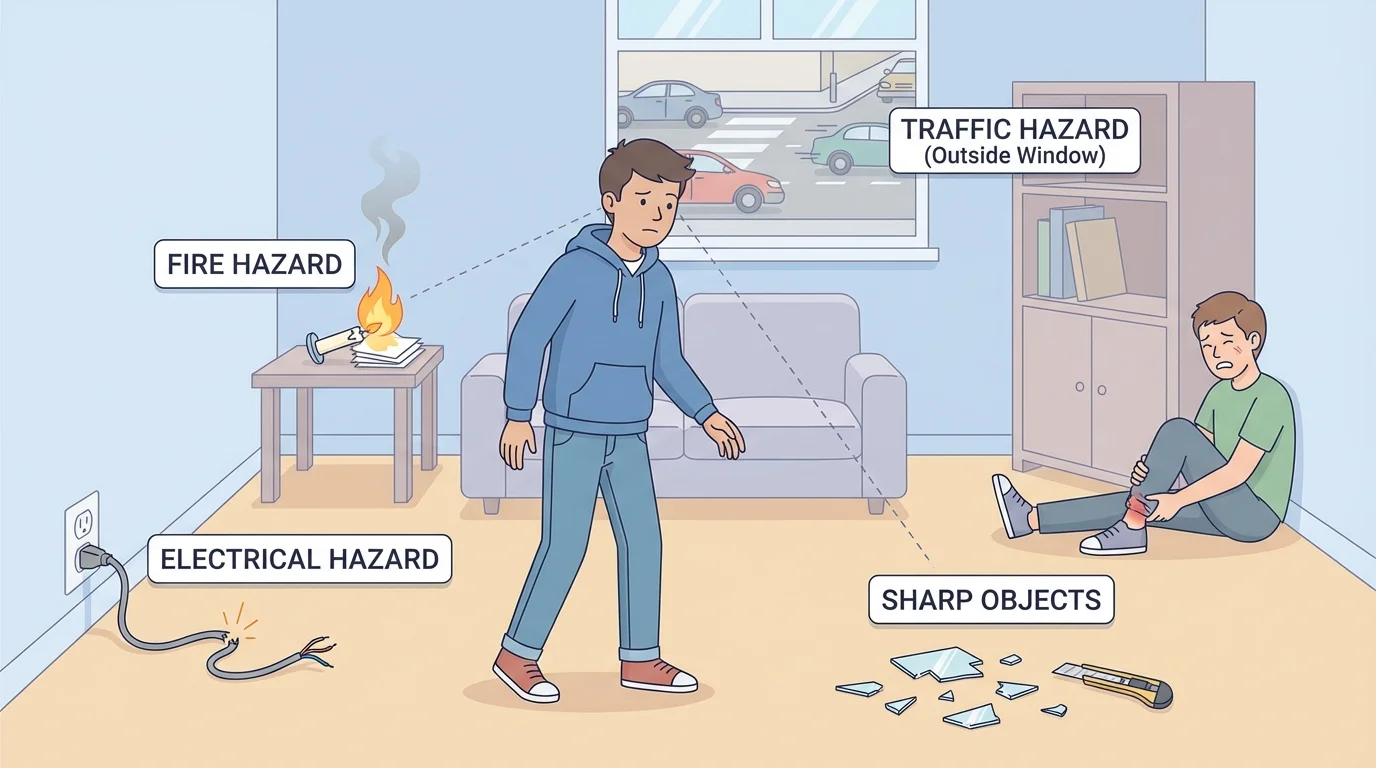
Sometimes the safest choice is to ask the person to stay still. For example, if someone fell from a bike and says their neck hurts, do not try to pull them up. Stay with them, keep them still, and get adult help right away.
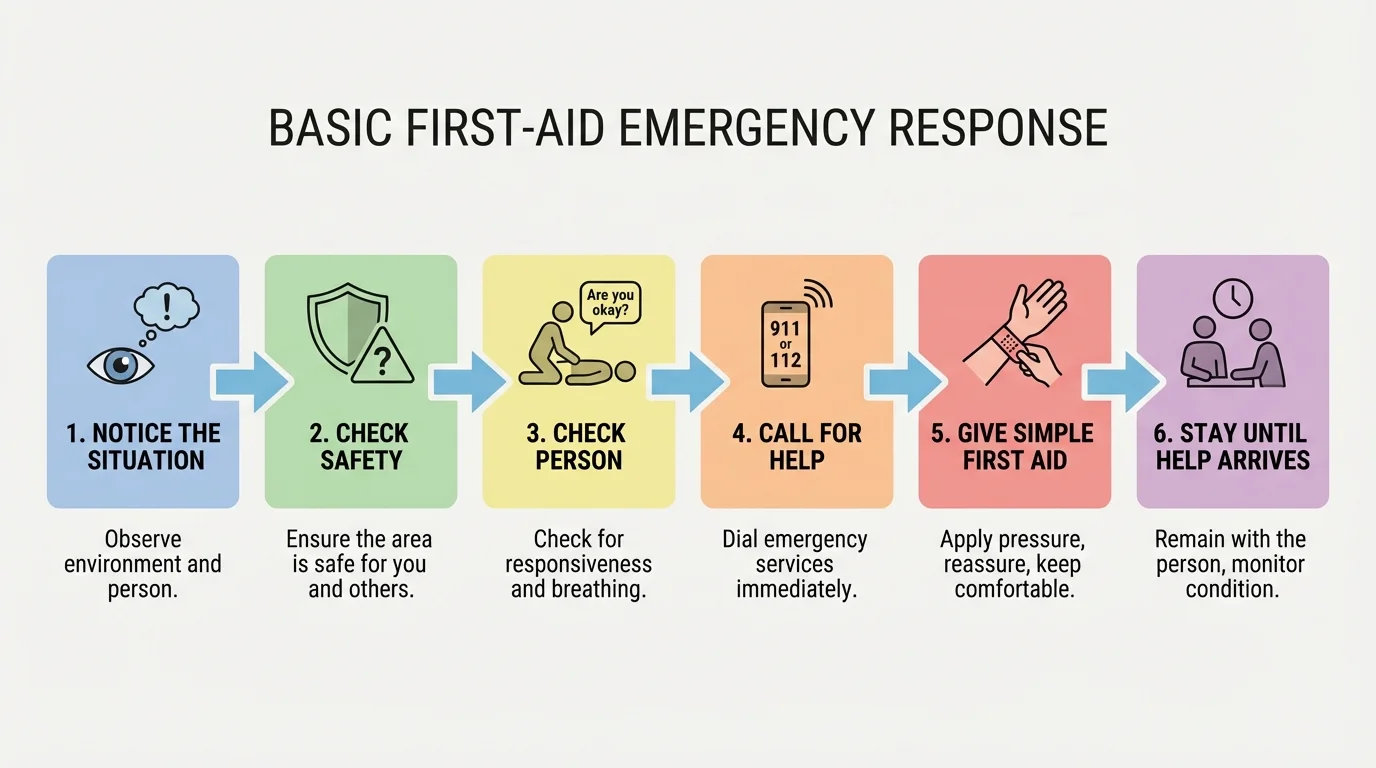
When stress hits, your brain can feel scrambled. That is why it helps to remember a simple emergency action plan. The basic order is: notice the problem, check safety, check the person, call for help, give simple first aid, and stay with them.
Step 1: Notice the problem. [Figure 2] Look for what is wrong. Are they bleeding? Struggling to breathe? Awake but confused? Not responding?
Step 2: Check safety. Make sure the area is safe for you and for the person.
Step 3: Check the person. Ask, "Are you okay?" If they respond, find out what hurts. If they do not respond, get help immediately.
Step 4: Call for help. Get a trusted adult. If the person is unresponsive, has trouble breathing, is having a seizure, has severe bleeding, or you think their life is in danger, call emergency services.
Step 5: Give simple care you know how to give. For example, apply pressure to bleeding or cool a minor burn with cool running water.
Step 6: Stay with the person. Keep them calm, watch for changes, and do not leave unless you must go get help.
Calm beats fast
In an emergency, moving quickly is important, but panicking is not. A calm person notices more details, gives clearer information, and makes fewer mistakes. Even taking one slow breath before you act can help you think more clearly.
If you are alone with the injured person and you have a phone, put the call on speaker if possible. That way you can keep talking to emergency services while staying with the person.
Many people know they should call for help but freeze because they do not know what to say. You do not need perfect words. You need clear facts.
When you call emergency services or a trusted adult, give this information in a simple order: who you are, where you are, what happened, how many people are hurt, and what condition the person is in. If you know the address, say it first. If you do not know the exact address, give landmarks, apartment numbers, trail names, or the name of the store, park, or building.
Example emergency call
You are home with your cousin, who suddenly faints and does not wake up right away.
Step 1: Start with location.
"I'm at 214 Oak Street, Apartment 3B."
Step 2: Explain the emergency.
"My cousin fainted and is not responding normally."
Step 3: Give important details.
"She is breathing, but she won't answer me. She hit the floor when she fell."
Step 4: Follow instructions.
Stay on the phone and answer questions. Do not hang up until told to do so.
Never prank call emergency services. A fake call can delay help for someone with a real emergency.
Some first-aid skills are safe and realistic for you to learn now. These do not replace medical care, but they can protect someone until an adult or professional takes over.
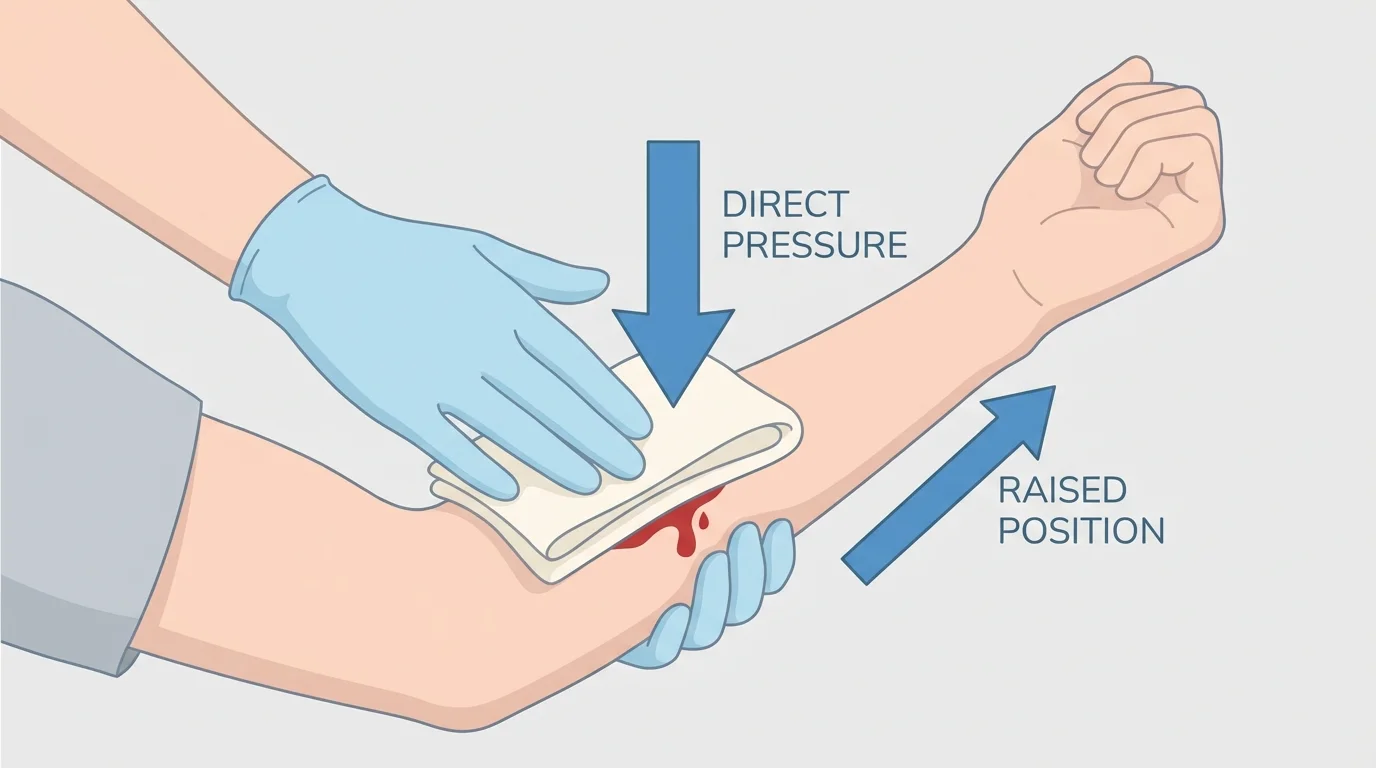
Bleeding: [Figure 3] If a person has a cut and it is bleeding, use a clean cloth or bandage and apply firm, direct pressure. Direct pressure is one of the most useful first-aid actions. It helps when the cloth is pressed right on the wound instead of wiped back and forth. If possible, keep the injured area still. If blood soaks through, add more cloth on top and keep pressing. Do not keep lifting the cloth to check every few seconds, because that can restart bleeding.
Call for adult help immediately if the bleeding is heavy, spurting, does not slow down, or comes from the head, neck, chest, or abdomen.
Minor burns: Cool the burn with cool running water for about 10 to 20 minutes. Do not use ice, butter, toothpaste, or greasy creams. Remove tight jewelry near the burn if it can be done easily before swelling starts. Tell an adult. Burns need urgent medical help if they are large, deep, blistering badly, on the face, hands, feet, or genitals, or caused by electricity or chemicals.
Nosebleeds: Have the person sit upright and lean slightly forward, not backward. Pinch the soft part of the nose for about 10 minutes without checking too early. Leaning forward helps keep blood from going down the throat. Get adult help if the nosebleed happens after a hard hit to the head or face, or if it does not stop.
Sprains and strains: If an ankle or wrist is hurt, help the person rest it. A cold pack wrapped in cloth can reduce swelling. Do not force the joint to move. If there is major swelling, severe pain, a strange angle, or the person cannot put weight on it, get adult help because it could be a fracture.
Fainting: If someone feels faint, help them lie down safely if possible. If they faint, check whether they are breathing and responding. If they are not breathing normally or they do not wake up quickly, call emergency services. Even if they wake up, they should still be checked by an adult, especially if they fell or hit their head.
Choking: If someone cannot speak, cough, or breathe, this is an emergency. Get an adult and call emergency services right away. If you have formal choking-response training, follow that training. If not, your main job is to get help fast and stay with the person. If they can cough or speak, encourage them to keep coughing while help is on the way.
Severe blood loss can become dangerous faster than many people expect. That is why firm direct pressure is such an important first step for serious bleeding.
Heat illness: If someone becomes dizzy, weak, very sweaty, or confused after being in the heat, move them to a cooler place, loosen extra clothing, and get water only if they are awake and able to drink safely. If they become confused, vomit, stop sweating, or pass out, call emergency services.
Some warning signs are too serious to "wait and see." These red-flag symptoms mean you should get an adult immediately and often call emergency services right away.
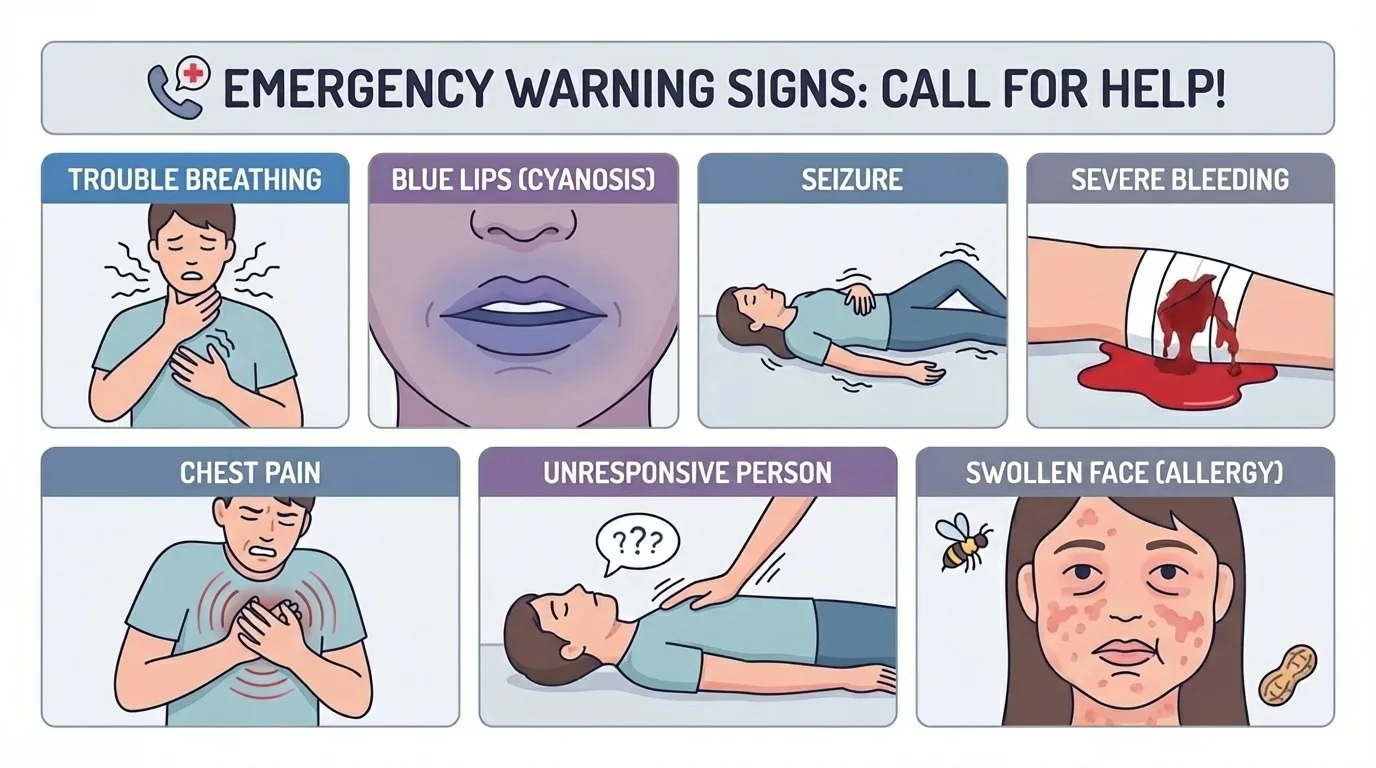
Trouble breathing: [Figure 4] If someone is gasping, wheezing severely, turning blue around the lips, or cannot speak in full sentences, this is urgent.
Unresponsiveness: If a person does not wake up, does not answer, or cannot stay awake, call for emergency help.
Severe bleeding: If blood is pouring out, spurting, or does not stop with pressure, do not delay.
Head injury: If someone hits their head and then vomits, faints, becomes confused, has a seizure, or complains of worsening headache, get emergency help. As we saw earlier with scene safety in [Figure 1], you should avoid moving the person unless there is immediate danger.
Seizure: A seizure is a sudden burst of unusual brain activity that can cause shaking, staring, falling, or loss of awareness. Move hard or sharp objects away, protect the head with something soft if possible, and call for help. Do not put anything in the person's mouth. Get emergency help if it is the person's first seizure, if it lasts several minutes, if they are injured, or if they do not wake up normally afterward.
Possible poisoning: If a person swallowed a dangerous substance, breathed in strong fumes, or took too much medicine, get an adult immediately. Call emergency services right away if the person is hard to wake, having trouble breathing, having a seizure, or acting very confused. Save the container or package if it is safe to do so, because responders may need to know what was taken.
Allergic reaction: A serious allergic reaction can involve swelling of the face or throat, hives, vomiting, dizziness, or trouble breathing after food, medicine, or an insect sting. This can become life-threatening very fast.
Chest pain: Chest pain is less common in kids than adults, but it should still be taken seriously, especially if it happens with trouble breathing, fainting, or after a hit to the chest.
| Situation | Get an adult | Call emergency services now |
|---|---|---|
| Small cut that stops bleeding | Yes | No, unless it gets worse |
| Heavy bleeding that will not stop | Yes | Yes |
| Minor burn on a finger | Yes | No, unless severe |
| Person not waking up | Yes | Yes |
| Possible broken bone | Yes | Sometimes, especially if severe or unsafe to move |
| Trouble breathing | Yes | Yes |
| Seizure | Yes | Often yes, especially first seizure or long seizure |
Table 1. Quick comparison of when to involve an adult and when to call emergency services immediately.
Some injuries may look simple at first but need professional care. Deep cuts, injuries from broken glass, animal bites, electrical shocks, suspected fractures, and any injury with visible bone are not "just clean it up and move on" problems.
You also should not handle emergencies alone if the person is much bigger than you and difficult to move safely, if the area is dangerous, or if there are multiple injured people. In that case, calling for help becomes the most important action.
"The best helper is the one who stays safe, gets help fast, and does the basics well."
If someone may have a concussion, watch for confusion, dizziness, memory trouble, vomiting, sensitivity to light, or unusual sleepiness. Sports, biking, skateboarding, and falls are common causes. The person should stop activity and be checked by an adult.
You handle emergencies better when you prepare before one ever happens. Know where your home first-aid kit is. If your family does not have one, help create a simple kit with bandages, gauze, adhesive tape, antiseptic wipes, gloves, a cold pack, scissors, and emergency numbers.
Keep emergency contacts saved in your phone if you have one. Memorizing at least one important phone number is smart in case your battery dies. Know your home address clearly. In a real emergency, being able to say the correct address quickly matters.
If someone in your family has asthma, diabetes, severe allergies, or seizures, learn what adults want you to do in an emergency. You do not need to know every medical detail, but you should know the basic plan, where rescue medicine is kept, and who to call.
Build a simple home readiness checklist
Step 1: Find the first-aid kit.
If there is no kit, choose one place where supplies will be stored.
Step 2: Learn the emergency address.
Practice saying it clearly without looking.
Step 3: Save contacts.
Add a parent, guardian, neighbor, and another trusted adult.
Step 4: Learn special medical needs.
Know whether anyone in your home has allergies, asthma, diabetes, or seizure history.
Preparation does not make life scary. It makes you more capable.
Here are some situations a 13-year-old might actually face.
Scenario 1: You are cooking noodles and your brother touches a hot pan handle. You move his hand away from the heat, run cool water over the burn, tell an adult immediately, and watch for blistering.
Scenario 2: At the park, a friend crashes a scooter and their knee is scraped, but they are talking normally and can stand. You clean up only if an adult says it is okay, apply gentle pressure if needed, and tell a trusted adult because the injury may need better cleaning.
Scenario 3: During a community soccer practice, another player takes a hit to the head and seems dazed. They say they are "fine," but they look confused. You get the coach or another adult right away and do not let them go back into play.
Scenario 4: A younger cousin drinks from an unknown bottle under a sink. You do not make them vomit. You get an adult immediately, keep the bottle, and call emergency help if the child seems sleepy, confused, or has trouble breathing.
Scenario 5: On a video call, your friend says their parent collapsed in the next room. You tell your friend to call emergency services immediately, unlock the door if instructed by an adult, and stay on the call only if it helps them follow directions.
Even with a plan, emergencies feel intense. Your hands may shake. Your heart may pound. That is normal. Calm is not the absence of fear. Calm is choosing your next useful action anyway.
Try this: plant your feet, inhale slowly through your nose, exhale slowly, and say the steps in your head: safe, check, call, care, stay. That short phrase can help you remember the order from [Figure 2] when your brain feels overloaded.
Speak in short sentences. Give one instruction at a time if others are around: "Get my phone." "Bring the first-aid kit." "Go get an adult now." Clear direction reduces chaos.
You do not need to be fearless. You need to be steady enough to do the next right thing.
If you ever feel torn between helping and getting help, choose the safer option. Fast communication is often the most powerful first-aid skill you have.
As the warning signs in [Figure 4] make clear, serious emergencies usually involve one big clue: breathing problems, severe bleeding, major confusion, unresponsiveness, or rapid worsening. When you notice those signs early, adult intervention happens sooner and outcomes are often better.
