A lot of risky choices do not start with someone wanting to get hurt. They start with a message, a rumor, a dare, a joke, or a thought like, What's the big deal? A quick decision can be made in less than a minute, especially when someone wants you to click, try, sip, inhale, or keep quiet. Learning how that pressure works gives you more control.
This topic matters because you may hear about alcohol, vaping, nicotine pouches, cannabis, pills, or other substances long before you are ready to deal with them. You might see them in videos, hear people joke about them online, or come across them at a community event, sports gathering, party, or friend's house. Knowing how influence works helps you protect your health, your judgment, and your future choices.
A substance in this lesson means a chemical that changes how your brain or body works. That includes alcohol, e-liquids used in vaping products, nicotine, cannabis, prescription medicines used the wrong way, and illegal drugs. Some are sold legally to adults. That does not make them safe for teens.
One reason this gets confusing is that products can look harmless. A vape may smell fruity. A drink may look like juice. A pill may come from a medicine bottle. But appearance does not tell you what a substance does inside the body.
Alcohol is a drug that slows down the brain and body. Nicotine is a highly addictive chemical often found in vaping products and tobacco products. Misinformation is false or misleading information that can cause people to make unsafe choices.
Another complication is that people often talk about substances in extreme ways. Some say, "One try ruins your life." Others say, "It's no big deal." Real life is more complicated. Different substances have different risks, but all of them can affect judgment, health, and safety, especially in a growing brain and body.
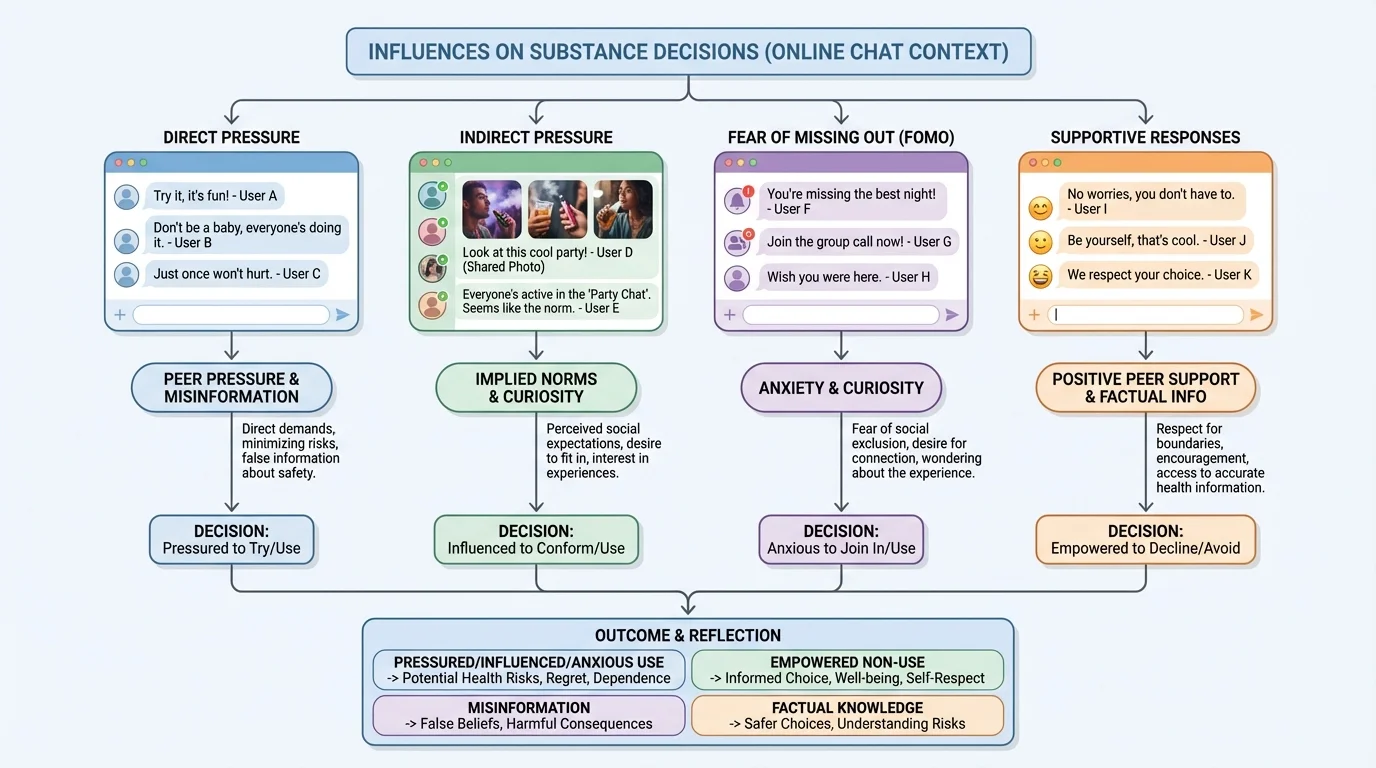
Peer pressure is not always someone saying, "Do it." Sometimes it is a lot quieter, as [Figure 1] shows in digital situations where pressure comes through group chats, social media posts, teasing, or the fear of being left out. Pressure can be direct, like a dare, or indirect, like seeing everyone act as if something risky is normal.
Here are common forms of pressure: being told you are boring if you say no, seeing edited videos that make substance use look funny or cool, being offered something "just once," being told "everyone does it," or being warned not to tell adults. Pressure can also come from wanting approval from older teens or wanting to fit in with a team, club, or neighborhood group.
Online pressure can feel extra powerful because messages can pile up quickly. If five people react with laughing comments or fire symbols, it may look like the whole world agrees. But a loud group is not the same as a smart group. People online often hide risks and only post what looks exciting.
A major sign that pressure is unhealthy is when someone does not respect your answer. Real friends may ask a question once. They do not keep pushing, guilt-tripping, threatening to leave you out, or recording you for content. Respect is a sign of friendship. Pressure is a sign that someone is putting their wants ahead of your safety.
Another clue is secrecy. If someone says, "Don't tell your parent," "Delete the messages," or "No one has to know," stop and take that seriously. Secrecy usually protects the risky behavior, not you.
Real-life case
You are on a weekend group chat. Someone posts that a few people are meeting at a cousin's house and says there will be alcohol and vapes. Another person replies, "If you come, don't act scared."
Step 1: Notice the pressure.
The message is trying to connect substance use with being brave or mature.
Step 2: Name the trick.
This is a false choice. Being safe is not the same as being scared.
Step 3: Respond clearly.
You might text, "I'm out. I'm not doing that," or "No thanks. I'm not risking it."
Step 4: Protect yourself.
Mute the chat, leave the chat, or contact a trusted adult if the situation seems dangerous.
Later, when you think back to [Figure 1], notice that the safest path usually begins with recognizing the pressure early. The earlier you spot it, the easier it is to step away before the moment gets bigger.
Curiosity is normal. Wanting to know what something feels like, why people do it, or whether the stories are true does not make you weak or bad. It makes you human. The important part is what you do with that feeling.
Curiosity becomes risky when it turns into testing something with your body just to get an answer. Some questions do not need a personal experiment. You do not need to inhale a chemical, drink something unsafe, or take a mystery pill to prove a point.
People often underestimate this because they think trying something once is a tiny event. But "once" can still lead to an accident, panic, getting sick, impaired judgment, addiction risk, conflict at home, legal trouble for adults involved, or being recorded in a moment you would never choose if you had time to think.
Curiosity needs a safer path. If you are curious, switch from "Should I try it?" to "How can I learn the truth safely?" That may mean asking a trusted adult, reading information from a health organization, talking to a doctor, or learning how marketing tricks people into confusing novelty with safety.
A practical rule is this: if a choice could affect your brain, breathing, heart, balance, memory, or decision-making, do not use your body as the test. Use questions, trusted sources, and support instead.
Try This: The next time you feel curious about a risky trend, write down three questions you have and ask a trusted adult or health professional instead of searching random posts. Curiosity is strongest when it gets a healthy answer.
[Figure 2] Misinformation spreads because it is often simple, emotional, and repeated through common claims and fact-check questions. A short post saying "vaping is just flavored water vapor" sounds easy to remember, but easy is not the same as true.
False or misleading claims about substances often sound like this: "It's natural, so it's safe." "It helps you relax, so it can't hurt you." "Prescription pills are safe because doctors use them." "Everyone does it." "You can quit any time." "This brand is clean." These statements leave out important facts.
Marketing can make misinformation worse. Companies, influencers, or sellers may focus on flavors, colors, sleek designs, or words like smooth, clean, or lite. Those words are meant to shape feelings. They are not proof of safety.
| Claim | What makes it unreliable | Better response |
|---|---|---|
| "It's only vapor." | It ignores the chemicals and possible nicotine in the aerosol. | Ask what is actually in the product and check a trusted health source. |
| "My friend did it and was fine." | One story is not proof that something is safe for everyone. | Look for evidence from doctors or public health experts. |
| "It's legal for adults, so it's okay." | Adult legality does not mean safe for teens. | Consider age, brain development, and health risk. |
| "It helps with stress." | It may hide short-term effects, dependence, or other harm. | Use healthy stress tools instead. |
Table 1. Examples of common substance-related claims, why they can mislead, and safer ways to respond.
A good fact-check habit is to ask five quick questions: Who made this claim? What do they gain if I believe it? Where is the evidence? Is it coming from a trusted health source? What important detail might be missing?
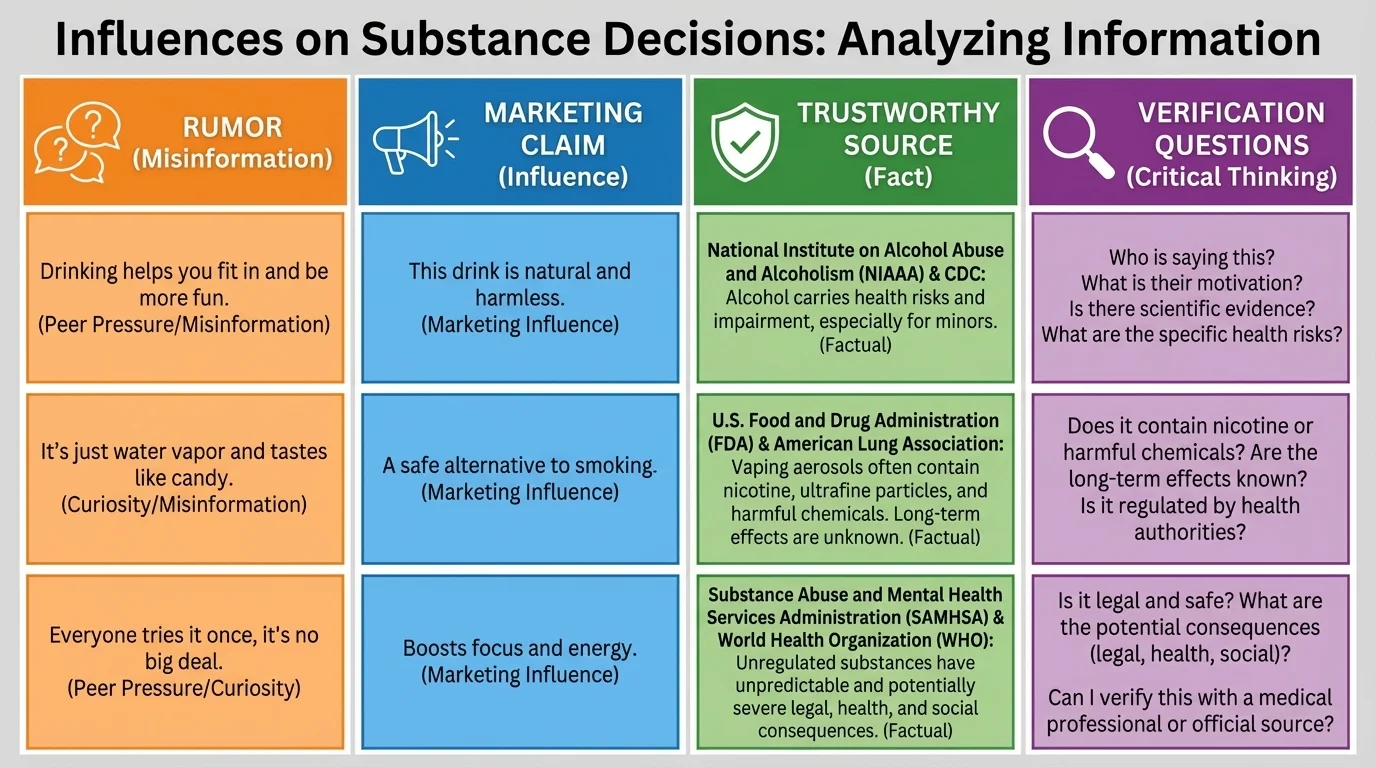
If a post uses shame, hype, or "secret truth" language, be careful. Reliable health information usually explains risks clearly, avoids dramatic promises, and does not pressure you to act fast. Think of that fact-checking process as a filter: pause before believing something just because it sounds confident.
The aerosol from a vape is not just harmless water. It can contain nicotine and other chemicals, and the exact contents may not always be obvious to the person using it.
Addiction risk is one reason substances matter so much during the teen years. Your brain is still developing skills like planning, self-control, learning, and decision-making. Substances that affect the brain can interfere with those systems.
Alcohol can slow reaction time, reduce coordination, and weaken judgment. That means a person may do unsafe things they would normally avoid. Vaping products with nicotine can affect attention and can lead to dependence, which means the body and brain start wanting more. Misusing pills or other drugs can affect breathing, heart rate, mood, and awareness.
These effects are not only about dramatic emergencies. They can show up in everyday life: worse sleep, more irritability, less energy for sports or hobbies, trouble focusing on schoolwork, arguments with family, risky online behavior, and poor decisions around biking, swimming, crossing streets, or riding with someone unsafe.
Substances can also increase danger in combinations. Mixing unknown products, using a large amount quickly, or taking something from an untrusted source raises the risk. If a person does not know exactly what they are taking, the danger goes up even more.
When your brain is under pressure, it tends to choose fast reactions over wise decisions. That is why having a plan ahead of time matters. Safety plans work best before the stressful moment starts.
One important truth: even if someone says a substance helps them calm down, that does not make it a healthy coping tool. Relief is not the same as safety. A short-term feeling can hide a long-term problem.
A fast moment needs a simple plan, and [Figure 3] lays out a tool you can actually use when someone offers a substance or pushes you toward a risky situation. Think of it as Pause, Check, Choose, Leave, Tell.
Pause. Do not answer instantly. Even a few seconds gives your thinking brain time to catch up.
Check the facts. What is being offered? Do you know what is in it? Is someone hiding risks, joking too much, or telling you to keep it secret?
Check safety. Could this affect breathing, judgment, balance, mood, or your ability to get home safely? Are adults nearby? Is anyone already acting out of control?
Choose your response. Say no, change the subject, suggest another plan, or leave. You do not need a long explanation.
Leave and tell. If the situation feels unsafe, go to a safer space and contact a trusted adult. If someone seems very sick, confused, passed out, or unable to breathe normally, get emergency help right away.
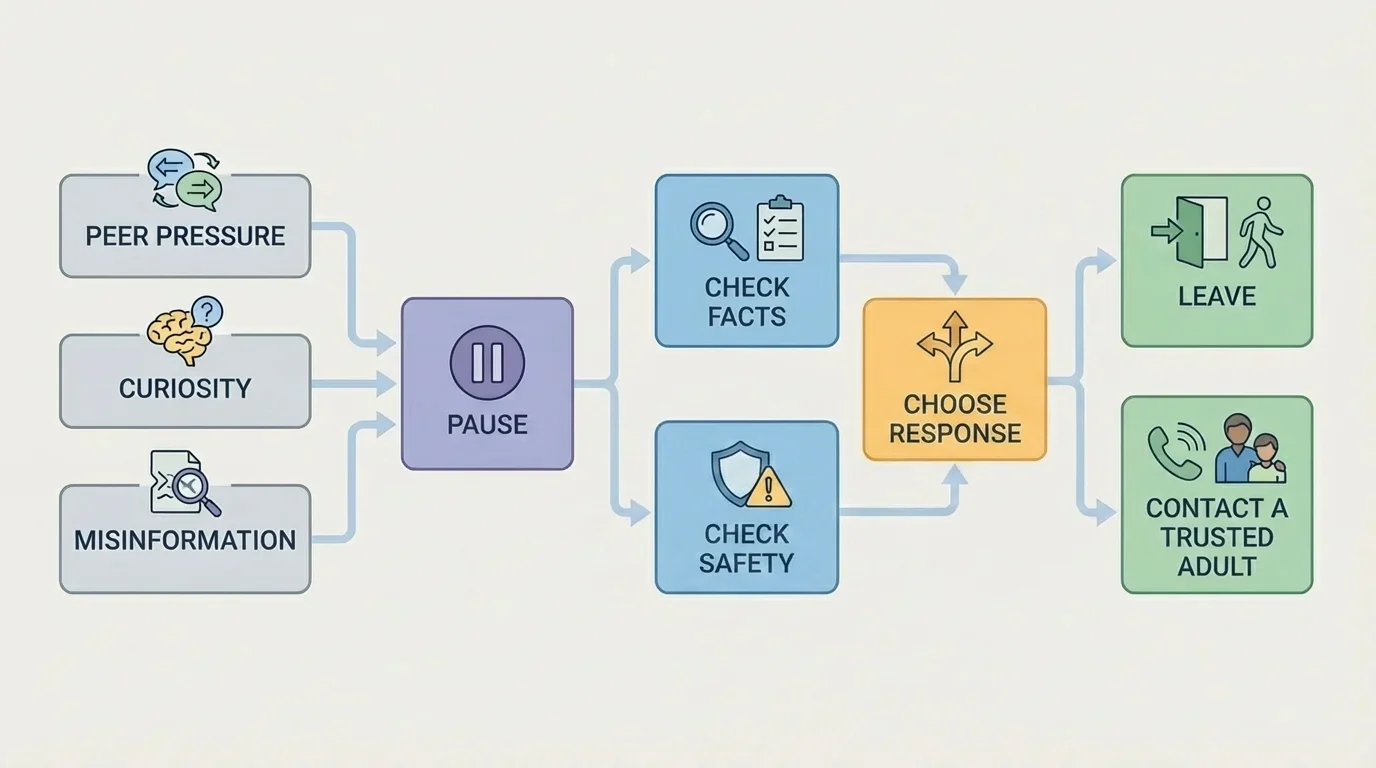
This tool works because it turns a blurry social moment into clear actions. When you look back at [Figure 3], notice that the goal is not to win an argument. The goal is to protect your safety and make the next right move.
Using the decision tool
You are at a neighborhood hangout. Someone offers you a vape and says it is "just flavor."
Step 1: Pause.
Take one breath. You do not owe a quick answer.
Step 2: Check the facts.
You do not know what is in it or whether it contains nicotine.
Step 3: Check safety.
Inhaling an unknown chemical is not safe, and the person offering it may not know the truth either.
Step 4: Choose.
Say, "No. I'm not using that."
Step 5: Leave and tell if needed.
If the pressure keeps going, move away and message a trusted adult.
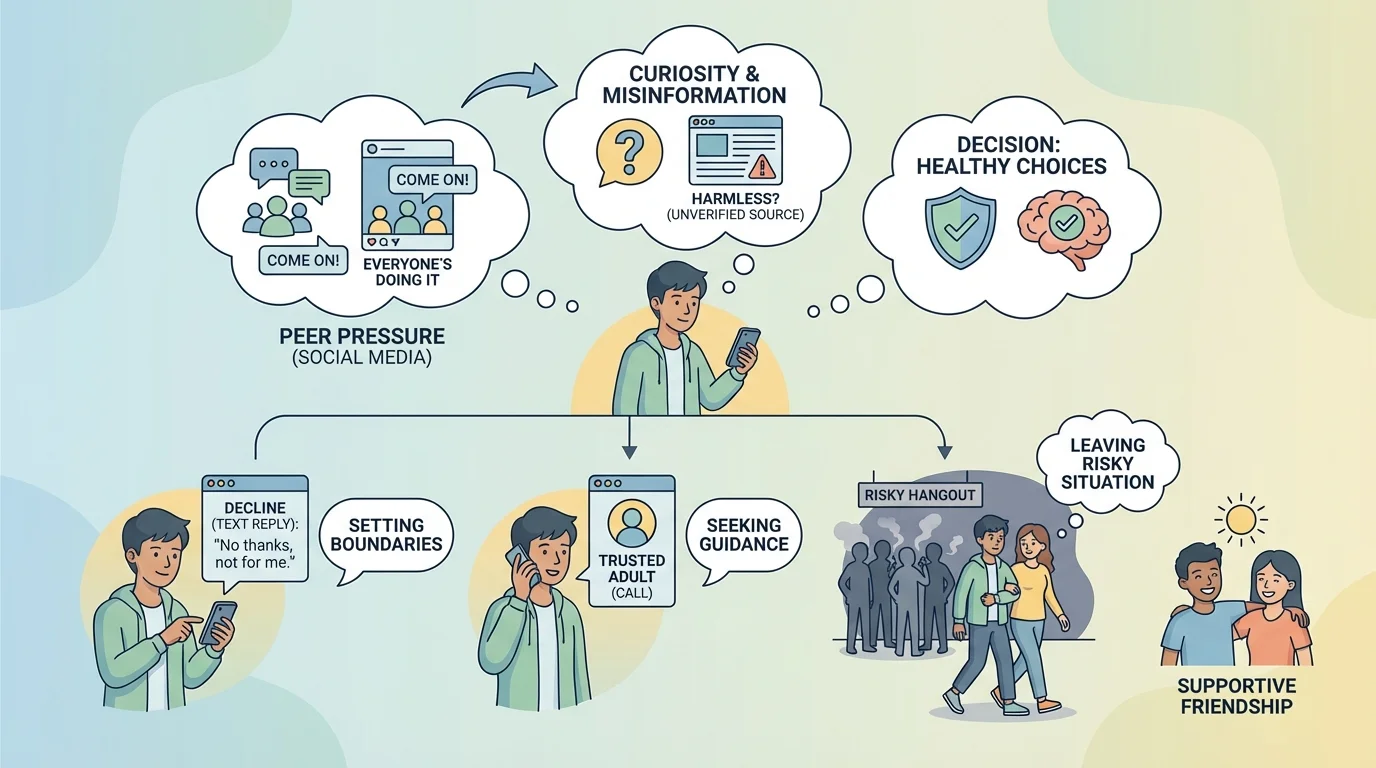
Saying no is easier when you decide your words ahead of time, and [Figure 4] shows how a clear reply, a quick text, and an exit plan work together. You do not need a perfect speech. Short, calm, and direct usually works best.
Here are some refusal lines you can use: "No thanks." "I'm not doing that." "I don't want that in my body." "I'm good." "I'm leaving." "My answer is no." If someone keeps pushing, repeat yourself instead of debating.
Exit plans matter too. You can arrange a code word with a parent or trusted adult, keep your phone charged, know how you will get home, and stay near people who respect your boundaries. If you are with a friend, agree ahead of time that either of you can say, "Let's go," without needing to explain everything in front of others.
If pressure turns into threats, humiliation, recording, or blocking your way, that is no longer just awkward social pressure. It is a safety problem. Get to a safer place and contact a trusted adult immediately.
Looking again at [Figure 4], the biggest idea is that confidence is often prepared, not spontaneous. Practice makes safe choices easier to say out loud.
"You do not have to explain a boundary for it to be real."
Try This: Save two refusal texts in your notes app, such as "I'm not coming if people are using stuff" and "Pick me up now, please." Having the words ready can make a stressful moment much easier.
Sometimes the most important choice is not about saying no for yourself. It is about getting help for someone else. If a person is hard to wake up, breathing strangely, vomiting and not responding, acting extremely confused, having a seizure, or may have taken an unknown substance, treat it as an emergency.
Do not leave the person alone. Get an adult right away and call emergency services if needed. If possible, tell responders what the person may have used. You are not "getting them in trouble." You are helping protect their life.
If the situation is not an emergency but you are worried, talk to a trusted adult, school support staff member from your online program, doctor, counselor, coach, or family member. Asking for help early is a strong move, not a weak one.
Trusted adults are part of your safety system. A trusted adult is someone who listens, takes safety seriously, and helps you act. You do not need to solve every risky situation by yourself.
If you made a choice you regret, tell the truth to a trusted adult as soon as possible. Hiding a dangerous situation usually makes it harder to fix.
The strongest protection is not a single comeback line. It is building habits and relationships that make risky choices less attractive and less powerful. When you know your values, choose friends who respect boundaries, and have healthy ways to deal with stress, pressure loses some of its grip.
That can look like sleeping enough, staying involved in activities you care about, spending time with people who do not mock your boundaries, limiting accounts that glamorize substance use, and being honest with adults when something feels off. These actions may seem small, but they shape what feels normal to you.
You can also make a personal rule before the moment arrives. For example: "I do not put unknown substances in my body." "I leave when people start using substances." "I do not get in a car or ride with someone who has used alcohol or drugs." A rule decided early is easier to follow than a rule invented under pressure.
Real confidence is not proving you can handle dangerous things. It is knowing when something is not worth the risk. Protecting your brain, body, and future is not overreacting. It is smart adulting.
