Many relationship problems do not start with major dramatic moments. They often start with small choices: someone keeps texting after being told to stop, someone shares a private screenshot "as a joke," someone pressures a friend to say yes, or someone acts like respect only matters when it is convenient. Those moments matter because healthy relationships are built on three basics: consent, respect, and responsibility.
Relationships can include friendships, family relationships, team or club connections, online friendships, and dating relationships. No matter what kind of relationship it is, the same question matters: Are both people being treated with care, honesty, and fairness? If the answer is no, the relationship needs attention.
Healthy relationships make life feel safer and more comfortable. You can be yourself, speak honestly, and trust that your boundaries matter. Unhealthy relationships do the opposite. They create stress, confusion, fear, guilt, or pressure. That can affect your sleep, your confidence, your focus, and your mental health.
Knowing how consent, respect, and responsibility work helps you in everyday situations: deciding whether to hug someone, asking before posting a photo, handling private messages, turning down pressure from a friend, or noticing when someone is trying to control you. These are not "just drama" problems. They are life skills.
Consent means giving clear permission for something.
Respect means treating another person like their feelings, rights, privacy, and boundaries matter.
Responsibility means being accountable for your words, choices, and the effect they have on others.
These three ideas work together. Consent without respect is weak, because a person might ask for permission but still ignore feelings. Respect without responsibility is incomplete, because caring is not enough if your actions still harm someone. Strong relationships need all three.
Think of a healthy relationship like a three-legged stool. One leg is consent, one leg is respect, and one leg is responsibility. If one leg is missing, the whole thing becomes unstable. A person who says, "I asked once, so I did nothing wrong," may still be ignoring discomfort. A person who says, "I care about you," but spreads private information is not acting responsibly.
In real life, these ideas show up in simple ways. Consent is asking before touching, sharing, posting, or continuing a conversation. Respect is listening when someone says no, not making fun of boundaries, and not pushing people to explain personal choices. Responsibility is owning your mistakes, apologizing honestly, and changing your behavior.
Many people think consent only matters in serious romantic situations, but it also matters in ordinary daily choices like borrowing belongings, posting photos, joining calls, reading private messages, or bringing up sensitive topics.
That matters because a lot of harm happens when people treat boundaries like they are optional. They are not optional. A boundary is not a challenge to beat. It is information you are supposed to respect.
Consent is clear, informed, and freely given permission. Real consent is not silence, freezing, guilt, fear, pressure, or someone giving in because they are tired of being asked. If a person feels pushed, the situation is not healthy.
[Figure 1] Consent also has to be ongoing. Someone can say yes to one thing and no to something else. Someone can say yes at first and then change their mind later. That change must be respected right away. A past yes does not mean automatic permission in the future.
Another essential part of consent is choice. If a person is being pressured with threats, guilt, begging, repeated asking, embarrassment, or social pressure, then the choice is not fully free. For example, if someone says, "If you really cared about me, you would do it," that is not respectful. That is pressure.
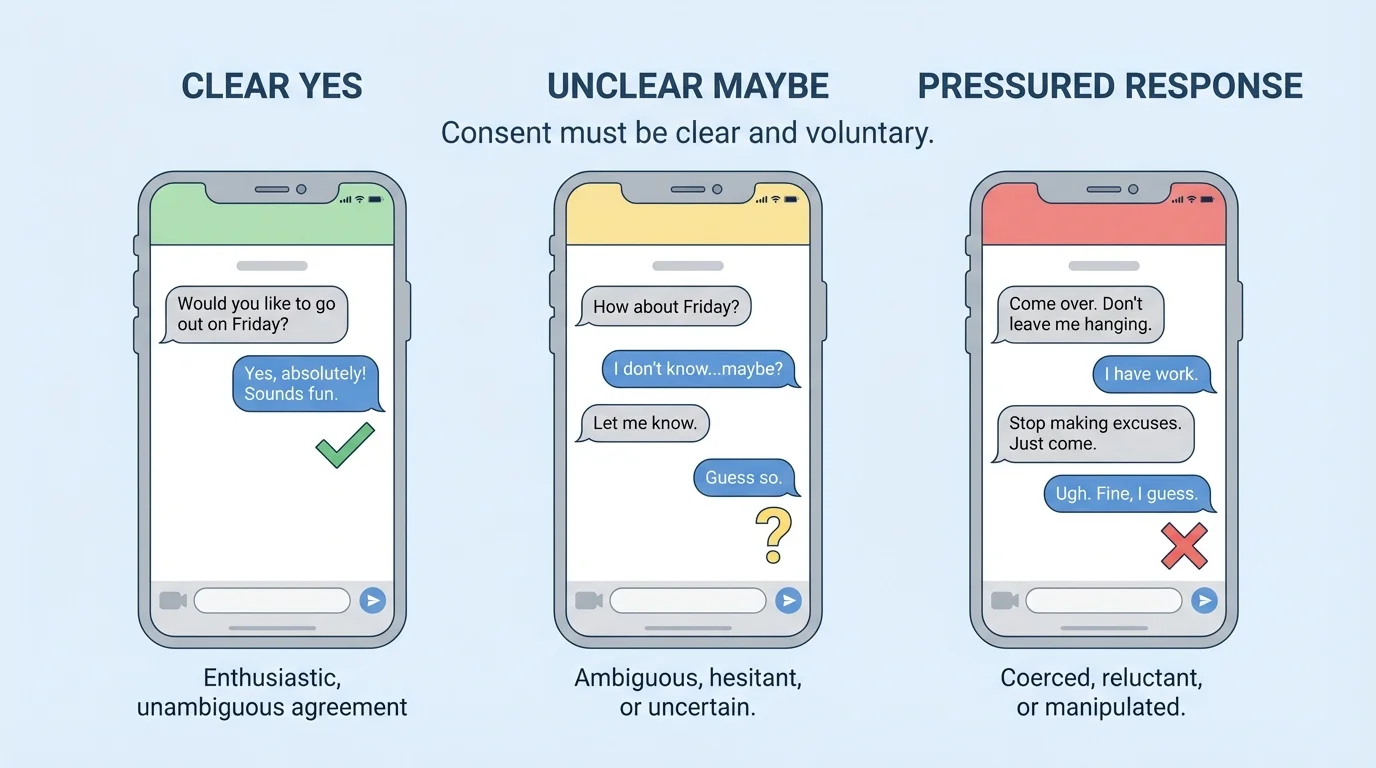
Consent is not only about physical affection. It also applies to digital life. You need permission before posting someone's photo, sharing their private message, adding them to a group chat, or giving out their username, location, or personal information. Just because you can share something does not mean you have the right to.
Clear examples of consent: "Yes, that's okay." "I want to." "You can post that picture." "I'm fine talking about this."
Not clear enough: "I guess." "Maybe." "Whatever." No answer. A nervous laugh. Looking uncomfortable. Ignoring the message. Saying yes after being asked over and over.
When you are not sure, stop and ask again. A simple check-in can protect both people. You can say, "Are you comfortable with this?" or "It's okay to say no." That shows maturity, not awkwardness.
Scenario: Posting a photo
You and a friend hang out at a community event and take several pictures. One photo is funny, but your friend looks embarrassed.
Step 1: Notice the situation
Your friend does not seem excited about the photo, even if they do not directly say no.
Step 2: Ask clearly
Say, "Do you want me to post this, or keep it private?"
Step 3: Respect the answer
If they say no, do not argue, tease, or post it somewhere else.
Step 4: Be responsible
If you already posted it by mistake, take it down quickly and apologize.
One strong habit is this: if the answer is not a clear yes, treat it like a no for now. That protects trust and reduces confusion.
Boundaries are the limits people set around what feels safe, comfortable, and acceptable. They can involve privacy, time, personal space, digital sharing, and emotions. Some boundaries are spoken out loud, and some are shown through behavior. Healthy relationships pay attention to both.
[Figure 2] Respect means you do not mock, pressure, or punish someone for having boundaries. You do not say, "You're too sensitive," "You owe me," or "Stop being dramatic." Respect means understanding that another person is allowed to have needs that are different from yours.
Respect also includes privacy. Reading someone's messages without permission, demanding passwords, tracking their location, or forcing them to prove where they are is not caring behavior. It is controlling behavior. In a healthy relationship, trust is built through honesty, not surveillance.
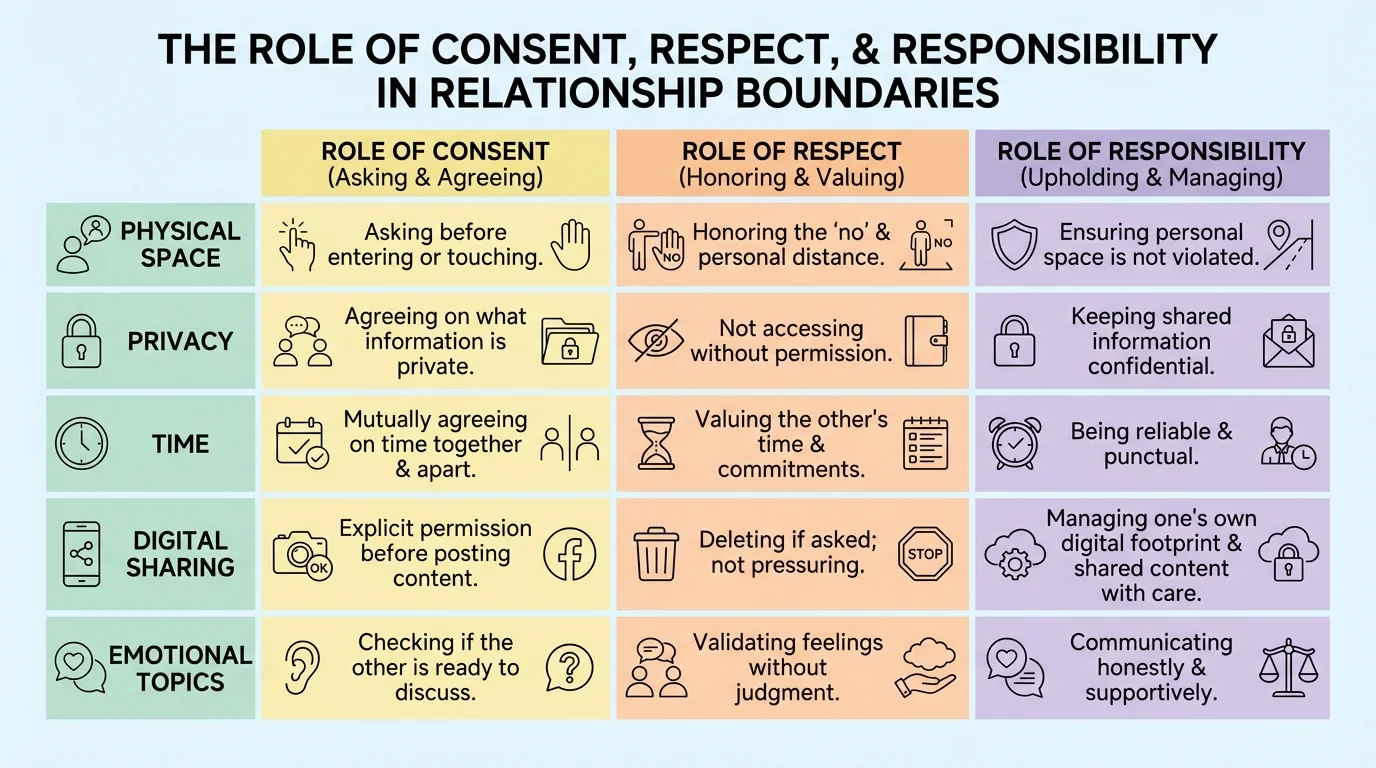
Another part of respect is listening. If someone says they are not ready to talk, not comfortable sharing, or not interested in certain plans, pushing harder does not show closeness. It shows that you are putting your wants above their comfort.
Respect works both ways. You also have to respect your own boundaries. Sometimes people ignore their own discomfort because they do not want to disappoint others. But saying yes when you mean no can leave you feeling upset, trapped, or resentful. Respecting yourself means noticing your feelings and taking them seriously.
| Situation | Respectful Response | Disrespectful Response |
|---|---|---|
| A friend says they need space | "Okay, message me when you're ready." | Sending repeated messages to make them answer |
| Someone says no to a photo post | Delete or keep it private | Posting it anyway or sending it to others |
| A person does not want to share a password | Accept their privacy | Acting suspicious or demanding proof of trust |
| A friend declines a hangout | Say "No problem, maybe another time" | Guilt-tripping them for saying no |
Table 1. Examples of respectful and disrespectful responses in everyday relationship situations.
As you can see in [Figure 2], boundaries are not only about touch. They include your time, your attention, your information, and your emotional energy. That is why respect matters in every type of relationship, not just dating.
Responsibility in relationships means understanding that your choices affect other people. It is not enough to say, "I didn't mean it." Intent matters, but impact matters too. If you hurt someone, break trust, or ignore a boundary, you are responsible for fixing what you can and changing your behavior.
Responsibility includes being honest. Do not lead people on for attention. Do not spread rumors because you are upset. Do not promise something you know you cannot keep. Do not use private information as a weapon during an argument. Responsible people think before acting.
Impact versus intent
You may not intend to embarrass someone by sharing a screenshot, but if that action exposes private information and harms trust, the impact is still real. Taking responsibility means responding to the harm, not only defending your original intention.
Responsibility also means managing your emotions without taking them out on other people. Feeling jealous, angry, disappointed, or left out does not give you permission to be controlling or cruel. Your feelings are real, but they are not excuses for harmful behavior.
If you make a mistake, a real apology has three parts: say what you did, acknowledge the harm, and explain what you will do differently. "I'm sorry you got upset" is not a strong apology because it avoids responsibility. "I'm sorry I shared your message without asking. That was not okay. I deleted it, and I won't do it again," is much better.
Scenario: Breaking trust in a group chat
You send a screenshot of a private conversation to another friend because you are annoyed.
Step 1: Stop the spread
Delete the screenshot where possible and ask others not to share it further.
Step 2: Admit exactly what happened
Do not make excuses or blame the other person for "being dramatic."
Step 3: Apologize clearly
Say what you did wrong and why it broke trust.
Step 4: Change your behavior
Decide that private messages stay private unless you need adult help for safety reasons.
Responsible behavior makes relationships safer because people know your words can be trusted. That trust is significant.
[Figure 3] Healthy and unhealthy relationships often reveal themselves through patterns. A red flag is a warning sign that something may be unsafe, disrespectful, or controlling. A green flag is a sign of health, safety, and trust.
Green flags include listening, honesty, respecting privacy, taking no for an answer, apologizing sincerely, and supporting your independence. Red flags include guilt-tripping, jealousy used as control, humiliation, repeated pressure, threats, ignoring boundaries, demanding constant access, or making you feel afraid to disappoint them.
Watch out for coercion, which means pressuring, manipulating, or forcing someone into something they do not freely choose. Coercion can sound quiet, not dramatic. It might be repeated begging, "If you loved me, you would," "Everyone else does this," or "Don't make this a big deal." Those phrases are meant to wear someone down.
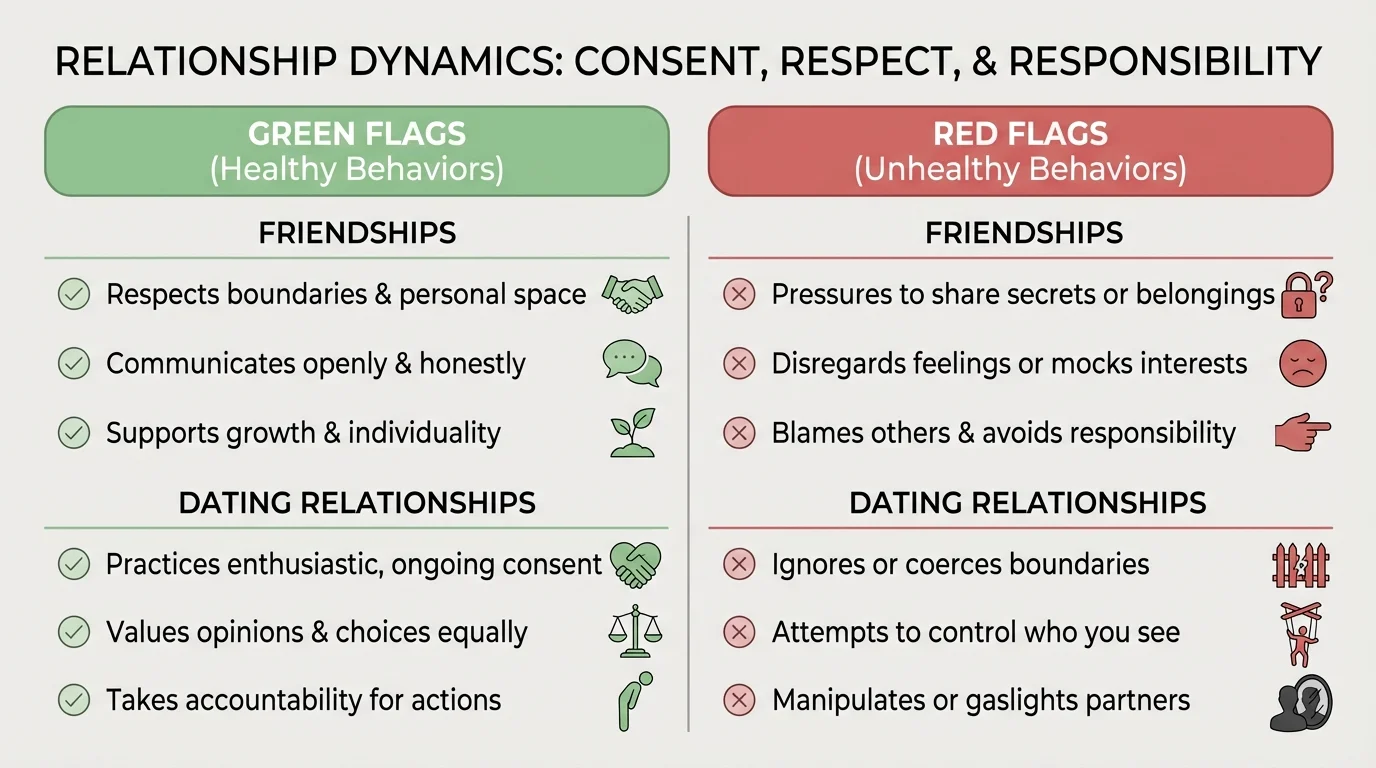
Another red flag is isolation. If someone tries to pull you away from supportive people, acts angry when you spend time with others, or makes you feel guilty for having separate interests, that is not closeness. It is control.
There can also be digital red flags: constant checking, demanding instant replies, forcing read receipts, sharing your photos without permission, using fake accounts to monitor you, or threatening to leak private information. Online behavior counts as real relationship behavior because the harm is real.
Looking back at [Figure 3], one useful question is: Do I feel safe, respected, and free to say no in this relationship? If the answer is often no, take that seriously.
You do not need a perfect speech to set a boundary. You just need clear words. Short and direct is often best. The goal is not to win an argument. The goal is to communicate what is okay and what is not okay.
Here is a simple way to do it:
Step 1: Say the boundary clearly. Example: "I don't want my pictures posted without asking."
Step 2: If needed, add a brief reason. Example: "I like choosing what I share online."
Step 3: Say what needs to happen next. Example: "Please delete that post."
Step 4: Follow through if the person ignores you. That might mean ending the conversation, leaving the chat, blocking the account, or getting a trusted adult involved.
Some useful phrases are: "No." "I'm not comfortable with that." "Stop." "I said no." "Don't share that." "I'm ending this conversation." "You don't need my password." "I need space right now."
"No is a complete sentence."
You also need to respect other people's boundaries when they communicate them. A mature response sounds like this: "Okay." "Thanks for telling me." "I understand." "I'll stop." Good communication is not only about speaking up. It is also about responding well when someone else speaks up.
Consider a friend who keeps pressuring you to join a late-night group video call after you already said you need sleep. Consent matters because your time belongs to you. Respect matters because they should accept your answer. Responsibility matters because they should stop pushing instead of making you feel guilty.
Now think about a dating situation where one person wants constant updates, passwords, and instant replies. They call it trust, but it is really control. Real trust does not require giving up privacy. Respecting a partner or friend means allowing them to have space, other relationships, and time offline.
Another example: someone shares a rumor about another person's relationship and tells you not to say anything. Responsible behavior means not spreading private drama for entertainment. Respect means remembering that real people are affected. If the situation involves safety, then tell a trusted adult instead of passing it around socially.
Scenario: A boundary text you can actually send
A person keeps asking for a personal photo after you already avoided the question.
Step 1: Be direct
Text: "I'm not sending that."
Step 2: Do not over-explain
You do not need a long reason for a personal boundary.
Step 3: Notice the response
If they respect it, that is a good sign. If they guilt-trip or pressure you, that is a red flag.
Step 4: Protect yourself
If pressure continues, stop replying, block them, save evidence, and tell a trusted adult.
One practical rule is this: if someone only acts kind when they are getting their way, that is not real respect. Real respect stays in place even after a no.
Your instincts matter. If a relationship makes you feel unsafe, trapped, scared, constantly guilty, or like you cannot be honest, pay attention. You do not need to wait for things to get "bad enough" before getting help.
Start by naming what feels wrong. Is the person ignoring your boundaries? Pressuring you? Sharing private information? Threatening to embarrass you? Tracking you online? Once you can name the behavior, it becomes easier to act.
Then reach out to a trusted adult. That could be a parent, guardian, older family member, counselor, coach, club leader, or another safe adult in your life. If there is evidence such as texts, screenshots, voicemails, or posts, save it. If someone is threatening your safety, get help immediately.
If a problem involves safety, abuse, threats, sexual pressure, blackmail, stalking, or fear, this is not something you are expected to handle alone. Getting adult help is a strong decision, not an overreaction.
You are allowed to leave a chat, block a person, stop sharing your location, change privacy settings, and end contact when needed. Protecting your well-being is responsible. It is not rude.
Try This: The next time someone asks for your time, information, or attention, pause and ask yourself three quick questions: "Do I want this?" "Do I feel comfortable?" "Would I still say yes if there were no pressure?" If any answer feels off, slow down.
Try This: Practice one boundary sentence out loud: "I'm not comfortable with that." Saying it before you need it can make it easier to use when the moment comes.
Try This: Review your social media settings and check who can see your posts, tag you, message you, or share your information. Digital responsibility is part of relationship safety too.
