Being independent is not about doing everything perfectly. It is about being ready. If you can find your charger when you need it, leave on time, know how to get somewhere safely, and keep your living space under control, everyday life gets much easier. These skills may seem small, but together they build real freedom. When you have routines, you spend less energy scrambling and more energy actually living your life.
A routine is a pattern you repeat on purpose. Good routines help you remember important things without having to rethink them every time. That matters because your brain has limited attention. If every morning starts with hunting for shoes, checking messages, and trying to remember whether you packed what you need, your stress level rises before the day even begins.
Strong routines also make you more reliable. People trust someone who arrives prepared, remembers responsibilities, and follows through. That can help at home, in community activities, during volunteer work, and later in jobs. On the other hand, weak routines often lead to late arrivals, missed deadlines, wasted money, lost items, and arguments over chores.
Small systems beat good intentions. A system is something you set up ahead of time so the right action becomes easier. For example, putting your keys in the same bowl every day is a system. Setting a reminder to move laundry from the washer to the dryer is a system. Saying "I'll remember" is not a system.
You do not need a complicated planner or a perfect cleaning schedule. You need a few routines that match your real life and that you can keep doing even on busy days.
The easiest way to stay organized is to give important things a regular time and a regular place, as [Figure 1] shows. If your backpack, headphones, water bottle, and charger all live in different random spots, getting ready becomes harder than it needs to be. A simple organization system has three parts: a calendar, a task list, and home drop zones.
Your calendar is for events that happen at a specific time: online classes, appointments, club meetings, rides, practice, or family plans. Your task list is for things that need to get done but may not have one exact time: finish laundry, take out trash, refill your bag, reply to an email, or clean your desk. A drop zone is a small, consistent place for everyday items, such as a hook for keys, a basket for chargers, or a shelf for shoes.
Pick one main place to track your schedule. That could be a phone calendar, a paper planner, or a whiteboard in your room. What matters is that you actually use it. If you keep some plans in your head, some in messages, and some on random sticky notes, you will miss things.
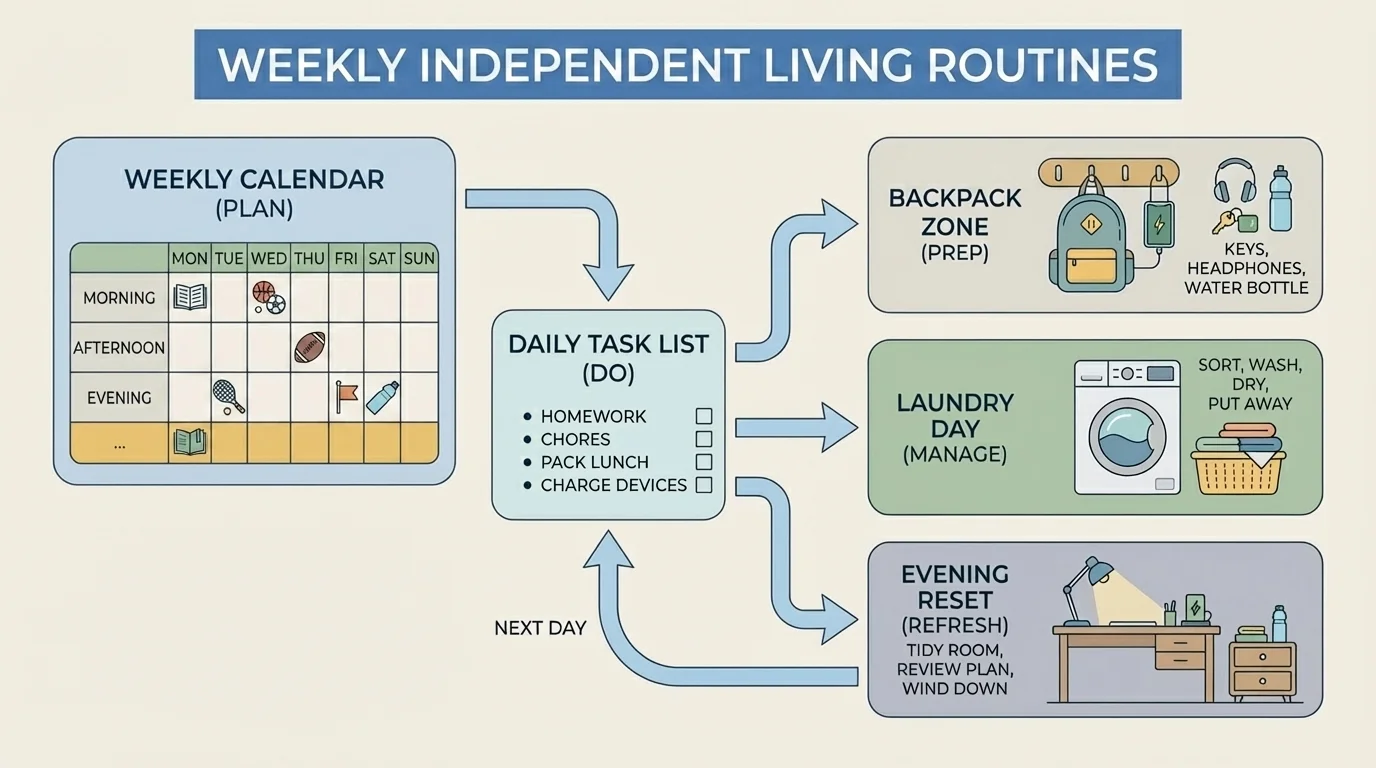
Create two reset routines: a daily reset and a weekly reset. A daily reset can take only about ten minutes. Put items back in their places, plug in devices, check tomorrow's schedule, and prepare what you need for the next day. A weekly reset can be a little longer. Review upcoming plans, wash clothes you need, restock supplies, clear trash, and make sure your main space is usable.
Try This: Tonight, choose one spot in your home to become your launch area. Put there the items you usually need when leaving: bag, shoes, charger, transit card, water bottle, or jacket. Tomorrow, notice how much faster leaving feels.
Many people are not actually bad at time management. They are bad at time estimates. They think a task will take five minutes when it really takes fifteen. Then the whole day starts slipping. A smarter habit is to guess the time, then add a small buffer.
For example, if packing your bag usually takes about ten minutes and finding the right shoes takes about five more, planning only ten minutes is risky. A better plan is to allow about fifteen minutes total, or even twenty if you know mornings are hard. This is not laziness. It is realistic planning.
Real-life timing example
You need to leave home at 3:30 for an appointment.
Step 1: List the tasks before leaving.
Fill water bottle, pack charger, put on shoes, and check route.
Step 2: Estimate the time.
If each task takes about 3 minutes, that is roughly \(3 + 3 + 3 + 3 = 12\) minutes.
Step 3: Add buffer time.
Add about 8 extra minutes for delays. Now you need \(12 + 8 = 20\) minutes.
That means starting your leaving routine around 3:10 is much safer than starting at 3:20.
One more useful tool is prioritizing. Ask: What must happen today, what should happen soon, and what can wait? If your room is messy and you also have a doctor appointment, charging your phone and checking the ride matter first. Cleaning can happen later. Independence means handling the important thing first, even when the less important thing feels easier.
Travel independence does not only mean knowing where to go. It means making a plan before leaving, as [Figure 2] illustrates, and having a backup if something changes. Whether you are walking, biking, getting a family ride, using public transit, or using a rideshare with permission, safe travel starts before you open the door.
First, check the basics: where you are going, when you need to be there, how long the trip takes, and what route makes the most sense. If you use a map app, look at the route before it is time to leave. Do not assume the fastest option is always the best. A route that saves two minutes but requires crossing unsafe roads or making a confusing transfer may not be the smartest choice.
Next, prepare for problems. What if the bus is late? What if your ride changes plans? What if your phone battery drops? Good travelers have a backup plan. That could mean carrying a charged phone, knowing one alternate route, having emergency contact numbers saved, and leaving early enough that a small delay will not ruin everything.
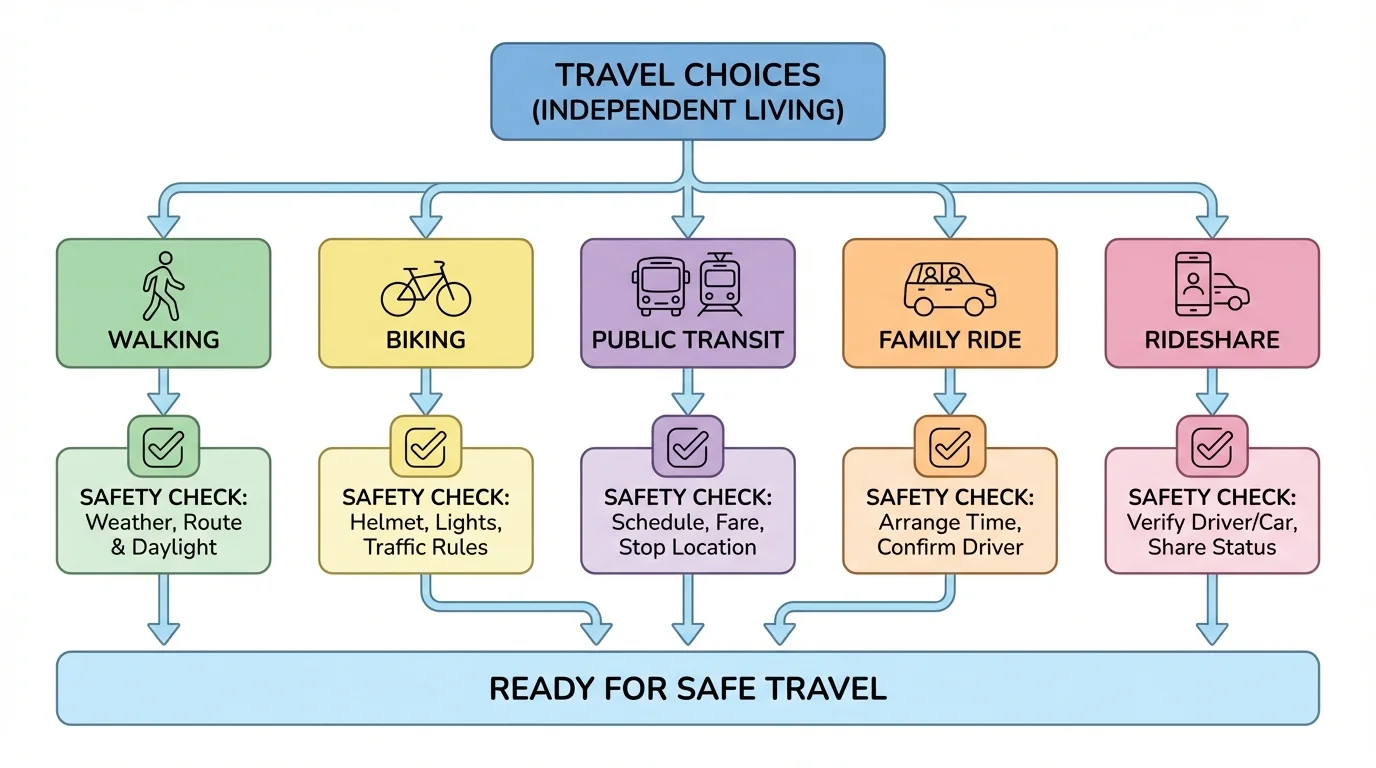
Travel safety also means paying attention. Keep your device volume low enough to hear what is happening around you. Stay in well-lit areas when possible. Share your location or trip details with a trusted adult when appropriate. If something feels wrong, trust that feeling and move to a safer place or contact someone. [Figure 3]
If you are walking or biking, wear what helps you be seen. If you use public transit, know your stop before you board and pay attention during the ride. If a rideshare is allowed, verify the driver and vehicle details before getting in. Never rush so much that you skip safety checks.
People are often late not because the trip itself takes too long, but because they forget the "hidden minutes" before the trip starts: finding shoes, locking up, checking the route, and walking to the stop or pickup point.
As with the organization system in [Figure 1], travel gets easier when repeated steps happen in the same order. Check route, check battery, grab essentials, confirm time, then leave.
A lot of stress comes from forgetting small things that become big problems later. To avoid that, create a personal essentials list. Your list may include phone, charger, wallet, ID, keys, water, medicine, headphones, notebook, or transit pass. The exact items depend on your life, but the habit is the same: check before leaving.
Use a short leaving routine. Step 1: Look at your calendar or message with destination details. Step 2: Check weather and route. Step 3: Pack your essentials. Step 4: Make sure your phone has enough battery. Step 5: Lock up or tell the correct person you are leaving if needed.
Keep a small backup kit ready if you often go out: tissues, lip balm, a pen, a charging cable, and any needed personal care item. That reduces repeat packing and makes it less likely you will forget the basics.
Leaving-home checklist example
You are going to a community center for a two-hour activity.
Step 1: Confirm the details.
Check the address, start time, and who knows where you are going.
Step 2: Pack only what matters.
Bring phone, charger, water bottle, notebook, and any required pass or ID.
Step 3: Prepare for the return trip.
Know how you are getting back and what time you expect to return.
This takes only a few minutes but prevents many avoidable problems.
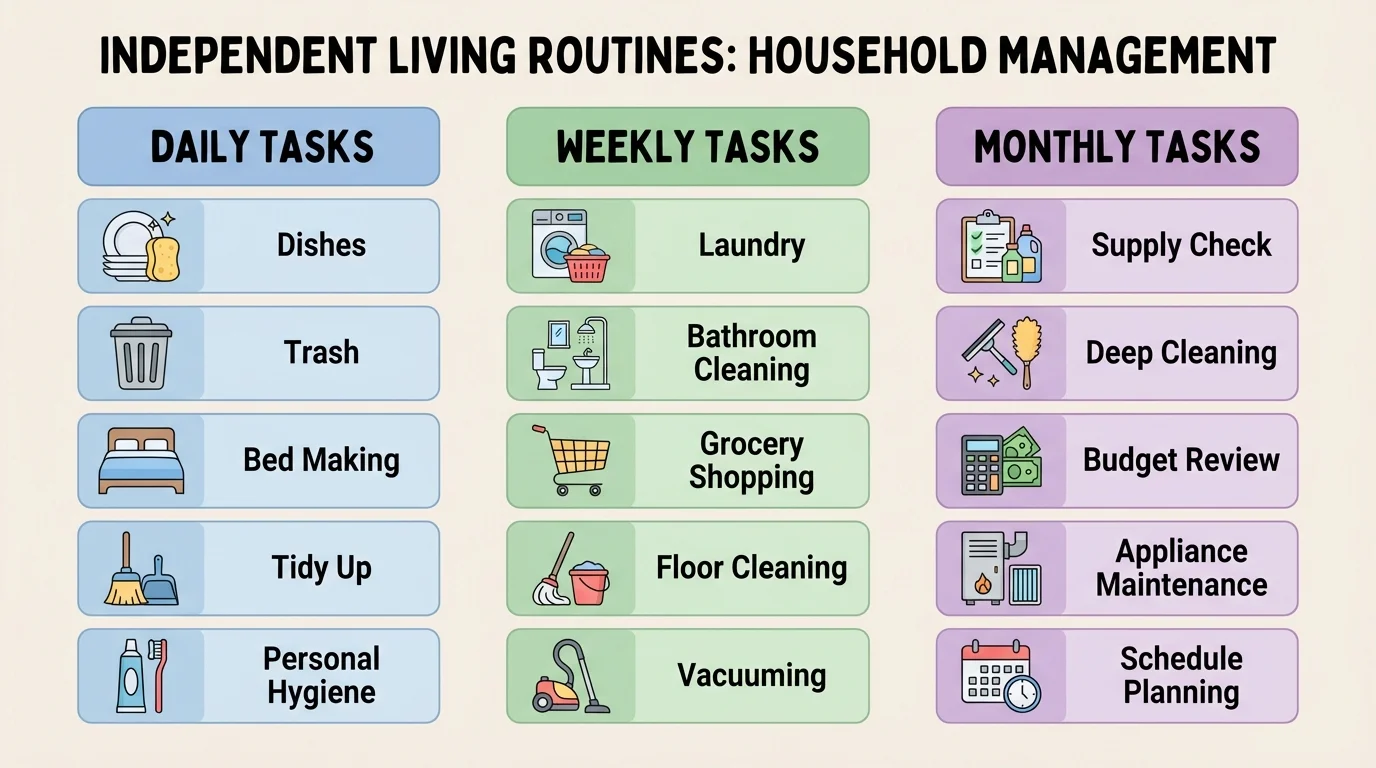
Home care feels easier when tasks are grouped by how often they need to happen. Household management means handling the regular jobs that keep a living space clean, safe, and usable. You do not need to become an expert cleaner. You do need to know what jobs repeat and how to keep them from piling up.
Some tasks are daily: making your bed if that helps your room stay orderly, putting trash in the bin, washing dishes you use, wiping spills, and returning things to their places. Some tasks are weekly: laundry, changing towels, taking out trash and recycling, vacuuming or sweeping, cleaning the bathroom sink, and checking food in the fridge. Some tasks are less frequent but still important: restocking soap, replacing empty paper products, cleaning out old food, and checking whether anything smells strange or looks damaged.
One of the biggest household mistakes is waiting until a task becomes a problem. One dish in the sink is quick. A pile of dishes is annoying. One load of laundry is manageable. Running out of clean clothes the morning you need them creates stress. Routines prevent buildup.
Laundry is a basic independence skill. Read labels when possible, separate items if needed, use the correct amount of detergent, and set a reminder to move clothes when the cycle ends. Leaving wet clothes sitting too long can create bad smells. After clothes are dry, fold or hang what wrinkles easily and put the rest away. Clean laundry on the floor turns into messy laundry very fast.
Dishes matter for both cleanliness and health. Rinse or wash them soon after use. Wipe counters if food or drinks spill. Store leftovers in containers and label them if needed. A simple rule is: if you open something, close it; if you spill something, wipe it; if you use something, put it back.
Food safety means handling food in ways that lower the chance of getting sick. This includes washing hands before preparing food, refrigerating items that need to stay cold, and not eating food that smells spoiled or looks unsafe.
Bathroom and bedroom care matter too. Towels need changing. Trash needs emptying. Floors need to stay clear enough to walk safely. A clean space is not just about looks. It helps prevent lost items, bad odors, bugs, and accidents.
| Task | How Often | Why It Matters |
|---|---|---|
| Dishes and counters | Daily | Prevents smells, mess, and bacteria buildup |
| Laundry | Weekly or as needed | Keeps clothes clean and ready to wear |
| Trash and recycling | Several times a week | Prevents odors and overflow |
| Bathroom wipe-down | Weekly | Keeps surfaces cleaner and more sanitary |
| Fridge check | Weekly | Reduces waste and spoiled food |
| Supply check | Monthly | Prevents running out of essentials |
Table 1. Common household tasks, suggested timing, and reasons they matter.
Later, when you plan your own week, the pattern in [Figure 3] can help you decide which tasks belong in a daily reset and which fit better into a weekly reset.
Independent living also includes protecting your important information. Know where your ID, insurance card if you have one, transit card, house key, and emergency contact information are kept. Do not leave these items loose in random bags or pockets. Give them a home.
Your phone can help, but it should not be your only system. Save important numbers in your contacts, but also keep a written backup in a safe place. Use strong passwords and do not share them casually. If you rely on a notes app for everything, make sure it is organized so you can find what you need quickly.
If you borrow something, return it. If you need to bring something back home, put a reminder in your calendar right away. Losing trust is often about repeated small carelessness, not one giant mistake.
When you make a routine, tie it to something you already do. For example, check tomorrow's schedule right after charging your phone, or start laundry right after breakfast on the same day each week. Linking habits makes them easier to remember.
Real independence is not one big skill. It is a group of small habits working together. A solid morning routine might look like this: wake up, wash up, get dressed, check schedule, eat, pack essentials, and leave a few minutes early. A solid evening routine might look like this: charge devices, reset your space, check tomorrow's plans, set out what you need, and go to bed at a reasonable time.
If you share space with family or others, communicate clearly. Ask what responsibilities are yours. If trash day is Wednesday, put a reminder in your system. If you use the last of something, mention it or replace it. Independent living is not only about taking care of yourself. It is also about not creating extra work for other people.
Sample weekly routine
Monday: Check calendar for the week and refill your daily bag.
Wednesday: Wash one load of laundry and put it away the same day.
Friday: Clean out old papers, wrappers, and bottles from your room or bag.
Sunday: Do a weekly reset: review plans, charge devices, check supplies, and choose clothes for the next day.
This kind of routine is simple, but it prevents many problems before they start.
Even great routines fail sometimes. You oversleep. A ride cancels. You forget your charger. Your laundry is still wet. Independence includes recovery skills. Instead of panicking, pause and solve the next problem.
If you miss a bus, check the next one and contact the person waiting for you if needed. If you forgot an item, ask whether you truly need it right now or whether you can manage without it. If your room got messy again, do not tell yourself you failed. Restart with one area: trash first, then clothes, then surfaces.
A useful recovery question is: What is the smallest action that gets me back on track? Sometimes that means charging your phone immediately. Sometimes it means washing just the clothes you need most. Sometimes it means rewriting your list instead of staring at the mess.
"You do not rise to the level of your goals. You fall to the level of your systems."
— A practical life principle
The goal is not to become a perfect adult overnight. The goal is to build routines that make daily life more organized, safer, and calmer. Each time you prepare ahead, put something back where it belongs, or handle a home task before it becomes a problem, you are practicing real independence.
