Many of the biggest moments in your life will not look dramatic at first. They may be a comment you post in ten seconds, a screenshot you decide to share, or a shortcut you take on an assignment when no one seems to be watching. Small choices often feel private and temporary, but they can shape your reputation, your relationships, and your future.
Every day, you make choices in digital spaces, friendships, and learning. Some choices are obvious: whether to be kind, whether to cheat, whether to tell the truth. Others are less obvious: whether to laugh at a mean joke in a group chat, whether to repost something without checking if it is true, whether to let someone else do all the work in a shared project.
What connects these situations is not just the rule you follow. It is the person you are becoming. Your choices show your character. Over time, repeated choices build patterns. Those patterns become habits. Habits affect trust, and trust affects opportunities.
Values are the beliefs and priorities that matter to you, such as honesty, fairness, kindness, loyalty, or responsibility. Character is how those values show up in your actions, especially when a choice is hard. Ethics is thinking about what is right, fair, and respectful in a situation.
If you say you value kindness but join in when someone is mocked online, your actions do not match your values. If you say honesty matters but copy work from a website and submit it as your own, your character is showing something different from what you claim to believe. Strong character means closing that gap.
Your values act like an internal compass. They do not make every decision easy, but they help you know what direction is right. For example, if you value respect, you are more likely to pause before posting something embarrassing about another person. If you value responsibility, you are more likely to complete your work without excuses.
Ethical choices are not always the same as easy choices. Sometimes the right action costs you something. You might lose attention, avoid gossip that others enjoy, or admit a mistake instead of hiding it. That can feel uncomfortable in the moment. But it protects something more important: your integrity.
Integrity means being the same person across situations. It means your actions match your values whether you are in a public comment section, a private chat, a video call, or working alone on an assignment. Integrity matters because people learn whether they can trust you from what you do consistently, not from what you say once.
One useful way to think about character is this: values are what you believe is important, and character is what you actually do when tested. A person can know the right answer and still make a poor choice. That is why good decision-making takes more than knowledge. It takes self-control, courage, and honesty.
Online choices matter because they move quickly and often last longer than you expect. Your digital footprint includes posts, comments, likes, usernames, photos, videos, search habits, and even screenshots other people save. As [Figure 1] shows, something shared with one person can travel far beyond the audience you intended.
Before you post, ask yourself a few direct questions: Is it true? Is it respectful? Is it necessary? Could it hurt someone? Would I be okay with a parent, coach, future employer, or younger sibling seeing it later? If the answer makes you uncomfortable, that discomfort is useful information.
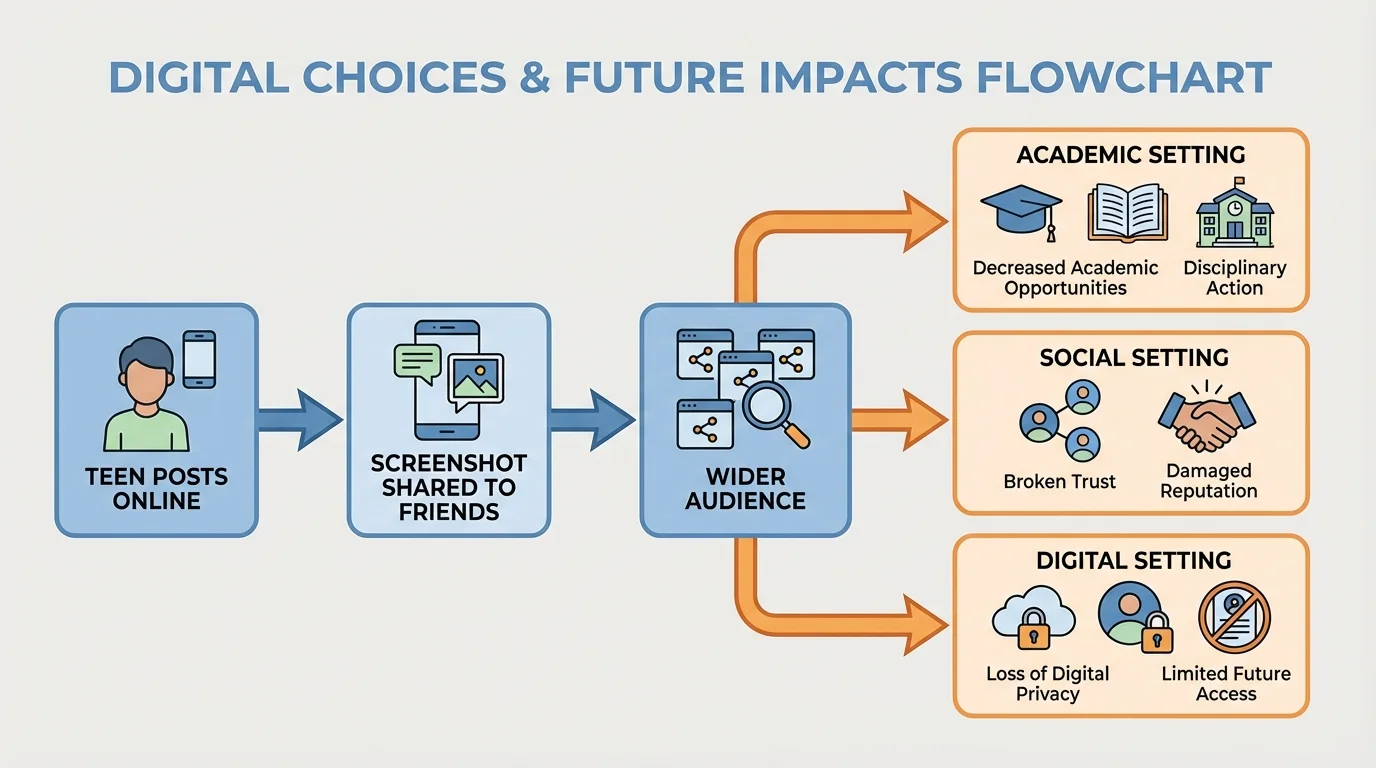
Digital choices often test values in subtle ways. For example, you may see a rumor spreading fast. Sharing it may get attention, but responsibility means checking facts first. You may be tempted to comment something harsh because everyone else is doing it, but respect means remembering that a real person is on the other side of the screen. You may want to post a private image or message from someone else, but loyalty and fairness mean protecting their privacy.
Sometimes the best online choice is not posting at all. Silence is not always weakness. It can be self-control. If you are angry, embarrassed, or trying to impress people, your emotions can push you toward a choice that does not match your values. Waiting even ten minutes can change the result.
Real-life digital choice
A student gets a screenshot of a classmate's awkward message and is tempted to repost it for laughs.
Step 1: Notice the pressure.
The student wants attention and does not want to seem boring.
Step 2: Check values.
Reposting would conflict with kindness, respect, and privacy.
Step 3: Predict consequences.
The classmate could feel humiliated, trust could be damaged, and the reposting student could gain a reputation for being unsafe to confide in.
Step 4: Choose a better action.
Delete the screenshot, refuse to share it, or tell others to stop spreading it.
This choice protects both the other person and the student's own integrity.
Your digital footprint is not only about avoiding mistakes. It is also about building a positive record. Helpful comments, respectful disagreement, honest work, and thoughtful posting all strengthen your reputation. The same online spaces that can spread harm can also spread trust.
Social choices can be tricky because they involve belonging. Most people want to be accepted. That is why peer pressure can be powerful. In online group chats, game chats, and social media threads, pressure can happen fast, as [Figure 2] illustrates through the different paths a single decision can take.
A common mistake is thinking that only the person who starts the harm is responsible. In reality, joining in, encouraging it, forwarding it, or staying silent when someone is being targeted can all affect the outcome. Character shows up not only in what you create but also in what you support.
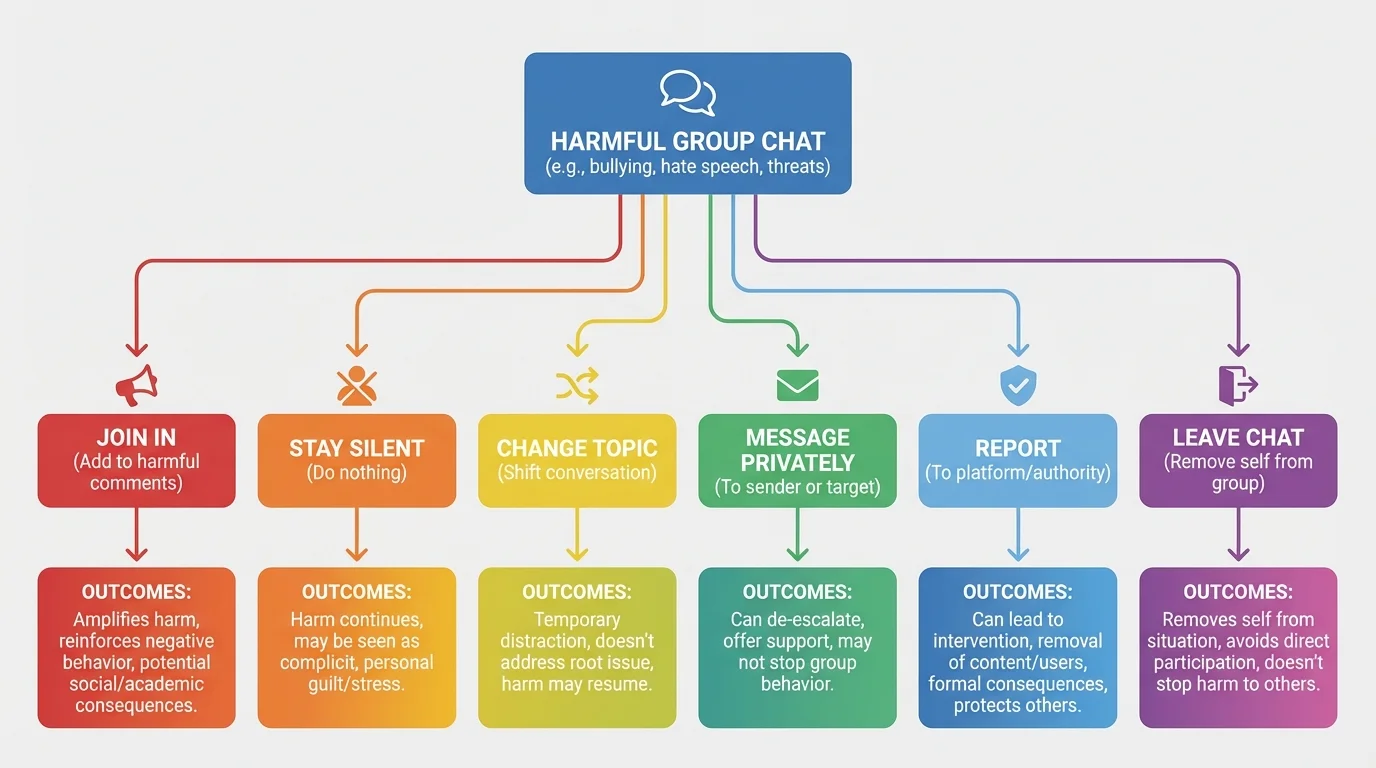
Suppose you are in a group chat and someone begins mocking another person. You have several choices. You could add your own joke. You could stay quiet. You could message the person privately to check on them. You could say, "Let's stop." You could leave the chat or report the behavior if it becomes serious. Not every option feels equally easy, but not every option is equally responsible.
Respect does not mean you must agree with everyone. You can disagree honestly without being cruel. You can set boundaries without being rude. You can be loyal to a friend without helping them do something harmful. Real loyalty is not covering up bad behavior. It is encouraging better behavior.
"Character is what you do when no one is watching."
This idea matters in private messages and closed chats. People sometimes act as if private spaces do not count. They do. A hidden choice is still a real choice. If anything, private spaces reveal character more clearly because there is less pressure to look good.
Another important social skill is handling conflict. If someone hurts your feelings, values can guide your response. Instead of posting a vague insult or starting a pile-on, try direct communication. Say what happened, explain how it affected you, and ask for a change. This is more mature and more effective than revenge posting.
Many conflicts grow larger not because of the first mistake, but because people react quickly, publicly, and without checking facts. A pause can prevent a problem from spreading.
Later, when you think again about the choices in [Figure 2], notice something important: the brave option is not always the loudest one. Sometimes courage means quietly refusing to participate, privately supporting someone, or stepping away from a harmful conversation.
In online learning, character matters a lot because you often work independently. There may be no teacher nearby. That makes academic integrity especially important. Academic integrity means doing your work honestly, giving credit when you use someone else's ideas, and following the rules for collaboration and tools.
Cheating is not only copying answers from another student. It can also include using websites to submit someone else's writing, letting another person complete your work, hiding the use of outside tools, or pretending you understand material that you did not actually learn. A choice can still be dishonest even if it is easy to do.
Plagiarism happens when you present someone else's words, ideas, or work as if they were your own. That might look like copying from a website, pasting from a chatbot without permission, or lightly changing a few words and pretending it is original. The problem is not just breaking a rule. The deeper problem is that it blocks real learning and damages trust.
| Situation | Choice with integrity | Choice without integrity |
|---|---|---|
| Writing a response | Use your own words and cite sources when required | Copy from a website and submit it unchanged |
| Using a tool for help | Follow class rules and use the tool to support learning | Use the tool to produce the full answer when that is not allowed |
| Working with others | Collaborate only in approved ways | Share answers when independent work is required |
| Not understanding a topic | Ask for help, review notes, and try again | Guess, copy, or hide confusion |
Table 1. Comparison of honest and dishonest choices in online academic work.
When you choose honesty in learning, you may get a lower score sometimes than if you cheated. But you gain something more valuable: actual skill. Over time, honest practice builds confidence because you know what you can truly do. Dishonest shortcuts create the opposite. They may help for a moment, but they weaken your ability and increase stress.
Academic choice check
You are stuck on an assignment and find a full answer online.
Step 1: Stop before copying.
Notice that frustration is pushing you toward a shortcut.
Step 2: Read the instructions carefully.
Check what kinds of help are allowed.
Step 3: Use support the right way.
Review notes, ask your teacher a question, use approved resources, or write what you do understand first.
Step 4: Turn in honest work.
Even if it is incomplete, honest work gives you feedback you can use to improve.
That choice supports learning instead of faking it.
Responsibility in academics also includes time management. Sometimes cheating starts earlier than students think. It begins when work is delayed, sleep is ignored, or tasks pile up. Then panic appears, and panic makes bad choices seem reasonable. Planning ahead is part of ethical behavior because it lowers the chance that pressure will control you.
Good choices become easier when you have a process. The five-step framework in [Figure 3] helps when emotions are high, other people are pressuring you, or the right answer is not obvious.
Step 1: Pause. Slow yourself down. Do not reply, repost, or submit something just because the moment feels urgent.
Step 2: Check the facts. What actually happened? What do you know for sure? What are you assuming?
Step 3: Test against your values. Does this match honesty, respect, fairness, responsibility, and self-control?
Step 4: Predict consequences. Who could be helped? Who could be harmed? What happens today, and what might happen later?
Step 5: Choose and review. Make the best decision you can, then reflect on the result so you learn from it.
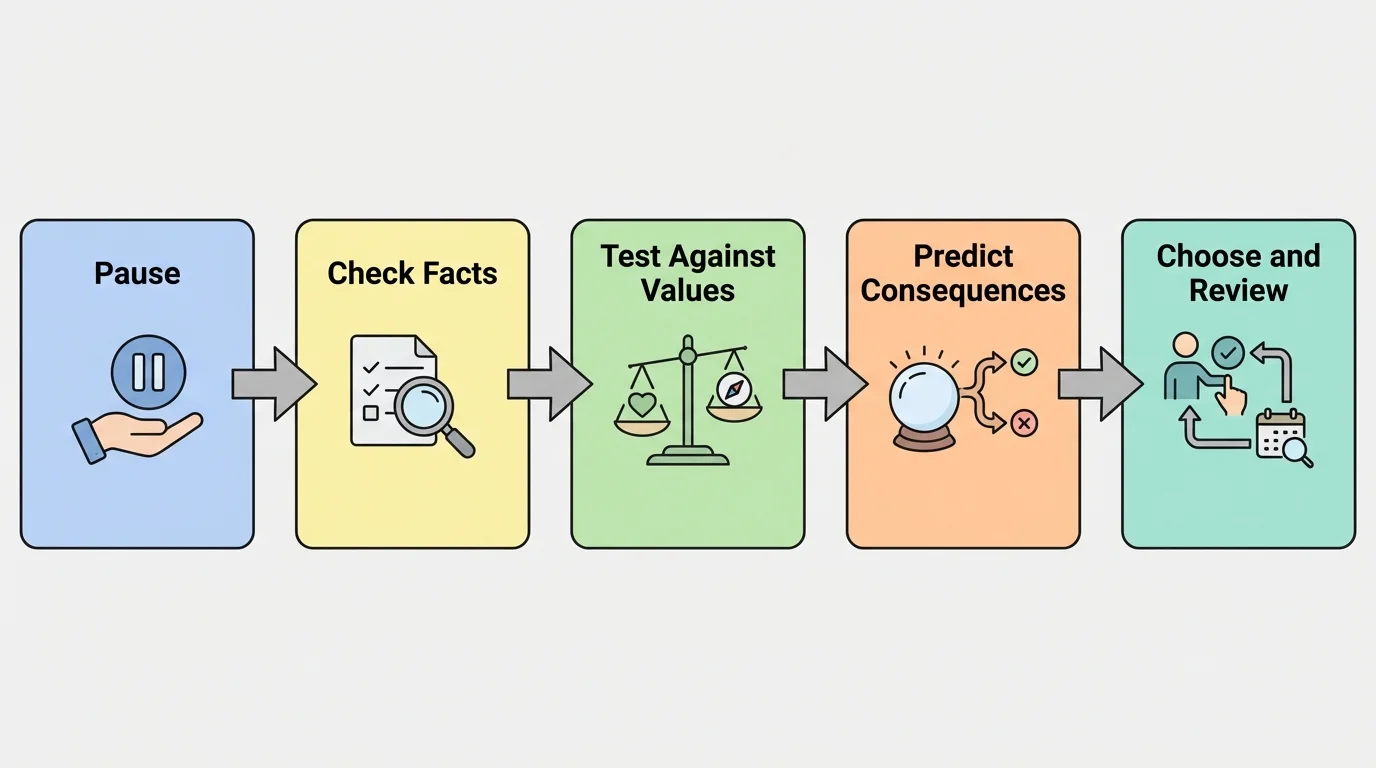
This process sounds simple, but it is powerful because it interrupts automatic behavior. Many poor choices happen when a person reacts before thinking. A pause creates space for character to lead instead of impulse.
Try this: the next time you are about to send a message while angry, wait for at least ten minutes and reread it. Then apply the five steps. You may still send a message, but it will probably be clearer, calmer, and more respectful.
Short-term pressure vs. long-term identity is one of the biggest challenges in ethical decision-making. A quick choice may help you fit in, avoid embarrassment, or escape effort right now. But your long-term identity is built from repeated choices. Ask, "What kind of person does this action train me to become?"
When you return to the flow in [Figure 3], notice that the strongest step is often the middle one: testing against your values. Facts matter, and consequences matter, but values help you decide what kind of outcome is worth choosing.
Everyone makes mistakes. Character is not about being perfect. It is about what you do next. If you post something harmful, cheat, break confidence, or act unfairly, the most responsible move is to face it honestly.
Repair usually includes four parts. First, admit what happened without excuses. Second, acknowledge the impact on other people. Third, take action to correct what you can, such as deleting a post, telling the truth, or redoing work honestly. Fourth, make a plan not to repeat the mistake.
Repairing trust after a bad choice
You forwarded a private message that was not yours to share.
Step 1: Stop the spread.
Delete what you sent and ask others not to continue sharing it.
Step 2: Apologize clearly.
Say what you did, why it was wrong, and that you understand the harm.
Step 3: Accept consequences.
Do not argue if trust takes time to rebuild.
Step 4: Change future behavior.
Use a pause before sharing messages, photos, or screenshots again.
A real apology is not just words. It includes changed behavior.
Rebuilding trust can be slow. That is normal. If someone does not trust you right away, it does not always mean they are being unfair. Trust is earned through consistency. The way forward is patience, honesty, and repeated good choices.
Character grows through practice. You do not wait until a huge situation appears. You build it in ordinary moments. Each time you tell the truth, return to your values, respect someone's privacy, or complete work honestly, you strengthen the habit of doing what is right.
Try this: choose three values that matter most to you, such as honesty, respect, and responsibility. Write them somewhere you see often. Before posting, replying, or turning in work, ask, "Does this match my values?" That one question can change a lot.
Habits form through repetition. The more often you practice a behavior, the easier it becomes to repeat. That is true for both strong habits and harmful ones.
You can also build support around yourself. Follow people online who model respect. Spend less time in spaces that reward cruelty or dishonesty. Ask trusted adults for help when a decision feels too big to handle alone. Responsibility does not mean solving everything by yourself. It also means knowing when to ask for guidance.
Your future is shaped not only by talent, intelligence, or popularity, but by the quality of your choices. In digital spaces, in social situations, and in academic work, values and character guide what you do when the answer is not easy. When you practice honesty, respect, fairness, courage, and responsibility, you become someone others can trust and someone you can be proud to be.
