You probably notice community problems before you ever learn the official words for them. A streetlight stays broken for weeks. A park is clean in one neighborhood but full of trash in another. The local library cuts its hours. A road floods every time it rains. None of those problems happen by accident. They connect to decisions, rules, money, and people working together—or not working together. That is why understanding civic life matters. It helps you see how your community really works and how you can respond in smart, responsible ways.
Even if you are not old enough to vote yet, local decisions still affect your life. They can shape whether your area has safe sidewalks, clean water, reliable internet, youth programs, public transportation, emergency services, and places where people feel welcome. If a community handles problems well, daily life usually becomes safer, healthier, and more organized. If it handles problems poorly, stress, unfairness, and conflict often grow.
When you understand civic systems, you are better at asking useful questions instead of just saying, "This is unfair." You can ask: Who makes this decision? Where does the money come from? Who benefits? Who might be harmed? What are the short-term and long-term effects? Those questions turn frustration into action.
Civic systems are the structures and processes that help a community function, including local government, laws, public services, community groups, and the ways residents communicate with decision-makers.
Public issues are problems or concerns that affect many people in a community, such as traffic, pollution, public safety, access to housing, or the quality of local parks.
[Figure 1] A practical life skill is being able to notice a public issue, evaluate it fairly, and decide what responsible action makes sense. That skill helps you online, at home, in volunteer work, and later as a voter, employee, customer, tenant, or community member.
Local communities function through connected parts. Residents notice needs. Local leaders or agencies review them. Rules and budgets shape what can happen next. Then public workers, nonprofit groups, or community volunteers carry out solutions. This process may seem slow, but it affects everyday realities such as trash pickup, road repairs, animal control, emergency response, parks, and zoning.
A local government usually includes leaders such as a mayor, council, commissioners, or other officials. Different departments handle different jobs. One department may focus on transportation, another on parks, another on health, and another on public safety. Communities also depend on courts, public utilities, libraries, and special districts. In many places, nonprofit groups and neighborhood associations also help fill gaps where government services are limited.
Money matters too. Public services often depend on budget decisions. A budget is a plan for how money will be used. If a town spends more on road repair, it may have less available for recreation programs unless new funding is found. That does not always mean one side is right and the other is wrong. It means choices involve trade-offs.
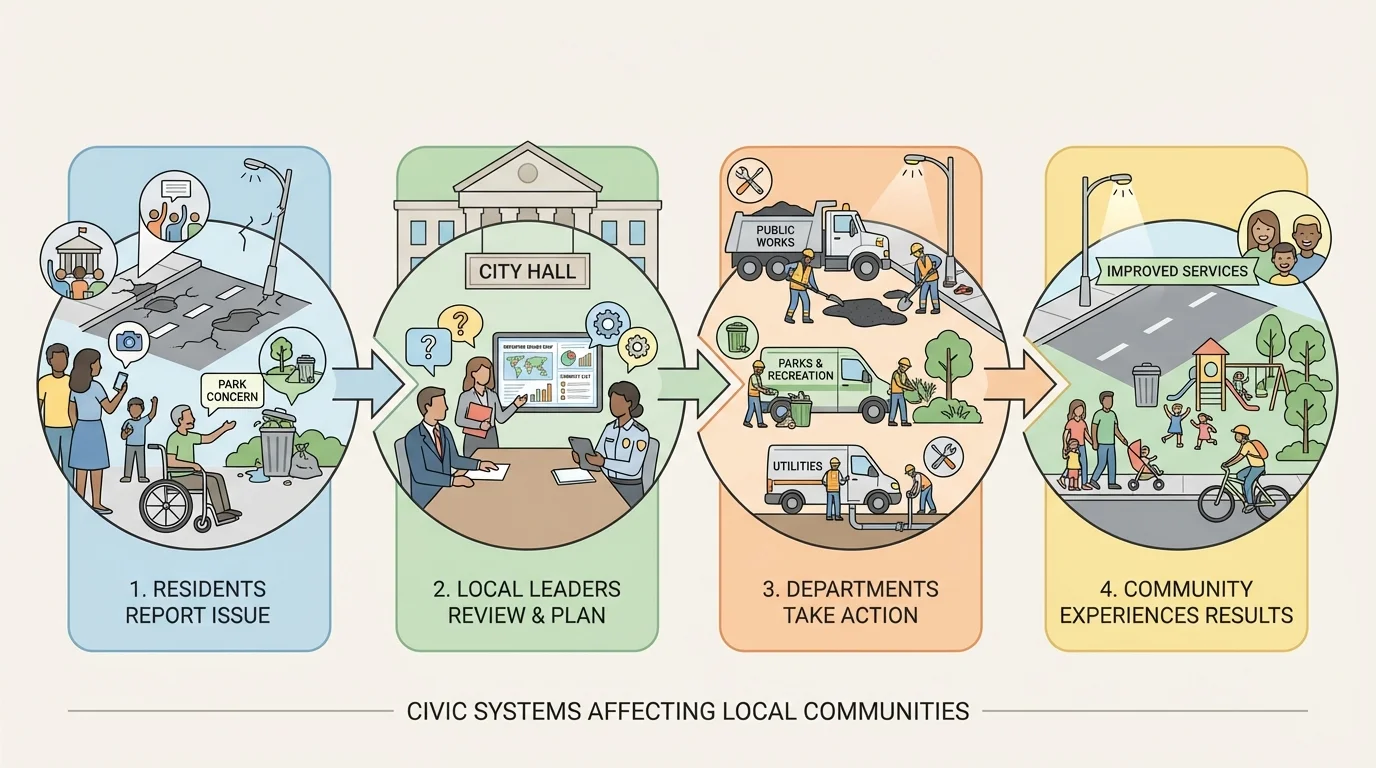
Laws and policies shape these choices. A policy is a rule or plan used to guide decisions. For example, a city might adopt a policy requiring new buildings to include ramps for accessibility. That policy affects builders, people with disabilities, business owners, and visitors. One rule can change daily life for many different groups.
Not every problem is solved only by government. Community organizations, local businesses, faith groups, and volunteers often help with food drives, tutoring, neighborhood cleanup, or mentoring. Civic systems work best when people understand both their responsibilities and their power to contribute.
Many local issues that seem "small," such as a crosswalk, bus stop shelter, or library hour change, can affect hundreds or even thousands of people over time because those services are used again and again every week.
That is why civic awareness is not just about politics. It is about noticing how systems affect real life. If the system responds quickly, people may feel heard and protected. If it ignores certain neighborhoods, trust can break down.
A public issue is easier to understand when you connect it to everyday life. Here are some common local issues you might notice in your own area or nearby communities.
Housing: If rent rises too fast, families may have to move often, live farther from jobs, or struggle to pay for food and healthcare. Housing issues can affect school stability, transportation time, and stress at home.
Transportation: Limited bus service, unsafe roads, or missing sidewalks can make it harder for people to get to work, medical appointments, stores, or community events. Transportation problems hit hardest when people do not have many options.
Public safety: This includes more than policing. It can involve streetlights, emergency response times, dangerous intersections, fire prevention, and safe public spaces. A neighborhood may feel unsafe because of poor lighting, speeding cars, or abandoned buildings.
Environmental concerns: Pollution, litter, flooding, poor air quality, and lack of trees can affect health and quality of life. If one part of a community has more industrial waste or fewer green spaces, people there may face more risks.
Access to services: A community may lack clinics, grocery stores, libraries, recreation spaces, mental health support, or strong internet access. These gaps can create unfair differences between neighborhoods.
| Issue | Possible Community Effect | Who May Be Affected Most |
|---|---|---|
| Broken sidewalks | Higher injury risk, harder travel | Older adults, children, people using wheelchairs |
| Limited library hours | Less access to computers and study space | Students, job seekers, families without home internet |
| Poor bus routes | Late arrivals, fewer opportunities | Workers, teens, seniors, people without cars |
| Flooding streets | Property damage, unsafe travel | Nearby residents and businesses |
| Few parks or trees | Less recreation, more heat | Children, families, neighborhoods with dense housing |
Table 1. Examples of local public issues, their effects, and groups that may be impacted most.
Notice that the same issue can affect people differently. A road closure might be a small inconvenience for one family but a major obstacle for someone who depends on a bus route or medical transport. Good civic thinking means looking beyond your own experience.
When you want to understand a local issue, use a simple process instead of reacting only with emotion. The evaluation path in [Figure 2] helps you slow down, gather facts, and think more clearly. This is useful whether you are reading a social media post about a neighborhood problem or talking with your family about a local proposal.
Step 1: Name the issue clearly. Be specific. "The community is bad" is too vague. "The bus route was reduced, and now some residents have no direct ride to the clinic" is specific enough to evaluate.
Step 2: Gather facts from reliable sources. Look for local news, official websites, public meeting notes, city department pages, and direct statements from organizations involved. If a post online says, "They are shutting down the park forever," check whether that claim is true before repeating it.
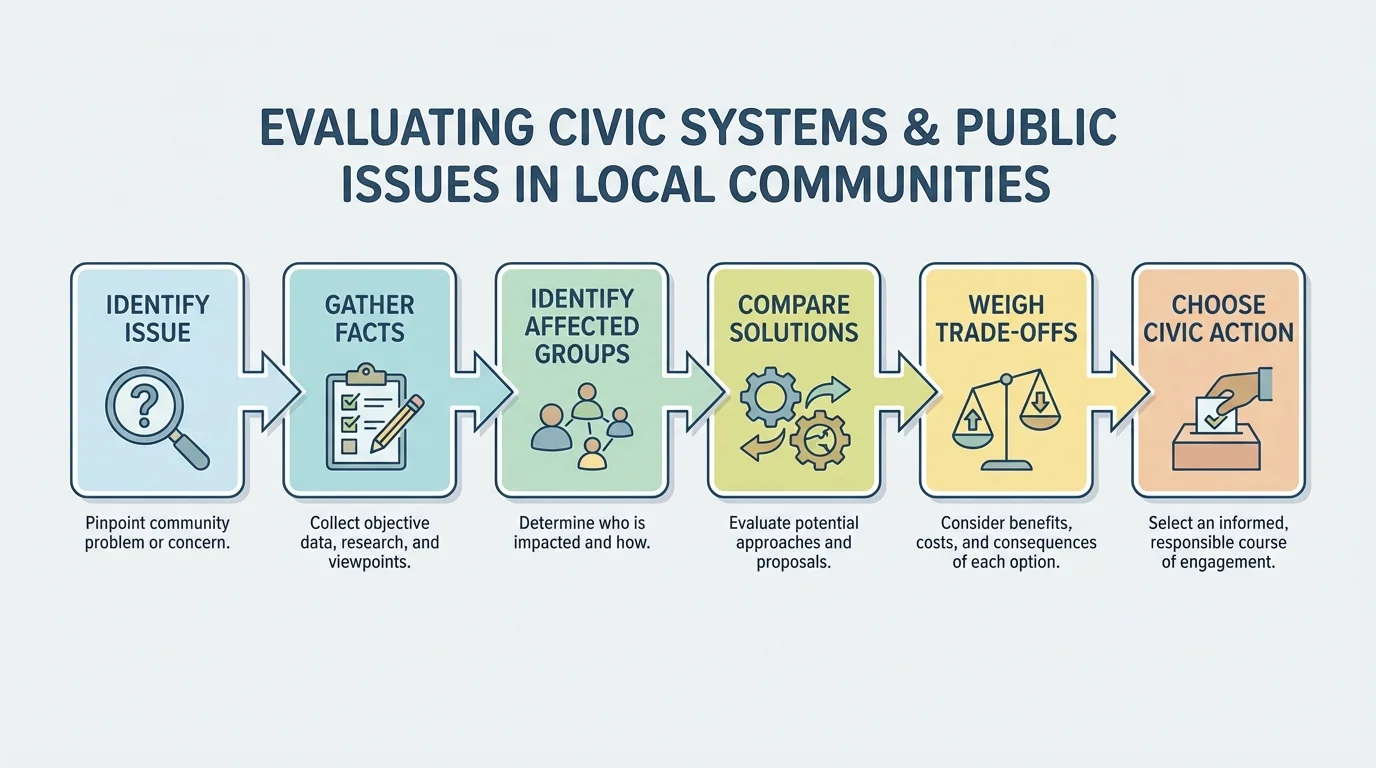
Step 3: Identify the stakeholders. A stakeholder is any person or group affected by the issue. For a park renovation, stakeholders may include children, parents, nearby residents, athletes, local businesses, disability advocates, and taxpayers.
Step 4: Ask who benefits and who bears the burden. Sometimes a solution helps many people but creates a challenge for others. For example, adding more parking may help drivers but reduce green space. Building a bike lane may improve safety but temporarily slow traffic during construction.
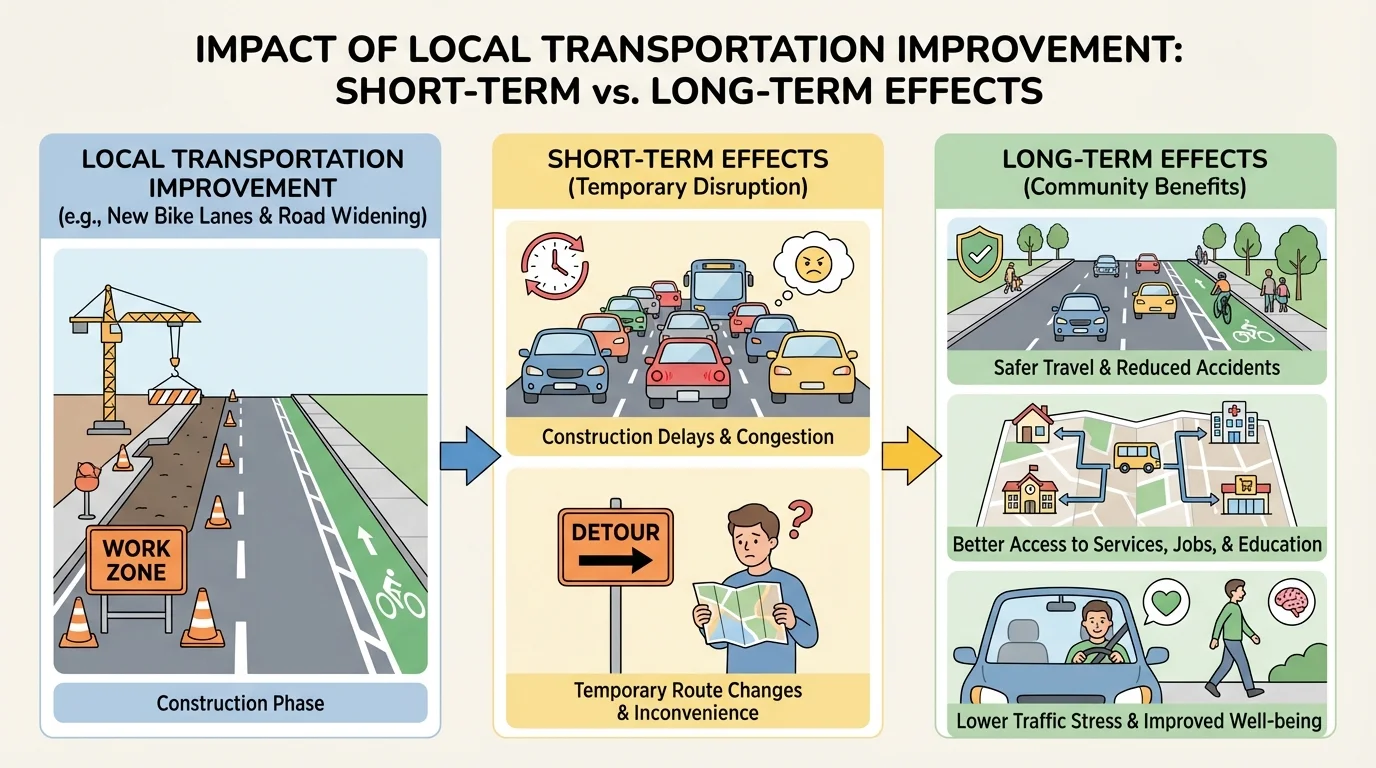
Step 5: Compare short-term and long-term effects. Some decisions feel annoying now but help later. Road construction can cause delays for a few months but reduce accidents for years. Other choices feel easy now but create bigger problems later, like delaying repairs until damage gets worse.
Step 6: Consider fairness. Ask whether the issue affects some neighborhoods more than others. If services are strong in one area but weak in another, that may point to an equity concern. Equity means trying to make things fair by recognizing that different people and neighborhoods may need different levels of support.
Case study: Evaluating a proposal to reduce library hours
Step 1: Define the issue
The library may close earlier on weekdays because of budget pressure.
Step 2: Gather facts
You check the library website, local council notes, and community comments to learn whether the change is permanent, temporary, or still under discussion.
Step 3: Identify stakeholders
Students, job seekers, parents with young children, older adults, and people without home internet may depend on the library most.
Step 4: Compare effects
Short-term benefit: lower staffing costs. Short-term harm: fewer hours for people who need computers after work. Long-term risk: reduced access to learning and services.
Step 5: Choose a response
A responsible action might be sending a respectful message to local leaders asking about alternatives, such as reduced hours on fewer days instead of every weekday.
This process does not guarantee that everyone will agree. It does help you make stronger, fairer judgments. That matters because many public issues involve complicated trade-offs rather than easy answers.
When people disagree about public issues, they often think the other side "does not care." Sometimes that is true, but often people simply have different priorities, information, or experiences. A parent might care most about safe crosswalks. A shop owner might worry about losing street parking. A city planner may focus on long-term traffic flow. All three perspectives matter.
This is where civic engagement becomes more than arguing. Civic engagement means taking part in community life in responsible ways, such as staying informed, speaking up respectfully, joining discussions, or helping solve problems. Good civic engagement requires listening as well as speaking.
Be especially careful online. Local issues spread fast through short videos, comments, screenshots, and rumors. A dramatic post may leave out key details. Before sharing, ask: Is the source reliable? Is there evidence? Is this current? What might be missing? A misleading post can make people angry and damage trust even if the claim is incomplete or false.
Fair evaluation means separating facts, opinions, and values. Facts are pieces of information you can check, such as meeting dates, budget amounts, or repair schedules. Opinions are personal views, like whether a project seems worth the cost. Values are beliefs about what matters most, such as safety, freedom, convenience, or fairness. Public debates often become confusing when people treat opinions like facts or ignore the values behind a disagreement.
Respectful disagreement is a real skill. You do not have to stay silent to be polite. You can say, "I understand this may help one group, but I am concerned about how it affects another," or "What evidence supports that claim?" That kind of response is more powerful than insults or reposting anger.
Later, when you compare new issues, the system we saw in [Figure 2] still helps: define the issue clearly, gather facts, identify affected groups, and weigh trade-offs before deciding where you stand.
You do not need to wait until adulthood to participate in community life. You can act now in ways that are safe, legal, and realistic. Small actions matter when they are thoughtful and consistent.
Learn before you react. Read local updates, follow reliable community sources, and check whether meetings, proposals, or service changes are real. Being informed is one of the simplest forms of civic responsibility.
Communicate respectfully. You can email a local office, fill out a community survey, comment during a virtual public meeting if allowed, or write a clear message explaining a concern. Short, specific messages usually work better than emotional rants.
Support community efforts. Volunteer with cleanup events, food banks, tutoring programs, donation drives, or neighborhood projects. Service helps you understand community needs from real experience.
Use your voice wisely online. Share verified information, encourage respectful discussion, and avoid spreading rumors. Civic participation online can help people learn about local issues, but it can also create harm if used carelessly.
Work with others. Community problems are often easier to address when people collaborate. Families, neighbors, local groups, and youth organizations can collect concerns, compare experiences, and suggest solutions together.
Practical message template for a local concern
You notice that a crosswalk signal near a community center has not worked for several days.
Step 1: State the problem clearly
"I am writing to report that the crosswalk signal near the community center on Maple Street is not working."
Step 2: Explain the impact
"This makes it harder for children, families, and older adults to cross safely."
Step 3: Ask respectfully for action
"Could your office let residents know whether a repair is scheduled?"
Step 4: Stay calm and factual
A respectful tone increases the chance that your message is taken seriously.
Try This: The next time you see a local complaint online, pause before reacting. Identify the exact issue, find one reliable source, and ask who is affected. That one habit can make your civic thinking much stronger.
Being active in your community also means understanding basic legal awareness. Legal awareness means knowing the rules, rights, and limits connected to a situation. It helps you participate responsibly instead of accidentally causing problems for yourself or others.
For example, communities often have rules about public meetings, permits, public property, and online conduct. If you want to join a community event, campaign, or public gathering, it is smart to learn what is allowed, what requires permission, and what safety rules apply. Not every action that sounds good is safe or lawful.
Privacy matters too. If you post about a local issue, avoid sharing private addresses, personal phone numbers, medical details, or images of minors without permission. It is possible to care about a community problem and still respect people's rights.
You should also know that rights come with responsibilities. Free expression is important, but threats, harassment, and false accusations can hurt real people and lead to serious consequences. Responsible civic action stays truthful, respectful, and within legal boundaries.
Remember: Being "passionate" is not the same as being effective. Effective civic action usually combines facts, safety, respect, and persistence.
If you are unsure about a legal or safety issue, ask a trusted adult, check an official source, or contact the relevant organization directly. Guessing can create unnecessary risk.
Strong communities do not just solve today's problem. They plan for what comes next. As [Figure 3] illustrates, one local choice can create both short-term inconvenience and long-term benefits. A construction project may be noisy now, but later it could make streets safer, reduce flooding, or improve access for people with disabilities.
Future thinking matters because public issues are connected. If a town cuts tree planting, heat may become worse in the summer. If road maintenance is delayed, repair costs may rise later. If youth programs disappear, some young people may lose safe spaces, mentoring, or support networks that help a community stay healthy.
A useful question is not only "What happens now?" but also "What happens next year if this continues?" That question helps you evaluate sustainability, fairness, and long-term community health.
Communities also change over time because of population growth, weather patterns, technology, jobs, and housing costs. That means civic systems must adapt. Reliable internet access, for example, is now much more important than it was years ago because people use it for school, work, healthcare, and public information. A community without strong internet access may fall behind in opportunities.
When you think about the future, you start to notice patterns. The same system that responds to flooding can also affect housing. The same transportation decision can affect safety, jobs, and pollution. That big-picture thinking is one of the most valuable civic skills you can develop.
"The best way to predict the future is to help create it."
— Common civic principle
You do not need to fix every public issue by yourself. Your role is to stay aware, think carefully, act responsibly, and contribute where you can. Communities become stronger when more people do that consistently.
As you evaluate future issues, remember the community trade-offs shown in [Figure 3]. A smart civic decision often balances present needs with long-term well-being rather than focusing on only one side.
