People usually notice accountability most when it is missing. A group project falls apart because one person never sends their part. A rumor spreads because someone reposts before checking facts. A younger sibling is left waiting because you said you would help and forgot. In each case, the problem is not just the action itself. The bigger issue is that someone's choice affects other people. Accountability is what helps trust come back.
At your age, accountability becomes a real-life skill, not just a rule adults talk about. You are making more of your own decisions, managing more of your own time, and building a reputation online and offline. When your actions affect a friend, your family, a team, or a shared goal, people need to know whether they can count on you. That is what this lesson is really about: learning how to respond in a strong, honest, practical way when your choices have consequences.
Accountability matters because trust is built from patterns, not promises alone. If you regularly follow through, admit mistakes, and fix problems, people see you as reliable. If you avoid responsibility, make excuses, or disappear when something goes wrong, people start protecting themselves from being let down.
Think about a few everyday situations. If you borrow something and return it damaged without saying anything, the other person may stop lending you things. If you agree to join a video call for a community club and never show up, others may have to redo the plan. If you post a screenshot that includes someone else's private message, even as a joke, you can damage trust in a way that lasts much longer than the moment of humor.
Why people respect accountable behavior
Being accountable does not mean being perfect. It means being honest about your role when something goes wrong and doing what you can to make it right. Most people can handle a mistake more easily than they can handle denial, blame-shifting, or silence.
One reason accountability can feel hard is that nobody likes feeling embarrassed or guilty. Your brain may quickly search for a defense: I didn't mean to, everyone else was doing it, or it wasn't fully my fault. Sometimes those details are partly true. But if they become a shield against responsibility, they keep you from solving the real problem.
When your choices affect others, one important idea is impact. Impact means the real effect of your actions on someone else or on a result that multiple people share. Another important idea is a shared outcome, which is a result that depends on more than one person's effort. Family chores, team sports, online group projects, event planning, and group chats all involve shared outcomes.
Accountability means owning your actions, recognizing their effects, and taking steps to repair harm or improve what happens next.
Intention is what you meant to do. Impact is what actually happened because of what you did.
Shared outcome is a result that affects a group and depends on people doing their parts.
A big part of maturity is learning the difference between intention and impact. You may not have meant to hurt someone, waste people's time, or create extra work. But if that is what happened, accountability still matters. Saying "I didn't mean to" may explain your intention, but it does not solve the impact.
For example, suppose you are editing a shared slideshow and accidentally delete someone else's work. You did not intend to ruin the project, but the impact is still real. Accountability means saying what happened, apologizing, and helping restore the missing work. It does not mean pretending intention and impact are the same. It means understanding that both matter.
Sometimes people avoid accountability because they do not notice the full circle of effects. A choice can feel private when it really is not. If you stay up late gaming and then oversleep for a volunteer shift, that "private" choice affects the people who counted on you. If you joke in a group chat and one person becomes the target, the humor is not just your personal expression anymore; it changes the group environment.
Start asking yourself a few quick questions: Who could be affected by this? What happens if I do nothing? Is anyone depending on me? Does this involve someone else's time, privacy, feelings, safety, or work? Those questions help you notice responsibility earlier, before a situation gets bigger.
Here are common areas where accountability matters:
Accountability is often easier when you catch problems early. A late message saying "I'm running behind, and I know that affects the plan" is much better than silence. Early honesty gives other people time to adjust.
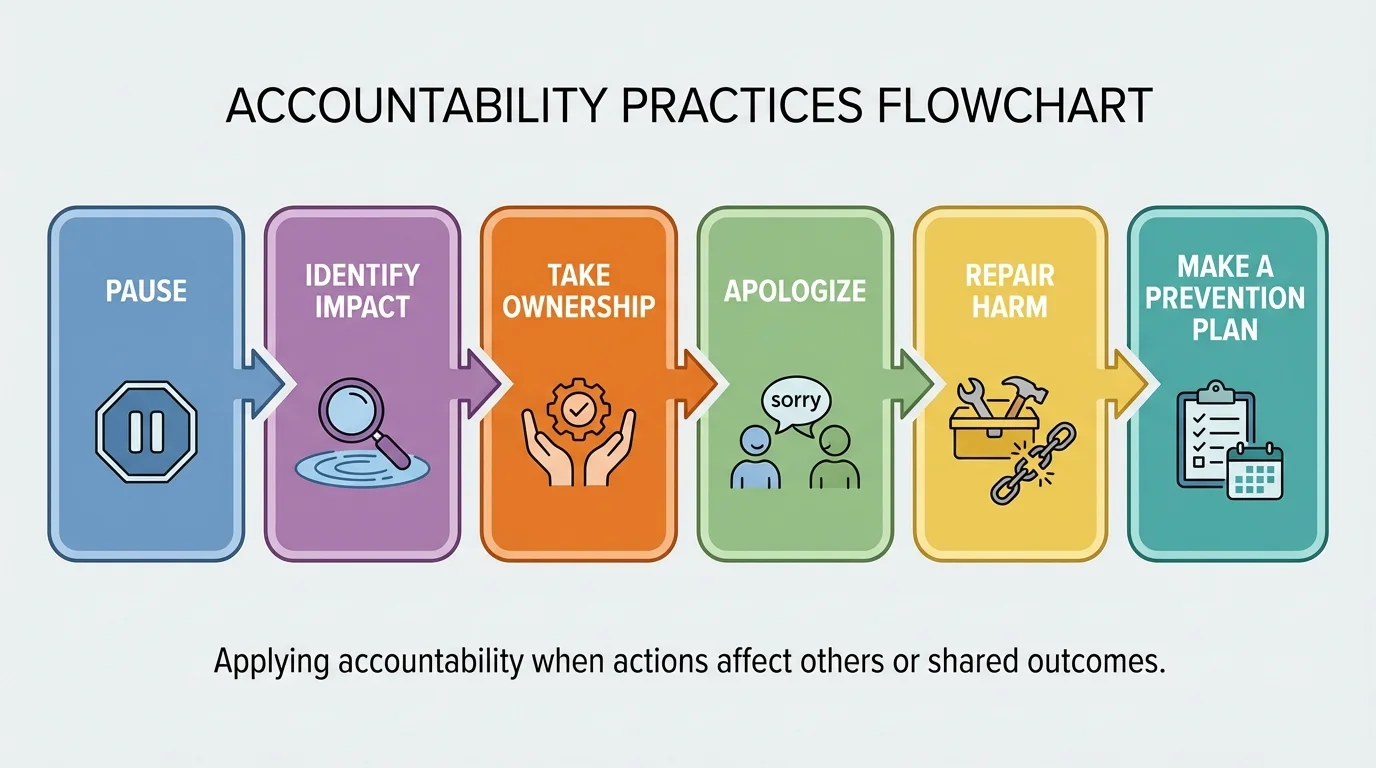
When things go wrong, you do not need a perfect speech. You need a repeatable process, as shown in [Figure 1], that helps you move from mistake to repair. Having steps matters because emotions can make people freeze, argue, or disappear. A process keeps you grounded.
Step 1: Pause. Before defending yourself, stop and breathe. If you react too fast, you may make the situation worse.
Step 2: Name what happened. Be specific about your action.
Step 3: Acknowledge the impact. Show that you understand how others were affected.
Step 4: Take ownership. Use clear language such as "I was responsible for that."
Step 5: Repair what you can. Ask what would help, and do the work.
Step 6: Make a prevention plan. Change a habit, system, or reminder so the same issue is less likely next time.
This process works whether the issue is small or serious. If you forgot to feed the dog, repair might mean feeding the dog right away and setting a daily reminder. If you embarrassed a friend online, repair may include deleting the post, apologizing privately, and not reposting similar content again.
Notice that accountability is not the same as punishing yourself. The goal is not to spiral into "I'm the worst." The goal is to respond usefully. Shame often keeps people stuck. Responsibility helps people move.
Case study: You forgot your part of a group task
You promised to upload research notes by the evening, but you got distracted and did not do it. The rest of the team had to wait.
Step 1: State the action clearly.
"I said I would upload my notes tonight, and I didn't do it."
Step 2: Name the impact.
"That delayed everyone else because they needed my section to keep going."
Step 3: Repair.
"I'm finishing it now, and I can also help combine the final document so some of the delay is on me, not the group."
Step 4: Prevent.
"Next time I'll set an alarm for two hours before the deadline and send an update if I'm behind."
This kind of response is stronger than saying, "Sorry, I was busy." Most people are busy. Accountability answers the real question: What are you doing now that the problem happened?
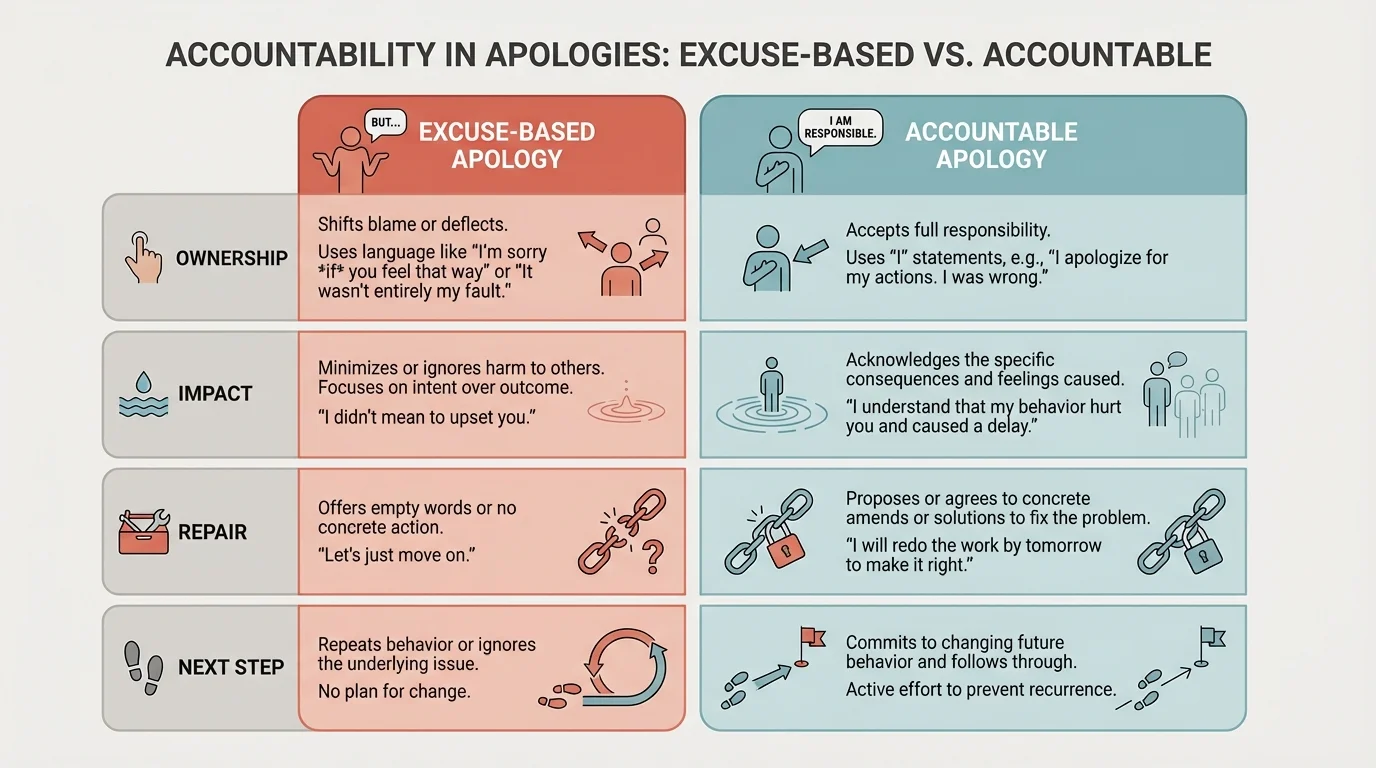
A good apology is a skill. It has parts that you can learn and practice, as [Figure 2] lays out in a simple comparison. Strong apologies sound direct, calm, and honest. Weak apologies usually contain excuses, vagueness, or pressure on the other person to forgive you quickly.
Here is a practical script you can adjust: "I did ____. I realize that affected you by ____. I'm sorry. I want to fix this by ____. Next time I will ____." This script works because it includes action, impact, apology, repair, and prevention.
Here are examples of accountable language:
Here are examples that sound like apologies but avoid responsibility:
Those responses protect your pride, but they do not rebuild trust. They make the other person feel unseen or blamed.
Sometimes the other person is still upset even after you apologize well. That can be uncomfortable, but accountability includes respecting that their feelings may take time. An apology is not a machine where you put in words and instantly get forgiveness back. Your job is to be honest and make repair efforts, not control the other person's reaction.
"Character is not shown by never making mistakes. It is shown by what you do after the mistake."
If speaking feels hard, write your message first. Read it and remove excuses, blame, and extra details that distract from the core issue. Short and clear is usually better than long and dramatic.
A lot of modern accountability happens through screens. That matters because online actions can spread fast and stay visible. A post, comment, screenshot, or forwarded message can affect people far beyond the moment you hit send.
Digital accountability includes checking facts before sharing, asking before posting someone else's image or message, giving credit for ideas, and correcting misinformation when you spread it. It also includes basic reliability, like replying when people are waiting on your answer or telling a team early if you cannot meet a deadline.
There is also a skill called repair. Repair means doing something concrete to address harm after a problem happens. Online, repair might mean deleting a harmful post, adding a correction, sending a direct apology, or contacting the people affected. Sometimes repair also means stepping back and changing your habits, such as turning off impulsive posting during emotional moments.
Messages sent in anger often feel temporary when you type them, but screenshots can turn a ten-second decision into a long-term reputation problem.
Try this before posting or forwarding anything: Pause for ten seconds and ask, "Is it true? Is it kind? Is it necessary? Is it mine to share?" If the answer to one of those is no, stopping is often the most accountable choice.
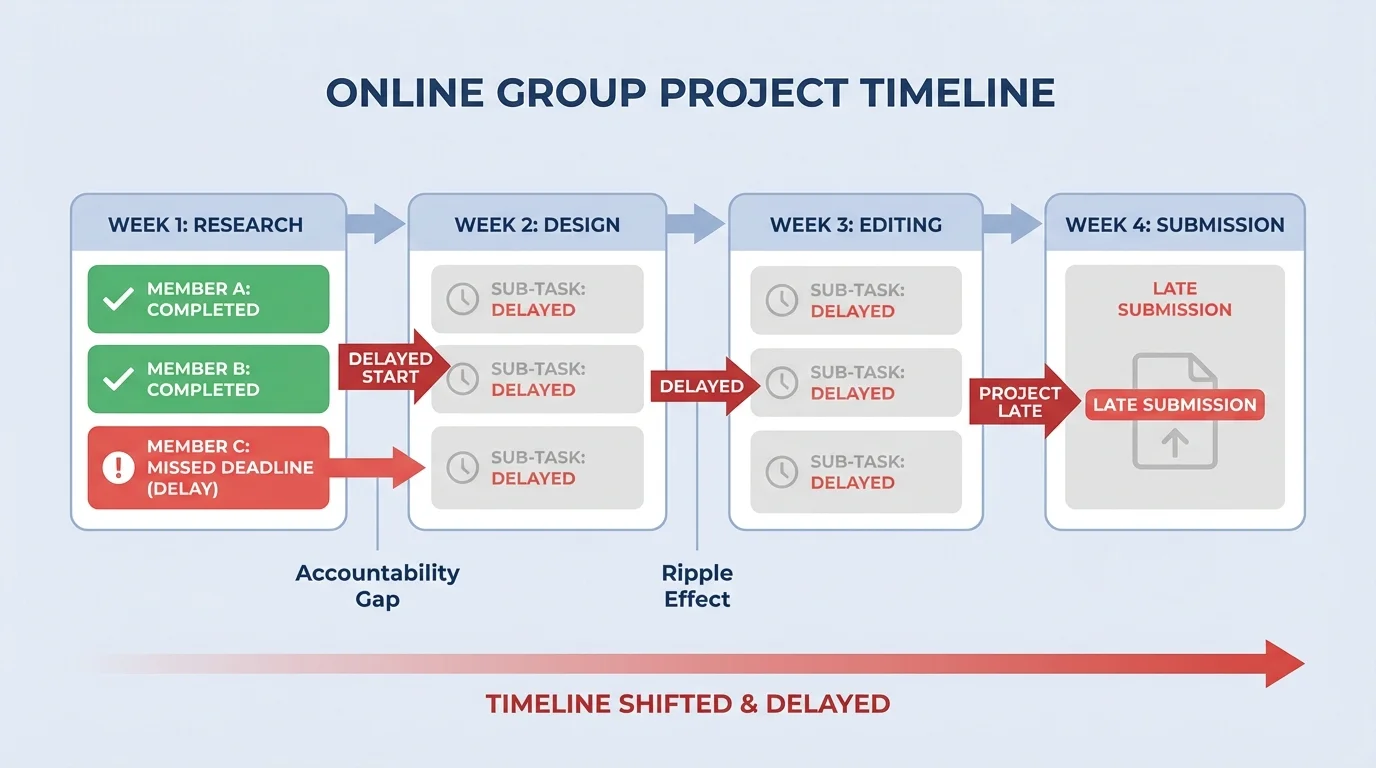
In situations that depend on reliability, people are not just judging your talent. They are judging whether you can be counted on. Shared outcomes work like a chain, and [Figure 3] shows how one missed link can delay the whole result. This is true in sports teams, family plans, volunteer projects, creative collaborations, and online study groups.
If one person misses a step, others often have to spend extra time covering for it. That can create stress and resentment. Even if the final result still gets done, the process becomes harder for everyone else.
One of the most accountable things you can do in a group is communicate early. If you are confused, ask sooner. If you are behind, update sooner. If you made an error, say so sooner. Waiting usually makes shared problems worse.
Here is a simple teamwork checklist:
Later, when you think about trust in teams, remember the chain effect shown in [Figure 3]. Accountability is not only about mistakes. It is also about being the person whose steady actions make the whole group stronger.
| Situation | Unaccountable response | Accountable response |
|---|---|---|
| Missed deadline | Stay silent and hope no one notices | Inform people quickly, apologize, and give a realistic new plan |
| Shared wrong information | Delete it quietly and pretend nothing happened | Correct it clearly and acknowledge the mistake |
| Hurt someone with a joke | Say they are too sensitive | Own the harm, apologize, and stop repeating the behavior |
| Forgot a responsibility at home | Blame being busy | Finish it, apologize, and use a reminder system next time |
Table 1. Comparison of unaccountable and accountable responses in common life situations.
Accountability is powerful, but it can be misunderstood. Being accountable does not mean accepting blame for things you did not do. It does not mean letting others dump their responsibilities onto you. It also does not mean you must fix every problem by yourself, especially when other people contributed to it.
This is where boundaries matter. Boundaries are limits that protect your time, energy, privacy, and well-being. Healthy accountability sounds like, "I was responsible for my part, and I will fix my part." It does not sound like, "Everything is my fault."
Healthy accountability vs. unhealthy guilt
Healthy accountability is specific, truthful, and connected to action. Unhealthy guilt is vague, overwhelming, and often turns into self-blame without repair. The first one helps you grow. The second one can keep you stuck.
For example, if a group of friends starts mocking someone in a chat and you add one rude comment, accountability means owning your comment. It does not mean taking full blame for every message in the chat. If a family plan falls apart because several people forgot things, you should own your part without pretending the entire problem was yours alone.
At the same time, avoid the opposite mistake: using the phrase "my part" to shrink your responsibility when your part was actually major. Honest accountability is accurate. Not bigger, not smaller.
Accountability becomes easier when it is built into your routines. You do not want to depend only on memory or good intentions. Systems help. A reminder app, a written checklist, a calendar, and a habit of sending updates can prevent many problems before they start. As [Figure 1] shows, the prevention plan matters because growth is not just about saying sorry; it is about changing what you do next time.
Here are practical habits that build accountability:
Try This: For one week, keep a small "follow-through list." Every time you promise to do something, write it down. At the end of the day, check what you completed, what still needs action, and whether anyone is waiting on you.
Try This: The next time you make a small mistake, use the full five-part apology script instead of a quick "my bad." Notice how much clearer and more respectful it feels.
Try This: Before sending a message when you are upset, wait five minutes. Re-read it and remove anything that attacks the person instead of addressing the problem.
Over time, accountable habits strengthen your character. People begin to see that you are someone who can be trusted with tasks, information, and relationships. That reputation opens doors. Friends feel safer with you. Teams work better with you. Adults trust you with more responsibility. Most importantly, you can trust yourself to face problems honestly instead of hiding from them.
