A single post, message, or impulsive act can spread faster than you think. A joke that feels private can turn into screenshots, reports, police involvement, money owed for damage, or restrictions that follow you for a long time. The important truth is simple: online actions are not separate from real life, and "I didn't mean it" does not always erase the consequences.
At this stage of life, you are building habits that affect your friendships, reputation, and future opportunities. You may use group chats, gaming platforms, social media, texting, and community spaces every day. That means you make choices every day about what to say, what to share, what to damage, what to laugh at, and when to stop yourself.
Some people think laws only matter to adults. That is not true. Young people can face consequences too. Those consequences may be different from adult penalties, but they are still serious. You could lose access to accounts, be required to pay for damage, be banned from places, have police contact your family, face court involvement, or be ordered to stay away from certain people.
Knowing the law does not mean being afraid of every mistake. It means becoming smarter. When you understand what can happen, you are more likely to pause, choose better, and protect both yourself and other people.
Legal consequence means a result that happens because a law may have been broken. It can include fines, restitution, community service, court orders, loss of privileges, or other official actions.
Rights are protections people have, such as the right to safety, privacy, and property.
Responsibilities are the duties people have to respect others, follow laws, and act safely in a community.
It also helps to separate two ideas: something can be mean without being illegal, and something can be illegal even if someone calls it a prank. Understanding that difference helps you judge a situation more clearly.
One common example is cyberbullying, which means using technology to repeatedly harm, humiliate, threaten, or target someone. This can include cruel group chats, fake accounts, posting embarrassing images, spreading rumors, pressuring others to pile on, or excluding someone on purpose and turning that exclusion into public humiliation.
Another important term is harassment. Harassment involves repeated behavior that seriously bothers, threatens, or intimidates another person. If messages become threatening, sexual, hateful, or relentless, the situation can move beyond "drama" and into something the law may treat very seriously.
A threat is a statement or message that suggests someone will be harmed. Even if the sender later says, "I was kidding," a threatening message can still cause fear and may still be investigated. The law often focuses on the effect and seriousness of the message, not just the excuse given after.
Offline, one major issue is property damage. This means harming something that belongs to another person, a business, or the community. Scratching a car, breaking a sign, ruining equipment at a park, spray-painting walls, or smashing items in a store are not harmless stunts. They can lead to repair bills, police reports, and legal responsibility.
Sharing harmful content is another area students often underestimate. A private photo shared without permission, a humiliating video reposted for laughs, or content that promotes violence, hate, or illegal acts can cause real damage. In some situations, even forwarding something you did not create can make you part of the problem.
Privacy matters too. Recording someone in a private moment, posting personal information like an address or phone number, or logging into someone else's account without permission can lead to serious consequences. "I knew the password" is not the same as having permission.
Intent does not erase impact
The law and community response often look at more than your intention. They also consider what you did, how much harm it caused, whether it was repeated, whether there was evidence, and whether another person's safety, privacy, or property was affected. That is why a "joke," "prank," or "repost" can still become a legal issue.
If you are unsure whether something crosses the line, ask yourself: would I be okay if this happened to me, was recorded, and was shown to adults or law enforcement? If the answer is no, stop and rethink.
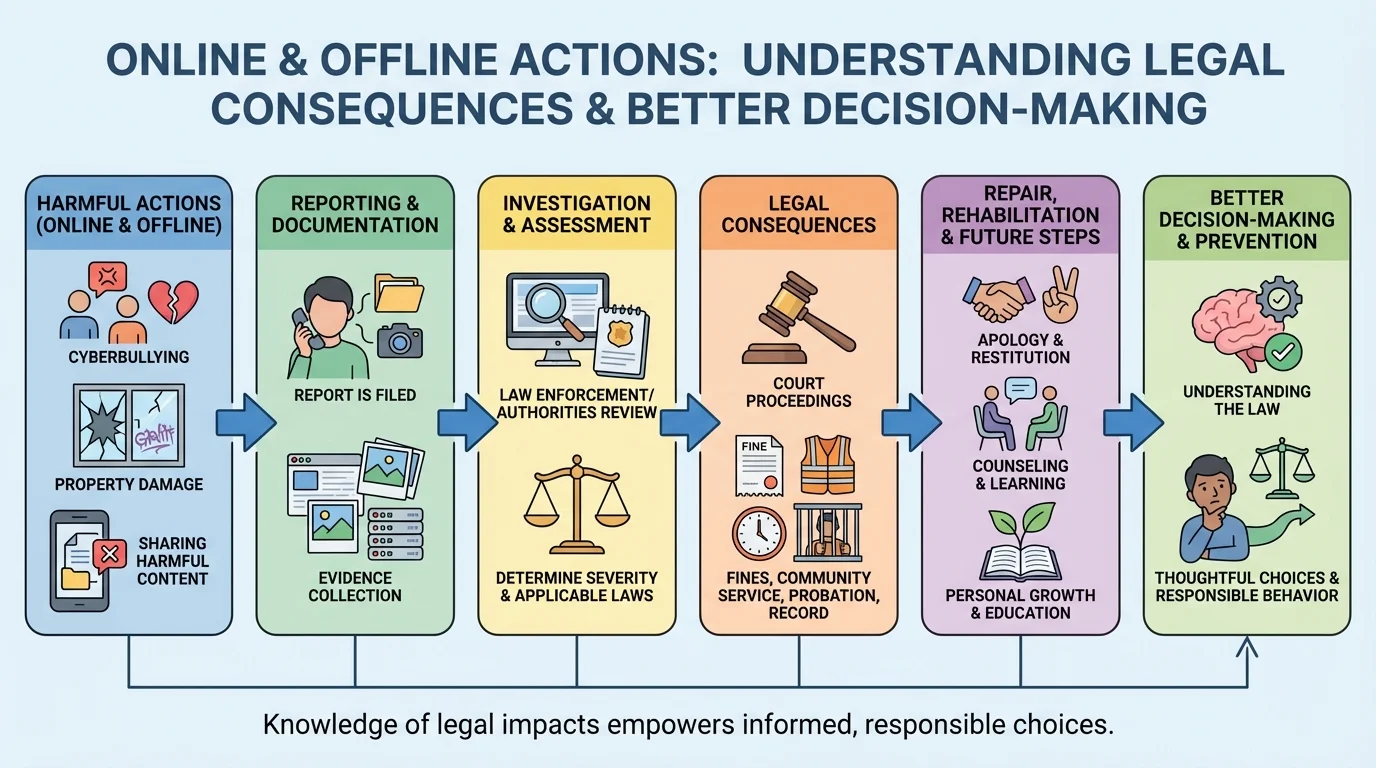
When a harmful act happens, one poor choice can trigger a chain of responses, as [Figure 1] shows through the path from report to evidence to consequences. The exact outcome depends on the situation, your age, local laws, and how serious the harm was, but there are several common possibilities.
First, there may be a report. A target, parent, neighbor, store owner, platform, or community member might report what happened. Second, there may be evidence: screenshots, videos, messages, witness statements, repair estimates, account records, or security camera footage. Third, adults or authorities decide what happens next.
Possible consequences can include warnings, account suspension, required apologies, being told to delete content, paying for repairs, staying away from someone, losing access to events or spaces, community service, counseling, court involvement, or a record of the incident with local authorities. If property was damaged, you may owe restitution, which means paying back the cost of the harm.
For example, if someone throws a rock through a neighbor's window, the legal issue is not just "a broken window." There may be repair costs, witness statements, security footage, and a police report. The person responsible may have to pay for the damage and face additional consequences because the act was intentional.
Now think about an online version. If someone creates a fake account to embarrass another student and spreads lies, there may be screenshots, usernames, time stamps, and reports to the platform. If the content includes threats, sexual images, stalking behavior, or hate-based targeting, the legal response can become much more serious.
The law also separates private conflict from public harm. An argument between two people may be handled differently from a coordinated pile-on involving many people or a post viewed by hundreds. The wider the harm spreads, the bigger the consequences can become.
| Action | Possible legal or official response | Real-life impact |
|---|---|---|
| Sending repeated cruel messages | Reports, account action, harassment investigation | Stress, fear, damaged reputation |
| Posting a threat | Police contact, safety investigation, restrictions | Fear, loss of trust, serious record of incident |
| Damaging property | Restitution, fines, community service, court action | Repair costs, conflict with neighbors or businesses |
| Sharing private images without permission | Platform removal, legal investigation, protective orders | Humiliation, privacy loss, emotional harm |
| Logging into someone else's account | Discipline, fraud or access-related investigation | Loss of privacy, account theft, distrust |
Table 1. Examples of harmful actions and some possible legal or official responses.
As the process in [Figure 1] makes clear, consequences do not appear out of nowhere. They usually follow evidence, reports, and decisions made by adults or authorities after the harm has already happened. That is why prevention matters so much.
Your digital footprint is the trail of information your online activity leaves behind. Messages, comments, likes, searches, uploads, tags, and shared posts can all become part of that trail. Deleting something does not guarantee it is gone, because other people may have saved it, forwarded it, or captured it in a screenshot.
As [Figure 2] illustrates, online evidence is often easier to collect than people expect. A group chat can be copied. A disappearing image can be photographed with another device. A fake account may still connect back to an email, device, IP address, or pattern of behavior.
Reposting harmful content can create responsibility too. If someone else makes a cruel video and you share it, laugh at it publicly, or encourage others to spread it, you are helping the harm grow. "I didn't make it" is not a full defense when you helped distribute it.
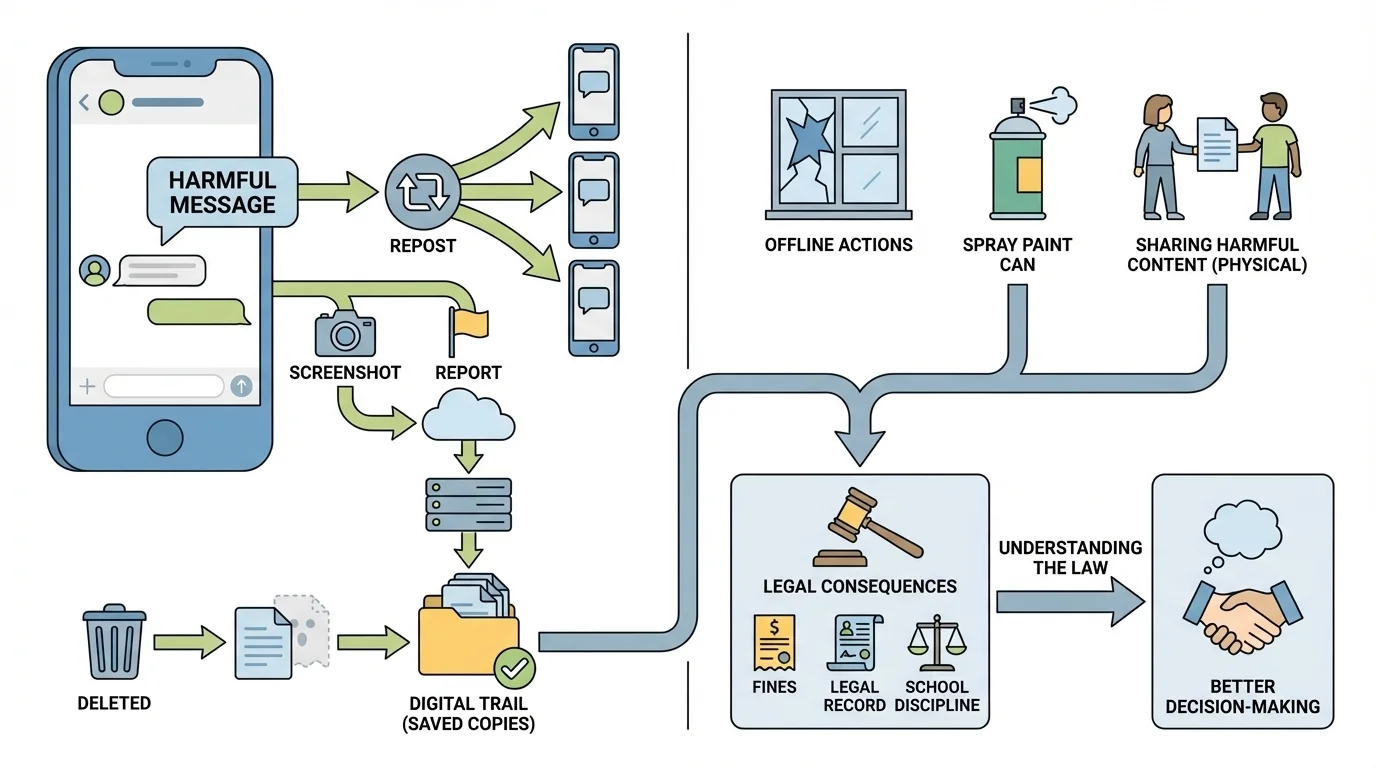
Another mistake people make is believing fake accounts erase responsibility. They do not always. Investigations can use platform records, writing style, connections between accounts, and device information. Trying to hide can even make a situation look more intentional.
Privacy violations are especially serious online. Posting someone's address, private photos, or passwords can put them in danger. Recording a video call without permission and sharing it can also break rules or laws depending on the situation and place.
Some platforms keep records even after content is deleted, and screenshots can preserve messages instantly. That means a few seconds of bad judgment can last much longer than the original post.
When you understand your digital footprint, you start to think differently before tapping "send." You realize that every post may have an audience beyond the one you pictured.
Not all harmful choices happen on a screen. Breaking, marking, stealing, or tampering with things in your neighborhood or community can lead to direct legal consequences. A dented mailbox, a damaged bike, a broken store display, or graffiti on public property may look quick in the moment, but each one creates cost, conflict, and cleanup for someone else.
Sometimes people say, "It was just a prank," after ruining property. But if the act required repairs, replacement, or cleanup, someone has to cover that cost. If the damaged item costs $250 to replace, that is real money someone loses because of one bad choice.
Property damage also affects the whole community. A broken park bench means fewer people can use the space. A damaged sign can create safety problems. A vandalized local business may lose customers or spend time and money fixing the damage instead of serving the community.
Case study: A prank at the community park
Three friends decide to record a "funny" video at a park. One of them jumps on a bench until it breaks, and another posts the clip online.
Step 1: Identify the harmful actions.
The bench was damaged, which is property damage. The video post spreads evidence of the act.
Step 2: Identify possible consequences.
The park department may report the damage. Adults may identify the people in the video. The cost of repair may be recovered through restitution. Access to the park or community programs may also be restricted.
Step 3: Notice the bigger effect.
The bench is unavailable to others, public money must be spent on repairs, and the online post makes the damage easier to prove.
This is a strong example of how offline and online choices can combine into one legal problem.
In many cases, the smartest move is the simplest one: if it is not yours, do not damage it, take it, alter it, or post it without permission.
You do not need to memorize every law to make better choices. You do need a quick system for slowing yourself down. A useful pause-and-check process, shown in [Figure 3], can help you decide before a message, post, prank, or action turns into a problem.
Step 1: Pause. If you are angry, embarrassed, trying to impress people, or acting on a dare, stop. Strong emotion often leads to weak decisions.
Step 2: Ask, "Could this hurt someone?" Think about emotional harm, privacy harm, physical safety, or damage to property.
Step 3: Ask, "Do I have permission?" Permission matters for photos, videos, accounts, spaces, and belongings.
Step 4: Ask, "Would I be okay if an adult, police officer, coach, employer, or family member saw this?" If not, that is a warning sign.
Step 5: Ask, "Could this break a rule or law?" Threats, harassment, account access without permission, private-image sharing, and vandalism are major red flags.
Step 6: Choose the safer option. Delete the draft. Walk away. Do not repost. Leave the area. Put the item back. Ask for help.
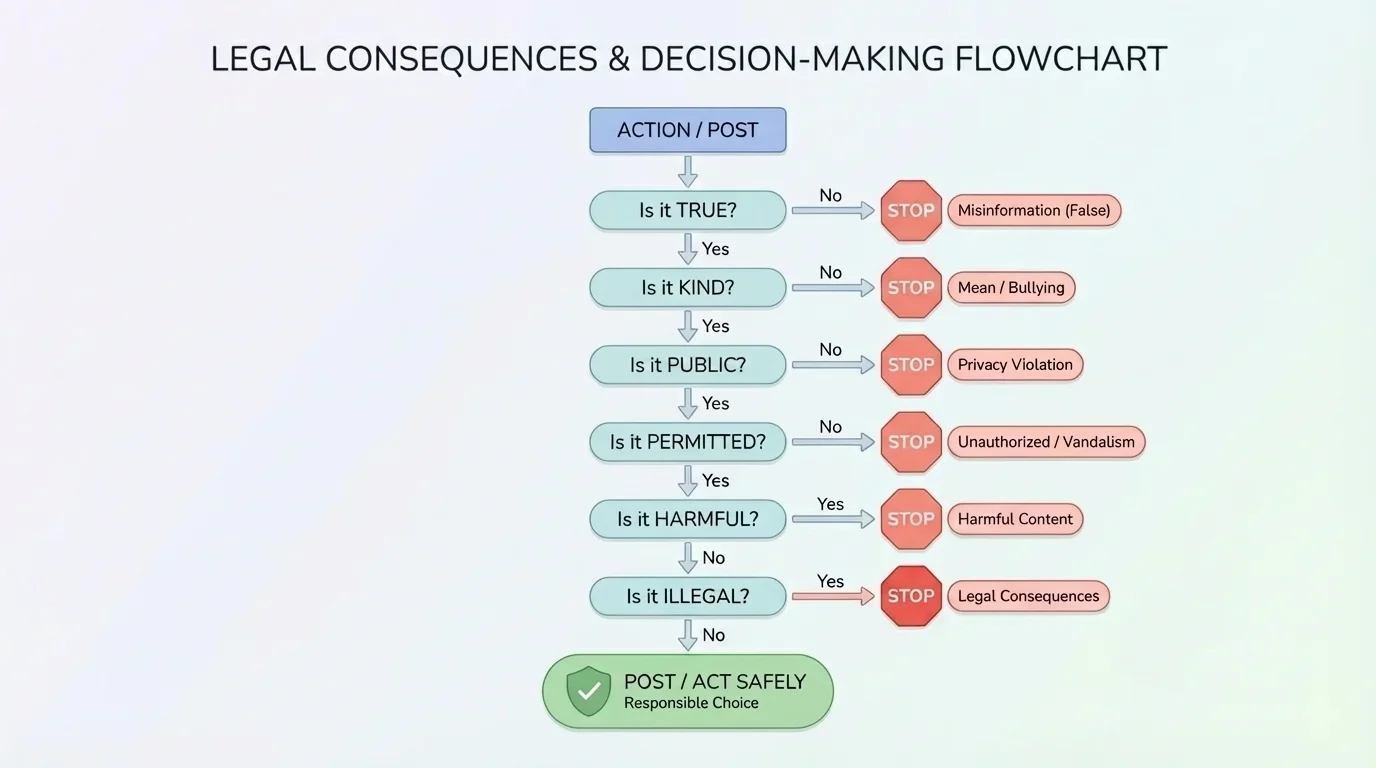
This kind of pause may feel small, but it protects you in a big way. Most legal trouble starts with a moment that someone did not stop to think through.
"Before you act, think about the person, the proof, and the possible consequence."
When you use the check in [Figure 3] regularly, it becomes a habit. Good judgment is not luck. It is a skill you practice until it becomes automatic.
When harm happens, panic usually makes things worse. A calm action plan helps you protect yourself and others while reducing further damage.
As [Figure 4] shows, if someone is targeting you online, do not argue publicly if it will escalate the situation. Save evidence first. Take screenshots, keep message links, note usernames, and record dates and times. Then block or report the account if that is safe to do.
If there is a threat, stalking behavior, sexual content involving minors, repeated harassment, or fear for someone's safety, tell a trusted adult immediately. This could be a parent, guardian, counselor, youth leader, coach, or another responsible adult who can help you take the next step.
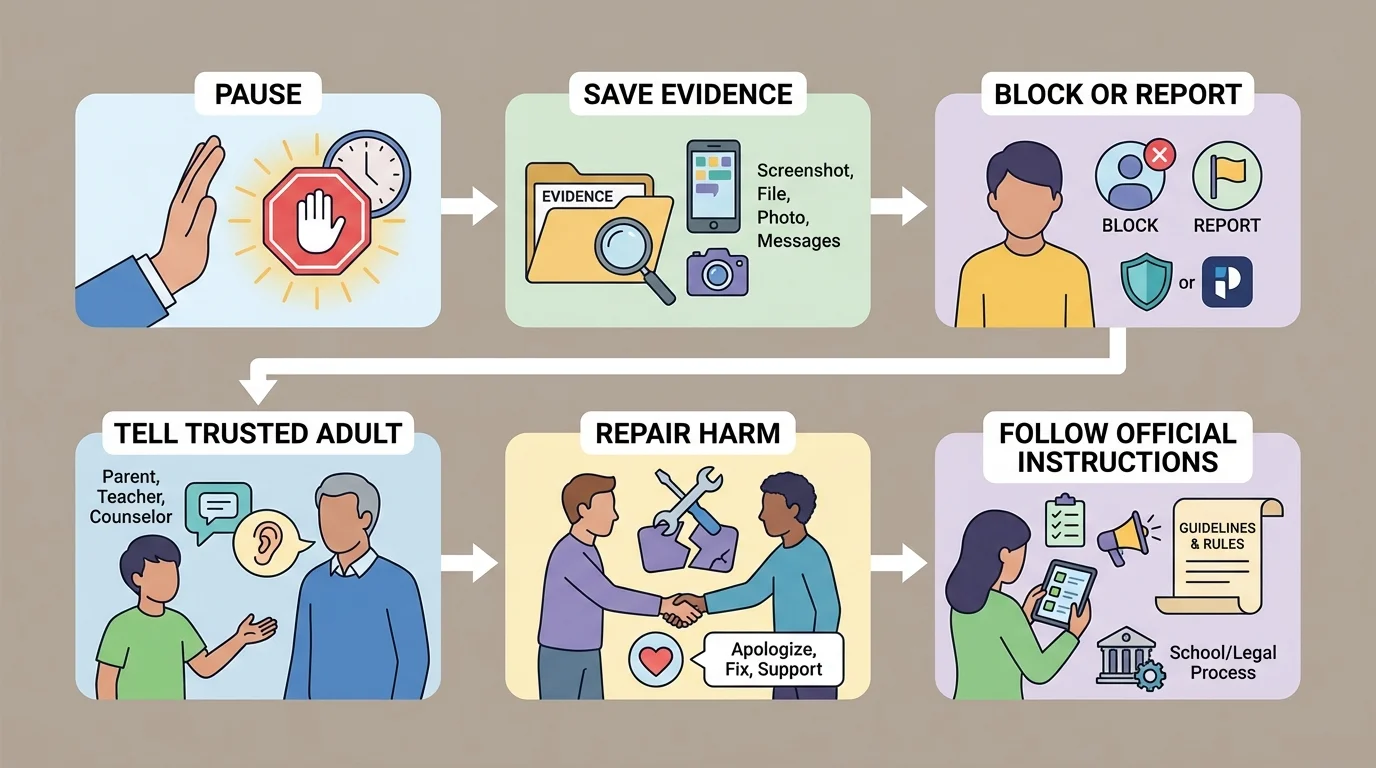
If you witness harmful behavior, do not join in, repost, or encourage it. Being a bystander does not mean being powerless. You can refuse to spread the content, support the person being harmed, and report what happened to a trusted adult or platform.
If you made the mistake, the best response is honesty and fast action. Delete harmful content if told to do so, stop contacting the person, admit what happened to a trusted adult, cooperate, and take responsibility. Trying to hide evidence, lying, or retaliating usually makes the legal and personal consequences worse.
Repairing harm after a bad decision
You repost an embarrassing video of someone and later realize it was wrong.
Step 1: Stop the spread.
Delete your repost, do not comment further, and do not send it to anyone else.
Step 2: Save what you need for accountability.
If a trusted adult needs proof of what happened, keep the necessary screenshots instead of pretending it never existed.
Step 3: Tell a trusted adult quickly.
Getting help early can prevent more damage and help you respond responsibly.
Step 4: Accept consequences and repair.
You may need to apologize, cooperate with reporting steps, or take part in a process to repair harm.
Owning a mistake is difficult, but it is usually far better than making the harm bigger.
The response steps in [Figure 4] matter because they focus on safety, evidence, and repair instead of panic, revenge, or denial.
Understanding the law supports better decision-making because it gives you a clearer picture of risk, rights, and responsibility. You stop thinking only about what is funny, fast, or popular in the moment. You start thinking about harm, proof, consequences, and fairness.
Legal awareness also makes you a stronger member of a community. Communities work better when people respect privacy, leave property alone, communicate safely, and report serious harm instead of feeding it. Trust grows when people know others will act responsibly.
This matters for your future too. A reputation for cruelty, threats, dishonesty, or reckless behavior can affect friendships, team membership, volunteer roles, and other opportunities. A reputation for good judgment, on the other hand, makes adults more likely to trust you with responsibility.
You do not need to live in fear of making any mistake. You do need to understand that actions have weight. A post can become evidence. A prank can become property damage. A rumor can become harassment. A threat can become an investigation. Knowing that helps you choose differently.
You always have more power than you think in the moment before you act. A pause, a refusal to repost, a decision to ask permission, or a choice to tell a trusted adult can stop a situation from turning into legal trouble.
Being responsible is not about being perfect. It is about noticing the warning signs early and making choices that protect people, property, and your own future.
