Here is something many students do not realize until later: high school preparation does not start on the first day of ninth grade. It starts much earlier, when you begin making choices about your time, your habits, your goals, and the people you go to for support. A strong plan does not make life perfect, but it does make you more ready when challenges show up.
Moving toward high school involves developing responsibility. You are learning how to manage more freedom, make smarter decisions, and think about your future. That future may include college, a training program, a job, military service, a business, or a path you have not discovered yet. The important thing right now is not mapping out your entire life. The important thing is building the skills and systems that keep doors open.
Readiness plan means a personal plan that helps you prepare for future expectations. It includes your goals, daily habits, support people, skills you need to build, and actions you will take to stay on track.
Transition is the process of moving from one stage to another. In this case, it means moving from middle school into high school and preparing for what comes after.
Post-secondary means any education or training after high school, such as college, technical school, apprenticeships, military training, or career certification programs.
A readiness plan matters because change can feel exciting and stressful at the same time. Without a plan, you may wait until problems appear. Then you are reacting instead of preparing. With a plan, you can notice challenges early and take action before they grow.
Think about two students. One keeps track of assignments, asks questions early, and talks with trusted adults about goals. The other assumes everything will work out and avoids planning. By the time deadlines pile up, the second student feels overwhelmed. The difference is not talent. The difference is preparation.
A readiness plan helps you in three big ways. First, it reduces stress because you know what to do next. Second, it helps you make decisions based on your goals instead of only your mood in the moment. Third, it helps you build confidence because you can see your own growth over time.
Students who use simple planning routines, such as checking deadlines daily and reviewing goals weekly, often feel more in control even when their workload increases.
Planning also helps you protect opportunities. Good habits now can affect later choices, such as which courses you are ready for, whether you can handle extracurricular commitments, and how well you present yourself to teachers, mentors, employers, or program leaders.
Before making a plan, you need to know what you are preparing for. High school often brings more independence. In an online school setting, that usually means less reminding from adults, more long-term assignments, more digital communication, and more responsibility for keeping yourself organized.
You may need to manage multiple deadlines in one week. You may need to send respectful emails or messages when you have a question. You may need to choose how to spend your after-school time if you join sports, arts, volunteering, religious groups, clubs, or part-time work in your community. You may also need to make healthier choices about sleep, screen time, and stress.
Another change is that your decisions start connecting more clearly to your future. That does not mean every grade decides your whole life. It does mean your habits are becoming more important. If you learn now how to follow through, communicate well, and recover from mistakes, those skills will help you in high school and beyond.
Preparation is not perfection
Being ready does not mean you never forget something, never feel nervous, or never need help. It means you have a system for handling problems. A prepared student notices a problem, takes responsibility, asks for help when needed, and makes a better plan for next time.
That idea matters because many students think planning is only for people who already have everything together. Actually, planning helps most when life feels busy or confusing. It gives you a way to respond instead of panic.
Your readiness plan should be simple enough to use and detailed enough to guide you. A strong plan has clear parts: goals, strengths, challenges, support people, routines, and next steps. If your plan is too vague, it will not help much. If it is too complicated, you probably will not use it.
[Figure 1] Start by writing one short-term goal and one long-term goal. A short-term goal is something you can work on now, such as turning in every assignment on time this month. A long-term goal is something farther ahead, such as being ready for a challenging high school course or exploring a future career area.
Next, list your strengths. These are the habits or qualities already helping you. Maybe you are persistent, creative, good at speaking up, or careful with details. Then list your challenges honestly. Maybe you procrastinate, get distracted by your phone, feel nervous asking questions, or forget deadlines.
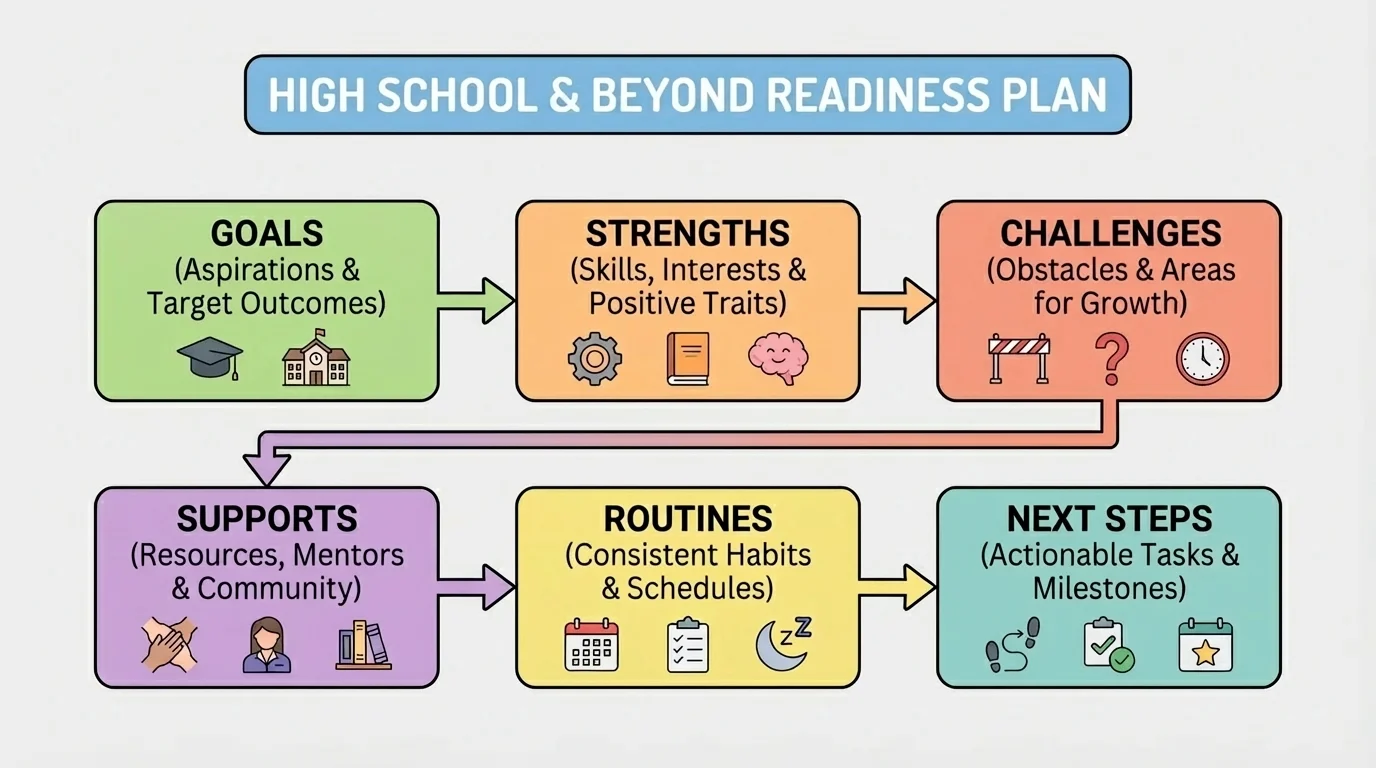
After that, identify your support system. Write the names of people you can contact when you need help. Include what kind of help each person can give. For example, one adult might help with scheduling, another with emotional support, and another with advice about school or careers.
Then build routines. A routine is a repeated action that saves you from making the same decision over and over. Instead of hoping you will remember everything, you create a system. For example, you might check your online school platform every weekday at the same time, write deadlines in one place, and spend ten minutes at night preparing for the next day.
Finally, choose your next steps. Keep them small and specific. "Be more organized" is too broad. "Use one digital calendar and check it at breakfast and at 7:00 p.m." is specific and doable.
Example: a simple readiness plan
Step 1: Set goals
Short-term goal: submit all work on time for the next two weeks. Long-term goal: feel confident starting high school courses next year.
Step 2: List strengths and challenges
Strengths: strong reading skills, good memory, asks thoughtful questions. Challenges: loses track of deadlines and spends too much time on entertainment apps.
Step 3: Name supports
Parent or guardian for schedule check-ins, teacher for assignment questions, older cousin for advice about balancing school and activities.
Step 4: Create routines
Check assignments at 8:00 a.m. and 6:30 p.m., silence distracting notifications during study time, pack materials for community activities the night before.
Step 5: Choose next actions
Use one planner starting today and send one message this week to ask a teacher about an upcoming assignment.
Try This: Write your plan on one page. If it takes more than a few minutes to understand, simplify it. A plan should help you act, not just look impressive.
Even though this topic is about life readiness, school habits still matter because they train you to manage responsibility. In an online setting, your habits are often more important than your location. You can have a flexible schedule, but without structure, flexibility turns into missed work.
Start with time management. A useful method is to estimate how long tasks really take. If you think an assignment takes about 20 minutes but it usually takes 40, your plan will always fall apart. You can test your estimates for a week. If a reading task takes about 30 minutes and a written response takes about 25 minutes, your total work time is about 55 minutes because \(30 + 25 = 55\).
Organization matters too. Keep one place for deadlines, one place for notes, and one place for saved files. If your materials are spread across random tabs, papers, and apps, you waste energy just trying to find things. That energy should go toward learning and problem-solving instead.
Self-advocacy is another key habit. Self-advocacy means speaking up for what you need in a respectful and responsible way. It includes asking questions, clarifying directions, and telling an adult when something is getting in the way of your progress.
For example, if you do not understand an assignment, waiting silently usually makes things worse. Sending a clear message early is better. You might write: "Hello, I reviewed the directions and I'm confused about the second part. Can you explain what the response should include?" That shows responsibility, not weakness.
You do not need to solve every problem alone. Being responsible includes knowing when to ask for help before a small issue becomes a bigger one.
When you look back at your own plan in [Figure 1], notice that routines and supports work together. Good habits help you stay steady, and support people help you recover when routines break down.
No one prepares for the future completely alone. Your support system is the group of people who help you learn, solve problems, stay encouraged, and make decisions. A clear support network makes it easier to know who to contact when you need different kinds of help.
[Figure 2] Think of support in categories. You might have someone for school questions, someone for emotional support, someone for career advice, and someone who keeps you accountable. One person can fill more than one role, but it helps to name the roles clearly.
Good communication keeps this support system strong. In online school, that means writing respectful messages, replying on time, showing up prepared for video calls, and being honest when you need help. It also means protecting your digital reputation. The way you communicate online can affect how adults trust you.
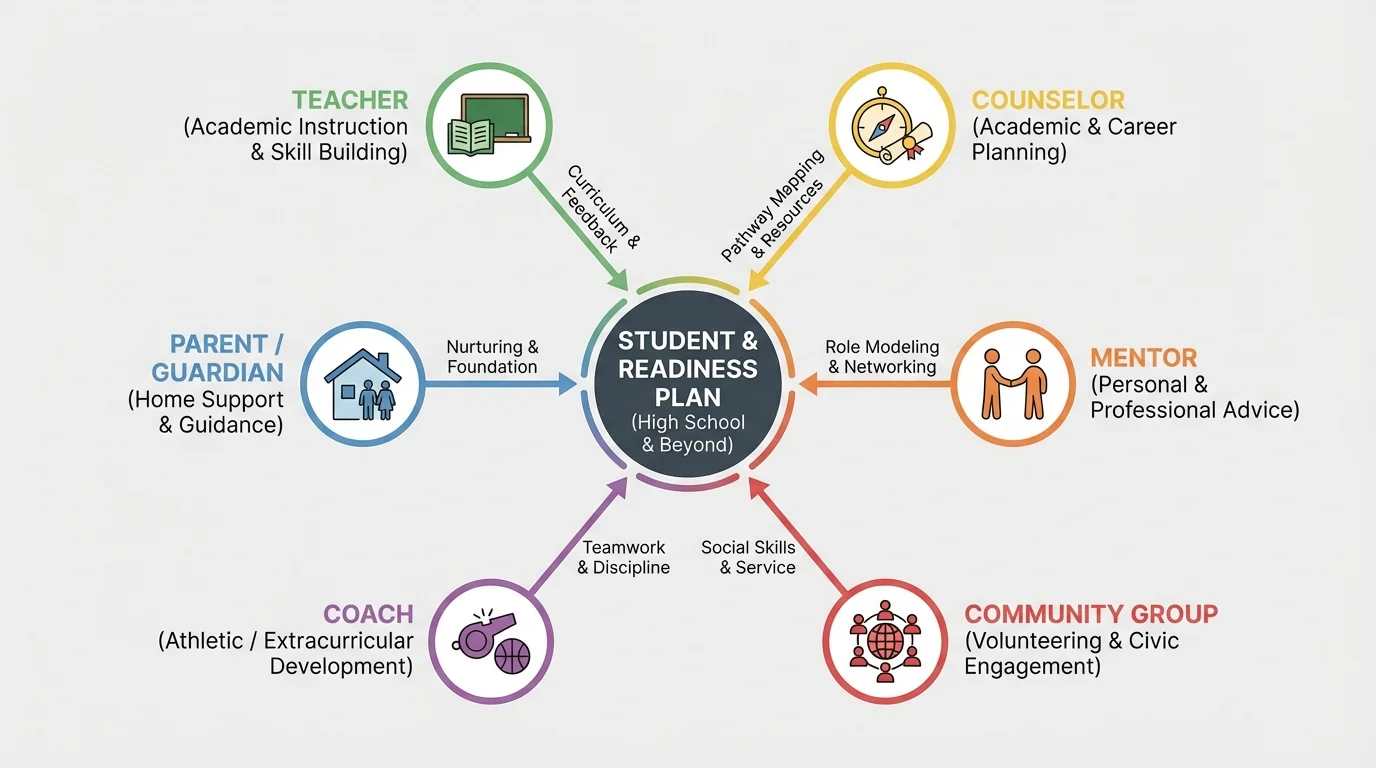
Community matters too. You may not sit in a physical classroom with other students, but you still belong to communities. These can include sports teams, youth groups, neighborhood programs, arts classes, volunteer organizations, gaming communities with healthy boundaries, or clubs that meet online. These spaces help you practice teamwork, leadership, and responsibility.
One of the best ways to prepare for high school and beyond is to take part in something where other people depend on you. When you show up on time, complete your role, and communicate clearly, you are practicing real-life readiness.
Example: using your support system well
Step 1: Notice the problem
You have two late assignments and feel too embarrassed to contact anyone.
Step 2: Choose the right support
Message your teacher about the assignments and tell a parent, guardian, or mentor that you need help building a catch-up plan.
Step 3: Be clear and honest
Say what happened, what you understand so far, and what help you need next.
Step 4: Follow through
Write down the new deadlines or next actions and complete the first task right away.
Later, when you need help balancing school and future planning, the relationships shown in [Figure 2] still matter. A trusted adult can help you compare options, notice your strengths, and remind you of goals when you feel unsure.
Part of readiness is knowing that high school is not only about required classes. It can also include choices that shape your path. Depending on your program, these may include different course levels, electives, dual-enrollment options, arts, athletics, service projects, career exploration, clubs, certifications, or leadership roles in your community.
You do not need to do everything. In fact, trying to do everything can lead to burnout. A better approach is to choose opportunities that match your interests, values, and capacity. If you love technology, maybe you explore coding, design, robotics, or digital media. If you like helping people, maybe you volunteer, babysit, tutor younger students, or join a service project.
What matters is not just collecting activities. It is building skills and experiences with purpose. For example, volunteering at an animal shelter can build reliability and compassion. Helping with a family business can build communication and problem-solving. Participating in a community theater group can build confidence and teamwork.
A useful question is: "What does this activity help me practice?" If the answer is leadership, discipline, creativity, service, teamwork, or responsibility, it may be a strong fit.
Many future opportunities are shaped by patterns, not single moments. Adults often notice whether you are dependable over time more than whether you were perfect once.
Try This: Pick one activity you already do and identify three skills it helps you build. Then ask yourself whether those skills could help in high school, work, or future training.
When people talk about the future, they sometimes act as if there is only one "right" path. There is not. Different post-high school pathways can lead to successful and meaningful lives. The key is matching your path to your goals, interests, finances, and strengths.
Some students may want a four-year college. Others may choose a two-year college, technical training, an apprenticeship, military service, direct entry into work, or entrepreneurship. These options are all forms of post-secondary planning because they involve what comes after high school.
[Figure 3] The best time to start learning about these options is now, without pressuring yourself to decide everything. You can begin by asking simple questions. What kinds of problems do I enjoy solving? What skills do I want to build? Do I prefer hands-on learning, academic study, structured training, or learning by doing?
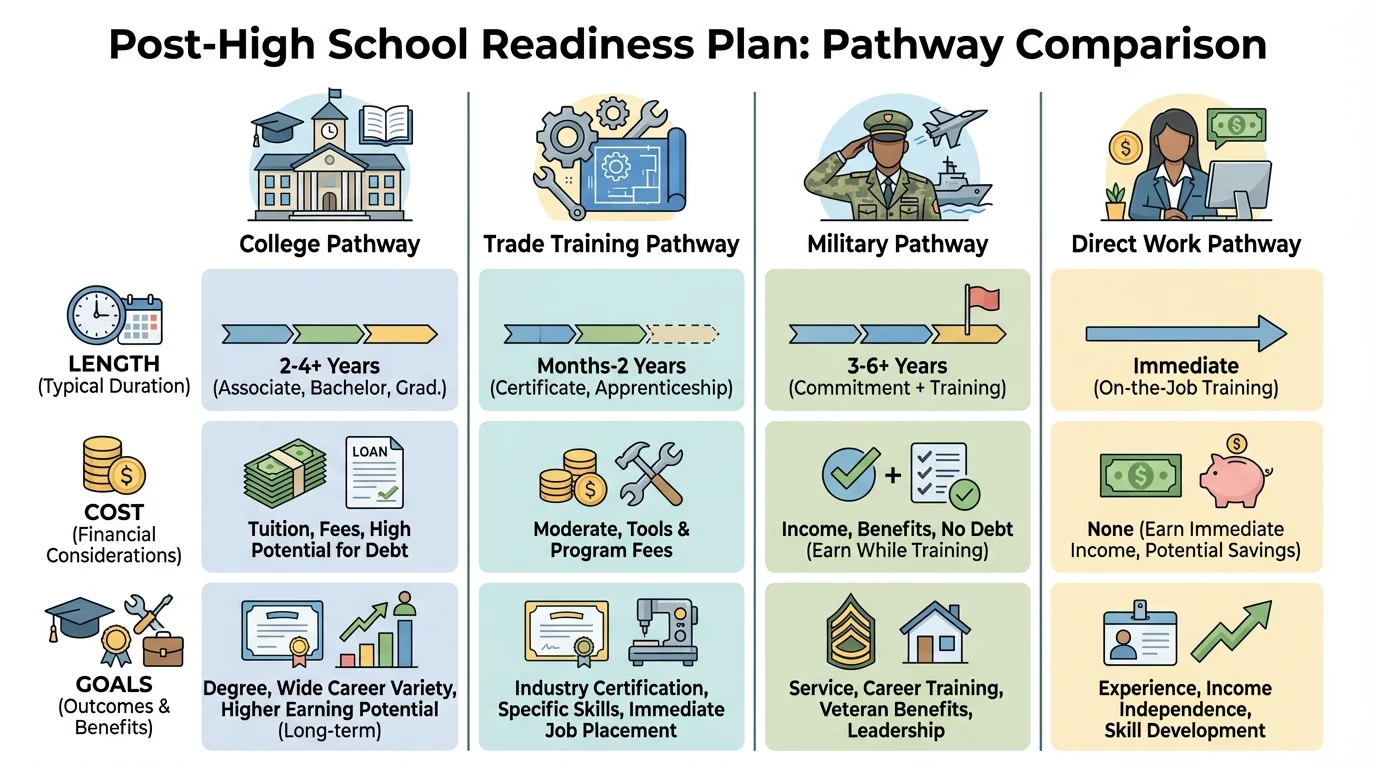
Money is part of future planning too. Some paths cost more than others, and some lead to earning money sooner. That does not automatically make one path better. It means you should learn how decisions connect to time, cost, and opportunity. For example, if a training program costs \(\$800\) and saves you from spending money on trial and error later, it may be a smart investment. If a program costs much more and does not match your goals, it may not be the right choice.
You should also understand that future readiness includes life skills beyond school. Colleges, employers, and training programs expect people to manage time, meet deadlines, communicate respectfully, solve problems, and act responsibly online and offline. These skills often matter as much as test scores.
| Pathway | Main Focus | Possible Benefits | Questions to Ask Yourself |
|---|---|---|---|
| Four-year college | Academic study and degree programs | Broad knowledge, many career options | Do I enjoy academic learning over several years? |
| Two-year college or community college | Affordable education, transfer options, career programs | Lower cost, flexibility, skill building | Do I want a lower-cost start or a shorter program? |
| Trade or technical training | Hands-on career preparation | Focused skills, faster path to work | Do I like practical learning and specific job skills? |
| Military service | Service, training, structure, benefits | Discipline, career training, education support | Am I comfortable with structure, service, and commitment? |
| Direct work or entrepreneurship | Earning, experience, business building | Income, real-world experience, independence | Am I ready to learn quickly through work or build something myself? |
Table 1. Comparison of common post-high-school pathways and the questions they raise.
As you compare options, the chart in [Figure 3] helps you see that "best" depends on fit. A smart plan is not about copying someone else's path. It is about understanding your own goals and preparing well enough to choose wisely later.
"The future depends on what you do today."
— Mahatma Gandhi
That quote matters because today's actions shape tomorrow's opportunities. Small choices, repeated often, create your direction.
A good plan is not something you write once and forget. It should change as you grow. Maybe a routine that worked in eighth grade no longer fits your schedule later. Maybe you discover a new interest. Maybe a challenge becomes easier because you practiced.
Set a regular time to review your plan. Once a week, ask: What went well? What got in the way? What needs to change? Once a month, ask: Are my goals still the right goals? Do I need new support? Am I using my time in a way that matches what matters to me?
You can even use a simple score to check your routines. If you planned to follow a routine for 7 days and you did it on 5 days, your completion rate is \(\dfrac{5}{7}\). That is not about judging yourself. It is about noticing patterns so you can improve them.
If something is not working, change the plan instead of giving up on yourself. For example, if you keep missing a study block at 4:00 p.m., maybe that is not a motivation problem. Maybe it is a timing problem. Try a different hour, a shorter session, or fewer distractions.
Adjusting a plan is a strength
Strong planners do not stick with a bad system just because they wrote it down. They look at results, learn from experience, and make smart changes. Flexibility and responsibility belong together.
Try This: Choose one day each week as your reset day. Use it to clean up your planner, review deadlines, message anyone you need to contact, and prepare for the week ahead.
Your transition to high school and beyond is not one giant leap. It is a series of manageable steps. Every time you plan ahead, communicate clearly, ask for help, and follow through, you are becoming more ready for the future you want.
