Some people wait for the future to "just happen." Then weeks pass, then months, and suddenly they feel behind, stressed, or unsure of what they are working toward. A personal roadmap helps prevent that. It gives you a way to make choices on purpose instead of only reacting to whatever comes next.
At your age, you do not need to have your whole life planned out. You do need a way to think ahead. Whether you want to improve your grades, build a skill, help your family more, save money, join a community activity, or explore possible careers, planning gives you direction. A roadmap is not about controlling everything. It is about knowing your next steps.
Personal roadmap means a plan that connects where you are now, where you want to go, and the steps you can take along the way.
Near-term goals are goals you can work on soon, such as this week, this month, or this semester.
Longer-term direction is the bigger path you want your life to move toward over the next few years, even if the details are not fully decided yet.
Milestones are important checkpoints that show progress between the starting point and the larger goal.
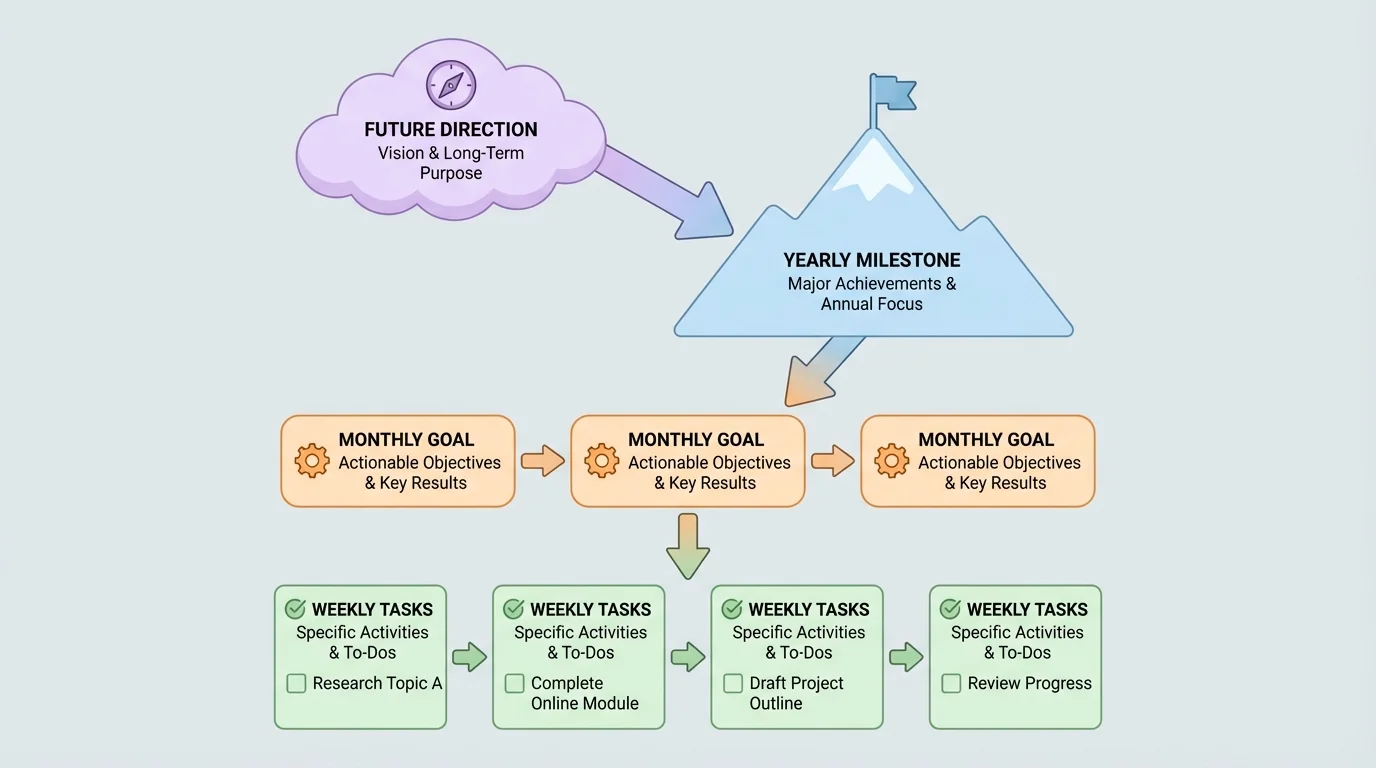
A roadmap works best when it connects big ideas to everyday actions, as [Figure 1] shows. If your longer-term direction is "become someone who can work with technology," your roadmap might include a milestone like learning basic coding, a monthly goal like finishing an online beginner course, and a weekly action like practicing for two hours.
This matters because responsibility grows through choices. When you plan ahead, you are more likely to use your time well, meet commitments, and notice opportunities. You also make better decisions when something unexpected happens, because you can ask, "Does this fit where I want to go?"
Without a roadmap, goals often stay as wishes. You might say, "I want to get better at drawing," "I want to be less stressed," or "I want to do well next year," but nothing changes unless those ideas turn into actions. A roadmap gives shape to your effort.
It also helps you handle pressure. A lot of students compare themselves to others online and feel like they are already late. But your future is not a race against everyone else. Good planning is personal. It depends on your life, your responsibilities, your resources, and your values.
People are more likely to follow through on goals when the goals are specific and when they decide in advance what action they will take and when they will take it.
A roadmap can support many parts of life at once. It can include school success, health habits, friendships, family responsibilities, hobbies, volunteering, and early career exploration. Real life is not divided into neat subjects. Your roadmap should match your actual life.
A good roadmap is clear but flexible. It tells you where you are headed, but it does not trap you. You can change your mind as you learn more about yourself. In fact, changing your roadmap after new experience is often a sign of growth, not failure.
Think of your roadmap in four layers. Your direction is the big picture. Your milestones are major checkpoints. Your goals are what you plan to complete in the near future. Your actions are the small things you actually do today or this week. The structure in [Figure 1] makes this easier to see: direction leads to milestones, milestones lead to goals, and goals lead to actions.
For example, your direction might be: "I want to become a reliable, skilled person who can help people and solve problems." That direction could fit many futures: healthcare, technology, trades, teaching, community service, or entrepreneurship. You do not need one perfect answer right now.
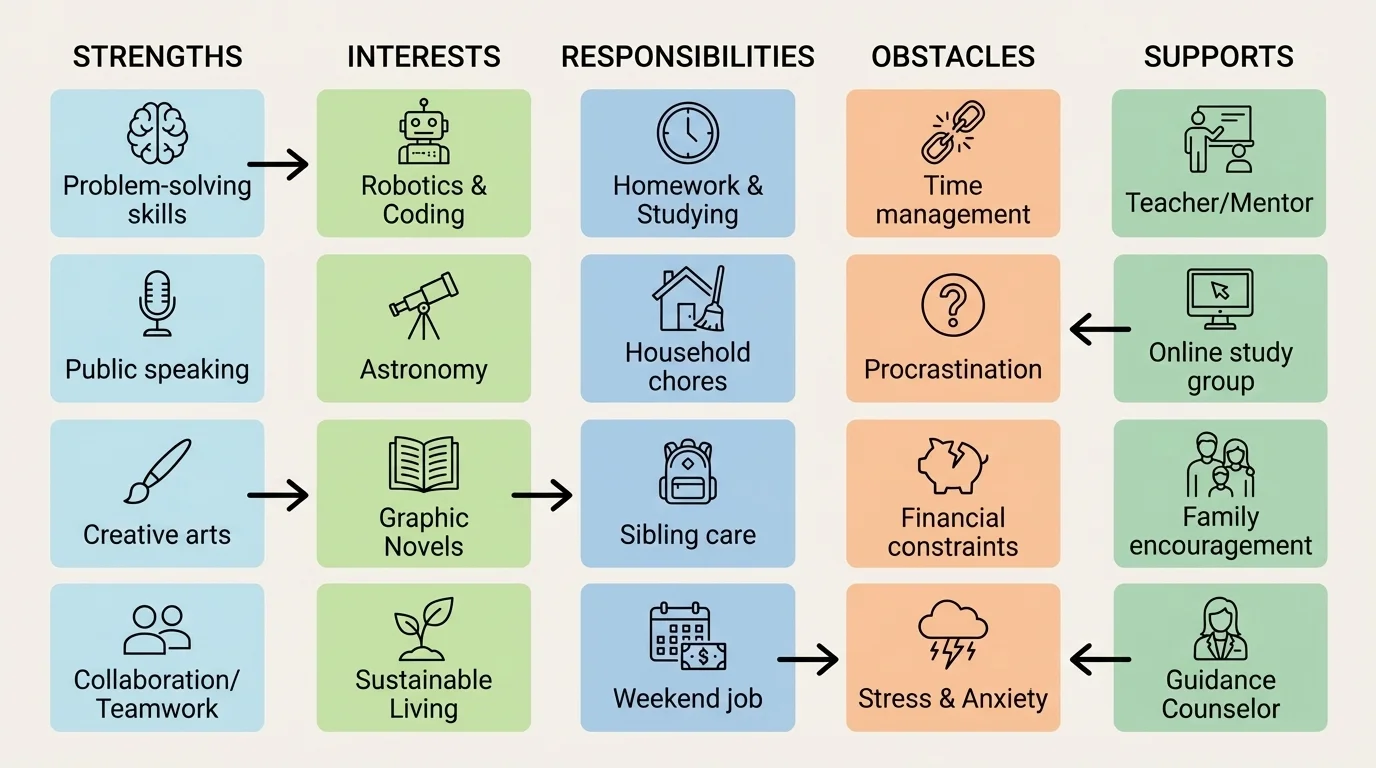
Before you plan where to go, be honest about where you are now. A strong self-assessment helps you create a roadmap that fits your real life, as [Figure 2] illustrates. If you ignore your current habits, limits, and strengths, your plan may sound good but fail quickly.
Make a simple personal inventory in five categories: strengths, interests, responsibilities, obstacles, and supports. Strengths could include being organized, creative, patient, athletic, good with younger children, or confident speaking on video calls. Interests might include music production, coding, animals, fitness, design, cooking, or helping others. Responsibilities could include chores, sibling care, coursework, religious commitments, or part-time work in the future.
Obstacles are not excuses; they are realities to plan around. Maybe your internet is unreliable sometimes. Maybe you get distracted by social media. Maybe you feel nervous trying new things. Supports are the people, places, and tools that can help: a parent, older cousin, coach, online mentor, local library, youth program, or educational website.
Write your inventory in a note app, journal, or document. Keep it short and honest. This is not for impressing anyone. It is for helping you make smart decisions.
Personal inventory example
Step 1: Strengths
Jordan writes: "I explain things well, I finish tasks when reminded, and I learn technology quickly."
Step 2: Interests
Jordan writes: "I like video editing, sports training, and environmental issues."
Step 3: Responsibilities
Jordan writes: "I help with dinner twice a week and watch my little brother for one hour on Thursdays."
Step 4: Obstacles
Jordan writes: "I procrastinate when tasks feel boring, and I spend too much time scrolling at night."
Step 5: Supports
Jordan writes: "My aunt works in media, and a community center nearby has a teen volunteer program."
When you know your starting point, your goals become more realistic. Instead of choosing goals that sound impressive, you can choose goals that are actually possible.
Your longer-term direction is not a final decision. It is more like a compass. It points you generally toward the kind of person you want to become and the kind of life you want to build.
Ask yourself questions like these: What kinds of problems do I enjoy solving? What skills do I want people to trust me for? What type of life matters to me: creative, stable, active, helpful, independent, team-based, or something else? What communities do I care about?
Direction before detail
You do not need to know one exact job right now. It is enough to identify themes. For example, "I want to work with people," "I want to build things," "I want to work outdoors," or "I want to use art and technology together" are all useful directions. Themes help you choose next steps without pretending you already know everything.
Try writing a direction statement that starts with one of these sentence frames: "I want to become someone who…," "In the next few years, I want my life to move toward…," or "I want to build skills in…" Keep it broad enough to allow change, but specific enough to guide choices.
For example: "I want to become someone who is dependable, good with technology, and able to help my community." Another could be: "I want to build creative skills and confidence so I can explore media, design, or communication work later."
Now connect your direction to a few near-term goals. A good near-term goal is clear, realistic, and useful. It should move you forward, not just keep you busy.
Choose goals in different time ranges. You might have one goal for this week, one for this month, and one for this semester. Limiting the number helps. If you choose too many, your roadmap becomes stressful and messy.
Strong goals usually answer these questions: What am I trying to do? Why does it matter? How will I know I did it? By when? For example, "Read more" is weak because it is vague. "Finish one nonfiction book about coding by the end of the month and write down five things I learned" is stronger.
You can also test goals by checking whether they fit your current reality. If you already struggle to complete one hour of work each week, setting a goal of studying three extra hours every night may not be realistic. A smaller goal done consistently is more powerful than a huge goal abandoned after three days.
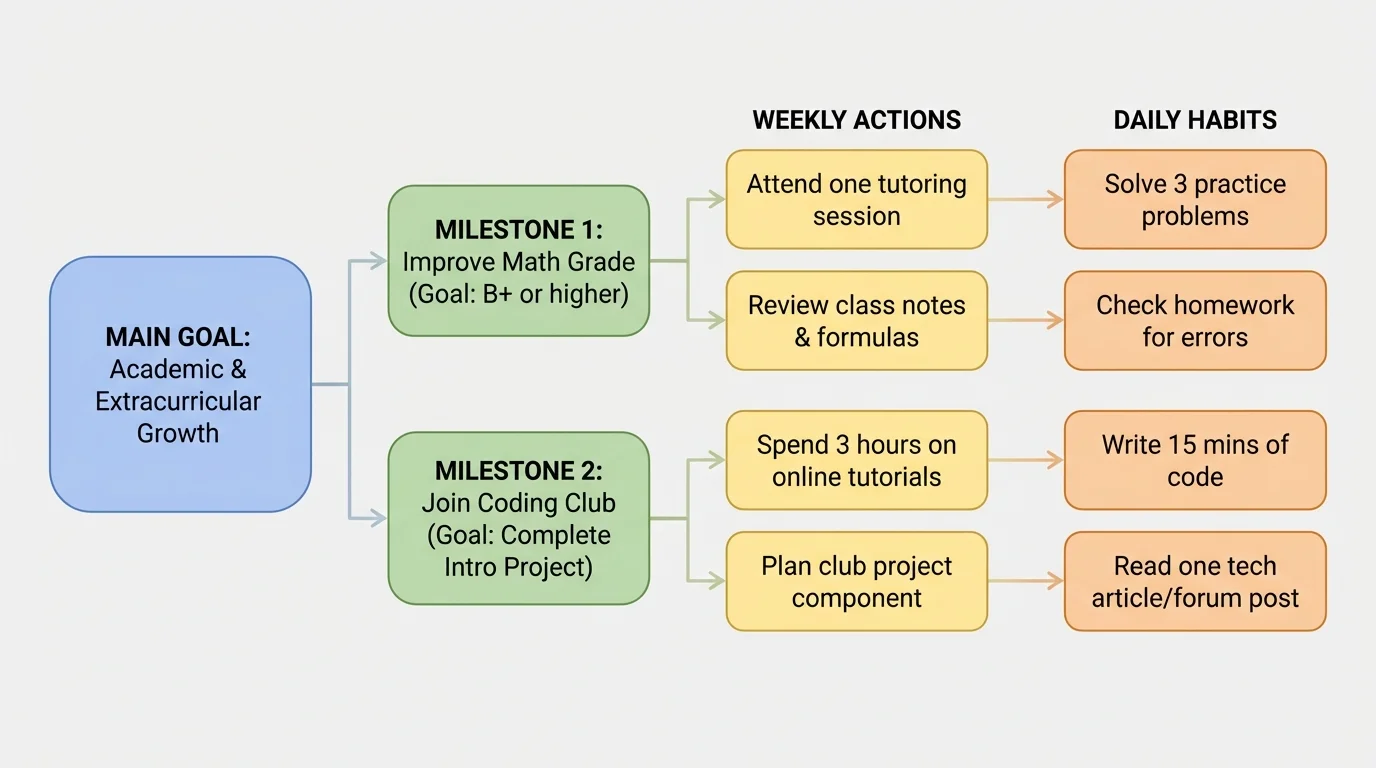
Big goals feel less overwhelming when you split them into smaller milestones and routine actions, as [Figure 3] shows. This is one of the most important parts of planning, because actions are what create progress.
Start with the goal. Then ask: what has to happen before this goal is complete? Those answers become milestones. After that, ask: what can I do this week? Then ask: what can I do today?
Suppose your goal is to improve your math grade by the end of the semester. Possible milestones could include finishing missing assignments, reviewing weak topics, attending online help sessions, and scoring higher on the next two quizzes. Weekly actions might include two practice sessions and one check-in message to your teacher.
Action steps should be small enough that you can actually start them. "Study harder" is not a useful action step. "Complete ten practice problems on Tuesday at 4:00 p.m." is much better.
Turning one goal into actions
Step 1: Goal
"Join a youth coding club and complete my first beginner project within two months."
Step 2: Milestones
Find a club, sign up, learn basic commands, complete a small project.
Step 3: Weekly actions
Search for local or online clubs on Monday, ask a parent for help signing up on Wednesday, and spend two sessions each week practicing beginner lessons.
Step 4: Daily action
Set a timer for twenty minutes tonight and complete one lesson.
When you look back at [Figure 3], notice that the bottom level is always the most immediate. Your roadmap succeeds or fails mostly at that level: the next action, not the big dream.
Planning is not only about deciding what matters. It is also about deciding what fits. You have a limited amount of time and energy each day. If your roadmap ignores that, it will not last.
One useful method is to estimate the time a goal needs each week. If one goal needs about two hours and another needs about three hours, then together they need about five hours. In math form, that is simply \(2 + 3 = 5\). If your schedule only has about three free hours, you either need to reduce, delay, or simplify one goal.
Energy matters too. Some tasks require focus, courage, or motivation. If you do your best thinking in the morning, place difficult tasks then. If evenings are noisy at home, use them for easier tasks like organizing notes or sending messages.
| Resource | Question to Ask | Example Adjustment |
|---|---|---|
| Time | How many hours can I truly give? | Choose one major goal instead of three. |
| Energy | When am I most focused? | Practice hard subjects earlier in the day. |
| Money | Does this cost anything? | Use free apps, library resources, or community programs. |
| Technology | Do I have the tools I need? | Download materials in advance if internet access changes. |
| Support | Who can help me stay on track? | Ask a trusted adult to check in weekly. |
Table 1. Common resources that affect whether a goal is realistic and sustainable.
Resources can include money, transportation, internet access, materials, and help from other people. A smart roadmap uses what you have now while also helping you build more options over time.
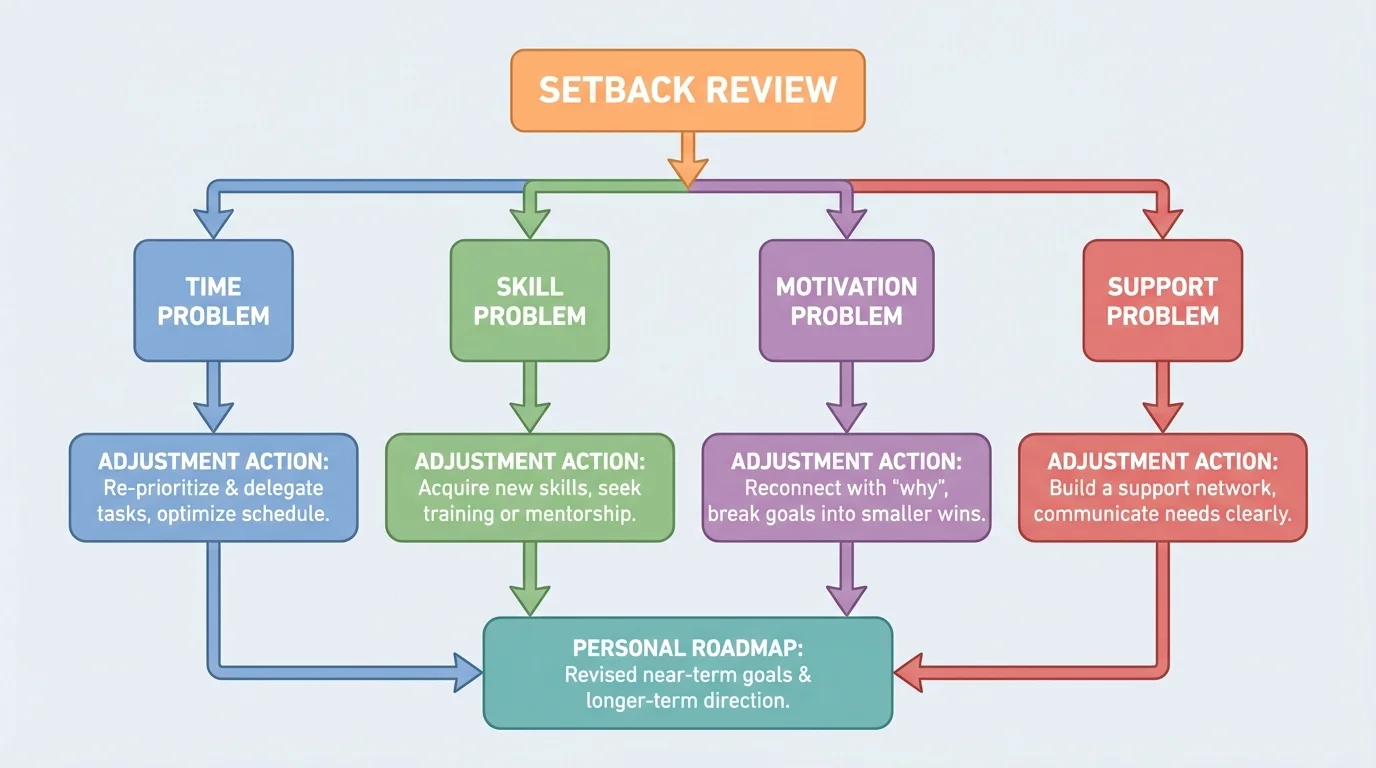
Even strong plans run into problems. That is normal. A roadmap should bend when life changes, as [Figure 4] makes clear. If you treat every setback like total failure, you may quit too early.
When progress stalls, ask what kind of obstacle it is. Is it a time problem? A skill problem? A motivation problem? A support problem? Different problems need different solutions. If you lack time, shorten the task. If you lack skill, get help or practice smaller pieces. If motivation is low, reconnect the goal to your reason for caring about it.
Backup plans are powerful. For example: "If I miss my scheduled study time, I will do a shorter twenty-minute version after dinner." Or, "If the club meeting is full, I will complete a free online tutorial this month instead."
A roadmap review can happen weekly or monthly. Look at what worked, what did not, and what needs changing. This is not about judging yourself harshly. It is about improving the plan so it fits reality better.
"Plans are useful when they help you act, not when they make you feel trapped."
If a goal no longer matches your direction, it is okay to remove it. If a new opportunity appears, it is okay to add it. Responsibility includes knowing when to continue and when to revise.
Your roadmap is personal, but you do not have to build it alone. Community support often makes goals easier to reach and more meaningful. This can include family members, neighbors, mentors, coaches, youth leaders, online interest groups, volunteer coordinators, or friends who share a healthy goal.
A strong accountability system means someone or something helps you follow through. That could be a weekly check-in text with an older cousin, a shared digital checklist with a parent, or a progress update you send to a mentor every Friday.
You already use planning skills in daily life when you remember appointments, meet deadlines, or prepare for a responsibility before it becomes urgent. A personal roadmap takes those everyday planning habits and makes them more intentional.
Community also helps you discover opportunities you would not find alone. A local animal shelter may need youth volunteers. A recreation center may offer low-cost classes. An online teen group may host writing challenges or coding projects. These experiences can become part of your roadmap because they build skills, confidence, and connections.
A full roadmap combines direction, goals, milestones, and actions in one place. You can make yours in a notebook, calendar app, digital document, or wall planner at home.
[Figure 5] Here is one example for a grade 8 student named Maya. Her longer-term direction is: "I want to become a confident person who communicates well, helps others, and explores healthcare or community service." Her near-term goals are to improve science organization, volunteer once a month, and become more comfortable speaking in groups online.
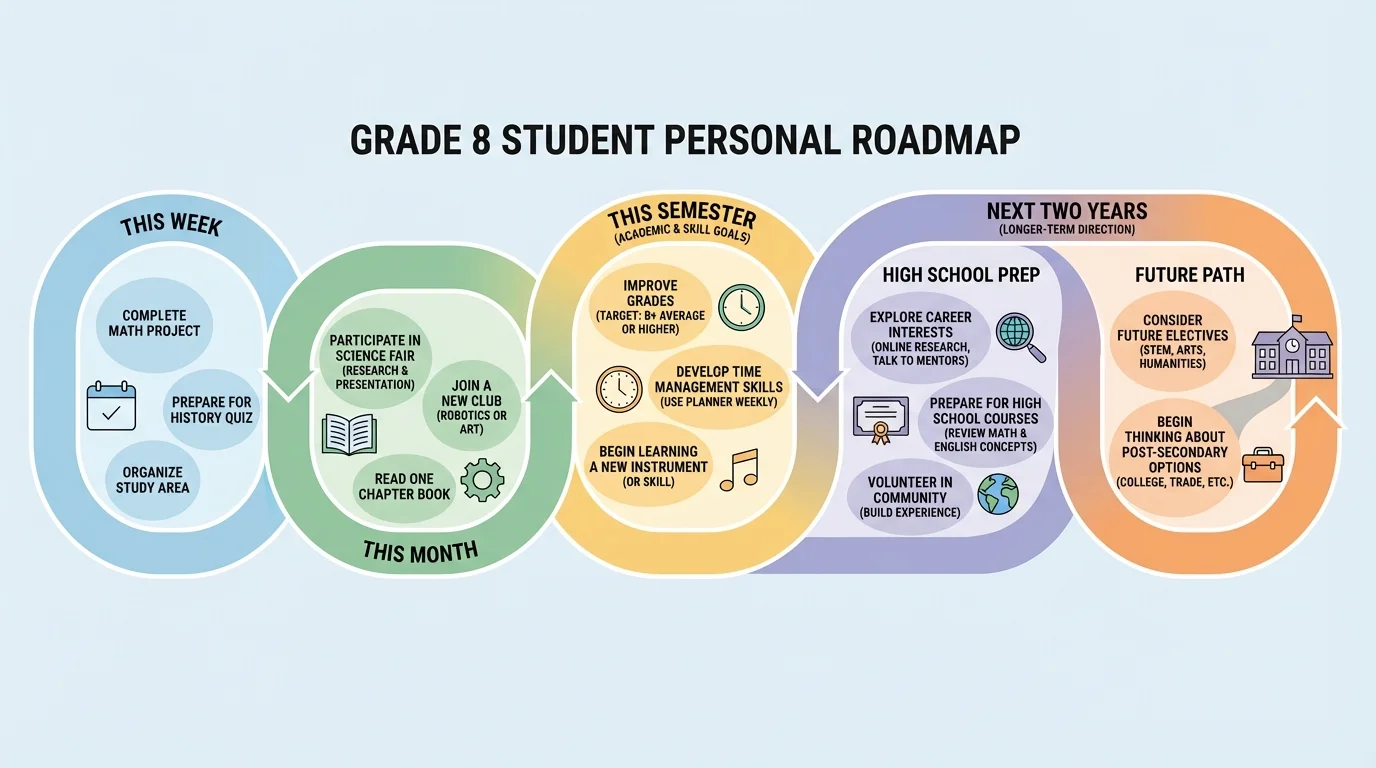
Sample roadmap
Step 1: Longer-term direction
Maya wants a future that involves helping people, staying organized, and building confidence in communication.
Step 2: This semester's goals
Raise her science performance by turning in every assignment on time, join one virtual youth discussion group, and volunteer at a food drive once each month.
Step 3: Milestones
Set up one folder for science materials, attend the first group meeting, contact the food drive coordinator, and finish all missing assignments by the end of the second week.
Step 4: Weekly actions
Check assignment due dates every Sunday, prepare materials every Monday morning, practice speaking once a week on video by sharing one idea, and ask for volunteer dates by message.
This roadmap works because it is connected. Her goals support her direction. Her actions support her goals. Her choices are not random. If she keeps reviewing and adjusting, she will build both skills and confidence.
You can do the same for your own life. Your roadmap does not need to look impressive. It needs to be useful.
Good planning includes emotional habits, not just schedules. One common mistake is perfectionism. If you think every plan must be flawless, you may avoid starting. Another mistake is comparison. Looking at someone else's achievements online can make your own steady progress seem small, even when it is meaningful.
Another helpful term is priority. A priority is what matters most right now. You can care about many things, but your roadmap should highlight only a few top priorities at a time. That keeps your effort focused.
Keep your roadmap visible. Review it regularly. Celebrate progress, even small progress. If you complete three planned study sessions in a week, that counts. If you asked for help instead of avoiding a problem, that counts too.
Your future is shaped by repeated choices. A personal roadmap helps you make those choices with purpose. It gives you a way to be responsible in the present while building toward the future you want.
