People often think big life choices happen later, when you are older. But many of the choices that shape your future already happen now: who you listen to, how you treat people online, what kind of friend you are, how you respond to pressure, and what goals you decide are worth your time. Even small choices can point your life in a direction. That is why understanding your values and identity matters so much.
When you choose whether to speak up, stay silent, join a group, leave a friendship, work hard on a goal, or copy what everyone else is doing, you are not just making a random decision. You are showing what matters to you. Sometimes that feels empowering. Sometimes it feels confusing. Both are normal.
Your choices are connected to two powerful parts of who you are: your values and your identity. Values are the principles you believe are important, such as honesty, loyalty, creativity, fairness, kindness, independence, faith, learning, or responsibility. Identity is your sense of who you are, including your personality, culture, interests, beliefs, strengths, and experiences.
If you value honesty, you may decide not to repost something misleading just because it gets attention. If your identity includes being dependable, you may show up on time for an online volunteer meeting even when no one forces you to. If you see yourself as someone who wants to help others, you may choose leadership roles where you support a team instead of trying to control it.
On the other hand, when your decisions do not match your values, you may feel uncomfortable, guilty, fake, or unsettled. That feeling can be a useful signal. It may mean you acted from pressure, fear, or impulse instead of from what matters most to you.
Values are the beliefs and principles that guide what you think is important.
Identity is your understanding of who you are, including your traits, beliefs, background, interests, and roles.
Self-awareness is the ability to notice your thoughts, emotions, habits, strengths, and patterns clearly.
Self-awareness helps you notice these patterns before they turn into regrets. It gives you a better chance of choosing on purpose instead of reacting automatically.
Your choices make more sense when you understand the connection between values, identity, and action, as [Figure 1] shows. Your values affect what feels right or wrong to you. Your identity affects what feels true to who you are. Together, they influence the decisions you make in leadership, relationships, and future planning.
For example, if you value fairness and see yourself as someone who includes others, you are more likely to notice when a group chat leaves someone out. If you value achievement and see yourself as determined, you may set strong academic or career goals. If you value peace and see yourself as conflict averse, you might stay quiet even when you should speak up. None of these patterns make you "good" or "bad." They simply help explain your behavior.
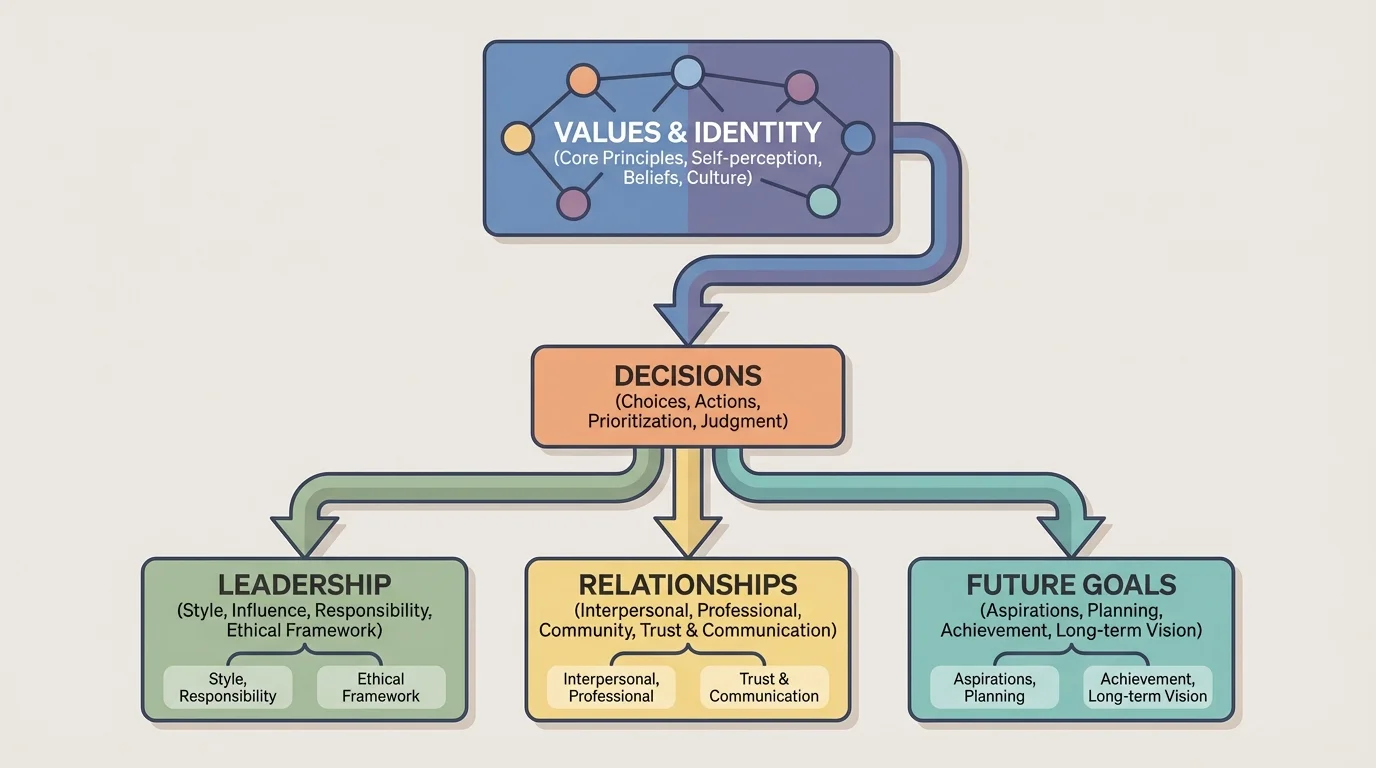
Identity is not just one thing. You are made up of many parts: your family background, beliefs, hobbies, community, experiences, talents, and challenges. Some parts feel stable. Others change as you grow. That means your decisions may change too. Growth is not betrayal. It is part of understanding yourself more honestly.
Sometimes students confuse identity with labels. Labels can be useful, but they do not tell the whole story. A person can be shy and still become a strong leader. A person can care deeply about friendship and still need firmer boundaries. A person can value success and still refuse to achieve it in a dishonest way.
Why alignment matters
When your decisions match your values and identity, you are more likely to feel steady, confident, and proud of your actions. When your decisions fight against them, you may feel stress, confusion, or pressure to keep pretending. Alignment does not make life easy, but it makes your choices more honest and sustainable.
This is also why copying someone else's path often feels wrong. A goal that fits one person's identity may not fit yours. The same is true for leadership style, friendships, and plans for the future.
Leadership is not only about being "in charge." It is also about influence. You lead when you organize a project, help solve a problem, encourage others, take responsibility, or set a tone in a group. Online spaces especially show this clearly. A person can influence a group chat, gaming team, youth program, or volunteer project without having an official title.
Your values shape the kind of leader you become. If you value respect, you are more likely to listen before speaking. If you value responsibility, you will finish what you said you would do. If you value popularity more than integrity, you may start making choices just to be liked, even when those choices hurt others.
Your identity shapes leadership too. If you see yourself as creative, you may lead by bringing fresh ideas. If you see yourself as calm under pressure, you may lead by stabilizing the group during stress. If you see yourself as someone who protects others, you may speak up when someone is being treated unfairly.
Good leadership usually includes three things: knowing yourself, respecting others, and making decisions that match your principles. That means leadership is not about pretending to be louder, tougher, or more confident than you are. It is about using your real strengths well.
Case study: Choosing how to lead in an online project
You are helping run a virtual fundraiser with teens from your community. One person is not doing their part, and another person wants to shame them publicly in the group chat.
Step 1: Check your values.
If you value respect and teamwork, public embarrassment probably does not match who you want to be.
Step 2: Check your identity.
If you see yourself as fair and dependable, you may choose a response that is direct but not cruel.
Step 3: Take action that fits both.
You might message the person privately, ask what is going on, and set a clear deadline. You could also remind the group to solve problems without attacking people.
This approach protects the project and your self-respect at the same time.
Who you follow matters too. If a leader pressures people, ignores others' boundaries, or only cares about image, that may clash with your values. It is smart to ask: Do I admire this person's character, or just their confidence?
[Figure 2] Relationships reveal your values fast. The way you talk, listen, apologize, forgive, disagree, and set limits tells a lot about what matters to you. In close relationships, your boundaries become especially important.
Boundaries are limits that protect your time, energy, emotions, safety, and self-respect. They are not walls that shut everyone out. They are guidelines that help relationships stay healthy. For example, you can decide not to answer messages late at night, not to share passwords, not to accept insults as "jokes," and not to stay in conversations that become manipulative or threatening.
If you value respect, your friendships should include respect. If you value honesty, trust matters. If you value growth, you may choose friends who encourage your goals instead of making fun of them. If you value loyalty, that does not mean accepting harmful behavior. Loyalty without boundaries can turn into self-neglect.
Digital life makes this even more important. Screens can make people say things they would never say face-to-face. That means you need clear standards for how you want to be treated online. A healthy relationship should not leave you constantly anxious, pressured, or confused.
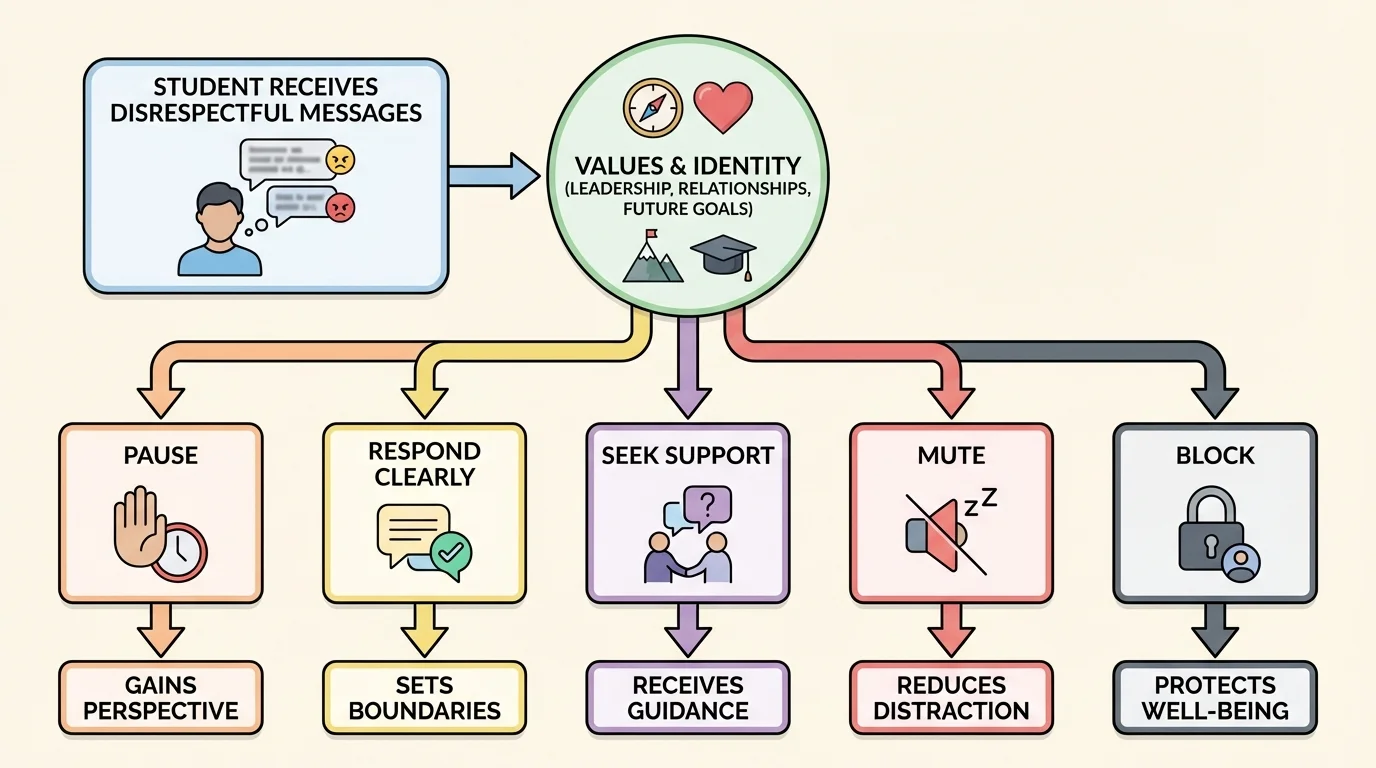
As you build relationships, watch for patterns. A trustworthy person usually shows consistency. Their words and actions match. They respect "no." They do not use guilt to control you. They can disagree without attacking your worth. They take responsibility when they mess up.
Unhealthy relationships often include pressure, disrespect, secrecy, manipulation, or repeated crossing of boundaries. When that happens, your values can help you respond. If you value safety and self-respect, stepping back may be the right choice even if it feels hard.
Boundaries are a form of honesty
Many people think setting a boundary is rude. Usually, it is the opposite. A clear boundary tells the truth about what is okay and what is not. It gives the other person a chance to respond appropriately, and it protects you from building a relationship based on silence and resentment.
For example, suppose a friend keeps sending you private information about other people and expects you to do the same. If you value trust, you might say, "I do not want to talk about people behind their backs." That choice may feel awkward in the moment, but it keeps your actions aligned with your principles.
The same idea applies to dating relationships. If a person pressures you to move faster than you want, share personal photos, or prove your feelings by ignoring your own comfort, that is not respect. A healthy response often starts with pausing, naming the problem clearly, and choosing an action that protects your well-being.
Your brain is still developing skills for judgment, impulse control, and long-term planning during the teen years. That does not mean your decisions are unimportant. It means practicing thoughtful choices now helps build stronger decision-making habits for adulthood.
One strong relationship skill is noticing the difference between being accepted and being valued. Some groups will accept you as long as you act like them. Real respect allows you to stay true to yourself.
Future goals are not only about success. They are also about fit. A goal should connect to what matters to you and who you are becoming. If it does not, you may chase something that looks impressive but feels empty.
For example, maybe one student wants a career with stability because they value security and family responsibility. Another wants a creative path because they value expression and originality. Another wants work that helps people because service is central to their identity. None of these goals is automatically better than the others. The question is whether the goal fits the person honestly.
This is where motivation matters. Motivation lasts longer when it connects to your values. If your only reason for a goal is outside pressure, you may struggle to stay committed. But if the goal reflects your real priorities, effort feels more meaningful.
That does not mean every goal must be exciting all the time. Sometimes your values push you to do hard things. Responsibility may require discipline. Compassion may require patience. Growth may require trying something uncomfortable. A goal can be difficult and still be right for you.
| Question | If the answer is mostly "yes" | If the answer is mostly "no" |
|---|---|---|
| Does this goal match what I care about? | It is probably value-aligned. | You may be chasing someone else's expectations. |
| Does this goal fit my strengths or interests? | It may connect well with your identity. | You may need a different path or more exploration. |
| Would I still want this if no one was impressed? | The goal may be personally meaningful. | The goal may depend too much on approval. |
| Does this goal help me become the person I want to be? | It likely supports long-term growth. | It may conflict with your deeper priorities. |
Table 1. Questions for checking whether a future goal fits your values and identity.
[Figure 3] It also helps to notice the difference between a dream, a plan, and a performance. A dream is what you hope for. A plan is the steps you are willing to take. A performance is what you say you want so other people will admire you. Honest self-awareness helps you tell the difference.
Case study: Choosing between two future paths
You are choosing how to spend your summer. One option is a program that looks impressive on social media but does not interest you. The other is a part-time job helping at a local community center, which fits your interests in mentoring younger kids.
Step 1: Name your values.
You value service, responsibility, and meaningful experience.
Step 2: Notice your identity.
You see yourself as caring, patient, and interested in working with people.
Step 3: Compare the options honestly.
The impressive program may bring status, but the community center role fits your values and identity more closely.
Choosing the second option may build stronger confidence because it matches who you are, not just how you want to look.
Later, when you look back, the choices that usually feel strongest are not the ones that impressed everyone. They are the ones that reflected your real direction.
When a choice feels confusing, a clear process helps. The framework breaks decision-making into practical steps you can use for leadership, relationships, and future goals.
Step 1: Pause. Do not decide in the middle of panic, pressure, or anger if you can avoid it.
Step 2: Name the choice. Be specific. Instead of saying, "I have a problem," say, "I need to decide whether to stay in this group, confront this issue, or leave."
Step 3: Check your values. Ask, "What matters most here?"
Step 4: Check your identity. Ask, "Which choice fits the person I am trying to become?"
Step 5: Consider consequences. Ask what may happen next week, next month, and next year if you choose each option.
Step 6: Decide, then reflect. Afterward, ask whether the choice felt aligned and what you learned.
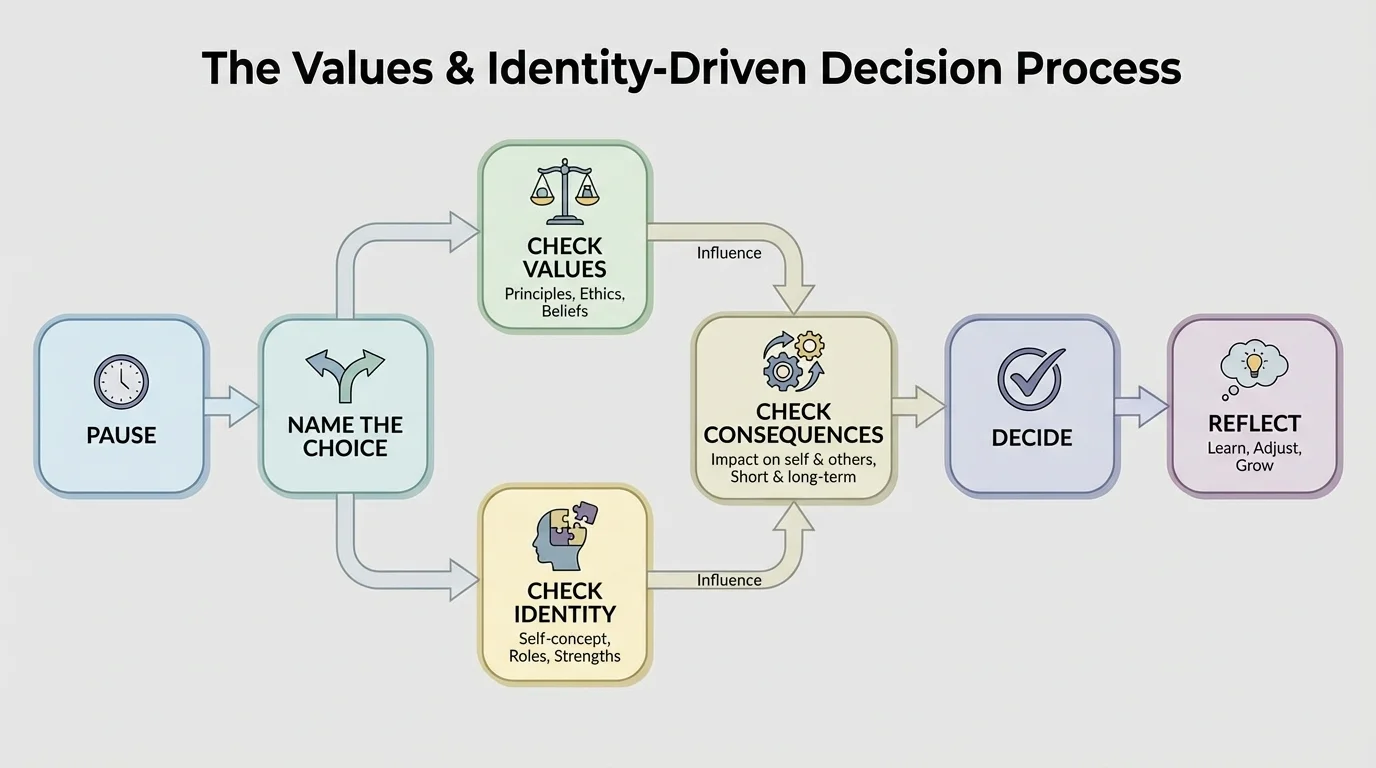
This process will not remove every hard feeling. But it gives you a way to think clearly instead of reacting only to emotion, pressure, or impulse.
For example, suppose you are tempted to join in mocking someone online because the group thinks it is funny. If you pause and check your values, you may realize the joke conflicts with kindness or fairness. If you check your identity, you may realize, "That is not the kind of person I want to be." That moment of self-awareness can change your decision.
"Character is what you do when no one is watching."
— Common leadership principle
The same framework works for goals. If a goal keeps you constantly pretending, draining yourself, or ignoring what matters most, it may need to change. As [Figure 3] illustrates, strong decisions are not random. They move through reflection, action, and learning.
Sometimes values pull in different directions. You might value honesty but also want to protect someone's feelings. You might value loyalty but also need to protect yourself from harmful behavior. You might value achievement but realize you also need balance and mental health.
When values conflict, ask which choice protects the most important principle in that moment. For example, if a friend wants you to hide something dangerous, loyalty should not come before safety. If telling the full truth in a harsh way would only wound someone, honesty may need to be guided by kindness.
It is also normal for values to become clearer over time. Maybe you once cared most about fitting in, but now you care more about peace, honesty, or purpose. That shift does not mean you were fake before. It means you are growing.
Feelings matter, but feelings are not always instructions. A choice can feel scary and still be right. A choice can feel popular and still be wrong. Self-awareness helps you notice emotions without handing them total control.
You will also make mistakes. Everyone does. The goal is not perfection. The goal is learning. If you realize a choice did not match your values, ask: What pulled me off track? Fear? Approval? Anger? Avoidance? That question turns mistakes into useful information.
You do not discover yourself once and finish. You build yourself through repeated choices. Every time you tell the truth, keep a promise, set a boundary, apologize sincerely, or work toward a meaningful goal, you strengthen a pattern. Over time, patterns become part of your character.
Here are some practical ways to build that pattern:
Name your top values. Pick a short list, such as honesty, respect, growth, responsibility, or compassion. If everything matters equally, nothing stands out when choices get hard.
Notice your triggers. Pay attention to situations where you are most likely to ignore your values, such as when you feel left out, rushed, embarrassed, angry, or desperate for approval.
Use reflection regularly. After a difficult choice, ask what went well, what felt off, and what you would do next time.
Choose people carefully. The people you admire and stay close to influence your standards. Their habits can strengthen or weaken your own.
Let goals match growth. Instead of only asking, "What do I want to achieve?" also ask, "Who am I becoming while I pursue this?"
Try This
At the end of the day, choose one decision you made, even a small one. Ask yourself three questions: What value showed up? What did this choice say about my identity? Did this move me closer to or farther from the person I want to become? Practicing this for a week can make your patterns much easier to see.
The more clearly you know what matters to you, the easier it becomes to lead with integrity, build healthier relationships, and choose future goals that truly fit. You do not need to have your whole life figured out right now. You just need to keep making honest choices that point in the right direction.
