Some pressure can help you focus. Too much can make even simple things feel impossible. You might be trying to keep up with online assignments, reply to messages, meet family expectations, stay involved in activities, and still somehow feel calm and motivated. That balancing act is real, and learning how to handle it is not just a "school skill." It is a life skill.
Pressure is not always the problem by itself. The bigger challenge is what happens when pressure, expectations, and emotions all pile up at the same time. If you do not know how to sort them, you may procrastinate, snap at people, stop sleeping well, or feel like you are always behind. But when you learn practical ways to manage them, you can stay productive and protect your mental and emotional health.
Balancing demands does not mean doing everything perfectly. It means making choices that are realistic, healthy, and sustainable. A balanced person still feels stress sometimes, but stress does not completely take over their thinking, mood, or behavior.
If you ignore your emotional well-being, pressure often grows. A late assignment becomes several. One tense conversation can turn into conflict. A bad week starts to feel like a bad identity: "I am lazy," "I always fail," or "I can't handle anything." Those thoughts are powerful, but they are not always true. Often, they are signs that you need better strategies, not harsher self-judgment.
Pressure is the feeling that you must meet a demand, solve a problem, or perform well.
Expectations are beliefs about what you should do, achieve, or be like. They can come from other people or from yourself.
Emotional well-being is your ability to understand your feelings, cope with stress, and keep yourself mentally and emotionally steady over time.
These three ideas connect closely. Pressure can come from expectations, and if the pressure stays high for too long, emotional well-being can suffer. On the other hand, strong emotional skills can help you respond to pressure in a calmer, smarter way.
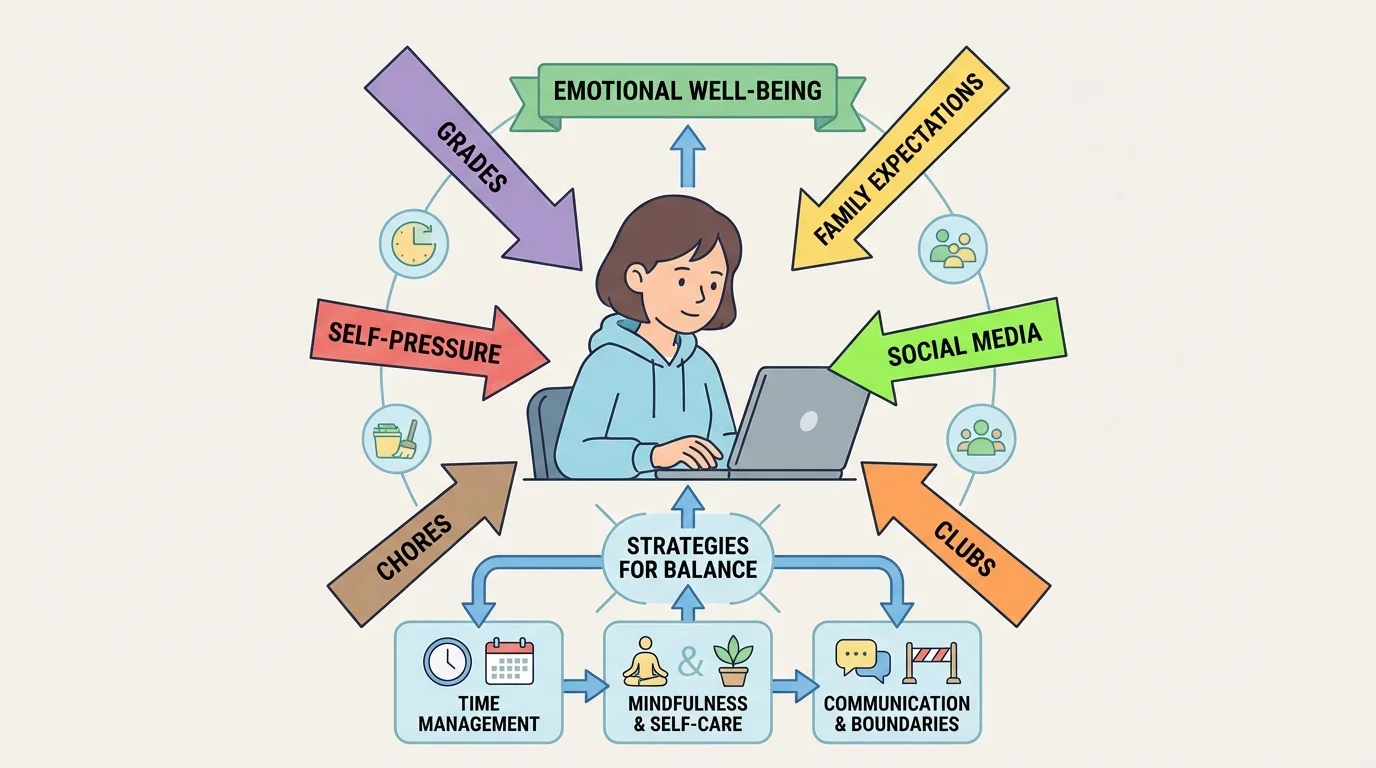
Stressors are the things that create stress, and they often come from several directions at once, as [Figure 1] shows. You might have external pressure from assignment deadlines, family rules, sports practice, part-time work, or community commitments. You might also have internal pressure, which comes from your own thoughts, such as "I have to get everything right" or "If I disappoint one person, I've failed."
For many teens, internal pressure is just as strong as outside pressure. You may compare yourself to people online, expect yourself to stay constantly motivated, or believe that needing rest means you are weak. Those beliefs can make normal challenges feel much heavier.
Not all pressure is harmful. There is a difference between a healthy challenge and overload. A healthy challenge might make you nervous before a presentation on video, but you still feel able to prepare and recover. Overload is different. It feels like you are carrying too many demands at once, with no space to think, rest, or reset.
That is why it helps to ask: What exactly is pressuring me right now? Be specific. "Everything" feels overwhelming. "I have two assignments due, my group chat is distracting me, and I'm worried my parent thinks I'm not trying" is much more useful. Clear problems are easier to solve than vague panic.
Your body and mind usually send signals before stress becomes a bigger problem. Learning to notice them early matters, and [Figure 2] illustrates how healthy challenge and unhealthy overload can look different. The earlier you catch the signs, the easier it is to respond before things snowball.
Warning signs can show up physically, emotionally, mentally, and behaviorally. Physical signs include headaches, tense muscles, stomachaches, low energy, or trouble sleeping. Emotional signs include irritability, sadness, frustration, or feeling numb. Mental signs include racing thoughts, constant worry, negative self-talk, or difficulty focusing. Behavioral signs include procrastinating, withdrawing from people, doom-scrolling, overeating, skipping meals, or suddenly getting angry over small things.
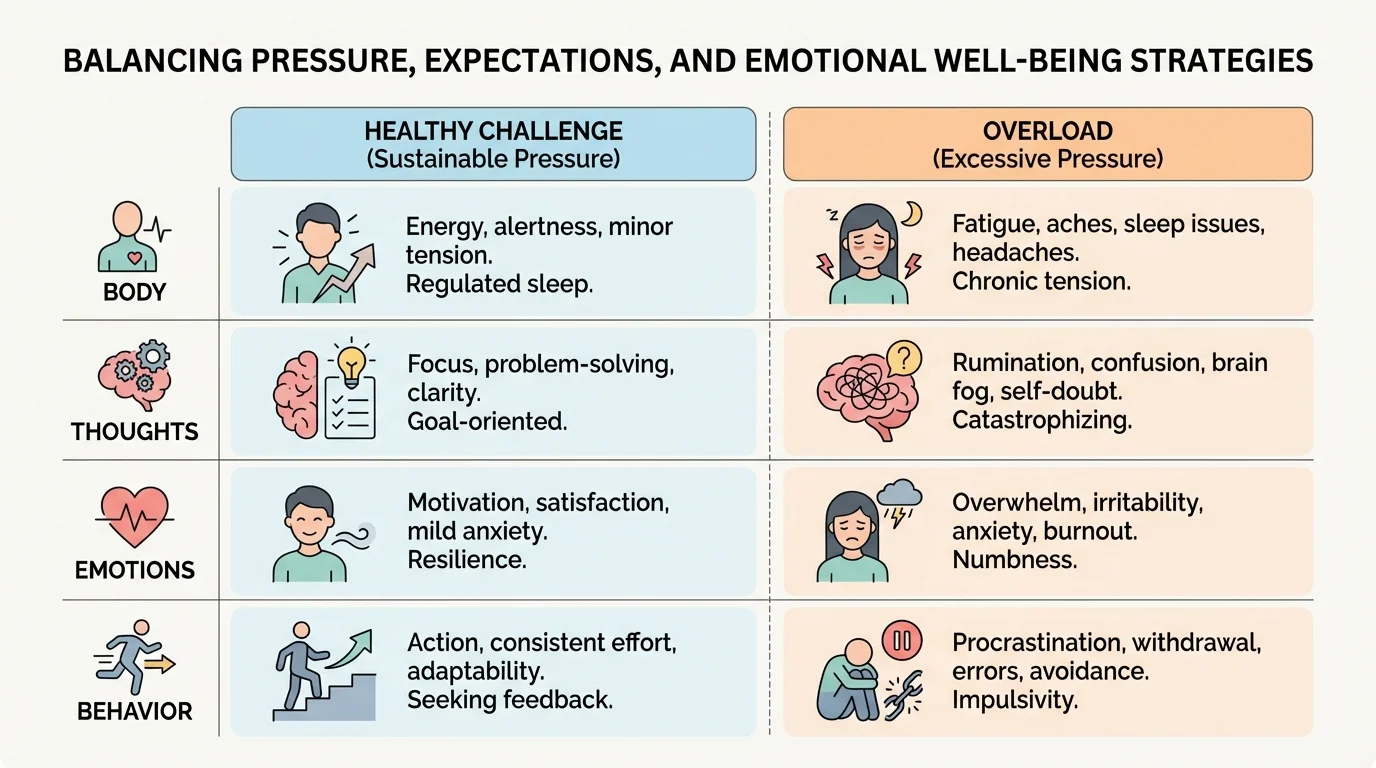
One hard day does not automatically mean something is seriously wrong. But patterns matter. If you notice the same signs for days or weeks, it is a clue that your current way of handling pressure is not working well enough.
| Area | Healthy challenge | Possible overload |
|---|---|---|
| Thoughts | "This is hard, but I can make a plan." | "I can't do any of this." |
| Emotions | Nervous but motivated | Anxious, angry, hopeless, or shut down |
| Body | Temporary tension | Constant headaches, exhaustion, poor sleep |
| Behavior | Starts tasks with effort | Avoids tasks, isolates, or melts down |
Table 1. Comparison of manageable stress and signs that stress may be becoming unhealthy.
As you saw earlier in [Figure 1], pressure often comes from more than one source at a time. That is why your warning signs may not come from one single assignment or one single conversation. Sometimes it is the buildup that affects you most.
Your brain handles stress better when it can name what is happening. Simply saying, "I am feeling overwhelmed because I have three deadlines and I slept badly," can reduce confusion and help you choose a response.
Naming the problem is not dramatic. It is a practical skill. You are not "making a big deal out of nothing." You are gathering information about yourself.
When pressure is high, you need a process, not just motivation. A simple routine of prioritize and adjust works well, and [Figure 3] shows the full flow from noticing stress to taking action. This kind of structure helps because stress can make your thoughts feel messy, even when the actual situation is manageable.
As [Figure 3] shows, use these six steps whenever you start to feel overloaded.
Step 1: Pause. Stop for a minute before reacting. Do not immediately quit, panic, or tell yourself a harsh story. Take a few slow breaths. If needed, step away from your screen for two minutes.
Step 2: Sort. Write down everything pressuring you. Then separate it into categories: urgent, important but not urgent, and not important right now. This keeps your mind from treating every problem as equally huge.
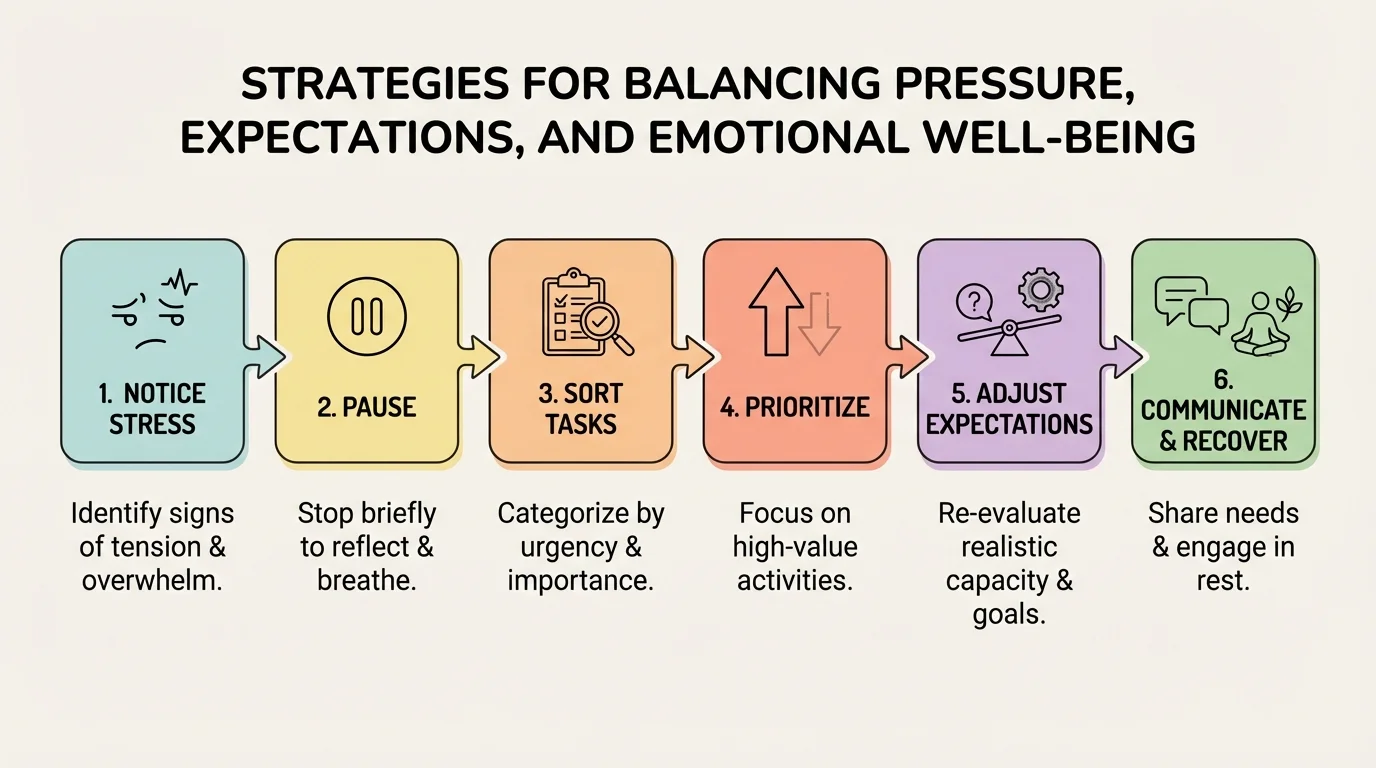
Step 3: Prioritize. Ask what needs attention first. If you have a quiz tomorrow, a project due next week, and a long text conversation causing drama, the quiz may come first. Prioritizing is not the same as saying everything else does not matter. It means choosing the next best move.
Step 4: Adjust expectations. Sometimes the best plan is not your ideal plan. It is the realistic one. Maybe your original goal was to finish every assignment perfectly tonight. A healthier goal might be to finish the most urgent work well, email about the next deadline, and go to sleep on time.
Step 5: Communicate. If another person is involved, tell them what is realistic. Silence often increases pressure because others do not know what is going on. A respectful message can prevent misunderstandings.
Step 6: Recover. Recovery is part of responsibility, not a reward you earn only after exhaustion. Your brain works better after sleep, food, movement, hydration, and a real break.
Example: Using the six-step framework
You have a science assignment due tomorrow, a club meeting online tonight, and you are upset after an argument with a friend.
Step 1: Pause
You take five slow breaths and stop switching between tabs.
Step 2: Sort
You list the science assignment, club meeting, and friendship issue.
Step 3: Prioritize
The science assignment comes first because it has the nearest deadline.
Step 4: Adjust expectations
Instead of attending the entire club meeting, you decide to join for the first part only.
Step 5: Communicate
You send a message: "I have a deadline tonight, so I can only stay for 20 minutes."
Step 6: Recover
After submitting the assignment, you take a shower, put your phone down, and go to bed earlier than usual.
The goal is not a perfect evening. The goal is preventing one stressful night from turning into a bigger spiral.
Later, when you face a different challenge, the same structure still works. The order matters: first calm yourself, then organize, then act. Trying to solve everything while panicking usually makes decisions worse.
Not every expectation deserves equal power over you. Some are fair and helpful. Others are too vague, too extreme, or based on comparison instead of reality. A strong boundary often begins with noticing which expectations are healthy and which are not.
Ask yourself these questions: Is this expectation clear? Is it realistic with the time, energy, and resources I actually have? Is it flexible when life gets hard? Does it help me grow, or does it only make me feel afraid? If the answer shows that an expectation is rigid or unreasonable, it may need to be challenged or adjusted.
For example, "I want to improve my grades by being more consistent" is realistic. "I must get top scores on everything while sleeping very little and never making mistakes" is not. The second expectation sounds determined, but it usually leads to burnout, hiding struggles, and feeling ashamed whenever life is imperfect.
Healthy expectations are demanding but humane. They ask effort from you, but they also leave room for rest, mistakes, learning, and changing plans when necessary. Unhealthy expectations often treat you like a machine instead of a person.
Sometimes the hardest expectations come from yourself. You may think self-criticism keeps you driven, but in many cases it does the opposite. It drains energy, increases fear, and makes starting harder. A more useful approach is self-honesty plus self-respect: "I am behind, and I need a plan" works better than "I'm terrible at everything."
Emotional regulation means managing your feelings in a way that helps you respond wisely instead of reacting impulsively. It does not mean pretending you are fine or forcing yourself not to feel anything.
When emotions rise fast, use short tools that calm your body first. Try slow breathing, unclenching your jaw, stretching your shoulders, drinking water, or walking around the room. Physical calming matters because your body and emotions affect each other. If your body stays in high alert, thinking clearly becomes harder.
Next, use balanced self-talk. Balanced self-talk is not fake positivity. It sounds like: "This is a stressful moment, not my whole life." "I can do one step at a time." "I do not need to solve everything in the next ten minutes." These statements reduce panic without ignoring reality.
A grounding technique can also help. Name five things you can see, four things you can feel, three things you can hear, two things you can smell, and one thing you can taste. This brings your attention back to the present instead of letting your thoughts race into worst-case scenarios.
"You do not have to control every thought. You do need ways to guide your next action."
If your stress is connected to social conflict, avoid replying instantly when you are flooded with emotion. A message written in anger can create consequences that last much longer than the feeling itself. Pause first. Draft your response. Read it again when you are calmer.
You do not have to choose between being rude and saying nothing. There is a middle path: clear, respectful communication. This is especially important in online school, group projects, family responsibilities, extracurricular activities, and friendships.
A simple communication formula is: state the situation, name the limit, offer the next step. For example: "I'm working on two deadlines tonight, so I can't join the full call. I can check in for 15 minutes and read the updates later." That message is honest, respectful, and useful.
Here are a few scripts you can adapt:
Respectful communication supports balance because it reduces guessing. Other people may not automatically understand your stress level, your schedule, or what kind of help you need. Clear words protect your time and your relationships.
Communication comes after you sort out what is realistic. If you message people before you know your actual limit, you may promise more than you can truly handle.
Resilience is the ability to recover, adapt, and keep going after stress, setbacks, or disappointment. It is not about never struggling. It is about returning to balance more effectively.
Resilience grows from habits, not just personality. Sleep helps your mood and concentration. Regular meals help your energy stay more steady. Movement helps release stress. A basic routine reduces decision fatigue. A quiet study space, even if small, helps your brain switch into work mode more easily.
Boundaries matter here too. You may need a cutoff time for screens at night, limits on notifications while studying, or rules about not checking stressful messages right before bed. These habits are not about being strict for no reason. They protect your focus and emotional recovery.
Resilience routine for a high-pressure week
Step 1: List your non-negotiables
Choose basics you will protect: sleep, meals, a planner, and one short break after focused work.
Step 2: Reduce extras
Mute non-essential group chats and postpone tasks that are not urgent.
Step 3: Build support
Tell one trusted adult or friend that the week is intense so you are not carrying it alone.
Step 4: Review daily
Each evening, ask what worked, what did not, and what needs adjusting tomorrow.
Resilience gets stronger when you repeat these actions, even imperfectly.
Self-compassion is part of resilience too. Self-compassion does not mean avoiding responsibility. It means responding to mistakes like a coach instead of an enemy. A coach says, "That did not go well. Let's fix it." An enemy says, "You failed, so why try?" Only one of those voices actually helps you improve.
Consider two students with the same amount of work. One ignores stress signals, stays up very late, avoids messages, and keeps telling themselves they must do everything perfectly. The other notices early overload signs from [Figure 2], sorts tasks, lowers one unrealistic expectation, and asks for help on one piece. The second student is not weaker. They are using a better strategy.
Here are some common situations:
Situation 1: Family pressure. Your family wants strong grades, and you also have chores and younger siblings to help with. If you stay silent, pressure may turn into resentment. If you calmly explain your deadlines and ask to reorder tasks for one evening, you have a better chance of meeting both school and family responsibilities.
Situation 2: Social pressure online. You feel like you must answer every message right away. If you keep doing that during study time, your focus breaks again and again. If you set a boundary such as checking messages every hour instead of every two minutes, your work quality and stress level both improve.
Situation 3: Self-pressure. You got one low score and decide it means you are falling behind forever. If you believe that thought completely, you may give up. If you treat it as feedback instead, you can review what went wrong and improve on the next task.
Good self-management is not about controlling every part of life. It is about noticing what you can control right now: your next step, your schedule, your words, your habits, and when you ask for support.
The consequences of poor balance are real: more conflict, lower focus, worse sleep, more missed work, and a stronger feeling of being stuck. The consequences of good balance are just as real: clearer thinking, steadier emotions, healthier relationships, and better follow-through.
Sometimes the best strategy is not doing more by yourself. If stress feels constant, your mood is low most days, you are panicking often, you cannot sleep, you are losing interest in things you usually care about, or you feel hopeless, it is important to tell a trusted adult, school counselor, doctor, or mental health professional.
Asking for help is not overreacting. It is a responsible move when your usual coping tools are not enough. Support can include changing deadlines, getting help with organization, talking through emotions, or creating a plan for bigger challenges at home or in your personal life.
Even before things become serious, reaching out can help. You do not need to wait until you are completely overwhelmed. Early support often prevents bigger problems later.
Tonight, take three minutes and write down one pressure you feel from others, one pressure you put on yourself, and one action that would make tomorrow more manageable. Keep it small and specific. Examples include packing what you need, muting one distracting app, emailing about a question, or deciding what task comes first.
Then ask yourself one final question: What would balance look like here, not perfection? That question can change the way you respond to pressure.
