Some of the strongest leaders are not the loudest people in the room or the fastest to speak in a group chat. They are often the ones who notice what others are feeling, understand how their words are received, and make choices that help people work together instead of pulling apart. That is what makes empathy and social awareness so powerful. They do not just make you "nice." They make you better at leading, deciding, and handling real situations online and in your community.
At your age, you already make leadership and peer decisions all the time. You decide whether to speak up when someone is left out in a chat, whether to follow a crowd online, whether to calm conflict or make it worse, and whether to think only about what you want or also about how your choice affects other people. These moments may seem small, but they shape your reputation, your relationships, and the kind of person others trust.
Empathy is the ability to understand and care about what another person may be feeling or experiencing.
Social awareness is the ability to notice what is happening around you in a social situation, including tone, mood, facial expressions and body language in video interactions, group dynamics, and what people may need even if they do not say it directly.
Leadership is guiding a group, situation, or decision in a positive direction. You do not need a title to be a leader.
Empathy and social awareness work together. Empathy helps you connect with one person's experience. Social awareness helps you read the bigger situation. If a friend sounds short in a message, empathy helps you consider that they may be stressed. Social awareness helps you notice that the whole group conversation has become tense and that your next reply could either calm things down or push everyone further into conflict.
Many people think empathy means agreeing with everyone. It does not. You can understand why someone feels hurt, angry, embarrassed, or excited without agreeing with everything they say or do. Empathy is not surrendering your judgment. It is using your judgment more wisely because you have more information about the human side of the situation.
Social awareness is also more than "reading the room." In online life, there may not be a physical room at all. You may need to read timing, response patterns, silence, emoji use, when people keep their cameras off on a video call, or the difference between a joke and a targeted insult. If one person keeps getting talked over in a video meeting, if one teammate is doing all the work, or if a post is clearly humiliating someone, social awareness helps you catch what others miss.
These skills matter because decisions are rarely only about facts. They are also about people. A technically correct choice can still be a poor choice if it damages trust, embarrasses someone publicly, or ignores how a group will react. When you combine empathy with awareness, you make choices that are not just smart in the short term, but effective in the long term.
People often remember how you made them feel longer than they remember your exact words. That is one reason a thoughtful leader can have more influence than a flashy one.
This matters in practical life: clubs, volunteer groups, sports teams, online study groups, family decisions, part-time jobs, gaming communities, and friendships. In all of these places, people notice whether you pay attention to others or only to yourself.
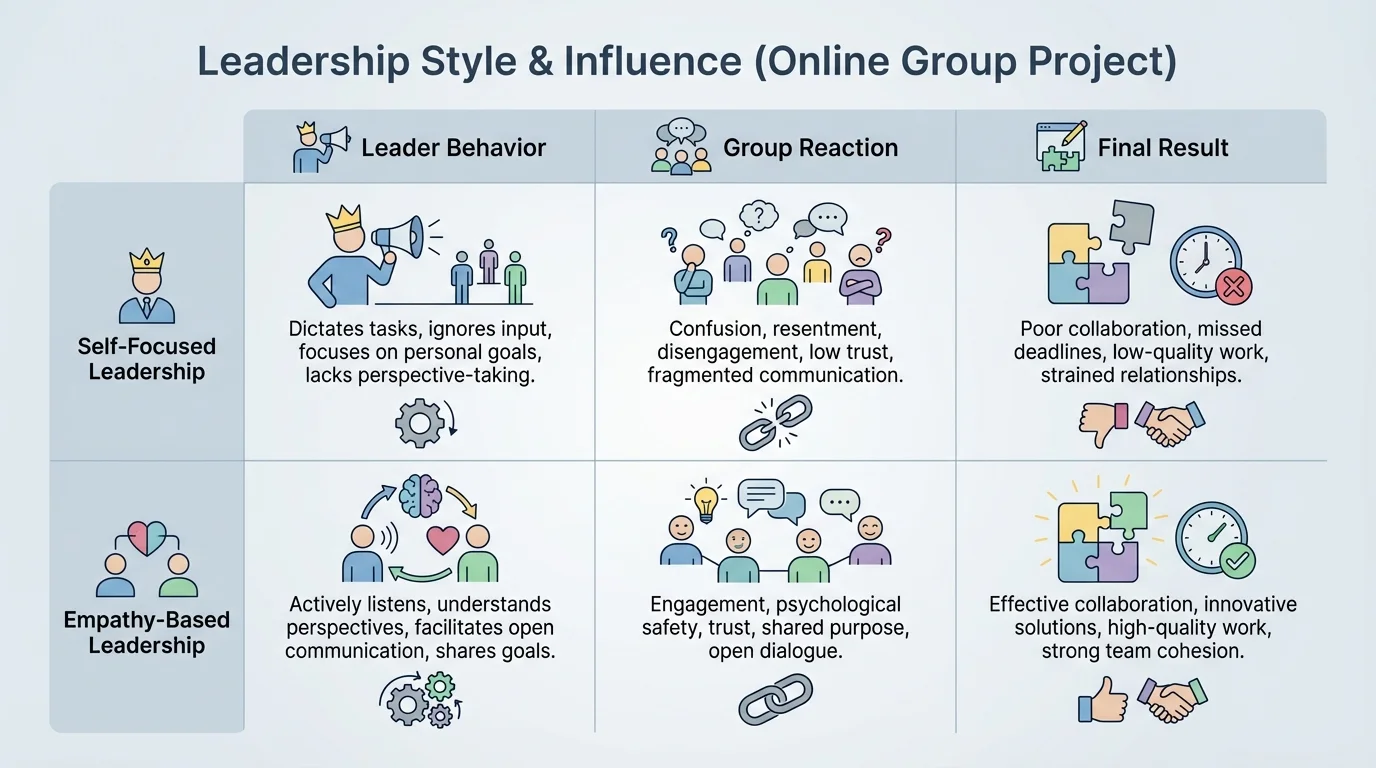
A leader without empathy may still look strong at first, but that kind of leadership often breaks down when people feel ignored or disrespected. In contrast, a leader who uses empathy and social awareness notices what a group needs, as [Figure 1] shows in the difference between self-focused and people-aware leadership. That leader pays attention to who has spoken, who has not, who seems confused, and what decision will help the group move forward together.
For example, suppose you are helping organize an online volunteer event. One person keeps missing deadlines. A low-empathy response might be: "You're unreliable. If you can't handle it, leave." An empathy-based response might be: "I noticed the deadlines have been hard to meet. What is getting in the way, and what support or role change would help?" The second response still addresses the problem, but it does so in a way that preserves dignity and often gets better results.
Empathy in leadership builds trust. When people feel heard, they are more willing to be honest. They are also more likely to cooperate, admit mistakes, and accept feedback. A leader who embarrasses people may get silence, but silence is not the same as respect. Silence can mean fear, withdrawal, or resentment.
Social awareness helps leaders understand timing and context. Maybe a teammate needs correction, but not in front of the whole group. Maybe the group is tired and needs a smaller goal instead of a big lecture. Maybe two people are disagreeing, but one is frustrated and the other is embarrassed, so the best next move is to slow the conversation rather than force a quick decision.
Leadership also includes setting the emotional tone. If you are calm, fair, and respectful, people often match that energy. If you are sarcastic, dismissive, or impulsive, that tone spreads too. This is especially true online, where people cannot always hear your full tone and may assume the worst. That is why leaders need to think not just, "What do I want to say?" but also, "How will this likely land?"
Case study: leading an online project meeting
A student notices that one teammate has stopped speaking during weekly video calls after their idea was brushed aside.
Step 1: Notice the pattern
The leader pays attention instead of assuming the person is lazy or uninterested.
Step 2: Consider the other person's experience
The leader thinks, "They may feel dismissed or awkward about speaking again."
Step 3: Respond in a respectful way
The leader says, "I want to pause and make sure everyone gets a chance. Alex, if you want, I'd like to hear your idea again."
Step 4: Improve the group process
The leader suggests a turn-taking system or shared document so quieter people can contribute.
This is leadership because it improves the group, not just the leader's image.
Later, when you compare outcomes again, the pattern becomes clear: empathy-based leadership usually creates better participation, fewer unnecessary conflicts, and stronger follow-through.
You do not have to be "the leader" for these skills to matter. Peer decisions happen every day: whether to laugh at a mean joke, whether to repost something humiliating, whether to leave someone out, whether to pressure a friend, or whether to check in when someone suddenly goes quiet. These are not random moments. They are choices shaped by what you notice and what you value.
Peer pressure becomes stronger when you stop paying attention to the human impact of a choice. If the group wants to mock someone or pile onto a rumor, it can feel easier to go along. Social awareness interrupts that automatic reaction. It helps you notice: "The group is acting intense right now," "People are trying to impress each other," or "No one is considering how this will affect the person being targeted."
Empathy then adds another layer: "How would this feel if it happened to me?" That question does not solve everything, but it slows impulsive behavior. It makes harmful choices harder to justify. It also makes brave choices more likely, such as privately supporting the person who was excluded or choosing not to join a harmful trend.
Peer decisions also involve positive moments. Social awareness helps you notice when someone is nervous joining a new online group, unsure during a community activity, or being subtly ignored in a conversation. Empathy helps you respond in ways that include rather than exclude. Sometimes leadership looks like a simple message: "Hey, I noticed you got talked over. Want to share your idea?"
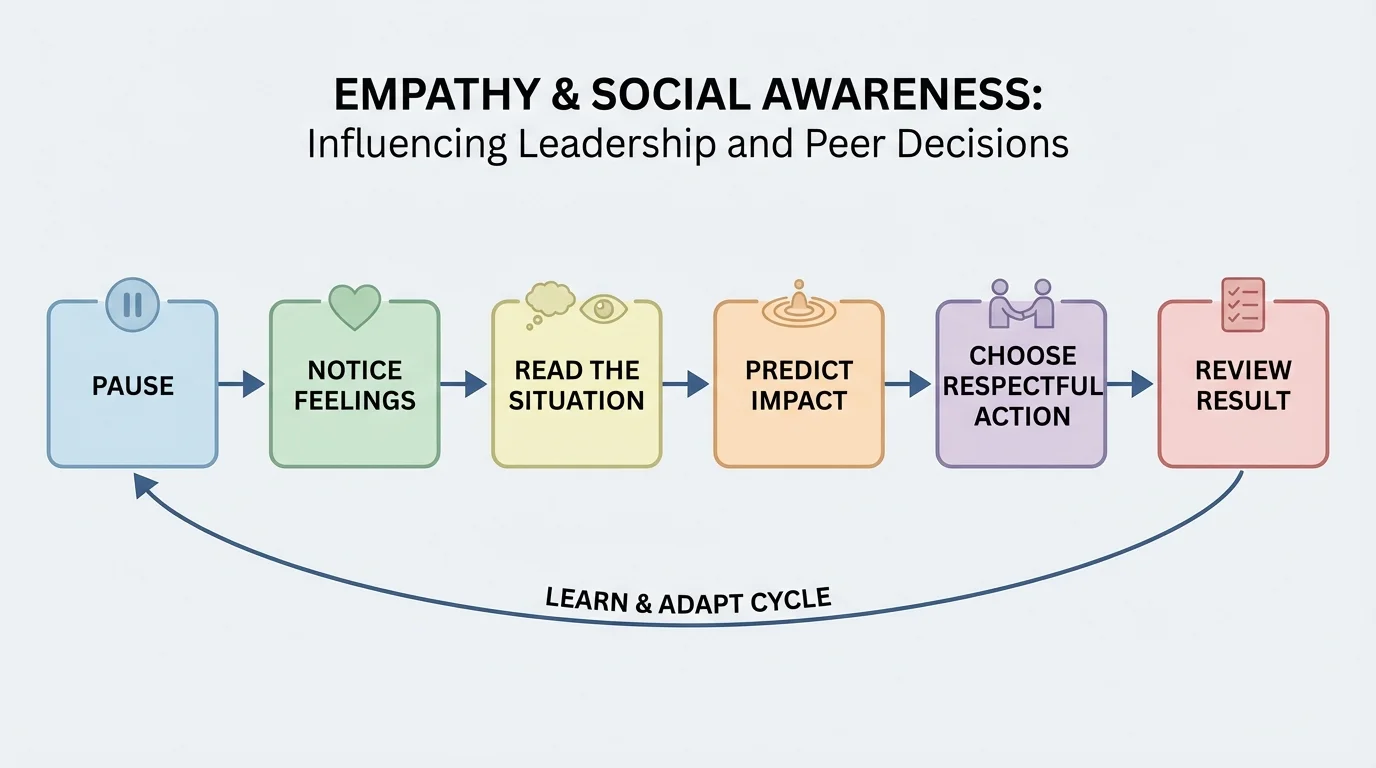
When emotions are high, it helps to have a process. A practical decision framework keeps you from reacting without thinking. The one below works before sending a message, making a group choice, responding to conflict, or deciding whether to follow others. As [Figure 2] illustrates, the goal is not to become slow or awkward. The goal is to pause just long enough to make a stronger choice.
Step 1: Pause. Do not answer at your fastest emotional speed. If you are angry, embarrassed, excited, or trying to impress people, that is exactly when a short pause matters most.
Step 2: Notice your feelings. Ask yourself, "What am I feeling right now?" If you are feeling left out, defensive, jealous, or pressured, those feelings can quietly push your decision.
Step 3: Read the situation. What is happening with the other person or the group? Is someone joking, venting, testing limits, feeling embarrassed, or trying to fit in? What signs are you seeing?
Step 4: Predict impact. If you say or do this, what is likely to happen next? Will it solve the problem, escalate it, embarrass someone, or build trust?
Step 5: Choose the most respectful and effective action. Respectful does not mean passive. It might mean being direct, but in a calm and clear way.
Step 6: Review afterward. Did your action help? If not, what would you change next time?
This process is especially useful online because digital communication removes some clues and speeds up bad decisions. A rushed text, public comment, or screenshot can travel fast. A thoughtful choice may take only a few extra seconds, but it can prevent long-lasting damage.
Respectful does not mean weak
Empathy-based decisions can still be firm. You can say no, set limits, call out harmful behavior, or leave a group that is acting badly. The difference is that you do it with control and awareness instead of cruelty or carelessness.
A good test is this: can you be honest without trying to humiliate someone? If yes, you are probably using empathy and social awareness well.
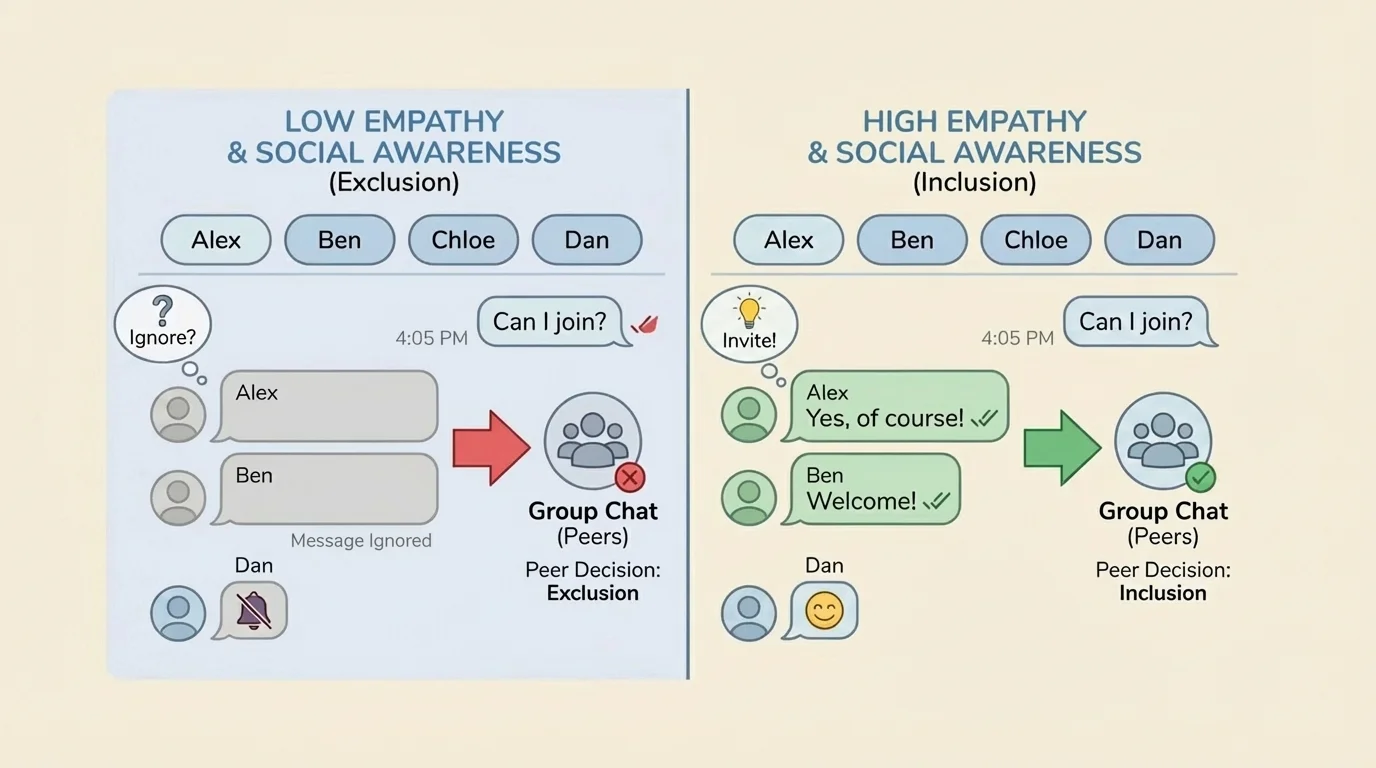
One of the clearest places these skills matter is in online group chats. A chat can quickly turn from fun to hurtful because people react fast, copy each other, and forget there is a real person on the other side. In the group-chat situation shown in [Figure 3], one path ignores a person's message and piles on with inside jokes, while the other path acknowledges them and makes space. That small difference can completely change whether someone feels welcome or shut out.
Suppose a class-related study chat starts mocking a student's question. A low-awareness response is to add another joke to fit in. A higher-awareness response is to redirect: "It's actually a fair question. Here's how I understood it." That one sentence can change the tone and protect someone from being embarrassed.
Projects are another big area. If one person is behind, empathy helps you ask what is happening before attacking them. Maybe they are disorganized. Maybe they are overwhelmed. Maybe they did not understand the task. Social awareness helps you also protect the group by setting clear expectations. This is where empathy and accountability work together.
Gaming spaces also test these skills. Competitive situations can bring out trash talk, blaming, or dogpiling. If a teammate makes a mistake, a socially aware player notices whether criticism will help performance or just increase frustration. An empathetic player can be honest without making the space toxic. For example: "Let's reset and try a different strategy" is usually more useful than "You ruined everything."
Community activities such as volunteering, clubs, youth groups, or neighborhood events also need people-aware decisions. A strong leader notices who feels new, who seems uncertain, and who is carrying too much. Sometimes the best choice is not to take over, but to help someone else participate.
When you look back at exclusion and inclusion, the lesson is simple: peer decisions are rarely neutral. They either move a group toward respect or toward harm.
Quick comparison of common choices
| Situation | Low empathy / low awareness choice | High empathy / high awareness choice |
|---|---|---|
| Friend replies late | Assume they are ignoring you and send an angry message | Consider they may be busy and ask calmly if everything is okay |
| Group chat joke targets one person | Join in to fit the mood | Change the tone or privately support the person |
| Team member misses a task | Publicly shame them | Ask what happened, then reset expectations clearly |
| You disagree with a plan | Dismiss everyone else's ideas | State your view and explain your reasoning respectfully |
Table 1. Comparison of how empathy and social awareness can change everyday peer and leadership choices.
The goal is not to become perfect. The goal is to make harmful choices less automatic and helpful choices more consistent.
Empathy is powerful, but it needs boundaries. If you care about everyone's feelings all the time without protecting your own limits, you can become exhausted, resentful, or easy to manipulate. That is why healthy empathy includes self-respect.
Boundaries are the limits that protect your time, energy, values, and safety. You can understand why someone is upset and still decide not to accept disrespect. You can care that a friend is struggling and still say, "I can listen for a little while, but I also need to log off and take care of my own work."
Another problem is people-pleasing. Some students confuse empathy with always keeping everyone happy. But leadership sometimes requires choices that not everyone likes. If you lead a group, you may need to enforce deadlines, stop rude behavior, or say no to a bad idea. Empathy helps you do that fairly; it does not mean avoiding discomfort.
"Clear is kind."
— A useful leadership principle
There is also a difference between understanding someone and excusing harmful behavior. If someone keeps insulting others, spreading rumors, or using personal struggles as a reason to hurt people, empathy should not erase accountability. Social awareness helps you notice patterns, not just isolated moments.
If you feel drained, take that seriously. Constantly managing other people's emotions can wear you down. Strong leaders know when to step back, ask for help, or reset their own emotional state before trying to guide others.
These skills improve with practice. You do not need a dramatic situation to build them. Start with small habits that make your decisions better.
Listen for meaning, not just words. When someone messages "I'm fine," ask yourself whether the timing, tone, or recent context suggests otherwise.
Ask one more question before judging. Instead of assuming laziness, rudeness, or rejection, ask for more information.
Notice who gets left out. Every group has patterns. Pay attention to who is ignored, interrupted, or excluded.
Practice naming impact. If something goes wrong, try saying, "I think that landed badly," or "That probably felt unfair," instead of pretending nothing happened.
Repair quickly. If you were insensitive, own it. A real apology is specific: "I interrupted you and made your idea seem unimportant. I'm sorry. I want to do better."
You do not need to read people perfectly to make better choices. You only need to slow down, pay attention, and stay willing to adjust when you learn more.
Try This: Before sending one important message today, pause and ask two questions: "What might this person be feeling?" and "What result do I want from this message?" That tiny habit can improve both friendships and leadership.
Try This: In your next group interaction, notice who has spoken the least. Find one respectful way to make more space for them.
Try This: If a conversation becomes heated, wait a few minutes before replying. Distance often makes empathy easier and impulsive choices less tempting.
The more you practice empathy and social awareness, the better your decisions become. People are more likely to trust you, include you, follow your lead, and feel safe being honest with you. Those are not small advantages. They are the foundation of strong relationships and effective leadership in real life.
