A strong school community is not built by posters, slogans, or one nice message in a chat. It is built by repeated choices: who gets invited, who gets heard, who receives clear explanations, who gets laughed at, and who gets ignored. In an online school, where much of your connection happens through messages, discussion boards, video calls, and shared documents, those choices matter even more. When people cannot read the room easily, small actions can either create belonging or make someone feel invisible.
School culture means the shared feeling of what your learning community is like. Is it respectful? Safe? Welcoming? Fair? Community trust means people believe they will be treated honestly, respectfully, and consistently. If students trust their school community, they are more likely to participate, ask questions, speak up about problems, and support one another. If trust is low, people pull back, stay silent, or assume they do not belong.
In an online setting, trust does not appear automatically. It grows when people make space for different backgrounds, needs, schedules, communication styles, and life situations. Some students have quiet workspaces and reliable internet. Others share devices, care for siblings, work part-time, or feel anxious speaking on camera. Inclusive actions recognize those differences instead of pretending everyone starts from the same place.
Inclusive actions are choices that actively help more people participate, feel respected, and have fair access to opportunities. Belonging is the feeling that you are accepted and valued as part of a group. Bias is a judgment or assumption that can unfairly affect how we treat people. Trust is confidence that others will act with honesty, care, and fairness.
Inclusion is not about making everyone the same. It is about making sure differences do not become reasons for exclusion. That means looking beyond your own experience. If something works well for you, that does not automatically mean it works well for everyone else.
Some actions are obviously inclusive, like welcoming a new student in a discussion forum or explaining group instructions clearly. Others are less obvious. For example, if a student says, "Let's meet tonight; other people's availability is not really my problem—everyone should just be available," that choice may seem efficient, but it ignores people with family duties, jobs, different time zones, or limited internet access. Inclusion often looks like planning with other people in mind before problems happen.
Inclusive actions usually share a few features. They remove barriers, invite participation, avoid unfair assumptions, and show respect in both words and tone. They also make room for people to communicate differently. Some students are comfortable speaking live on video. Others express themselves better in writing. A healthy online culture makes space for both.
You can often recognize inclusive behavior by asking: does this action make it easier or harder for more people to take part? Does it help people feel safe enough to contribute? Does it show that different experiences matter?
Inclusion is active, not passive. It is not enough to avoid being openly rude. A community can still be excluding if people are left out by jokes, confusing expectations, fast-moving chats, inaccessible schedules, or assumptions about money, technology, religion, gender, disability, language, or family life. Inclusive people notice these patterns and adjust their behavior.
That is why "I did not mean anything bad" is not the final test. Intention matters, but impact matters more. If your comment embarrasses someone, leaves them out, or makes them feel disrespected, the effect is real even if you thought you were joking.
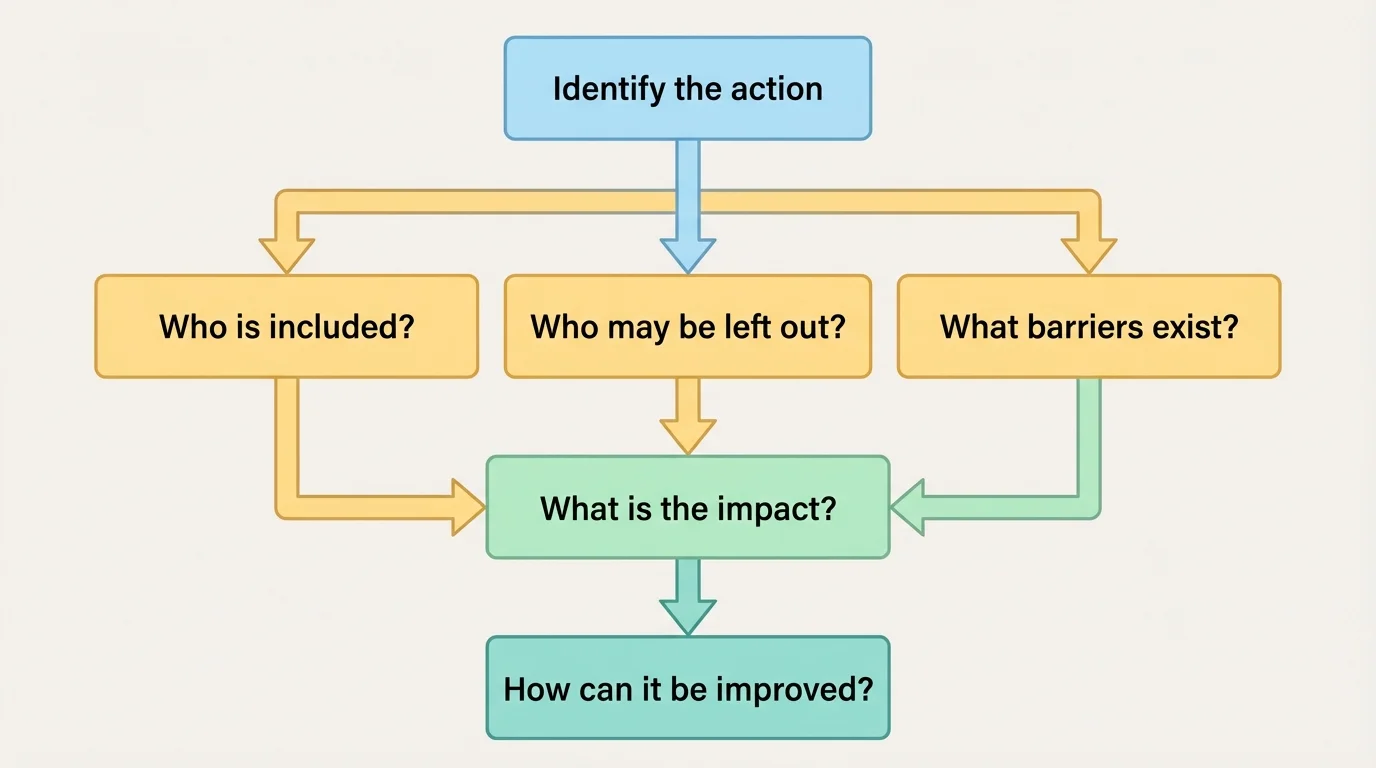
There is a simple way to judge whether a choice strengthens culture and trust, as [Figure 1] shows through a decision path you can use in real situations. Start by looking at who benefits, who may be left out, and what barriers might exist before you decide an action is "fine."
Step 1: Identify the action clearly. What exactly happened, or what is being planned? Be specific. "We are making a group chat for the project" is clearer than "We are organizing."
Step 2: Ask who is included and who might be excluded. Did everyone get the information? Is everyone able to join the platform, time, or format being used? Are there language, device, privacy, or scheduling barriers?
Step 3: Look at impact, not just intention. Even if the action was convenient or meant to be funny, did it create discomfort, confusion, or unfairness?
Step 4: Consider trust. Would this action make someone more likely to participate again, or less likely? Trust grows when people feel respected, listened to, and treated fairly.
Step 5: Improve the action. Ask what small change would make it more inclusive. Often the best fix is simple: clearer instructions, another participation option, a check-in message, or avoiding assumptions.
This process matters because exclusion is not always dramatic. Sometimes it is a pattern of little things: using slang some people do not understand, making inside jokes in a class server, posting key project details in a fast-moving chat instead of a shared document, or assuming everyone is comfortable turning cameras on. Each small choice sends a message about who is expected to adjust.
When you evaluate actions, try to separate intent from effect. A good intention can still lead to a bad result. A stronger response is not defensiveness. It is curiosity: "What did this feel like for the other person?" That question builds accountability and trust.
Case study: Evaluating a group project decision
A project team creates a private chat and starts assigning tasks before one student has joined.
Step 1: Identify the action
The group began planning in a space not all members could access yet.
Step 2: Check inclusion
One student missed important information and may now feel behind or unwanted.
Step 3: Check impact
Even if no one meant to exclude them, the result is unequal access.
Step 4: Improve it
Move decisions into a shared document, summarize what was discussed, and ask the missing student for input before finalizing roles.
The improved version strengthens fairness and makes future participation more likely.
Notice how the better response is not just "say sorry." It is "fix the system." Trust grows when people see that the group changes its behavior, not just its wording.
Most inclusive actions are ordinary choices, and [Figure 2] compares how small online behaviors can either include or shut people out. You do not need a leadership title to influence culture. If you join discussions, gaming communities, volunteer groups, study groups, or online clubs, your habits shape whether people feel welcome.
One common situation is communication speed. In a fast group chat, some people respond quickly while others need more time. If decisions happen in minutes, quieter members can get erased. An inclusive action is to pause before final decisions, post summaries, and invite input from people who have not responded yet.
Another situation is humor. Jokes can connect people, but they can also create an in-group and an out-group. If a joke depends on stereotypes, targets someone's identity, or embarrasses a person publicly, it damages trust. Even repeated teasing "for fun" can make someone stop participating. Inclusive humor does not require someone else to be the punchline.
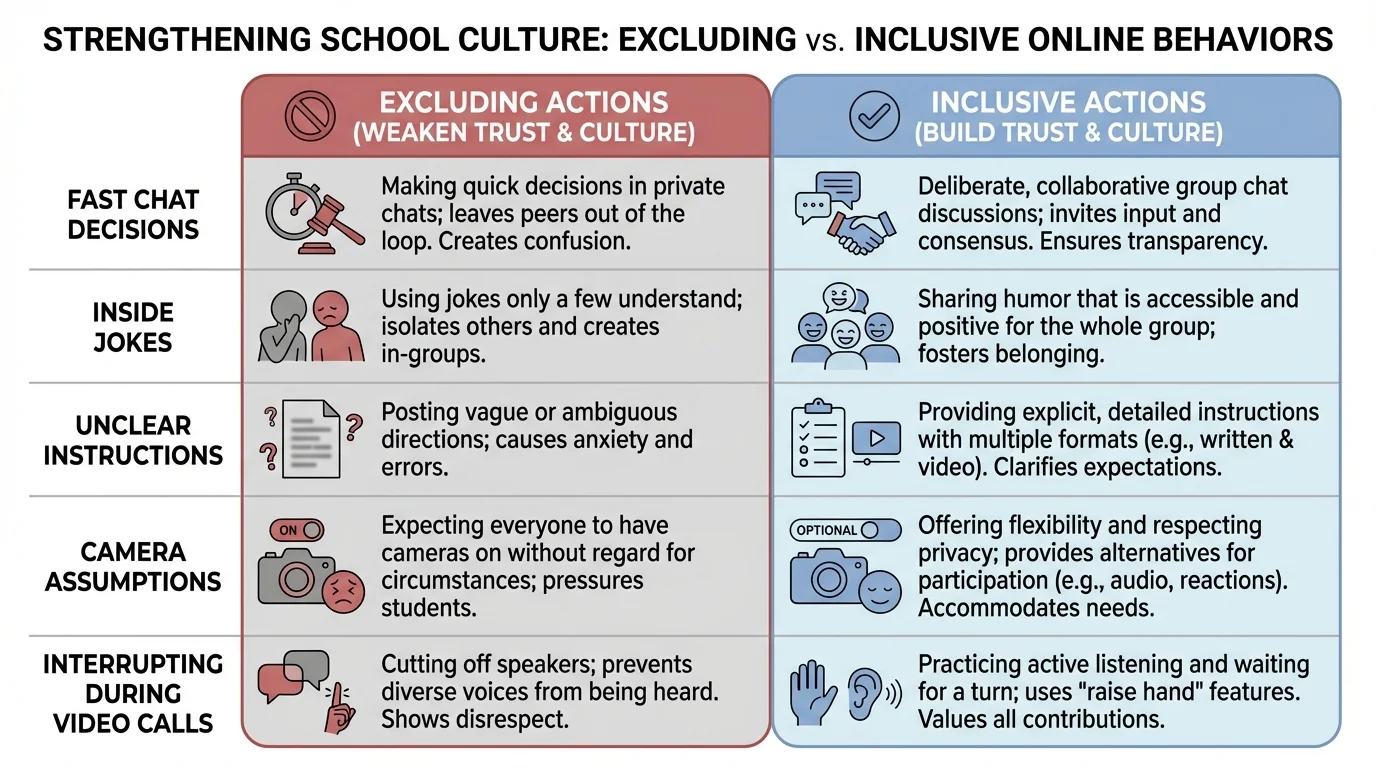
Video calls create their own challenges. Talking over people, ignoring chat comments, or acting like camera-off students are less engaged can make people feel judged. Some students keep cameras off for privacy, anxiety, bandwidth, or home-life reasons. A better approach is to judge participation by contribution, not by appearance on screen.
Language choices matter too. If you use unexplained slang, sarcasm, or references that only part of the group understands, others may feel lost. Clear language is not boring; it is respectful. It helps more people join the conversation without fear of getting it wrong.
Scheduling is another major issue. If you always choose one meeting time because it works for the most vocal people, others may repeatedly be left out. Inclusive planning looks for options: rotate times, use shared polls, record updates, or allow asynchronous responses.
The same idea applies on social media connected to school life. Sharing screenshots of private chats, posting about conflicts publicly, or mocking someone indirectly can break trust fast. Inclusive digital behavior protects privacy and avoids turning mistakes into entertainment.
| Situation | Excluding Action | Inclusive Alternative |
|---|---|---|
| Group planning | Making decisions in a private chat before everyone joins | Using a shared document and posting summaries for all members |
| Video calls | Assuming camera-off students are not trying | Offering chat, audio, or written ways to participate |
| Scheduling | Picking the easiest time for one part of the group | Polling options and rotating when possible |
| Humor | Using stereotypes or public embarrassment as jokes | Keeping humor respectful and never identity-based |
| Instructions | Giving vague or rushed directions | Providing clear steps, deadlines, and a place for questions |
Table 1. Common online situations and examples of excluding versus inclusive choices.
As you can see from the patterns in [Figure 2], inclusion often depends on whether you design communication for the easiest case or for the full group. Designing for the full group is usually what builds trust.
Research on belonging shows that people participate more when they believe their voice will be respected. Even one dismissive interaction can make someone much less likely to speak up again.
That is why consistency matters. One welcoming comment helps, but a repeated pattern of respectful behavior matters more.
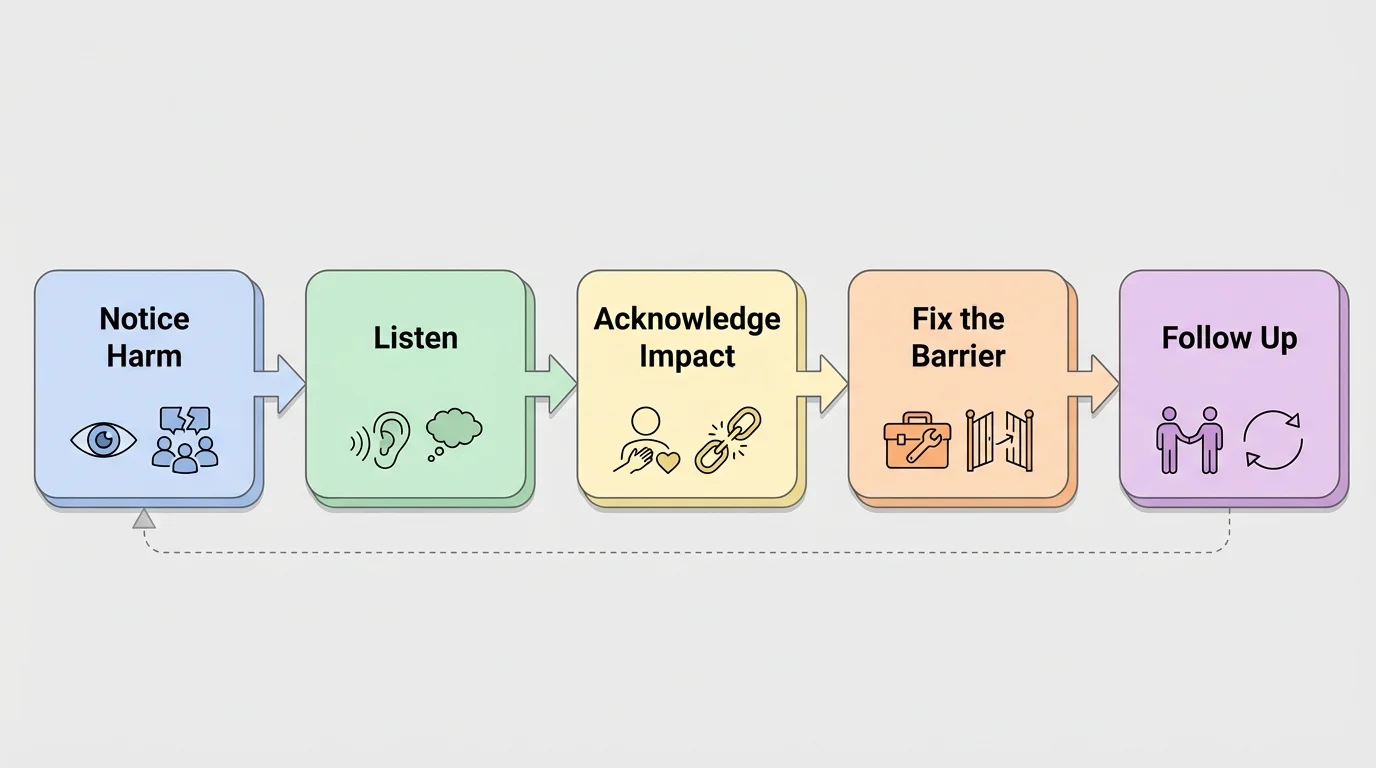
No community gets everything right all the time. People make assumptions, miss signals, or say things that land badly. What matters next is the response. A clear repair process, as [Figure 3] illustrates, helps turn a mistake into a moment of growth instead of a bigger breach of trust.
Step 1: Notice the harm. If someone seems hurt, excluded, or unusually quiet after an interaction, do not ignore it.
Step 2: Listen without arguing. Let the person explain what happened from their point of view. Do not interrupt with excuses.
Step 3: Acknowledge the impact. A strong apology might sound like this: "I see how that excluded you," or "I understand why that felt disrespectful."
Step 4: Fix the barrier. Change the behavior, platform, schedule, or wording that caused the problem.
Step 5: Follow up. Trust rebuilds when the better behavior continues over time.
A weak apology focuses on the speaker: "Sorry you got offended." A stronger apology focuses on responsibility: "I should not have said that in front of everyone. I am sorry, and I will handle concerns privately next time." The difference is huge. One protects pride; the other rebuilds trust.
Repair also means making room for the harmed person's choice. They may accept the apology quickly, slowly, or not at all right away. Trust cannot be forced. It has to be earned back through action.
"People may forget what you said, but they will remember whether they felt respected."
As the sequence in [Figure 3] makes clear, trust is not destroyed only by mistakes. It is often destroyed by denial, defensiveness, or repeated inaction after the mistake.
You do not have to wait for adults, moderators, or group leaders to create inclusion. You can do it where you already are. If you are in an online club, you can greet new members, explain norms kindly, and avoid mocking people for asking basic questions. If you are part of a volunteer group, you can check whether instructions are clear and whether everyone knows how to participate. If you are in a gaming community, you can shut down trash talk that targets identity and help set a respectful tone.
Belonging grows when people feel noticed. That can be as simple as asking, "Do you want a recap of what you missed?" or "What format works best for you?" Those questions communicate respect. They tell people their participation matters.
Inclusive actions also apply outside school spaces. In family settings, sports teams, faith communities, neighborhood groups, and online communities, the same skills matter: notice who is left out, challenge unfair assumptions, and choose communication that increases access.
Real-life example: Strengthening trust in an online club
A student notices that the same few members dominate every video meeting while newer members stay silent.
Step 1: Identify the pattern
Participation is technically open, but not equally comfortable for everyone.
Step 2: Try an inclusive action
The student suggests using a shared agenda, a chat option for comments, and a short pause after each topic so more people can respond.
Step 3: Evaluate the result
Newer members begin posting ideas in chat and speaking more often. The group becomes more balanced and respectful.
The key point is that inclusion improved because someone noticed a barrier and changed the structure.
Leadership in community is often quiet. It looks like making room, sharing information, checking assumptions, and helping others participate without being embarrassed.
If you want to evaluate your own choices, use this short checklist. Before posting, planning, joking, or organizing, ask yourself:
Who might be left out? Think about access, time, privacy, language, money, and comfort level.
Am I assuming everyone is like me? If yes, pause and widen your view.
Is the information easy to find? Scattered or rushed communication often excludes people.
Would this make someone more likely to participate again? If not, rethink it.
If harm happens, am I ready to listen and adjust? Inclusion requires humility.
Try This: Pick one online space you use this week, such as a class discussion board, group chat, gaming server, or community forum. Notice one pattern that makes participation easier for some people than others. Then make one small change: explain something clearly, invite a quieter person in, summarize missed information, or choose a more flexible option.
Try This: The next time you plan with others, offer at least two ways for people to respond, such as live discussion and written feedback. That simple choice can increase fairness immediately.
Try This: If you realize you excluded someone, do not disappear or pretend it did not happen. Acknowledge it, fix the barrier, and follow through.
Respect is not only about being polite. It is also about fairness, access, and consistency. A community feels safe when people know they will not be ignored, mocked, or left behind.
Evaluating inclusive actions means paying attention to real effects. The strongest communities are not perfect. They are responsive. People notice barriers, make adjustments, and keep showing through their actions that everyone deserves dignity and a fair chance to belong.
