One of the most useful life skills is not being the loudest person in the room. It is the ability to say, clearly and calmly, "This is what I need," "This is not okay with me," or "I need help." That skill is called self-advocacy, and it can protect your time, your mental health, your relationships, and your ability to succeed in school.
Self-advocacy does not mean arguing with everyone, demanding your way, or never compromising. It means understanding your needs, communicating them respectfully, and taking action to get support when needed. For a ninth grader learning online, this shows up in real situations: telling a teacher you do not understand an assignment, telling a friend a joke went too far, asking a parent for quiet time during a test, or reaching out when you feel overwhelmed.
Self-advocacy means speaking up for your needs, rights, feelings, and goals in a respectful, responsible way.
Boundary means a limit you set to protect your comfort, time, energy, privacy, or safety.
Assertive communication means expressing yourself clearly and respectfully without being passive or aggressive.
When self-advocacy is weak, problems often grow quietly. A student stays confused instead of asking for help, misses assignments, feels embarrassed, and gets more stressed. A friend keeps sending hurtful messages, but nobody says anything, so the behavior continues. When self-advocacy is strong, problems usually get addressed earlier, when they are easier to solve.
Self-advocacy matters because other people cannot read your mind. Even people who care about you may not know what you need unless you tell them. Teachers may not realize instructions were unclear. Family members may not know you need uninterrupted time for a live class. Friends may not realize a comment felt disrespectful.
It also helps you build trust in yourself. When you know you can handle uncomfortable conversations, you feel less trapped. You do not need every situation to be easy. You need tools for what to do when a situation is hard.
Many conflicts get worse not because the problem is huge, but because people avoid saying something early. A short, respectful message at the right time often prevents a much bigger problem later.
Self-advocacy is not only for major problems. It is also for everyday needs: asking for clarification, requesting more time, correcting a misunderstanding, or saying no to pressure. Small moments of speaking up build the confidence you need for bigger moments.
Good self-advocacy starts before you say anything. If your thoughts are scrambled, your message usually will be too. Before reaching out, pause and ask yourself four questions: What happened? How do I feel? What do I need? What is a reasonable next step?
For example, if you are upset about a group chat conflict, "I am annoyed" is not enough. Be more specific. Maybe what happened is that someone shared a private screenshot. You feel embarrassed and angry. You need privacy and an apology. A reasonable next step is asking the person to delete the post and stop sharing your messages.
This is where trigger awareness helps. A trigger is something that causes a strong emotional reaction. Knowing your triggers does not excuse rude behavior, but it helps you notice when you need a moment to calm down before responding. If you reply in the heat of the moment, your message can turn from clear to explosive fast.
The pause-then-plan habit makes self-advocacy stronger. Pause long enough to get clear, then plan the smallest useful action. You do not need a perfect speech. You need a message that explains the problem, names the need, and suggests a next step.
If the issue is school-related, gather facts first. Check the assignment instructions, due dates, past messages, and any screenshots or notes that matter. Facts make your request stronger. "I need help" is a start. "I reviewed the lesson, completed questions 1 through 4, and I am stuck on question 5 because I do not understand the directions" is much more useful.
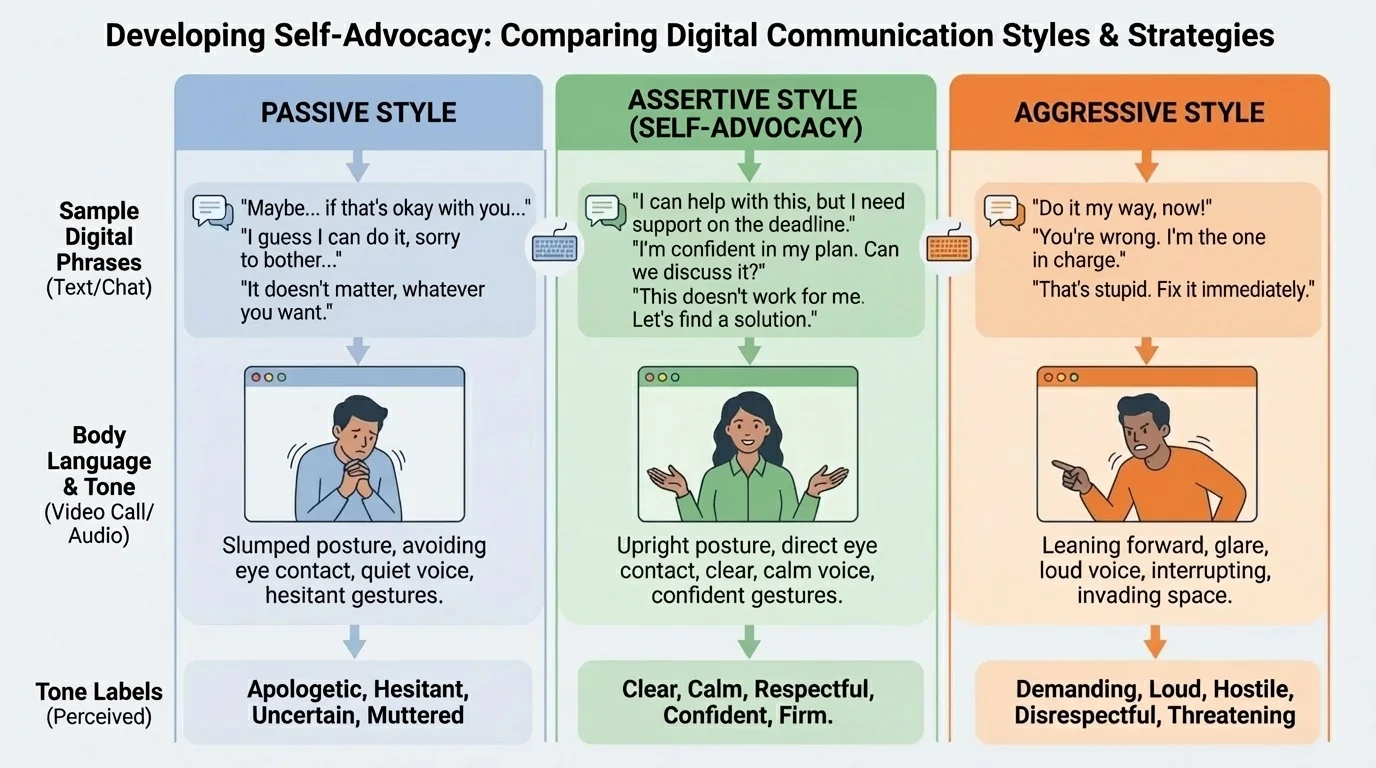
A helpful way to see the difference in communication styles is in [Figure 1]. Self-advocacy works best when you use assertive communication: calm, direct, respectful, and specific. This is different from being passive, where you hide your needs, and different from being aggressive, where you attack or pressure others.
One of the easiest tools is the I-statement. An I-statement keeps the focus on your experience instead of instantly blaming the other person. A simple pattern is: I feel... when... because... I need... For example: "I feel frustrated when assignment directions change at the last minute because I am trying to keep up. I need clarification on which instructions to follow."
Tone matters, especially online, where messages can sound colder or harsher than you intended. Before you send a text, email, or direct message, reread it once for clarity and once for tone. Remove extra sarcasm, all caps, or long emotional paragraphs. Short, respectful messages are easier for people to receive and answer.
Timing matters too. If you are furious, it may be better to wait ten minutes, take a walk, drink water, or write a draft without sending it. Calm is not weakness. Calm gives you control.
In video calls, self-advocacy includes nonverbal choices too. Sit up, look toward the camera when possible, and speak at a steady pace. You do not need to sound perfect. You do need to sound clear enough that your message is easy to follow.
Example: turning a weak message into a strong one
Step 1: Weak version
"This assignment makes no sense. I can't do it."
Step 2: Stronger version
"I reviewed the instructions twice, but I'm still confused about what the final project should include."
Step 3: Add a clear request
"Could you explain whether we need a slide presentation, a written response, or both?"
The stronger version is specific, respectful, and easier to answer.
If you compare your own messages to the styles in [Figure 1], you can usually spot the problem quickly. Passive messages sound like disappearing. Aggressive messages sound like attacking. Assertive messages sound like leadership.
In friendships, family relationships, dating relationships, and online communities, self-advocacy often means setting a boundary. A boundary is not a punishment. It is a limit that protects your well-being. You might say, "Please do not post pictures of me without asking," or "I can talk later, but I need to finish class first."
Healthy relationships can handle respectful honesty. If someone gets upset every time you express a need, that is important information. Good relationships do not require you to stay silent to keep the peace.
Here are common relationship situations where self-advocacy matters:
Sometimes students fear that setting boundaries will make them seem rude. Usually, the real issue is that boundaries disappoint people who were benefiting from your silence. Respectful people may not love every boundary, but they can still respect it.
"You teach people how to treat you by what you allow, what you stop, and what you reinforce."
When conflict happens, be specific about the behavior, not the person's whole character. "I did not like when you shared my message" works better than "You are fake." The first gives a chance for change. The second usually starts a fight.
If someone ignores your boundary more than once, your self-advocacy may need action, not just words. That could mean muting, blocking, leaving a chat, documenting messages, or involving a trusted adult. Speaking up is important, but protecting yourself is just as important.
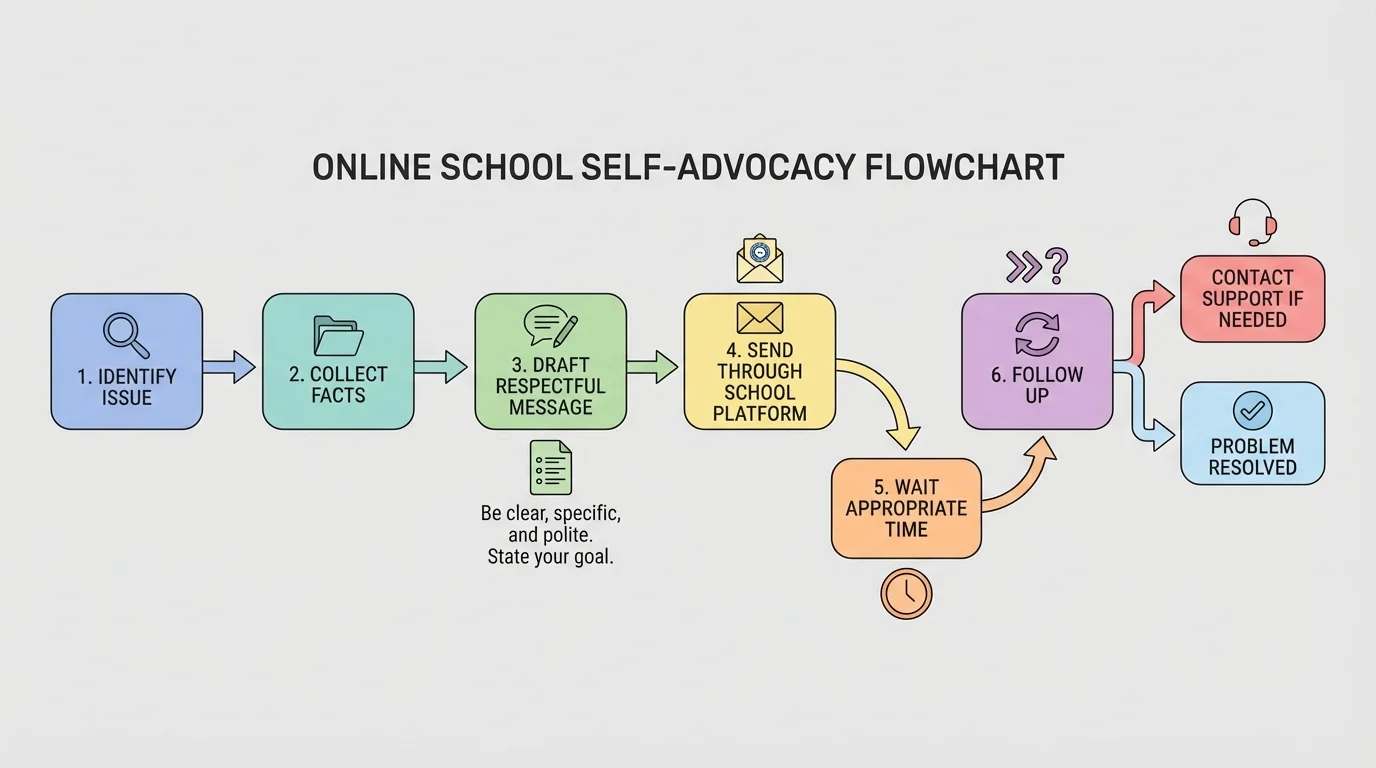
[Figure 2] shows a clear process for handling school problems online. In online school, self-advocacy often happens through email, class messaging systems, submitted comments, or video calls. Because teachers are not physically near you, it is even more important to communicate clearly when you are confused, behind, or dealing with a challenge.
Use a simple structure when contacting a teacher: greet them politely, state the issue, include key details, explain what you have already tried, and ask a specific question or request a specific next step. This saves time and shows responsibility.
For example, instead of writing, "I don't get anything," you could write: "Hi Ms. Lee, I watched the lesson and completed the notes, but I'm confused about how to format the final response. I want to make sure I submit it correctly. Could you clarify whether we should use paragraph form or bullet points?"
You can use the same structure for requests about missed work, technical problems, or schedule conflicts. If your internet cut out during a quiz, say what happened, when it happened, and what you are asking for. If family responsibilities affected your schedule, be honest without sharing more personal detail than necessary.
Sometimes you may need an accommodation or adjustment. An accommodation is a support that helps a student access learning more fairly, such as extra time, alternative formats, breaks, or technology support. If you have a documented need, self-advocacy includes understanding what support you are entitled to and respectfully following up if it is not being provided.
Even if you do not have a formal accommodation, you can still ask for help. You might request clarification, office hours, a check-in, or help breaking a large task into smaller parts. Teachers are usually better able to help when your request is specific.
Example: asking for an extension respectfully
Step 1: State the situation clearly
"Hi Mr. Patel, I'm reaching out about the discussion post due tomorrow."
Step 2: Briefly explain the barrier
"I've been dealing with a family situation this week and I'm behind on my coursework."
Step 3: Show responsibility
"I've already completed the reading and started my notes."
Step 4: Make a direct request
"Would it be possible to have until Friday to submit the post?"
This message is honest, respectful, and solution-focused.
Follow-up is part of self-advocacy. If you do not receive a reply, wait a reasonable amount of time, then send a short follow-up message. If the issue is urgent, contact the next appropriate support person rather than giving up.
[Figure 3] shows a clear support-seeking plan that helps you decide who to contact based on the type of problem and how urgent it is. Self-advocacy includes knowing when to handle something yourself, when to ask for guidance, and when to get immediate help.
A good first step is identifying the kind of support you need. Do you need information, emotional support, conflict help, academic help, or safety help? The answer changes who you contact. A teacher may help with assignments. A parent, guardian, or trusted adult may help with stress or household issues. A school counselor or support staff member may help with mental health, conflict, or a crisis.
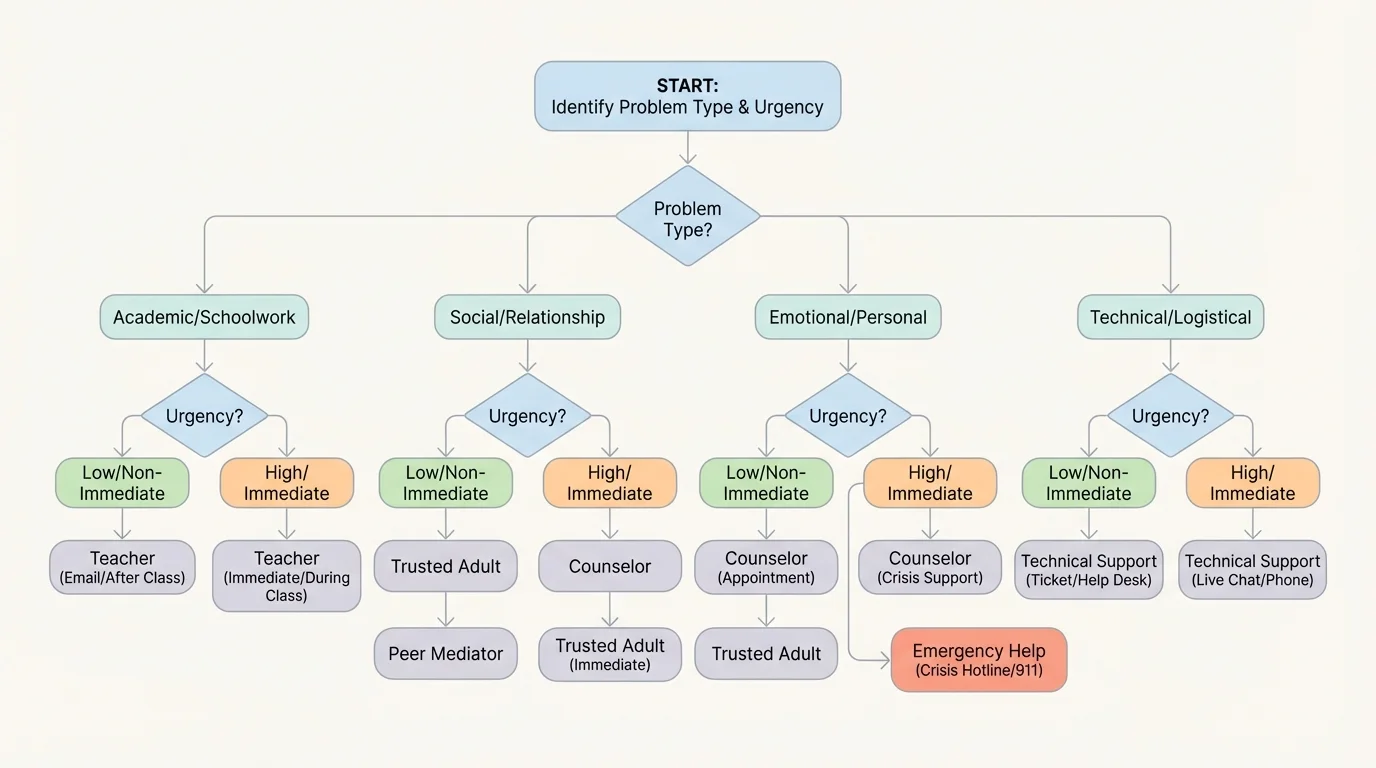
If the problem involves bullying, harassment, threats, self-harm thoughts, abuse, stalking, blackmail, sexual pressure, or fear for your safety, skip the "maybe I should wait" phase. Reach out to a trusted adult immediately. If there is immediate danger, contact emergency services right away. Self-advocacy is not only about being independent. It is about getting the right help fast enough.
When asking for support, keep your message simple: what is happening, how it is affecting you, and what kind of help you need right now. For example: "I'm feeling overwhelmed and I'm falling behind. I need help making a plan," or "Someone is sending me threatening messages, and I do not feel safe. I need an adult to help me handle this today."
You do not need to prove that your problem is "serious enough" before asking for help. If something is affecting your safety, mental health, or ability to function, it matters.
Documentation can help in serious situations. Save screenshots, dates, usernames, and copies of messages. Do not argue back endlessly. Evidence is more useful than a long fight. Clear decision paths become especially important when emotions are high and you need a next step.
You do not need a different strategy for every situation. A simple repeatable plan works in most cases.
Step 1: Name the issue. What exactly happened?
Step 2: Name the impact. How is it affecting you?
Step 3: Name the need. What do you need to change, understand, stop, or receive?
Step 4: Choose the person. Who is the right person to contact first?
Step 5: Communicate clearly. Use a calm, direct message.
Step 6: Follow up. If needed, check back or go to the next support person.
Step 7: Protect yourself. Use boundaries, documentation, and adult support when the issue is serious.
Case study: using the plan in real life
Situation: Your friend keeps pressuring you to stay online late, and it is hurting your sleep and school focus.
Step 1: Name the issue
Your friend gets upset when you log off at night.
Step 2: Name the impact
You are losing sleep and struggling in class the next day.
Step 3: Name the need
You need to stop messaging after a set time.
Step 4: Communicate
"I need to log off by 10:00 each night so I can sleep and focus on school. I can reply tomorrow."
Step 5: Follow through
Mute notifications and stop responding after your set time.
This is self-advocacy because you identified the problem, communicated clearly, and backed up your words with action.
Try This: Write one sentence you could use this week to ask for clarification, set a boundary, or request help. Keep it short and specific.
One common mistake is being too vague. "Things are bad" may be true, but it does not tell the other person what to do. Add details and a request.
Another mistake is overexplaining. You do not need a five-paragraph defense for every need. Brief and honest is usually enough. Too much detail can bury the main point.
Some people apologize too much when advocating for themselves. Politeness is good. Shrinking yourself is not. "Sorry to bother you, sorry if this is dumb, sorry again" can make your request sound less confident than it should. Try replacing extra apologies with appreciation: "Thank you for your time" or "I appreciate your help."
Another mistake is giving up after one attempt. Not getting a response right away does not always mean your need is unimportant. People miss messages. Systems fail. Reasonable follow-up is part of the process we already saw in [Figure 2].
And finally, do not confuse self-advocacy with winning every disagreement. Sometimes the best outcome is not getting everything you want. It is being heard, understanding your options, and making a safe, informed next move.
Self-advocacy gets easier with practice. Start with lower-stakes situations. Ask a teacher for clarification. Tell a family member when you need uninterrupted time. Tell a friend you cannot talk right now. Each small success teaches your brain that speaking up is possible.
You can also prepare scripts ahead of time. A few examples:
Try This: Save two support scripts in your notes app so you are not trying to invent words when stressed.
You are allowed to have needs. You are allowed to ask questions. You are allowed to protect your peace, your time, and your safety. Self-advocacy is not about being difficult. It is about being clear enough to take care of yourself and respectful enough to work with others.
