A lot can change because of one sentence. A message like "Take your time, no pressure" can make someone feel safe and respected. A message like "If you cared, you'd do it" can make someone feel trapped. That is why communication matters so much. The patterns in how you talk, text, respond, listen, and react shape whether people feel safe with you or guarded around you.
Communication shows up everywhere: in friendships, family conversations, team activities, online groups, dating situations, gaming chats, social media comments, and private messages. You do not need to be perfect at communication. You do need to learn how to notice patterns. A pattern is not just one moment. It is what happens again and again.
Healthy communication patterns support honesty, boundaries, emotional safety, and choice. Unhealthy patterns can create confusion, pressure, fear, or disrespect. Learning to tell the difference helps you protect yourself and treat other people well.
When people talk about a "good relationship," they often focus on feelings. Feelings matter, but patterns matter just as much. Someone can say kind words once and still behave in controlling ways over time. Someone can make a mistake once and still be trustworthy if they listen, repair the harm, and change their behavior.
Communication patterns affect whether people feel comfortable being honest. If a person gets mocked every time they disagree, they may stop speaking up. If a person is heard calmly and respectfully, they are more likely to share what they really think. That is how trust grows: not from mind-reading, but from repeated experiences of being treated with care.
Trust is confidence that someone will be honest, reliable, and safe with your feelings, boundaries, or information.
Consent is a clear, voluntary, informed, and ongoing agreement. It is never something you force, assume, or guilt someone into.
Mutual respect means treating each other as equally important human beings whose thoughts, comfort, and boundaries matter.
These three ideas work together. You can be polite without being respectful. You can say "yes" without real consent if you felt pressured. You can trust someone in one area and not in another. Looking at the full pattern helps you understand what is actually happening.
Healthy communication depends on linked qualities, as [Figure 1] shows. Trust, consent, and mutual respect are different, but they overlap in real life. When one is missing, the whole interaction becomes less healthy.
Trust grows when words match actions. If someone says, "You can tell me anything," but then shares your private message with others, trust drops. If someone says, "It's okay to say no," and then stays calm when they hear no, trust grows.
Consent means there is a real choice. Real choice requires freedom. If someone is afraid of losing a friendship, being embarrassed, or getting spammed with messages until they give in, that is not healthy consent.
Mutual respect means both people matter. One person does not get to set all the rules while the other just adapts. Respect includes listening, taking concerns seriously, and accepting that another person's boundaries do not need your approval to be valid.
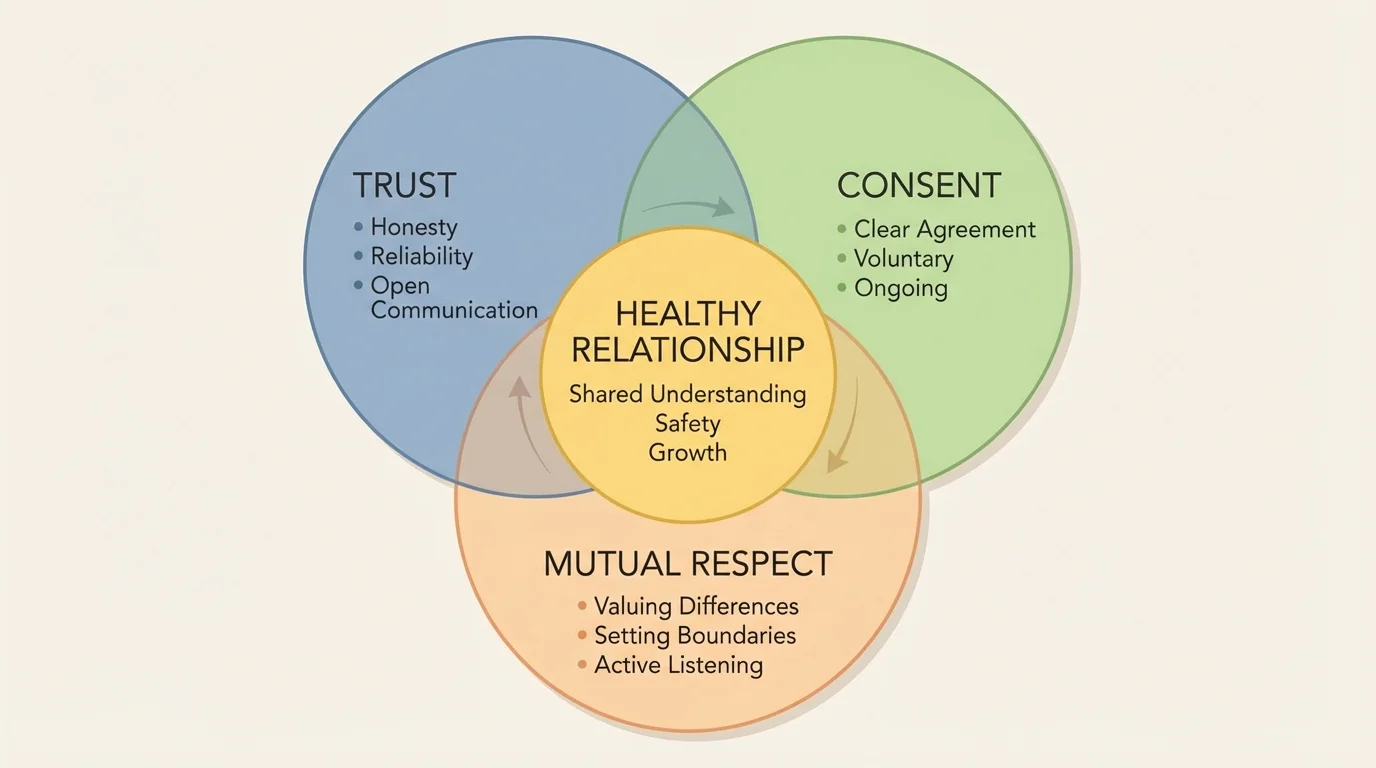
Here is a simple way to test whether these pillars are present: Can both people speak honestly? Can both people change their mind? Can both people set limits without being punished? If the answer is no, the communication pattern needs attention.
Many people think disrespect always looks loud or obvious. In real life, it can also look quiet: repeated guilt trips, "joking" insults, ignoring messages until someone agrees, or acting hurt to pressure a yes.
That is why it is important to pay attention not only to what is said, but also to how it is said, when it is said, and what happens after someone gives an answer.
Healthy communication usually looks ordinary, not dramatic. Over time, these patterns create safety and predictability, as [Figure 2] illustrates through message choices. You do not need fancy words. You need clear, respectful habits.
Active listening means paying attention so the other person feels heard. That includes not interrupting, not immediately making it about yourself, and checking that you understood. A useful line is, "So you're saying you felt left out when that happened. Is that right?"
Honesty helps people make informed choices. If you say you are fine when you are actually upset, the other person cannot respond to the real situation. Honesty does not mean blurting out every thought. It means saying what is true in a respectful way.
Clear boundaries make relationships safer. A boundary is a limit that protects your comfort, time, energy, values, or privacy. You might say, "I'm not comfortable sharing my password," or "I can talk for ten minutes, but then I need a break."
Checking in is one of the strongest trust-building habits. Instead of assuming, you ask. "Is this a good time?" "Are you okay talking about this?" "Do you want advice, or do you just want me to listen?" These questions show care without control.
Accountability means owning your actions. If you hurt someone, healthy communication sounds like: "I see why that upset you. I'm sorry. I won't do that again." Accountability is stronger than excuses.
Privacy and confidentiality matter too. If someone shares something personal, healthy communication does not turn that into gossip, content, or entertainment. Protecting private information is one of the clearest signs that a person can be trusted.
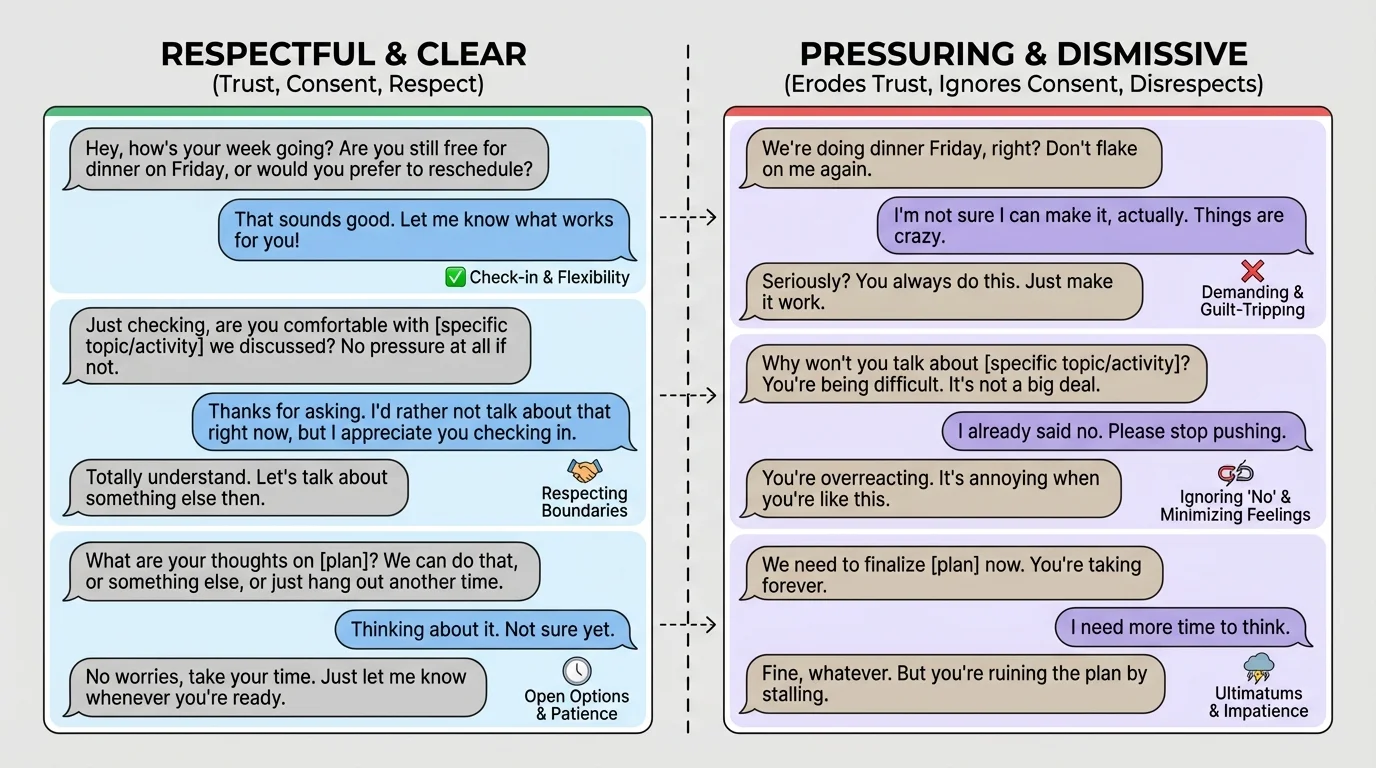
Consistency is what turns good moments into trust. A person who listens one day and mocks you the next creates confusion. A person who regularly responds with calm, honesty, and respect becomes easier to trust. Later, when a hard conversation comes up, that trust matters.
Real-world example: A respectful check-in
You want to vent to a friend after a stressful day, but you are not sure if they have the energy.
Step 1: Ask first
"Hey, I had a rough day. Do you have space to talk for a few minutes?"
Step 2: Accept the answer
If they say, "Not right now," respond with "Okay, thanks for being honest."
Step 3: Keep respect on both sides
If they say yes, you can share. If not, you can ask what time would work better or choose another support option.
This builds trust because it respects both people's needs.
Notice that healthy communication is not about always getting what you want. It is about creating a space where both people can be real without fear of pressure or punishment.
Unhealthy communication often works by reducing someone else's freedom. It may happen through pressure, confusion, guilt, intimidation, or repeated disrespect. Sometimes it is obvious. Sometimes it hides behind jokes, affection, or "I just care about you."
One harmful pattern is manipulation. Manipulation happens when someone tries to control another person through guilt, fear, shame, or emotional tricks instead of honest communication. Examples include: "If you trusted me, you'd do it," "Everyone else says yes," or "I'll be upset all night if you don't."
Another harmful pattern is ignoring or arguing with boundaries. If someone says no, changes the subject, goes silent because they feel uncomfortable, or sets a clear limit, a respectful person does not keep pushing. Repeating the same request in different ways after hearing no is still pressure.
Mocking and minimization are also damaging. Statements like "You're too sensitive," "It was just a joke," or "You're making a big deal out of nothing" can make people doubt their feelings. This weakens trust because it teaches them their comfort will not be taken seriously.
Public embarrassment is another red flag. Calling someone out in a group chat, posting private disagreements, or sharing screenshots to win support may create attention, but it damages dignity. Conflict should usually be handled as privately as possible unless safety is at risk.
Hot-and-cold behavior can also be harmful. If someone is kind when they get what they want and cruel when they do not, the pattern trains others to stay compliant. That is not mutual respect. That is control.
| Pattern | Healthy version | Unhealthy version |
|---|---|---|
| Asking | "Would you like to?" | "Come on, don't be lame." |
| Hearing no | "Okay, thanks for telling me." | "Why not? Give me one good reason." |
| Conflict | Discusses the issue calmly | Insults, threatens, or posts about it publicly |
| Privacy | Keeps personal information private | Shares screenshots or secrets without permission |
| Boundaries | Respects limits | Pushes, mocks, or tests limits |
Table 1. Comparison of healthy and unhealthy communication patterns.
When you notice these patterns, take them seriously. You do not need to wait until things get "bad enough" to protect your boundaries.
Words matter, but so do signals around the words. In person, you might notice hesitation, silence, pulling away, nervous laughter, a tense face, or a change in tone. Online, you might notice delayed responses, short answers, avoiding the question, changing the subject, or no reply at all.
These signals are not mind-reading tools. A delayed reply might mean someone is busy, not upset. A short answer might mean they are tired. That is why the best move is not to assume. The best move is to check in clearly and respectfully.
A good rule is this: if someone seems unsure, treat the situation as a no or a pause until you have a clear yes. Confusion is not consent. Silence is not consent. "Maybe" is not the same as enthusiastic agreement.
Why assumptions cause problems
Assumptions turn your guess into someone else's burden. If you assume a person is okay when they are uncomfortable, they may feel pressure to go along. Clear communication removes guessing and gives both people more control over what happens next.
This matters in many situations: hugging a relative, joining a voice call, discussing personal topics, reposting a photo, borrowing something, teasing someone in a game, or making plans. The more personal the situation, the more important it is to check and listen carefully.
As we saw earlier in [Figure 2], the difference between care and pressure often appears in message patterns. Respectful communication leaves room for a real answer. Pressuring communication tries to corner one.
[Figure 3] Consent that respects boundaries is a process, not a one-time event. It starts with a clear question, depends on a free answer, and continues only if the answer stays yes. If the situation changes, you check again.
Consent needs to be clear, specific, and ongoing. Clear means the answer is understandable. Specific means agreeing to one thing does not mean agreeing to everything. Ongoing means a person can change their mind at any time.
You can ask for consent in simple language. "Do you want to talk about this now?" "Can I post this photo?" "Are you okay with me inviting someone else to the call?" "Is a hug okay?" Clear questions make it easier for the other person to answer honestly.
Giving consent should also be clear. "Yes, that's okay." "I'm comfortable with that." "You can share this with our group, but not publicly." Specificity protects both people because expectations are understood.
Refusing consent does not require a long explanation. "No." "Not right now." "I'm not comfortable with that." "Please don't post that." Those answers are enough. A respectful response is to accept them without debate.
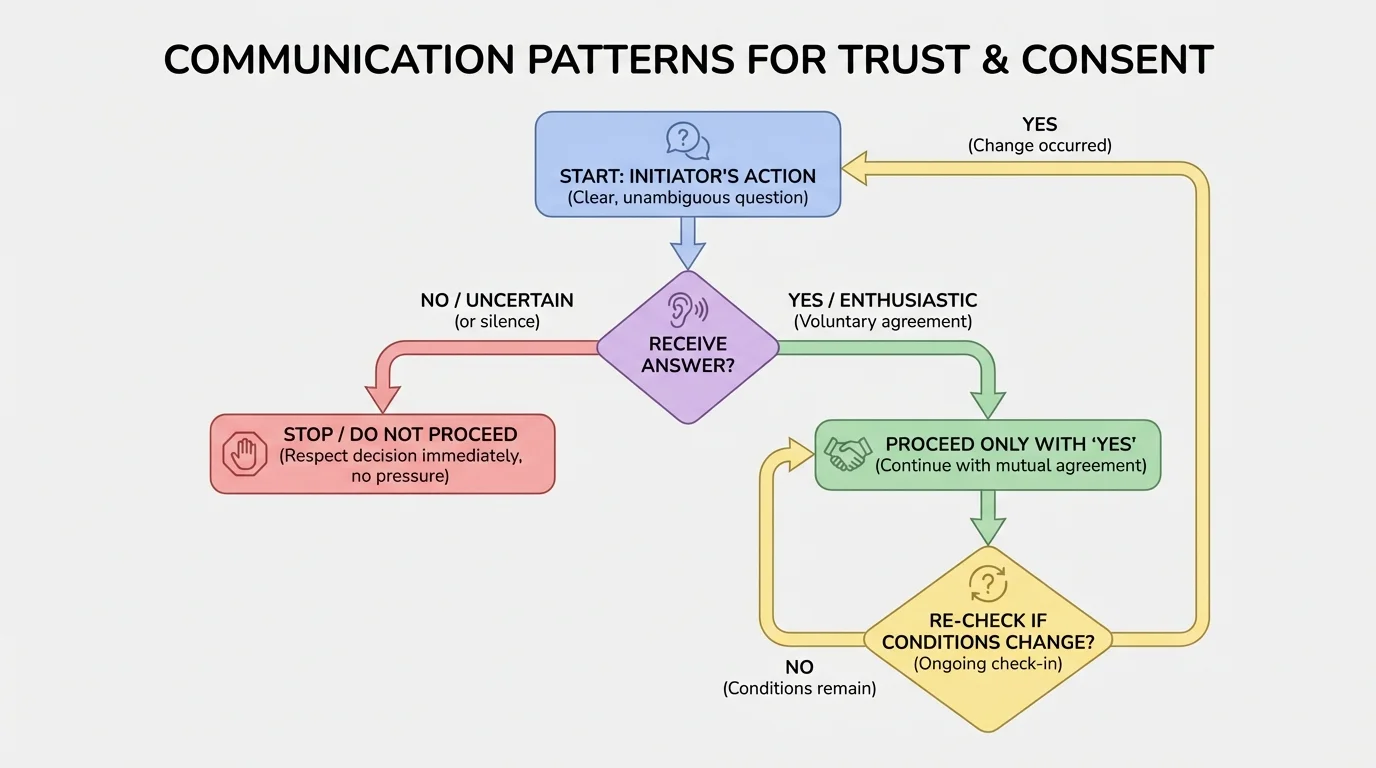
Revisiting consent matters because situations change. Someone might be okay joining a group call at first, then feel overwhelmed later. Someone might agree to take a photo but not to have it posted. A yes for one moment or one action is not a forever yes for everything.
Real-world example: Posting a photo
You take a fun picture during a weekend activity with friends and want to post it.
Step 1: Ask before posting
"I like this picture. Are you okay if I post it?"
Step 2: Respect limits
If a friend says, "You can send it to me, but please don't post it," that is a valid boundary.
Step 3: Follow through
Do not pressure them with "But you look fine" or "No one will care." The respectful choice is to honor their answer.
This protects trust because people learn that their image and privacy are safe with you.
If someone keeps asking after you say no, you can repeat yourself without adding more detail: "I already answered." "My answer is still no." "Stop asking." If needed, leave the conversation, mute the chat, block the account, or tell a trusted adult.
Even healthy relationships have conflict. The goal is not to avoid every disagreement. The goal is to handle disagreement without cruelty, control, or humiliation.
Start with what happened, not with an attack on the person. "I felt ignored when you left me on read after we made plans," works better than "You're fake." Focusing on behavior makes the conversation easier to solve.
Use a simple structure: what happened, how it affected you, and what you need now. For example: "When you shared that screenshot, I felt embarrassed. I need you not to do that again."
If the other person gets defensive, try to stay grounded. You do not need to match their intensity. Repeating your point calmly is often stronger than arguing in circles.
"Clear is kind."
— A useful principle for healthy communication
An effective apology includes three parts: naming the action, showing understanding of the impact, and changing future behavior. "Sorry you got mad" is weak because it shifts the focus to the other person's feelings. "I'm sorry I shared your message without asking. That was disrespectful, and I won't do it again," is much stronger.
Sometimes repair is possible. Sometimes it is not. If a person keeps repeating harmful patterns after you clearly address them, setting stronger boundaries may be the healthiest choice.
Online communication leaves records, spreads fast, and can feel less serious than face-to-face conversation, but the impact is real. Digital choices affect trust in visible ways, as [Figure 4] shows through privacy and sharing decisions.
One major issue is privacy. Screenshots, reposts, tags, shared passwords, location sharing, and group chat forwarding can all cross boundaries. Just because something is on your screen does not mean it is yours to share.
Another issue is tone. Without facial expressions and voice, messages can be misunderstood. Sarcasm can look harsh. A joke can look like an insult. If a topic is sensitive, a voice call or carefully worded message is often better than a quick text.
Digital communication also creates pressure in new ways: repeated notifications, "Why aren't you answering?", public comments, streaks, and read receipts. None of these tools give someone the right to demand constant access to you.
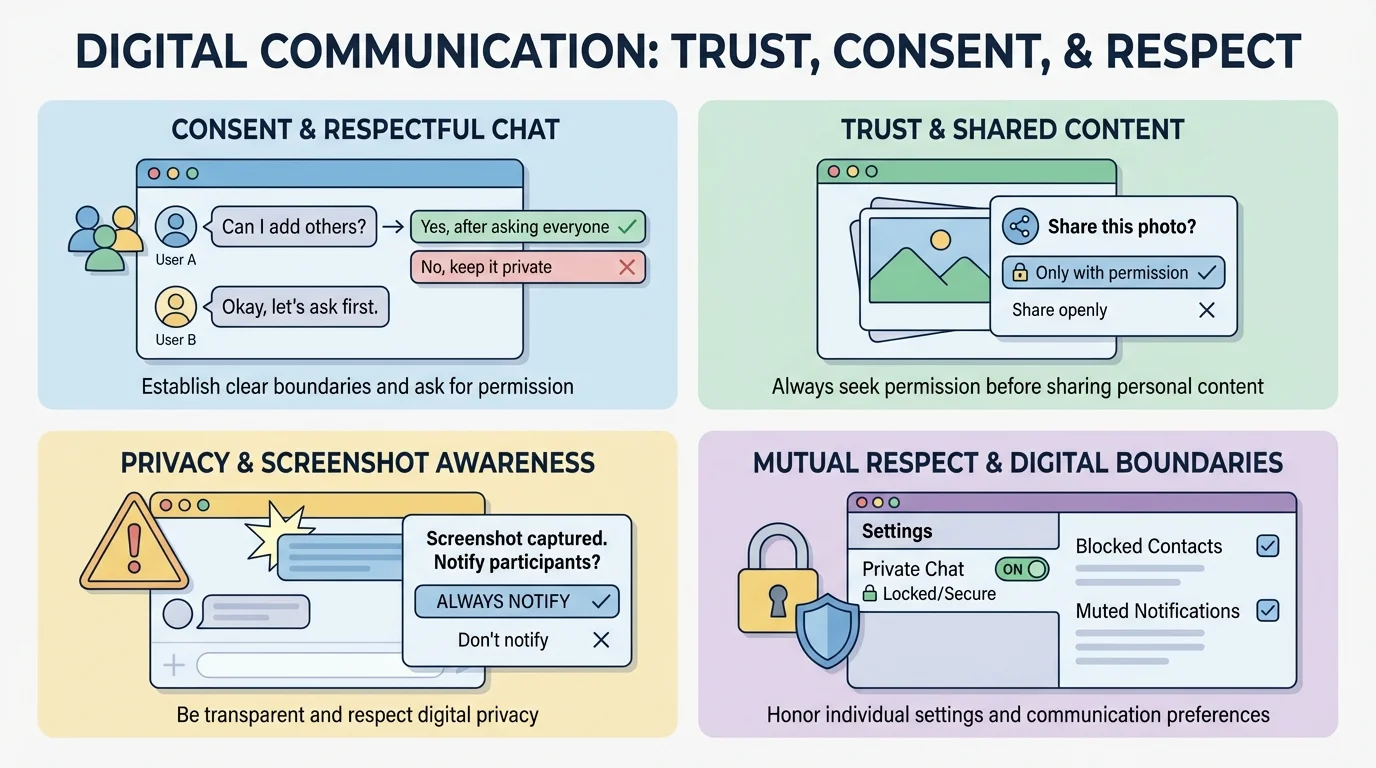
Respect online looks like asking before posting about someone, not sharing private messages, not spamming after a no, and not using group chats to embarrass or corner someone. It also looks like accepting that people can take time to respond.
As shown earlier in [Figure 3], consent is ongoing. That applies online too. Someone can agree to join a chat and still leave later. Someone can share a photo with you and still say no to posting it. Someone can be comfortable joking one day and not the next.
Real-world example: Group chat conflict
A disagreement starts in a group chat after someone posts a private joke that embarrassed another person.
Step 1: Move it out of the audience
Instead of arguing in front of everyone, send a direct message or pause before replying.
Step 2: Name the issue clearly
"That joke crossed a line for me because it shared something private."
Step 3: Set a request or boundary
"Please don't post things about me like that again."
Step 4: Protect yourself if needed
If the disrespect continues, mute, leave, block, or ask a trusted adult for support.
This approach reduces public escalation and keeps the focus on respect.
Digital communication is real communication. The same values apply: honesty, choice, dignity, and care.
You build communication skills by using them in small moments. Try asking before venting. Try saying no without apologizing for having a boundary. Try checking whether someone wants advice before giving it. Try pausing before posting anything that includes another person.
Here are a few habits that make a big difference:
If something feels off, pay attention. Discomfort is not proof by itself, but it is a signal worth exploring. You can slow down, ask questions, set a boundary, or get support from a trusted adult. Healthy communication does not require you to ignore your instincts.
The strongest relationships are not the ones with no conflict. They are the ones where people can be honest, hear no without punishment, repair mistakes, and keep treating each other with dignity.
