Some of the biggest problems people face do not begin with giant disasters. They begin with ordinary choices: clicking "buy now" too fast, trusting a rumor online, saying yes to too many commitments, ignoring a safety concern, or choosing what feels good for five minutes over what helps for five months. Good decisions are not about being perfect. They are about knowing what matters, checking what is true, and understanding what you might have to give up.
Every day, you make decisions about your time, friendships, money, health, technology, and goals. Some choices are small, like whether to spend $18 on food delivery. Others shape your future, like whether to accept a part-time job, how to respond to a conflict online, or how to divide your time between schoolwork, family responsibilities, and hobbies. The more clearly you understand your values, the stronger your evidence, and the more honestly you face the trade-offs, the more informed your decisions become.
A decision is not just a moment. It is often the start of a chain reaction. If you stay up too late scrolling, you may sleep less, think less clearly, miss work, feel stressed, and make worse choices the next day. If you compare options carefully before buying something, you may save money, avoid regret, and have more freedom later. One choice can affect trust, safety, finances, opportunities, and relationships.
That is why strong decision-making is a life skill. It helps you protect yourself, use your time better, solve problems, and act with confidence. It also helps you avoid being controlled by pressure from social media, advertising, friends, or your own emotions in the moment.
Informed decision means a choice made after thinking carefully about what matters to you, what reliable information shows, and what benefits and costs come with each option.
Values are the principles or priorities that matter to you, such as honesty, safety, loyalty, independence, health, learning, or financial responsibility.
Evidence is information that helps you judge whether something is likely to be true, useful, safe, or effective.
Trade-off means a situation in which you gain one thing while giving up another.
When one of these is missing, your decision gets weaker. If you follow your values but ignore evidence, you may mean well and still make a poor choice. If you look at evidence but ignore your values, the choice may not fit who you are. If you ignore trade-offs, you may focus only on what you gain and miss what it costs.
An informed choice works best when it brings together three parts: your values, your evidence, and your understanding of trade-offs. Think of these as three lenses. If one lens is blurry, the whole picture is weaker.
[Figure 1] Values answer the question, "What matters most here?" Evidence answers, "What do I actually know?" Trade-offs answer, "What do I gain, and what do I give up?" Strong decision-makers ask all three questions instead of only one.
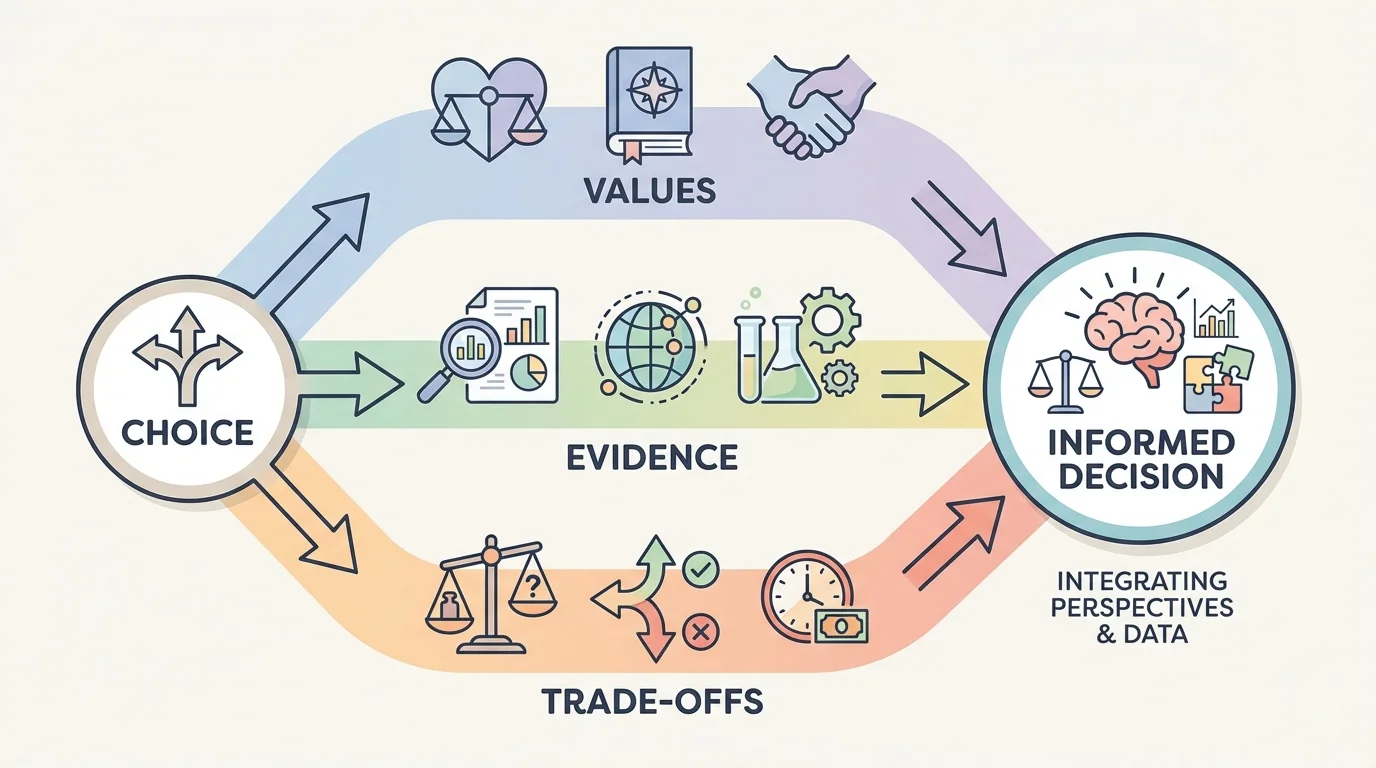
For example, suppose you are deciding whether to take a weekend job. Your values might include earning money, keeping time for rest, helping your family, and protecting your grades. Your evidence might include the pay rate, work hours, transportation needs, and how much homework you usually have. Your trade-offs might include having more money but less free time, or gaining work experience but losing part of your weekend.
None of these parts tells you the answer alone. Together, they help you make a smart choice that fits your real life.
Your values are like an internal compass. They do not make every decision easy, but they help you know what direction makes sense for you. Different people can make different smart choices because their values are not identical.
For example, if two students are choosing between an expensive phone upgrade and saving money, one might value staying current with technology, while the other values financial independence. Neither value is automatically wrong. The key is being honest about what matters instead of pretending every choice is only about facts.
Values can also change depending on the situation. In one decision, convenience may matter most. In another, safety should come first. If you are deciding whether to get into a car with a driver who seems distracted or unsafe, your top value should not be convenience. It should be personal safety.
How values guide action
Values help you sort priorities when options compete. If you value honesty, you are less likely to spread a rumor just because it gets attention. If you value health, you may choose sleep over late-night gaming before an important commitment. If you value responsibility, you might pass on a fun plan when you know you cannot afford it.
A useful question is: If I choose this, what does it say I am prioritizing? That question can reveal a lot. It can also show when your actions and your values do not match. For example, you may say you value saving money, but if you keep making impulse purchases, your spending habits are showing a different priority in practice.
A lot of bad decisions come from acting on feelings, guesses, or incomplete information. Evidence helps you slow down and ask, "How sure am I?" Not all information is equal. A random post, a rumor in a group chat, and a verified source should not carry the same weight.
Good evidence is usually relevant, specific, and trustworthy. If you are deciding whether to buy skin-care products, useful evidence includes ingredients, reviews from multiple buyers, advice from a qualified professional, and whether the product fits your skin type. A flashy ad alone is not enough.
You also need to watch for bias, which means a tendency to favor one view in a way that affects judgment. An influencer being paid to promote a product may give selective information. A friend may recommend something because it worked for them, even if your situation is different.
People often feel more confident after hearing the same claim many times, even when the claim is weak or false. Repetition can make information feel true, which is why checking sources matters so much online.
Here are practical ways to test evidence before deciding:
Ask who is giving the information. Are they experienced, qualified, or directly involved?
Ask what is missing. Are there hidden costs, side effects, or conditions not being mentioned?
Ask whether the source benefits. If someone profits when you say yes, be extra careful.
Compare more than one source. If three reliable sources agree, your information is stronger.
Separate facts from assumptions. "This has 4.8 stars from 2,000 reviews" is evidence. "So it must be perfect for me" is an assumption.
Evidence does not guarantee a perfect outcome, but it reduces avoidable mistakes.
Every real choice has limits. You cannot spend the same hour studying, working, gaming, resting, and helping at home all at once. Choosing one option means not choosing another. That is why trade-offs matter.
A closely related idea is opportunity cost, which means the value of what you give up when you choose something else. If you spend $40 on clothes you do not really need, the opportunity cost might be having $40 less for a concert ticket, emergency savings, or supplies for a hobby.
Trade-offs can be short-term versus long-term. Staying up late to finish a series may feel fun now, but the trade-off could be low energy and weaker performance tomorrow. Saying no to a distraction now may feel annoying, but the trade-off may lead to stronger grades, less stress, or more freedom later.
Trade-offs can also be visible or hidden. A cheap product may save money at first but break quickly. A free app may cost you privacy. A quick apology without sincerity may reduce immediate tension but damage trust over time.
As we saw earlier in [Figure 1], a good decision is not only about what you want to gain. It is also about what you are willing to give up and whether that cost fits your values.
| Type of choice | Possible gain | Possible trade-off |
|---|---|---|
| Taking a part-time job | Money and experience | Less free time and more fatigue |
| Buying the cheapest item | Lower cost now | Lower quality or shorter lifespan |
| Joining another activity | Fun and skill-building | Less time for rest or schoolwork |
| Posting in anger | Short-term release | Conflict, screenshots, damaged trust |
Table 1. Examples of gains and trade-offs in common everyday choices.
[Figure 2] You do not need a complicated system to make thoughtful choices. A repeatable process can help you slow down just enough to avoid careless decisions while still moving forward.
Step 1: Name the decision clearly. Be specific. Instead of "What should I do?" say, "Should I spend $35 on these headphones now, or keep saving for a better pair?"
Step 2: List your real options. There are often more than two. You might buy now, wait, borrow, choose a cheaper model, or decide you do not need it.
Step 3: Identify your top values for this situation. Pick two or three. For a purchase, they might be quality, price, and durability. For a social decision, they might be respect, honesty, and safety.
Step 4: Gather evidence. Look for facts, not just opinions. Check reviews, schedules, costs, rules, risks, or past experience.
Step 5: Compare trade-offs. Ask what each option gives you and what it costs in time, money, energy, trust, or missed opportunities.
Step 6: Decide and act. Make the best choice you can with the information you have.
Step 7: Review the result. Afterward, ask what worked, what you missed, and what you would do differently next time.
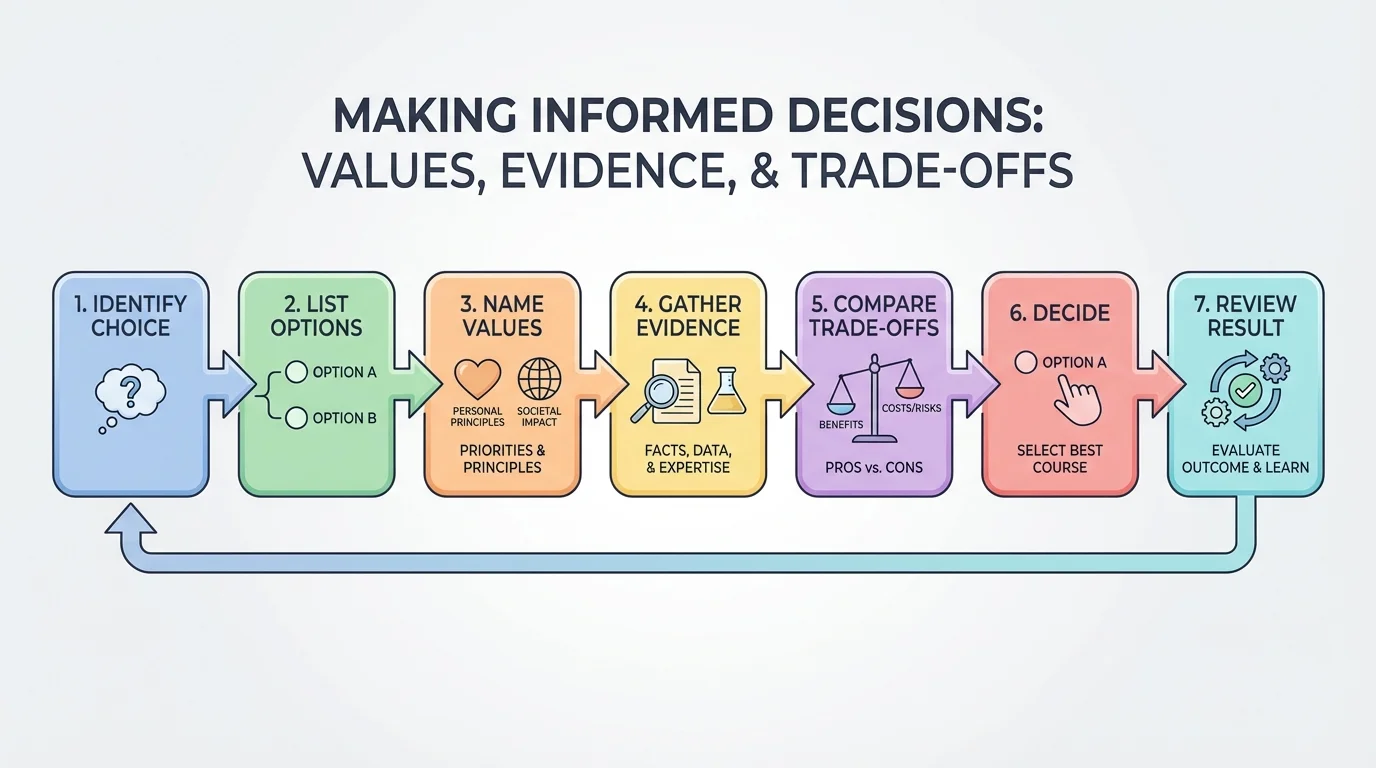
This process matters because thoughtful decisions are often built, not guessed. You can use it for money choices, schedule conflicts, online behavior, friend issues, or personal goals.
Case study: choosing whether to subscribe to a streaming service
Step 1: Name the decision.
You are deciding whether to start a subscription that costs $12 per month.
Step 2: Identify values.
Your main values are saving money, entertainment, and avoiding waste.
Step 3: Gather evidence.
You already use another service often, and you estimate you would watch the new one only about twice a month.
Step 4: Compare trade-offs.
In one year, the cost is $12 multiplied by 12 months, which is \(12 \times 12 = 144\). The gain is extra content. The trade-off is spending $144 on something you may barely use.
Step 5: Decide.
You choose to wait one month and see whether you still want it later.
This is a strong decision because it matches your values and uses actual evidence instead of impulse.
Notice that the smartest decision is not always "yes" or "no." Sometimes it is "not yet," "I need more information," or "I will choose a smaller version first."
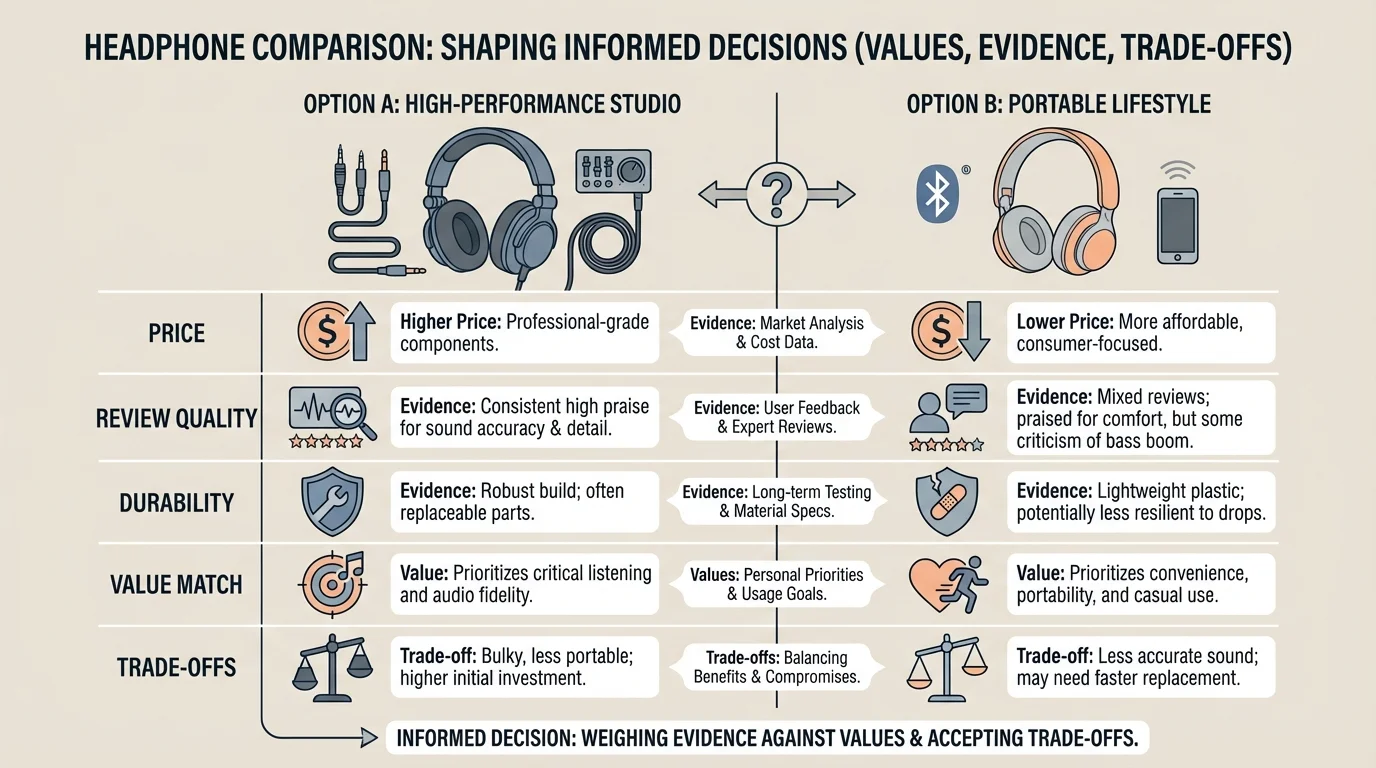
[Figure 3] Comparing options side by side makes hidden trade-offs easier to notice in a common buying decision. When your thoughts stay only in your head, it is easy to focus on the exciting part and ignore the cost.
Example 1: Buying headphones. Option A costs $20 and has mixed reviews. Option B costs $45 and has strong reviews for durability. If your values are saving money and getting something that lasts, the evidence suggests Option B may be better if you can wait and save. The trade-off is paying more now but reducing the chance of replacing them soon.
Example 2: Taking on too many commitments. Suppose you already have schoolwork, family tasks, and one weekly activity. A new opportunity appears, and it sounds exciting. Your values may include growth and responsibility. The evidence includes your actual schedule, energy level, and recent stress. The trade-off may be that joining helps you learn new skills but leaves you exhausted. A smart decision may be to decline for now or reduce something else first.
Example 3: Responding to online drama. Someone posts something negative about you or a friend. You feel angry and want to reply fast. Your values might be self-respect, honesty, and not making things worse. The evidence includes screenshots, context, whether the post is public, and whether responding helps or fuels the conflict. The trade-off of replying instantly may be short-term satisfaction but a larger argument and a permanent digital record.
Example 4: Choosing whether to trust health advice online. A video claims a "miracle" method will improve sleep or energy. Your values may include health and self-care. Evidence matters even more here: who made the claim, what qualifications they have, whether reliable sources agree, and whether there are risks. The trade-off of believing weak advice may be wasted money or harm.
Later, when you compare another choice using the same categories we used in [Figure 3], you will usually notice that the best option is the one that fits your priorities and survives a reality check.
Even smart people make poor decisions. Usually, the problem is not lack of intelligence. It is pressure, speed, emotion, or blind spots.
One common problem is impulse. You feel like doing something, so you do it before thinking. This is especially risky with spending, texting, posting, and agreeing to plans.
Another problem is confirmation bias. This means looking mostly for information that supports what you already want to believe. If you want a product badly, you may focus only on positive reviews and ignore warning signs.
There is also social pressure. People may push you directly, or you may feel pressure just from seeing what others appear to be doing online. But popularity is not evidence, and pressure is not proof.
Strong emotions can also narrow your thinking. When you are angry, embarrassed, excited, or afraid, your brain often wants fast relief instead of a wise outcome. In those moments, a delay can be powerful. Waiting even 10 minutes before replying, buying, or agreeing can improve your judgment.
"Not deciding is still a decision."
— Practical decision-making principle
That quote matters because avoiding a choice often has consequences too. If you ignore a deadline, the decision may be made for you. If you avoid asking questions, you may accept terms you do not understand. If you stay silent in an unsafe situation, risk may increase.
Some situations do not give you much time. You may need a faster version of the process. In urgent moments, ask three quick questions: What matters most right now? What facts do I know for sure? What is the safest or least harmful option?
This shorter method is useful when someone is pressuring you, when you feel emotionally overwhelmed, or when safety is involved. If a situation seems unsafe, confusing, or too big to handle alone, asking a trusted adult for help is not weakness. It is strong judgment.
For example, if someone online asks for personal information, photos, money, or secrecy, your top value should be safety. The evidence includes the fact that you cannot fully verify who they are. The trade-off of responding may include serious privacy or safety risks. The informed decision is to pause, not share, and get help if needed.
You already know from other life situations that quick choices can create lasting consequences. The skill here is not freezing or overthinking everything. It is learning when to pause long enough to make a better choice.
If the decision affects your health, safety, money, reputation, or future opportunities, that is usually a sign to slow down and check more carefully.
Decision-making improves with practice. You do not become thoughtful only during big moments. You build the habit through ordinary choices.
One helpful strategy is to keep a short personal checklist in your notes app. It can be as simple as: values, evidence, trade-offs, decide, review. Before a bigger choice, look at the checklist and answer each part in one sentence.
Another strategy is to learn from outcomes without attacking yourself. If a decision goes badly, ask: Was the problem weak evidence? A values mismatch? Ignoring a trade-off? Too much pressure? Reflection turns mistakes into training.
Try This: The next time you are about to spend money, agree to a plan, or respond to a tense message, pause and write three lines: what matters most, what facts you know, and what the likely trade-off is. This takes less than two minutes, but it can prevent hours of stress.
Try This: Notice one area where your actions and values may not match. Maybe you say you value sleep, saving, or honesty. Choose one tiny action this week that aligns your behavior with that value.
Try This: When a choice feels urgent, ask whether it is truly urgent or just emotionally intense. Those are not the same thing.
The goal is not to remove uncertainty from life. That is impossible. The goal is to make decisions that are more honest, more informed, and more likely to lead where you actually want to go.
