People often think professionalism starts when you get your first real job. It doesn't. It starts much earlier, in the way you answer a message, show up on time, follow directions, and handle mistakes. Adults notice these habits fast. A teen who communicates clearly and keeps promises often gets more chances, more trust, and stronger recommendations than someone with the same talent but weaker habits.
Professional habits are not about acting fake or trying to sound older than you are. They are about showing others that you are respectful, dependable, and ready to learn. Whether you are emailing a coach, joining a video meeting for a volunteer role, helping at a family business, or taking part in a community project, these habits matter.
Professional habits are behaviors that help people work well with others and be trusted. They include clear communication, reliability, responsibility, respect, preparation, and a willingness to learn.
Work-based learning is any experience where you learn job skills by doing real tasks or observing real workplaces. This can include volunteering, internships, job shadowing, service projects, entrepreneurship, and career exploration activities.
The simple truth is this: adults can teach you many job skills, but they cannot easily fix habits like constant lateness, rude replies, or missed deadlines. That is why these habits matter so much. They affect your reputation, and your reputation follows you.
Your reputation is what people expect from you based on your actions. If you usually reply politely, turn things in when you say you will, and stay calm when something goes wrong, people begin to trust you. That trust can lead to opportunities like leadership roles, references, paid work, and invitations to join projects.
On the other hand, weak habits create real consequences. If you ignore messages, send one-word answers, or miss a meeting without warning, adults may decide you are not ready for more responsibility. They may not say it directly, but they notice. Professional habits make life smoother because they reduce confusion and show maturity.
Many employers say they can train new workers on tasks, but they most value people who show up, communicate well, and keep trying when work gets difficult.
This does not mean you have to be perfect. Everyone forgets something, gets nervous, or makes a mistake. Professionalism means handling those moments well. It means you take responsibility, communicate early, and make a plan to improve.
Professional communication means sharing information in a clear, respectful, and thoughtful way. In digital spaces, this matters even more because people cannot always hear your tone or see your facial expression. A well-structured message helps adults understand and trust you quickly, as shown in [Figure 1]. Professional communication is useful in emails, direct messages, video calls, application forms, and interviews.
A strong message usually includes five basic parts: a greeting, the purpose, important details, a polite closing, and your name. For example, instead of sending, "hey i can't do it rn," you could write: "Hello Ms. Lopez, I wanted to let you know that I am having a technology problem and may need until tomorrow morning to submit the form. I am working on it now. Thank you for understanding. — Jordan." That version is clear, respectful, and helpful.
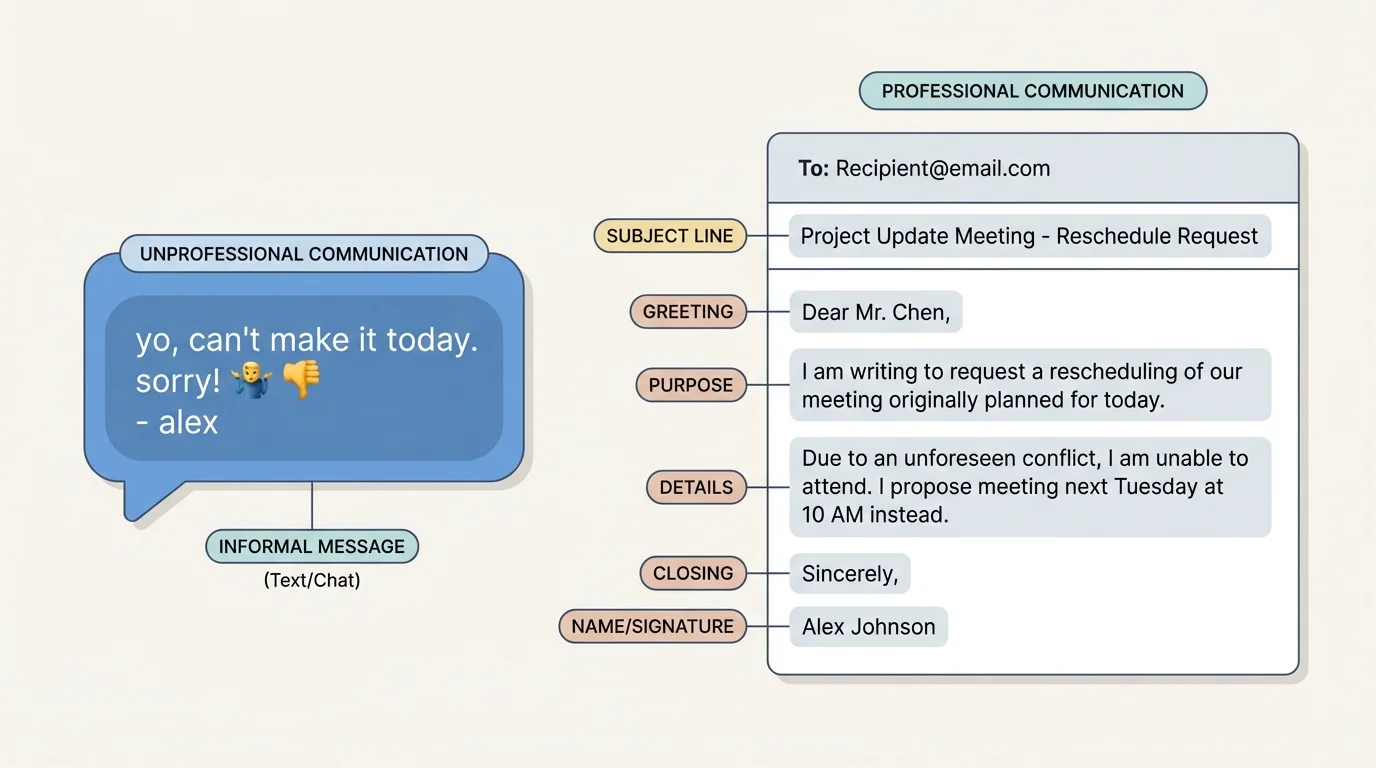
Notice what changed. The second message explains the problem, gives a time frame, and shows respect. It does not use random abbreviations, all lowercase writing, or vague excuses. It makes the other person's job easier.
Professional communication also includes active listening. That means you pay attention, do not interrupt, and show that you understand. On a video call, active listening can look like keeping your camera area neat if your camera is on, avoiding unrelated tabs, nodding, and responding with specific comments such as, "So the deadline is Friday at noon, correct?"
How tone changes a message
The words you choose create a tone. Tone is the feeling your message gives. Short messages can sound rude even if you did not mean them that way. Adding a greeting, full sentence, and polite closing can make your tone sound more respectful and mature.
There is also a difference between casual and professional communication. Casual communication is fine with close friends. Professional communication is better with adults, supervisors, program leaders, and customers. A good rule is this: when in doubt, be a little more formal. You can always become more relaxed later if the situation allows it.
Here are some practical communication habits you can use right away:
Later, when you communicate in a work-based learning setting, the same message structure from [Figure 1] still works. Clear communication is one of the easiest ways to stand out in a good way.
Reliability means people can count on you to do what you said you would do. This includes being on time, finishing tasks, remembering instructions, and following through without needing constant reminders. Reliability is not flashy, but it is powerful. In many real situations, reliable people are the ones who get picked again.
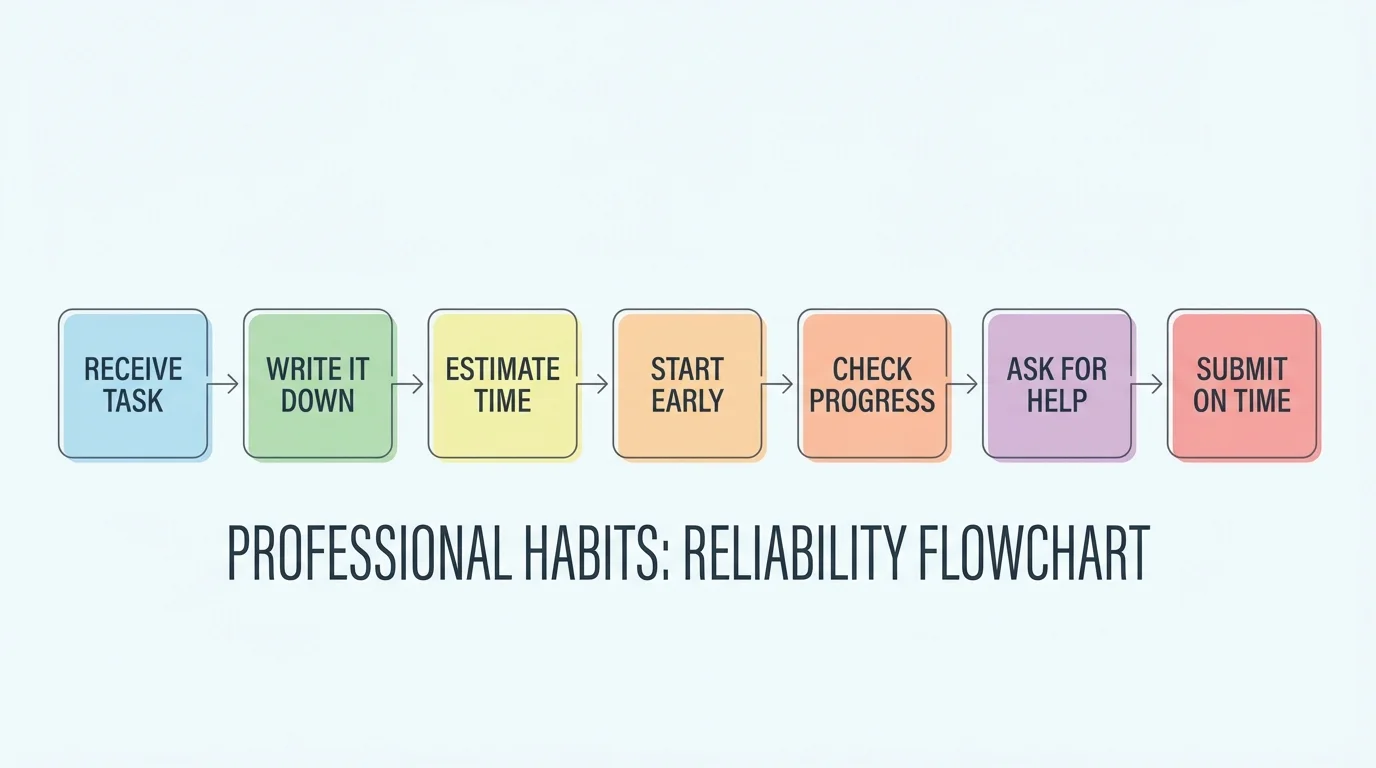
Being reliable is less about personality and more about systems. A simple system helps you stay on track. When you receive a task, write it down right away, estimate how long it will take, start earlier than you think you need to, and check your progress. This lowers stress and reduces last-minute problems.
As [Figure 2] shows, if you wait until the last minute, even a small problem can ruin your plan. Your internet might fail. You might misunderstand directions. You might need a signature or extra information. Starting early gives you room to fix problems before they become emergencies.
Responsibility also means owning your mistakes. If you miss a deadline, the professional move is not to disappear. It is to communicate quickly: explain briefly, apologize honestly, and say what you will do next. For example: "I'm sorry I missed today's check-in. I wrote the wrong time in my calendar. I've corrected it, and I'm available at 4:00 p.m. if that works for you."
Real-life reliability example
You agree to help with an online community fundraiser and are assigned to create a short social media post by Thursday.
Step 1: Record the task right away.
Write: "Draft fundraiser post, due Thursday, send to coordinator by 6:00 p.m."
Step 2: Break the job into smaller parts.
Find the event details, write the draft, check spelling, and send it early.
Step 3: Update the adult if something changes.
If you are waiting on missing information, ask for it before Thursday instead of staying silent.
This makes you look prepared and dependable.
Reliable people also pay attention to details. They read directions fully. They keep passwords, documents, and login times organized. They charge devices before meetings. These may seem small, but small habits often create big results.
If you struggle with reliability, that does not mean you are lazy or incapable. It usually means you need better routines. Set reminders. Use a calendar. Keep a notebook. Put deadlines in one place. The system matters more than trying to "just remember."
Work-based learning helps you practice real-world skills before you have a full-time job. It can happen in many places: an online internship, a volunteer project, helping with a family business, a youth leadership program, a job-shadow day, or a community event. These experiences teach you how workplaces function, as [Figure 3] illustrates through different settings and behaviors.
In these settings, your goal is not to know everything already. Your goal is to show curiosity, effort, and respect. Ask thoughtful questions. Follow instructions. Take notes. Be open to correction. Adults usually understand that beginners need guidance. What they want to see is whether you are teachable.
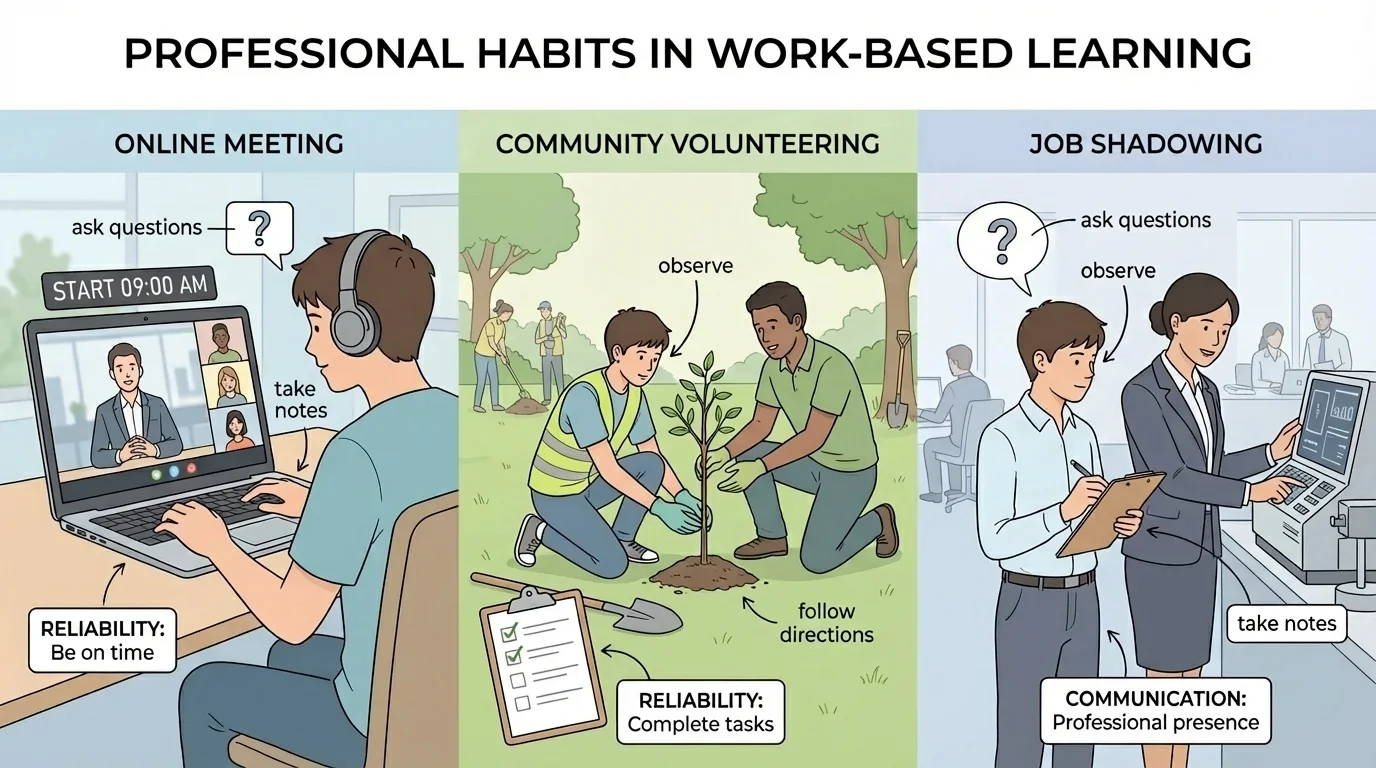
A job-shadow experience may involve observing more than doing. That still counts. Watching how adults talk to customers, solve problems, and manage time teaches a lot. Volunteering may seem less formal than a job, but professional habits still matter there. If the event starts at a certain time, be ready at that time. If you are assigned a role, stay focused on that role unless told otherwise.
Work-based learning also helps you build a network. Networking simply means building positive professional connections. This does not mean collecting contacts in a fake way. It means making a good impression so people remember you as someone helpful and responsible.
Adults who mentor you, supervise you, or work with you in community programs may later become references. The way you act now can help you later when you apply for jobs, scholarships, or leadership opportunities.
Here are smart habits to use in work-based learning situations:
As in [Figure 3], strong work-based learning behavior is usually simple: observe carefully, ask when you are unsure, and take your role seriously.
Every work or learning situation has problems sometimes. Someone may misunderstand your message. A group member may not do their part. You may feel disappointed by feedback. Being professional does not mean you never feel upset. It means you handle the situation in a controlled and respectful way.
Start by pausing before reacting. If you receive a message that feels rude, reread it once. Digital communication can sound harsher than intended. If you still need to respond, keep your answer focused on facts, not emotion. For example: "Thanks for letting me know. I'll revise the document and resend it by tonight."
"Being professional means staying steady when things are not easy."
Feedback can feel personal, but it is often meant to help you improve. Instead of thinking, "They hate my work," try asking, "What specific change would make this stronger?" That question shows maturity and helps you learn faster.
Conflict with others should be handled calmly and directly. Focus on the issue, not the person. Say, "I noticed the file was not added before the deadline. How can we divide the work more clearly next time?" That is much more useful than blame.
What to do when something goes wrong
You were supposed to attend a volunteer orientation on video, but your device stopped working right before it began.
Step 1: Contact the organizer immediately.
Send a brief message explaining the problem.
Step 2: Show that you are trying to solve it.
For example, say you are switching devices or checking for a recording.
Step 3: Ask for the next step.
Request a makeup option, notes, or another meeting time.
This approach shows responsibility, even when the problem was not your fault.
What you should avoid: arguing in public comments, blaming everyone else, disappearing, or sending emotional messages without thinking. Those actions damage trust quickly.
You do not need to wait for a future job to practice professionalism. You can start now in your daily routine, online classes, extracurriculars, creative projects, sports, and community activities. These habits build over time.
Try this simple daily checklist:
You can also create a personal professionalism routine. Choose one communication habit, one reliability habit, and one work-readiness habit. For example: reply to adults within 24 hours, put all deadlines in one calendar, and keep a notes app with questions during volunteer or career activities.
Small habits become your professional identity
Most people are not judged by one giant moment. They are judged by repeated patterns. If your pattern is respectful communication, steady effort, and follow-through, people begin to see you as mature and dependable.
Here is a useful comparison:
| Situation | Less Professional Choice | More Professional Choice |
|---|---|---|
| Missing a deadline | Stay silent and hope no one notices | Send a message early, explain briefly, and offer a new plan |
| Receiving feedback | Get defensive | Ask what to improve and make changes |
| Joining a video call | Arrive late and unprepared | Log in early, test tech, and have materials ready |
| Getting instructions | Guess and do it wrong | Ask clear questions and confirm details |
| Working with others | Wait for others to fix problems | Communicate, contribute, and follow through |
Table 1. Comparison of less professional and more professional choices in common real-life situations.
Professional habits are not about being perfect, stiff, or overly serious. They are about making life easier for the people who depend on you and making yourself someone others can trust. That trust can open doors.
Try this today: send one clear professional message, organize one upcoming deadline, and prepare one question you would ask in a work-based learning situation. Small actions done consistently lead to big growth.
