A single post can travel farther than you expect. Someone you have never met might form an opinion about you based on a username, a comment, a photo tag, or a screenshot taken in seconds. That matters because online spaces are not separate from real life anymore. Your digital choices can affect whether people trust you with a team role, a volunteer position, a creative collaboration, a part-time job later on, or even whether they feel comfortable talking with you.
When people say, "Be careful what you post," they do not just mean avoiding obvious trouble. They also mean that your online presence tells a story about you. It can suggest that you are thoughtful, respectful, skilled, funny, creative, and trustworthy. Or it can suggest the opposite. The important part is that your story online is not written only by your best moments. It is shaped by patterns.
Every account you use leaves clues about who you are. Even if your account is private, the way you communicate online still affects relationships and trust. Friends, relatives, coaches, club leaders, employers, and community adults may not see everything, but they often see enough to build an impression. In digital spaces, small actions can have a big impact because they are searchable, shareable, and easy to save.
This is especially important for teenagers because you are building habits now that will follow you into later opportunities. If you practice being responsible online now, that becomes part of your reputation. If you practice posting without thinking, arguing publicly, or sharing private information, that can become part of your reputation too.
Many people decide whether to trust a message, a seller, a creator, or a new contact within seconds of seeing a profile. They often use small clues such as the tone of comments, the quality of posts, and whether the account seems real and respectful.
That quick judgment is not always fair, but it is real. Since it happens anyway, it makes sense to manage your online presence on purpose instead of leaving it to chance.
Your online identity is the version of you that appears in digital spaces. It includes your profile picture, username, bio, the topics you post about, how you speak to people, what communities you join, and how you present your interests. Some parts are chosen by you. Other parts are shaped by what others post about you.
Your digital reputation is the overall opinion people form about you based on that online identity and your behavior over time. Reputation is about pattern and perception. One joke might not define you, but repeated rude comments can. One helpful post might be nice, but a pattern of respectful, honest behavior builds stronger trust.
Online identity is the image of yourself that appears through your accounts, profiles, posts, and online behavior.
Digital reputation is the impression other people develop about you based on your online identity and your actions over time.
Think of it this way: identity is what shows up, and reputation is what people conclude from it. You control some of that directly, but not all of it. That is why good digital citizenship is not just about looking good. It is about acting in ways that deserve trust.
Your reputation online is built from many small signals, not just one big moment, as [Figure 1] illustrates. People may notice your public posts, short videos, captions, comments under other people's content, gaming chat messages, usernames, profile bios, playlists, and the way you respond during disagreements.
It also comes from things you did not fully plan for, such as being tagged in photos, appearing in someone else's livestream, getting mentioned in a group chat screenshot, or having an old account still visible in search results. Even deleting something does not guarantee it is gone if someone already saved it.
This means your digital reputation is shaped partly by your digital footprint. A digital footprint is the trail of information connected to you online. Some of it is active, like a post you choose to publish. Some of it is passive, like data or mentions created as you use apps and platforms.
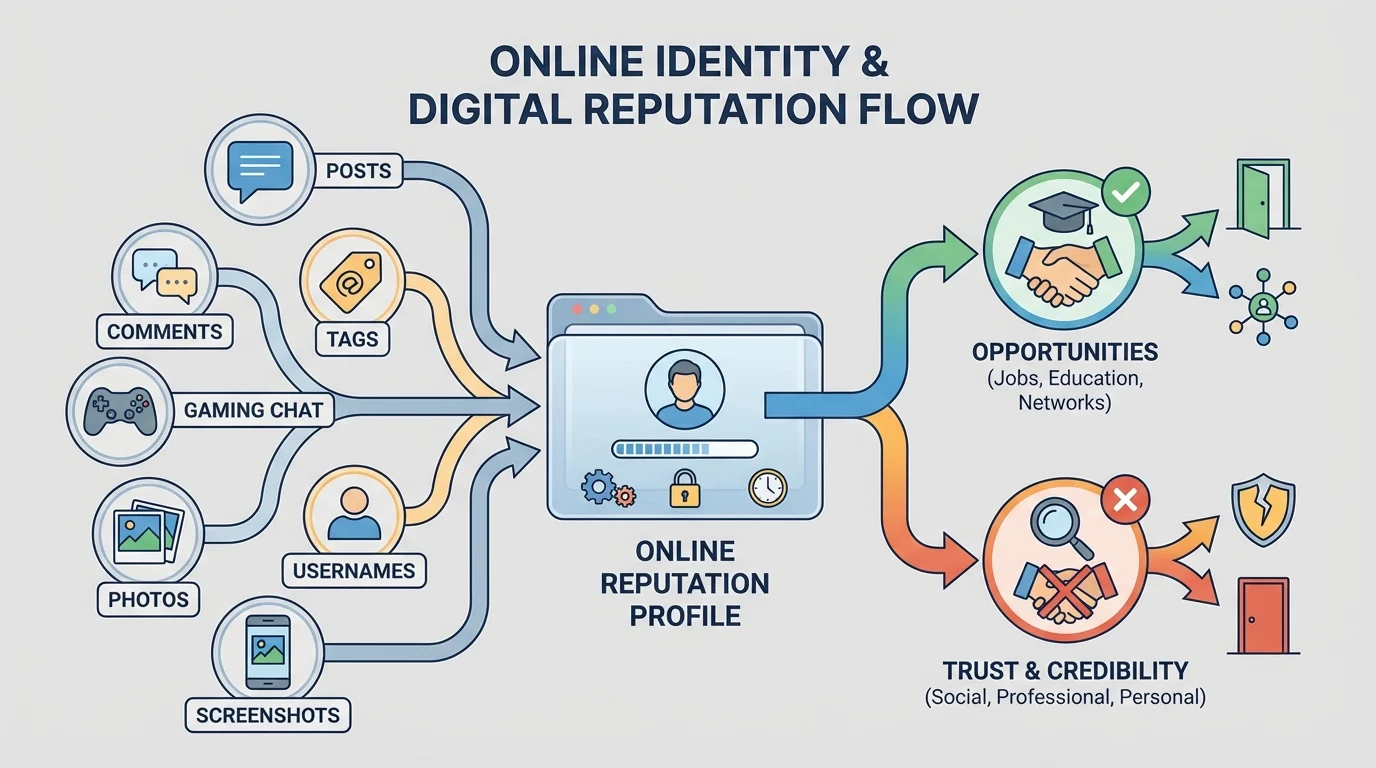
Notice that not all signals carry the same weight. A kind comment under a friend's success post usually helps your reputation. A cruel comment, a threat, a lie, or repeated disrespect hurts it more strongly because negative behavior often stands out.
Context matters too. A silly joke among close friends may look very different when seen by a stranger who lacks the background. Sarcasm, inside jokes, and trend-based humor are especially easy to misunderstand online because tone is hard to read.
People often make fast judgments from limited clues, as [Figure 2] shows when two profiles give very different impressions. They may ask themselves questions like: Does this person seem honest? Respectful? Safe? Mature? Real? Careful? Would I want to work with them, recommend them, or include them in a group?
Trust online is built from consistency. If your bio says you care about kindness but your comments are insulting, people notice the mismatch. If your profile looks polished but you spread rumors or repost false information, people question your judgment. Trust grows when your values, words, and actions line up.
People also watch how you act when something goes wrong. Anyone can seem nice when everything is easy. Character shows more clearly when you disagree, get corrected, lose a game, feel left out, or make a mistake. If you respond with honesty and respect, trust can actually grow.
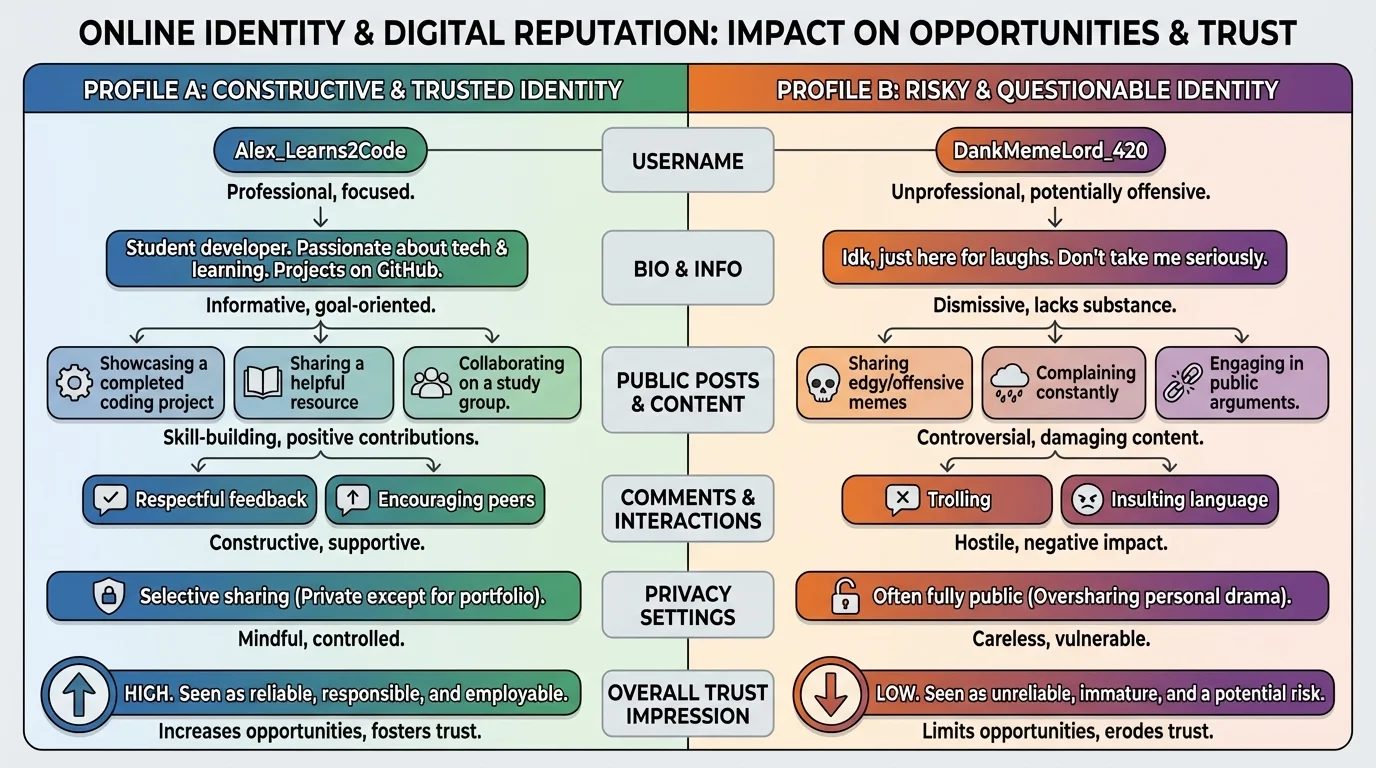
This matters in real situations. A community volunteer organizer might look at a public profile before choosing student helpers. A small business owner might search a prospective employee's name. A family friend might decide whether to recommend you for babysitting, pet sitting, lawn care, tutoring, or tech help. In each case, trust affects opportunity.
As we saw earlier in [Figure 1], that trust is built from many small pieces. People do not only judge what you create. They also notice what you like, repost, defend, laugh at, and ignore.
Why trust forms so quickly online
Online spaces give people fewer clues than face-to-face conversation, so they rely heavily on what they can see: tone, consistency, accuracy, and respect. Because there is less context, one careless post can have a bigger effect than you intended. The practical takeaway is simple: if a stranger saw only your recent digital trail, what story would it tell?
If that story feels incomplete or unfair, you can change it. Reputation is not fixed. But changing it takes repeated good choices, not just one cleanup day.
A strong digital reputation can open doors. If you regularly post your art, music practice, coding projects, thoughtful book reviews, sports training progress, or volunteer work, people may see dedication and skill. If you communicate respectfully in group chats and project spaces, others may trust you more in team settings.
A weak digital reputation can quietly close doors before you even know there was a chance. You may never hear, "We decided not to ask you because of your account." Instead, someone may simply choose another person who seems more reliable, safer, or easier to work with.
Opportunities affected by digital reputation include online internships, youth advisory groups, leadership roles in clubs or community programs, customer-facing jobs, content collaborations, mentorships, and recommendations. Even friendships can be affected. People often decide whether to get closer to someone based on whether that person seems respectful and emotionally safe online.
Real-world comparison
Step 1: Student A keeps a simple username, avoids public arguments, shares original digital art, and gives helpful comments to others.
Step 2: Student B often mocks people in comments, reposts unverified rumors, and uses an offensive joke account name.
Step 3: A local youth media group needs a student editor. Both students have talent, but the organizer searches their public profiles first.
Student A appears safer to trust with responsibility, even if Student B is also skilled. Reputation does not replace ability, but it strongly affects whether ability gets a chance to be seen.
This does not mean you need to become fake or perfect. It means your online behavior should support your goals instead of working against them.
Some online choices damage trust quickly because they raise concerns about judgment, safety, or character. These include bullying, harassment, threats, hate speech, sharing someone's private information, posting humiliating images, cheating, pretending to be someone else, and spreading misinformation.
Another major risk is oversharing. Oversharing means posting personal details that should stay private, such as your location, passwords, family information, private conflicts, or emotional messages written in the heat of the moment. Even if the post feels honest, it can create safety risks or long-term embarrassment.
Misinformation is also a trust problem. If you repost false claims without checking them, people may stop trusting your judgment. Being wrong once is human. Repeatedly sharing unverified content tells others you may not be careful with facts.
Humor can create problems too. Content that seems funny to one group may appear cruel, immature, or dangerous to another. "It was just a joke" does not erase harm. If the joke depends on embarrassing someone, normalizing violence, or targeting a group, it can seriously damage trust.
"Your reputation is what people think you are. Your character is what you are. Online, the two meet very quickly."
Private accounts are not a full shield. Screenshots, reposts, leaked messages, and changing privacy settings can all make private content more public than expected. A good rule is to post as if anything might someday be seen outside its original audience.
A reputation audit is a repeatable process, and [Figure 3] lays out the order clearly. You do not need to panic or delete everything. Start by getting accurate information about what someone else can find.
Step 1: Search your name, usernames, and common variations. See what appears in search results, images, old accounts, tagged content, and public comments.
Step 2: Review your profiles like a stranger would. Check your bio, profile picture, links, highlights, usernames, and visible posts. Ask: Does this feel respectful, safe, and consistent with who I want to be?
Step 3: Clean up what you can. Delete, archive, untag, or edit content that creates the wrong impression or shares too much. If someone else posted something harmful about you, politely ask for removal.
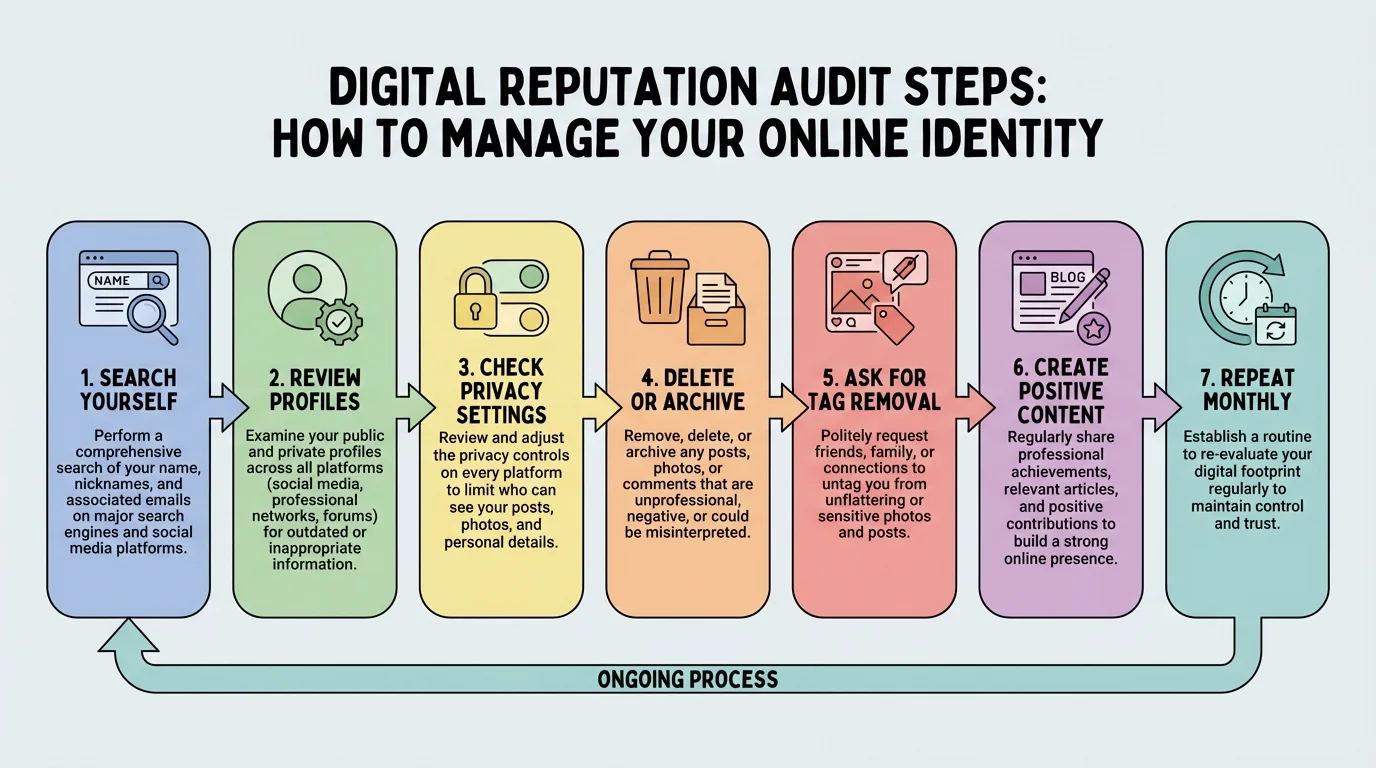
Step 4: Tighten privacy settings. Limit who can tag you, comment, message you, or see your location. Turn on account security features like strong passwords and two-factor authentication.
Step 5: Add positive signals. If your online presence says little about your strengths, build it intentionally. Share a project, a skill, a book recommendation, a community activity, or something you learned. You are not just removing risk; you are shaping a stronger story.
Step 6: Repeat regularly. Your reputation changes over time, so check it monthly or after major activity online. As shown in [Figure 3], this works best as a cycle, not a one-time event.
Quick personal audit
Step 1: Open your three most-used apps and look only at what is public or shareable.
Step 2: List three things that build trust and three things that may weaken it.
Step 3: Make one fix today: change a username, archive an old post, update privacy settings, or remove a risky bio line.
Small improvements matter because reputation grows from repeated patterns, not one dramatic change.
This is also a good time to think about your privacy settings. Privacy settings are the controls that decide who can view, contact, tag, or interact with your account. They do not make risky behavior safe, but they reduce exposure and give you more control.
Almost everyone makes online mistakes. The important question is what you do next. If you posted something harmful, start by taking it down if possible. Then think honestly about who was affected and whether an apology is needed.
An effective apology is direct. It does not blame the audience for being offended. It admits what happened, acknowledges harm, and shows changed behavior. After that, rebuilding trust takes time. One apology helps, but consistent better choices matter more.
If someone shares something embarrassing about you without permission, respond calmly. Save evidence, report the content if needed, block the person if necessary, and ask a trusted adult for help when the situation affects safety, harassment, or serious reputation harm. You do not have to handle major digital problems alone.
Trust is built slowly and damaged quickly. The same rule applies online and offline: honesty, respect, and self-control are easier to believe when people see them consistently over time.
Sometimes rebuilding trust also means replacing negative content with positive, truthful content over time. Helpful comments, responsible participation, and thoughtful sharing can gradually become the stronger pattern people notice.
Before you post, comment, tag, or repost, a simple decision tool can stop problems early, as [Figure 4] makes clear. You do not need to overthink every message, but you do need a pause button.
Ask yourself five questions: Is it true? Is it kind? Is it private? Could it be misunderstood? Would I be okay if a trusted adult, future employer, mentor, or community leader saw it later?
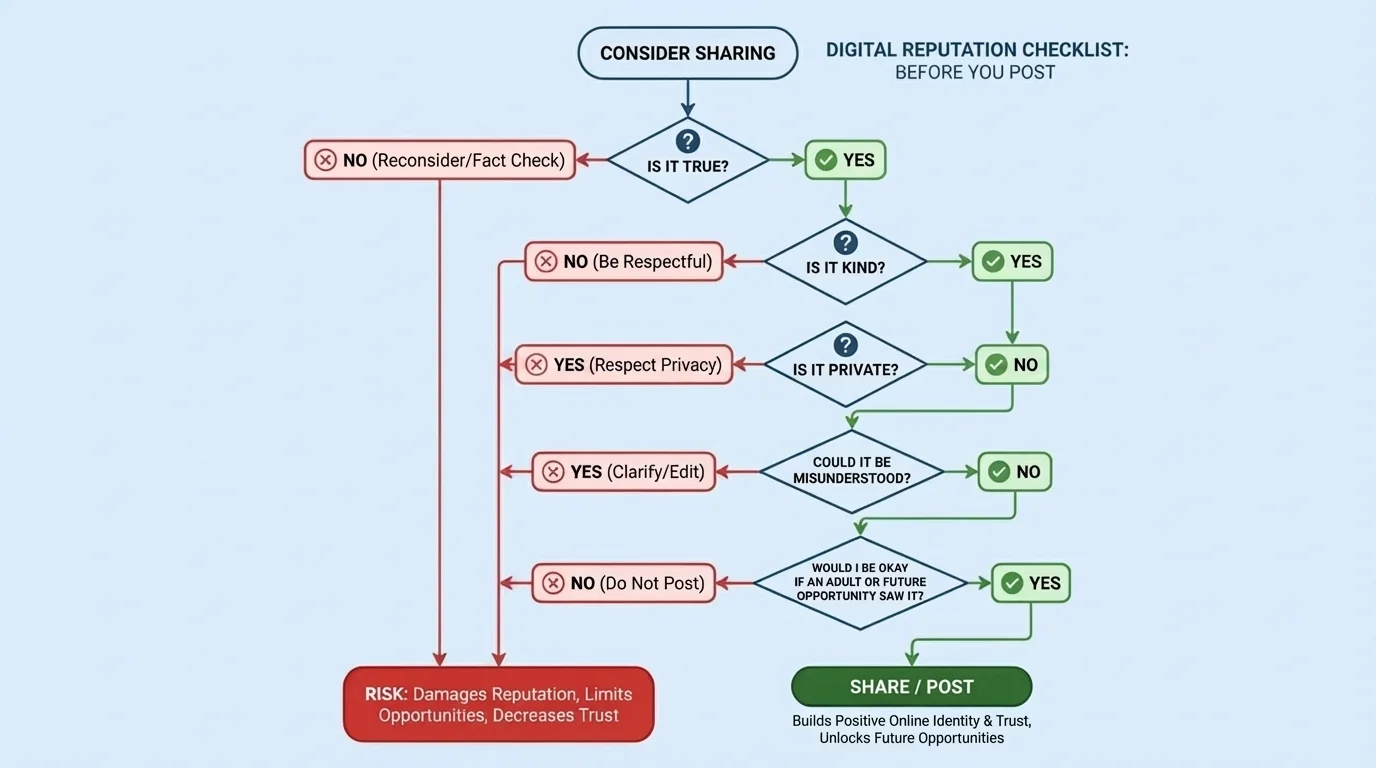
If the answer to any of those questions worries you, slow down. You can save a draft, send nothing, rewrite it, or talk privately instead of posting publicly. Delay is often a smart move, especially when you are angry, embarrassed, jealous, or trying to impress other people.
The checklist in [Figure 4] is useful in group chats too. Many reputation problems start in "private" chat spaces where people feel less careful. But screenshots can travel, and private cruelty still affects trust.
| Question | If the answer is yes | If the answer is no |
|---|---|---|
| Is it true? | You are sharing something accurate. | Do not post until you verify it. |
| Is it kind? | Your message is less likely to harm or humiliate. | Rewrite or do not send it. |
| Is it private? | You are protecting personal information. | Remove identifying details. |
| Could it be misunderstood? | Your meaning is probably clear. | Add context or keep it offline. |
| Would I be okay with future viewers? | The content likely supports your reputation. | Do not post it publicly. |
Table 1. A practical decision checklist for safer posting and stronger digital trust.
This kind of pause does not make you boring. It makes you someone people can trust.
Protecting your reputation is only half the job. The other half is building something positive. A healthy online presence does not need to be flashy. It just needs to reflect good judgment and real interests.
You can do that by sharing your work, encouraging others, joining meaningful conversations, crediting sources, correcting mistakes honestly, and showing consistency between what you say and what you do. If you care about photography, writing, gaming strategy, coding, music, fitness, crafts, animals, or volunteering, your online presence can show that in a respectful way.
This is where credibility matters. Credibility is the quality of being believable and worthy of trust. Online, credibility grows when your content is honest, your behavior is respectful, and your claims match reality.
Positive presence beats empty perfection
You do not need a perfectly polished profile. People trust what feels real and responsible more than what feels fake and overly staged. The goal is not to look flawless. The goal is to show that you are thoughtful, safe, respectful, and capable of learning.
That is good news, because it means you are not trapped by old mistakes or by pressure to perform. You can choose what patterns to build from now on. Every respectful comment, every careful repost, every truthful correction, and every smart privacy choice strengthens the kind of reputation that supports trust and opportunity.
