Some of the most powerful people influencing your choices may never meet you. A headline in your feed, a creator you follow, or a short video with dramatic music can affect what you believe, what you buy, who you trust, and even how you feel about yourself. That is why media literacy is not just a school skill. It is an everyday survival skill.
When you scroll, you are not just seeing information. You are seeing messages designed to get your attention, shape your opinion, earn your trust, or push you toward a reaction. Sometimes that reaction is harmless, like clicking on a video. Sometimes it is costly, like spreading false information, buying a bad product, or getting pulled into an argument based on misleading content.
If you can evaluate media well, you make better decisions. You waste less money, avoid more scams, protect your reputation, and stay calmer when the internet tries to rush you. If you do not evaluate media well, you are easier to manipulate. That can affect friendships, family conversations, purchases, and your digital footprint.
Think about common situations: a friend reposts a shocking claim about health, a gaming creator promotes a "must-have" product, or a video says a certain group of people is ruining everything. In each case, the smart move is not to react instantly. The smart move is to slow down and investigate.
Media literacy is the ability to access, understand, evaluate, and respond to messages in news, videos, ads, social media posts, podcasts, and other digital content. Persuasion is any attempt to influence what you think, feel, or do. Misinformation is false or misleading information shared without meaning to harm, while disinformation is false information shared on purpose to mislead.
One important truth: media messages are made by people or organizations for a reason. Even when content looks casual or "just for fun," it still has a target audience, a purpose, and a point of view. Your job is to notice those things before you let the message shape you.
Being media-literate does not mean distrusting everything. It means asking better questions. [Figure 1] previews this process visually: Who made this? Why did they make it? What do they want from me? What evidence do they provide? What might they be leaving out?
You can use five core checks on almost any piece of online content: source, purpose, evidence, context, and impact. Source means who created it. Purpose means what they want. Evidence means how they support it. Context means what background is missing. Impact means what could happen if people believe or share it.
These checks matter because online content often mixes facts, opinions, jokes, editing tricks, and advertising all in one place. A post can contain one true detail and still leave you with a false conclusion. That is why careful evaluation beats quick reactions.
Not every accurate detail adds up to an honest message
A creator can use real photos, real statistics, or a real event but still mislead you by removing context, choosing only one side, or using emotional language to push a conclusion. Media literacy means looking at the whole message, not just one impressive detail.
Another skill is noticing your own reaction. If a post makes you instantly angry, scared, proud, or excited, pause. Strong emotion is not proof that a message is true. In fact, emotional intensity is often used to reduce careful thinking.
Before you repost, comment, or act on something, use this quick routine. It helps you slow down just enough to avoid getting manipulated.
Step 1: Pause. Do not reward the post with an instant reaction. Ask yourself what it is trying to make you feel.
Step 2: Identify the source. Is it a news organization, a random account, a meme page, an influencer, a company, or an anonymous post? If you cannot clearly tell who made it, be cautious.
Step 3: Check the evidence. Does the post link to original reporting, data, interviews, or documents? Or does it just say "everyone knows" or "they do not want you to know"?
Step 4: Compare. Search for the same claim from at least two other reliable sources. If a dramatic claim appears only on one suspicious account, that is a warning sign.
Step 5: Decide. You do not have only two choices. You can share, save for later, ignore, report, mute, or investigate more.
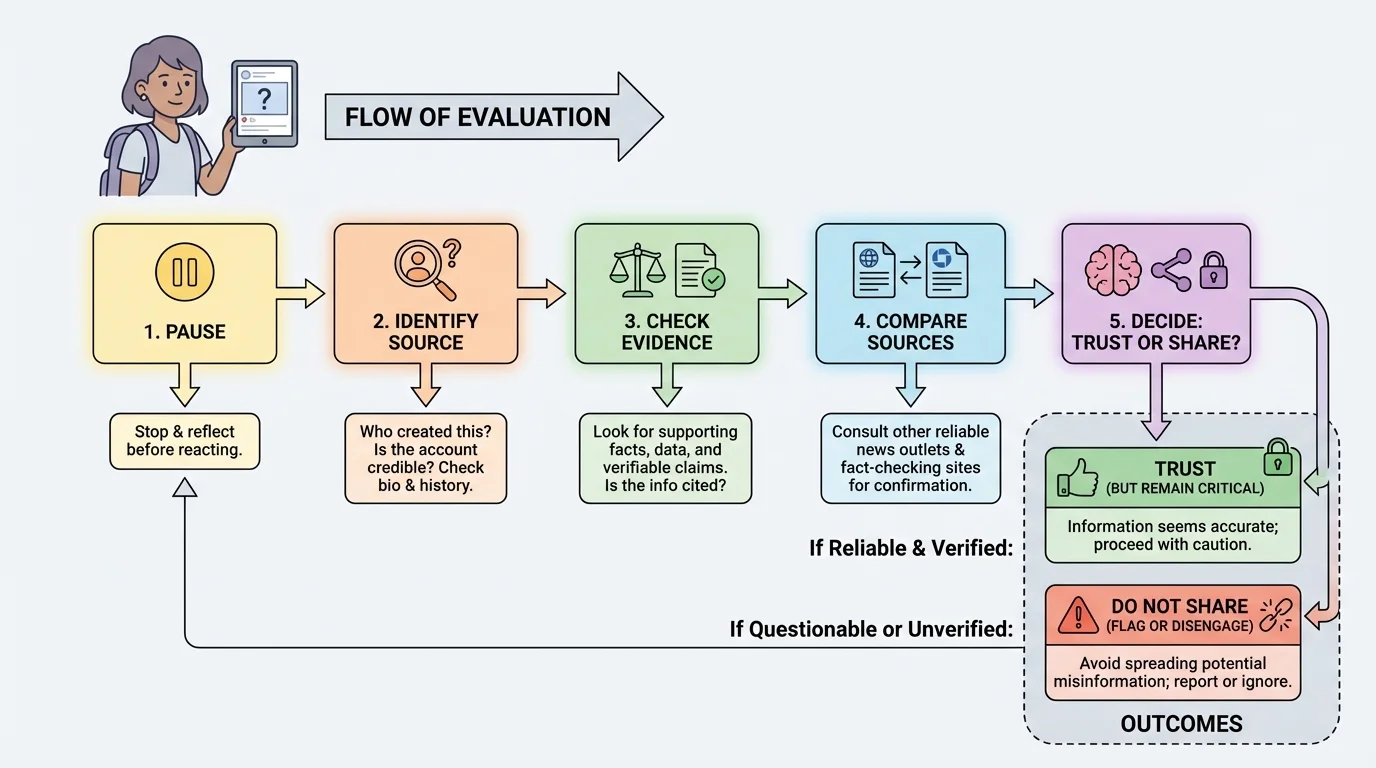
This routine is especially useful when you are tired, stressed, or already upset. Those are the moments when rushed decisions are most likely. A simple habit can protect you from making a public mistake that lasts much longer than the original post.
Real situation: a viral claim in your feed
You see a post saying, "This new law means your favorite app will be banned tomorrow. Share before it gets deleted."
Step 1: Pause and name the emotion
The post is trying to create panic and urgency.
Step 2: Check the source
The account is a repost page with no clear organization behind it.
Step 3: Check evidence
There is no link to an official statement or trustworthy reporting.
Step 4: Compare sources
You search established news outlets and the app's official account. None confirm the claim.
Step 5: Decide
You do not share it. You may even mute the account because it posts panic content for attention.
Try This: For the next week, use the five-step routine on one post per day before reacting. You are training your judgment, not just checking facts.
Trustworthy and untrustworthy posts can look surprisingly similar. A slick graphic does not prove a claim is reliable. People can make a false post look professional in minutes.
[Figure 2] Start with the headline. Watch for words that push emotion over clarity: "shocking," "exposed," "secret," "they lied," or "you will not believe." Strong language is not automatic proof of falsehood, but it should make you more careful. Reliable reporting usually tries to inform before it tries to thrill.
Next, check the date. Old stories often get reshared as if they just happened. A true event from two years ago can become misleading if people act like it happened today. Context includes time.
Then look for evidence. Are there named experts, eyewitnesses, official records, direct quotes, or original documents? Or is the post built mostly on screenshots, rumors, or "someone said"? Strong claims need strong support.
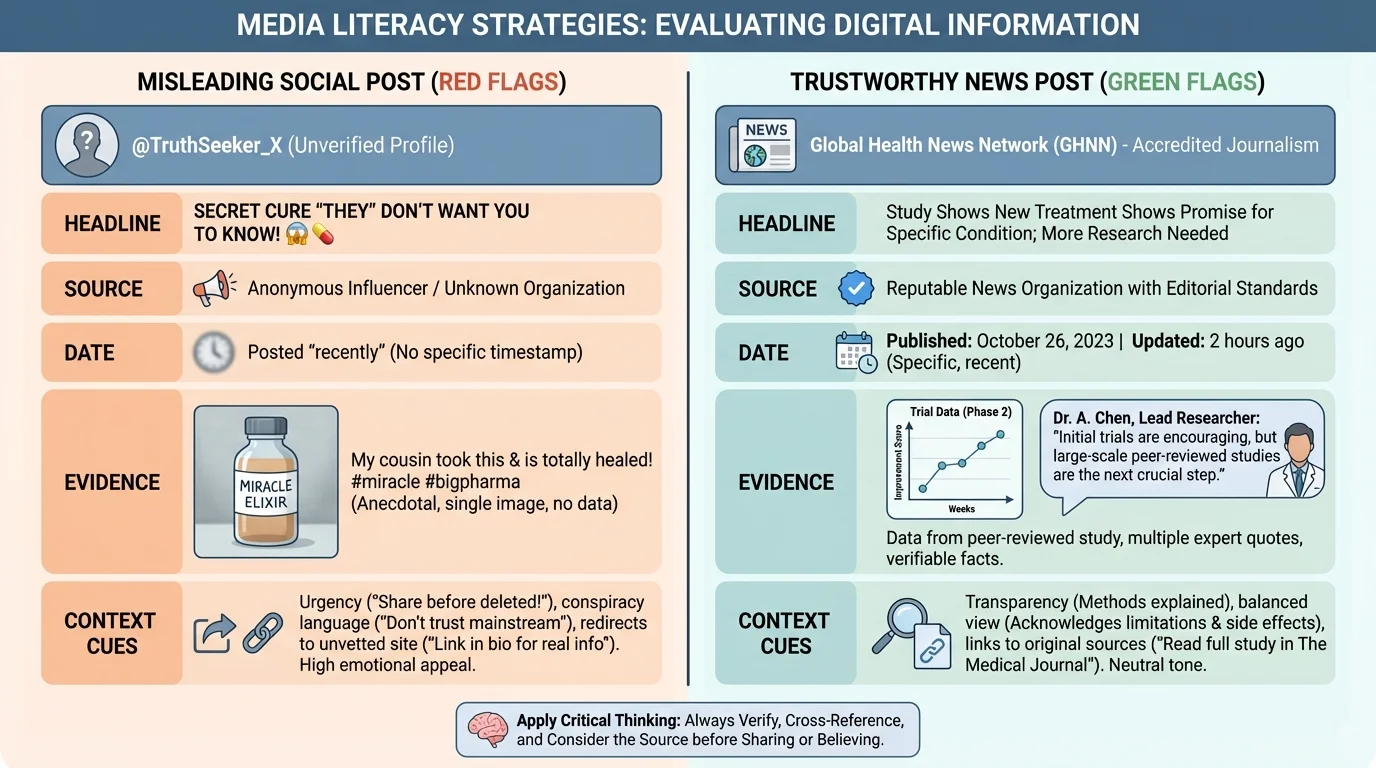
Also ask what is missing. Missing context can completely change meaning. A short clip may leave out what happened before and after. A statistic may sound huge until you learn the sample size was tiny. A quote may be real but cut off before the speaker explained it.
Watch for bias, but understand it correctly. Bias does not always mean lying. It means a source may favor certain viewpoints, stories, or interpretations. Every source has some perspective. Your goal is to recognize it, not pretend it does not exist.
Another useful check is whether a source corrects mistakes. Trustworthy organizations are not perfect, but they usually update stories, label corrections, and show who is responsible for the content. A page that never admits error is less trustworthy than one that fixes mistakes openly.
As you saw earlier in [Figure 1], comparison is one of your strongest tools. If a claim matters, do not stop at one source. Look across multiple credible reports and see what stays consistent.
| Question | More Trustworthy Sign | Warning Sign |
|---|---|---|
| Who posted this? | Clear author or organization | Anonymous or hard-to-trace account |
| What support is given? | Links, documents, direct reporting | Rumors, vague claims, no proof |
| How does it sound? | Specific and measured | Overheated and dramatic |
| What might be missing? | Context is included | Clip, quote, or stat stands alone |
| Can it be confirmed? | Other reliable sources match it | Only one questionable source says it |
Table 1. Quick comparison of signs that make a post more or less trustworthy.
Influencers can be entertaining, creative, and helpful. But they are also part of digital marketing systems, and their persuasion often works through trust, style, and identity as much as information. You may feel like you "know" a creator because you hear their voice often, see their room, and follow their daily life. That feeling can lower your guard.
[Figure 3] This one-sided feeling of connection is called a parasocial relationship. It can make recommendations feel personal, even when they are sponsored. A creator might genuinely like a product, but they may also be paid, given items, or rewarded through affiliate links and discount codes.
Check for sponsorship clues: "ad," "paid partnership," affiliate links, discount codes, repeated brand mentions, or product placement that feels too polished. Some creators disclose clearly. Others bury the disclosure or make the promotion sound like a casual favorite.
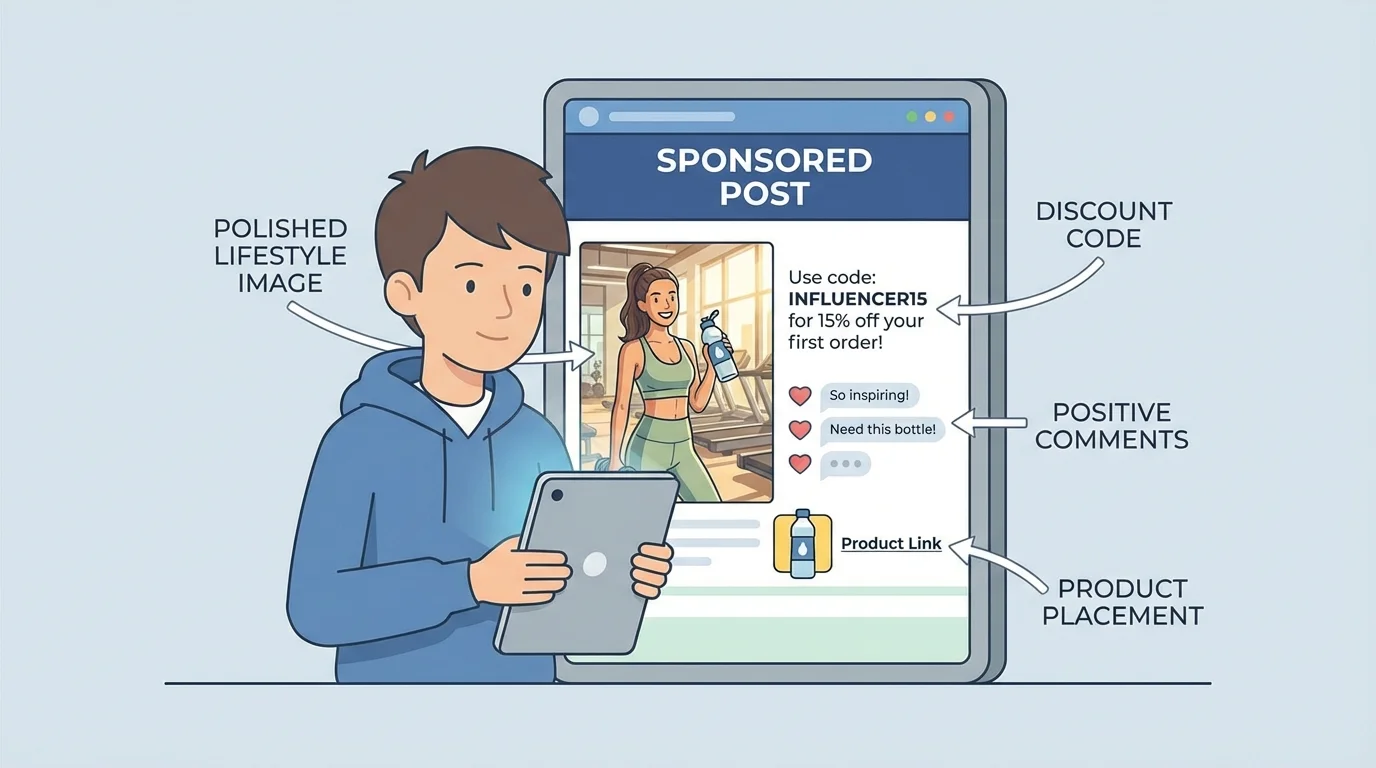
Credibility matters here too. Ask: Is this person qualified to give advice on this topic? A creator can be funny and likable without being informed about nutrition, money, mental health, or safety. Popularity is not expertise.
People are often more persuaded by someone they like than by someone with stronger evidence. That is one reason influencer marketing works so well, especially when the product is woven into everyday content instead of looking like a traditional ad.
Look at the lifestyle message behind the product. Sometimes the real pitch is not "buy this item." It is "buy the version of yourself that seems to come with this item." That is powerful because it connects the product to confidence, popularity, attractiveness, or success.
Comments can also persuade. A flood of positive comments may be real, but sometimes comments are filtered, selected, or influenced by fans who already trust the creator. Social approval can make a product seem better than it is.
Later, when you are deciding whether to spend money, remember what [Figure 3] makes visible: the product is only one part of the message. The mood, trust, visuals, and community reaction are also doing persuasive work.
Real situation: a creator recommends a supplement
A fitness influencer says a powder "changed everything" and offers a code for 15% off.
Step 1: Check qualifications
They may know workouts, but that does not automatically make them a health expert.
Step 2: Look for disclosure
The discount code suggests a financial connection.
Step 3: Check outside sources
Look up independent reviews and trusted health information, not just fan comments.
Step 4: Consider your goal
Do you actually need it, or are you reacting to the creator's confidence and image?
Try This: The next time a creator recommends something, write down three separate things: what they said, what they showed, and what they made you feel. That helps you separate information from persuasion.
Not all persuasion is obvious. Some of it works by using basic human habits. One common tactic is social proof, which means people are more likely to trust or join something if many others seem to approve of it. Likes, views, comments, and "everyone is doing this" language are all signals meant to push you toward agreement.
Another tactic is scarcity: "Only a few left," "today only," or "last chance." Scarcity can be real, but it can also be exaggerated to create pressure. Pressure reduces careful thinking.
Fear and outrage also drive attention. Content that makes you feel threatened or furious often gets more clicks, comments, and shares. Platforms notice that engagement and may show similar content again, creating a loop. This is one way algorithms shape your experience.
An algorithm is a set of rules a platform uses to decide what to show you. It often learns from what you watch, pause on, like, or argue with. That means even negative attention can train your feed. If you keep stopping for rage content, you may get more of it.
Why repeated messages feel true
When you see the same claim again and again, it can start to feel familiar, and familiar can feel true. This does not mean repetition equals accuracy. It means your brain uses shortcuts. Repetition is a persuasion tool, especially online where one idea can appear across many accounts in slightly different forms.
Another tactic is microtargeting, where messages are aimed at very specific groups based on their interests, behavior, or demographics. Two people on the same platform may see very different political ads, product promotions, or issue-based content. This is one reason your feed does not represent everyone's reality.
You should also watch for false choices. A post may act like there are only two options: agree completely or be foolish; buy now or miss out forever; share this or support the problem. Real life usually has more choices.
Try This: When a post feels urgent, ask, "What happens if I wait ten minutes?" If the answer is "probably nothing," you just found a pressure tactic.
When you meet digital persuasion in real life, you need a response plan. Use this four-part decision process: notice, check, choose, and protect.
Notice: Name the tactic. Is this trying to scare me, flatter me, rush me, or make me copy a crowd?
Check: Verify the source, evidence, and context. If the message is selling something, check whether the seller benefits from your trust.
Choose: Decide what action fits the situation. You can ignore, save, search, ask a trusted adult, report, block, or unsubscribe. Good digital citizenship includes not feeding harmful content.
Protect: Guard your privacy, money, time, and emotions. Not every message deserves access to your attention.
Real situation: a dramatic direct message
You get a message saying your account will be locked unless you confirm your password immediately.
Step 1: Notice
The message creates urgency and fear.
Step 2: Check
You inspect the sender and see it is not the real company account.
Step 3: Choose
You do not click the link. Instead, you open the app directly and check your account there.
Step 4: Protect
You report the message, delete it, and change your password if needed.
This same process works for more than scams. It works for gossip posts, "miracle" products, political clips, dramatic rumors, and pressure-filled trends.
Media literacy is closely connected to online safety. False information can lead to real-world harm: damaged trust, wasted money, unsafe choices, harassment, or panic. Being skeptical in a calm, thoughtful way protects you.
Privacy is part of this too. The more platforms know about you, the more precisely they can target messages. Review app permissions, limit oversharing, and think before taking quizzes or clicking "fun" links that collect data. Free content is often paid for with attention and information.
Your emotional safety matters as well. If a type of content keeps making you anxious, angry, or hopeless, that is a sign to change your media habits. Mute accounts. Unfollow pages that constantly manipulate emotions. Curating your feed is not weakness. It is good judgment.
From online safety basics, you may already know to protect passwords and avoid suspicious links. Media literacy adds another layer: protect your thinking. A safe account matters, but so does a safe decision process.
You do not have to win every online argument or respond to every claim. Sometimes the most mature digital choice is to disengage. Refusing to amplify weak or toxic content is a form of strength.
Good media literacy is not a one-time trick. It is a set of habits. Build routines that make smart choices easier.
Follow a mix of sources instead of living inside one corner of the internet. If all your information comes from people who think exactly alike, your view gets narrower. Variety helps you notice what different groups emphasize, ignore, or distort.
Take breaks before reacting to emotional content. If you are upset, hungry, tired, or stressed, your judgment is usually weaker. A delayed response is often the smarter response.
Save instead of share. If something seems important, save it and return later after checking it. Most content loses its power when you give yourself time.
Ask better questions in comments or messages. Instead of arguing instantly, try: "What is the source for this?" or "Is there a longer clip?" or "Where did this information come from?" Questions can slow down misinformation without escalating conflict.
"The goal is not to never be influenced. The goal is to notice when influence is happening and choose your response on purpose."
Finally, be honest with yourself: everyone is persuadable sometimes. That is not a personal failure. It is part of being human. The win is not perfection. The win is becoming harder to fool, rush, flatter, or scare into bad decisions.
