One fast decision can change everything. Choosing to tell an adult about chest pain, refusing to get into a car with an unsafe driver, or calling for help when a friend seems in danger can protect a life. On the other hand, ignoring warning signs, hiding a serious problem, or following pressure from others can make a bad situation much worse. Health and safety knowledge is not just something to memorize. It is something you use in real moments, often when you feel stressed, rushed, or unsure.
As a teenager, you are starting to make more of your own choices. You may stay home alone, go to activities in your community, talk with people online, manage stress privately, or support friends who share serious problems with you. That means you need practical judgment: knowing when to get help, how to prevent harm before it starts, and how to choose the safest next step even when other people are pushing you in a different direction.
Health and safety situations do not always look dramatic. Sometimes they begin as a quiet headache after a fall, repeated messages from someone who will not respect your boundaries, panic that makes it hard to breathe, or a friend posting messages that sound hopeless. Real safety means paying attention early, not just reacting when things become extreme.
Help-seeking means recognizing that you need support and taking action to get it from a trusted person or service.
Prevention means reducing risk before a problem happens or gets worse.
Responsible choices are decisions that protect your health, safety, rights, and future, even if they are not the easiest or most popular choices in the moment.
Being responsible does not mean handling everything alone. In fact, one of the most mature choices you can make is knowing when a problem is too big, too dangerous, or too confusing to manage by yourself.
One of the most useful skills is sorting a situation quickly, as [Figure 1] shows through a simple decision path. If you can tell whether something is an emergency, an urgent problem, or a routine concern, you are more likely to choose the right kind of help instead of freezing, guessing, or waiting too long.
An emergency is a situation where someone may be in immediate danger. Examples include trouble breathing, chest pain, severe bleeding, signs of overdose, loss of consciousness, seizure, a serious head injury, suicidal statements with immediate risk, or being in immediate physical danger from another person. Emergencies call for emergency services right away. If you are in the United States, that means calling 911. In other places, use your local emergency number.
An urgent concern needs help soon, usually the same day, but may not require emergency services. Examples include a high fever that will not go down, a possible sprain or broken bone, severe dehydration, a worsening infection, panic symptoms that are intense but not causing collapse, or a friend who is emotionally distressed and talking about self-harm without immediate means present. Urgent concerns still need adult support and quick action.
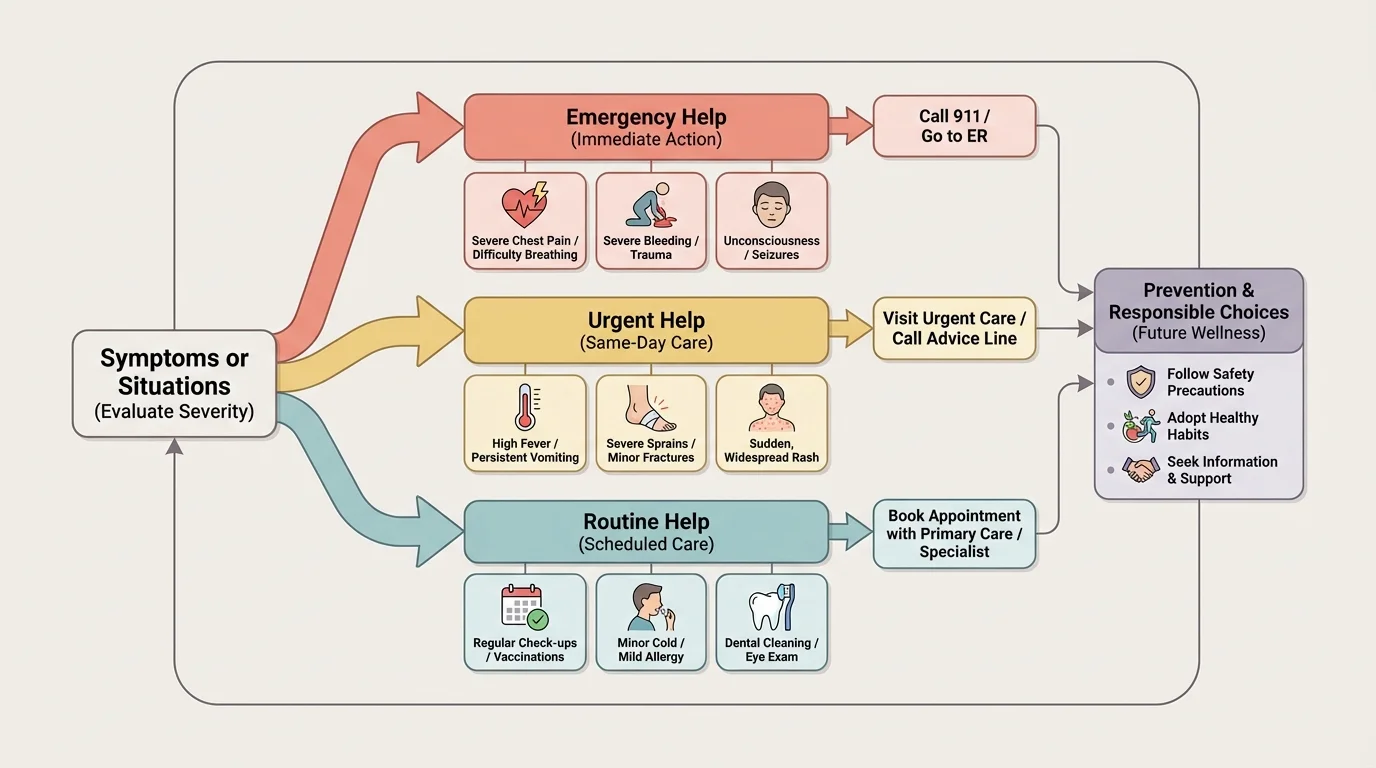
A routine concern matters, but it can usually be handled by scheduling support. Examples include ongoing stress, trouble sleeping, questions about nutrition, mild cold symptoms, sadness that continues for days, repeated headaches, or wanting advice about boundaries in a relationship. Routine does not mean unimportant. It means there is time to plan the best support.
If you are unsure, treat the situation as more serious until a trusted adult or professional helps you decide. It is better to overreact to real danger than to stay silent because you worried about seeming dramatic.
| Type of concern | What it looks like | Best next step |
|---|---|---|
| Emergency | Immediate danger, severe symptoms, unsafe situation now | Call emergency services and alert a trusted adult |
| Urgent | Needs fast care, may worsen quickly, serious emotional or physical concern | Contact a trusted adult, urgent care, doctor, crisis line, or same-day support |
| Routine | Important but stable, no immediate danger | Schedule a checkup, counseling, or conversation with a trusted adult |
Table 1. A comparison of emergency, urgent, and routine health and safety concerns.
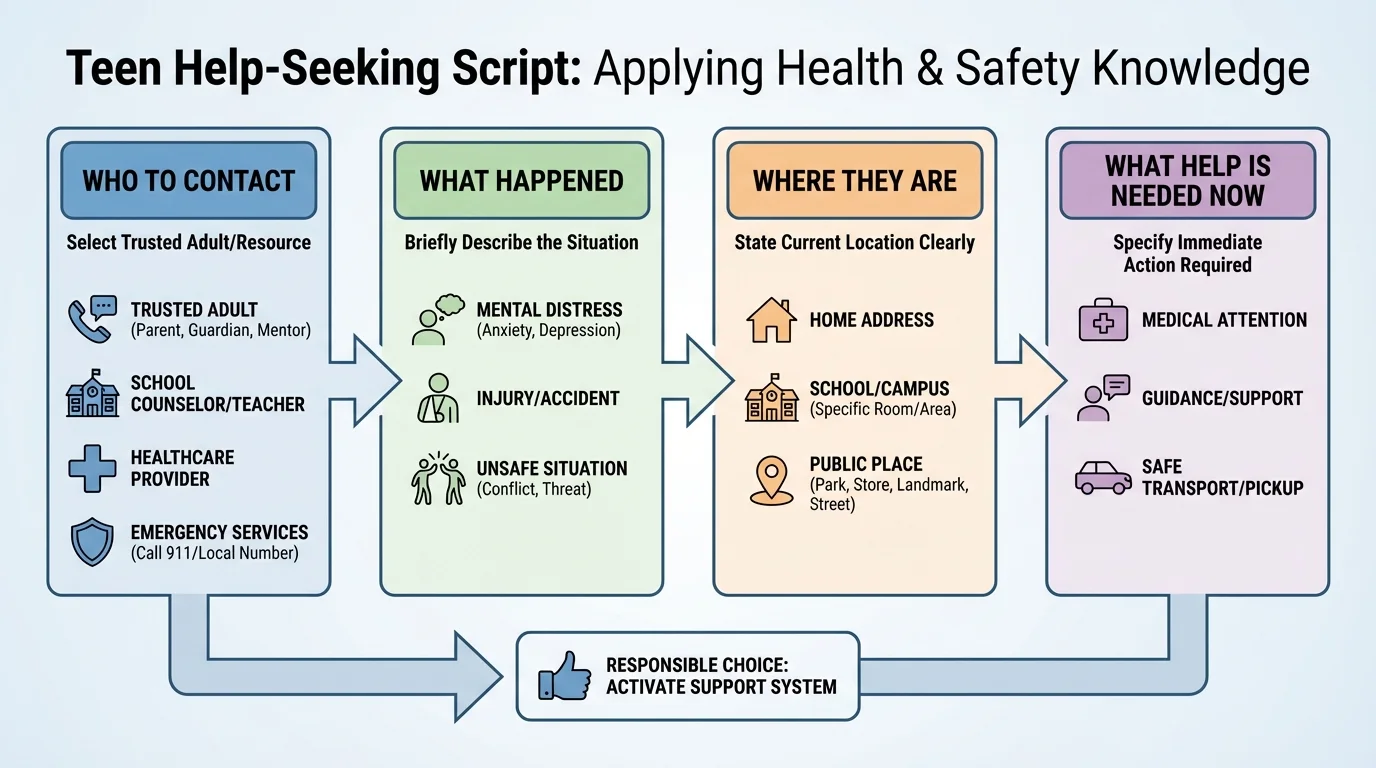
When people panic, they often send unclear messages like "Something's wrong" or "I need help" and then stop typing. A better method is to use a simple safety plan-style message pattern, as [Figure 2] explains: who you are, what is happening, where you are, and what you need right now.
Here is a strong help-seeking script: "This is [your name]. I am at [location]. [Describe what is happening.] I need help now. Please call me or come here." If texting is safer than calling, send the same information by text. If you cannot explain everything, send your location and one clear sentence first.
For example, instead of typing "I feel weird," you could send: "This is Maya. I am at the community gym on Pine Street. I hit my head and now I feel dizzy and sick. I need an adult to pick me up and help me get checked." That message gives useful facts fast.
If the situation is emotional, you can still be clear. For example: "I am at home and I do not feel safe being alone right now. I need you to stay on the phone with me and help me get support."
The help-seeking ladder
Start with the safest and fastest reliable option. If one person does not answer, go to the next. For example: trusted adult, second trusted adult, emergency contact, doctor or nurse line, crisis line, emergency services. Keep going until you reach a real person. Silence from one contact is not a sign to give up.
Sometimes you may be asking for help for a friend. In that case, do not promise to keep dangerous secrets. If a friend says they may hurt themselves, were assaulted, overdosed, or are trapped in abuse, your job is not to protect the secret. Your job is to protect the person.
A trusted adult might be a parent, guardian, older relative, coach, youth leader, neighbor you know well, or another responsible adult in your life. A trusted adult should listen, act, and take your safety seriously. If one adult minimizes the issue, tell another.
Crisis and mental health lines exist because many dangerous situations begin with emotional pain, panic, or hopelessness rather than a visible injury. Reaching out early can prevent a crisis from becoming an emergency.
If you need immediate emotional support in the United States, calling or texting 988 connects you to a crisis counselor. If there is immediate danger, emergency services are still the right choice.
Prevention often looks boring in the moment, but it is one of the strongest forms of self-protection. Wearing a helmet, locking down your privacy settings, getting enough sleep, refusing to share medication, drinking water during sports, and telling someone where you are going are all prevention habits. They lower risk before you need rescue.
Physical prevention includes basics you have heard before because they matter: sleep, hydration, regular meals, movement, hygiene, and using safety gear. A teen who is exhausted, dehydrated, and skipping meals may be more likely to make impulsive choices, misread danger, or have stronger emotional reactions.
Mental health prevention matters too. Build habits that reduce stress before it stacks up: taking breaks from nonstop scrolling, getting outside, talking honestly with safe people, limiting all-night gaming or messaging, and noticing when your mood is dropping for several days in a row. Prevention is easier when you act early.
Digital prevention is now part of personal safety. Use strong passwords, do not share your location publicly, do not send private images, and be careful about online relationships. A person can feel friendly and still be dishonest, manipulative, or unsafe. If someone pressures you to hide conversations, send explicit photos, or meet alone quickly, that is a warning sign.
Medicine safety is another important area. Only take medication that is meant for you and given correctly by a parent, guardian, or healthcare professional. Never take pills from friends, never mix substances because someone says it is harmless, and never assume "natural" means safe. Some substances can interact in dangerous ways.
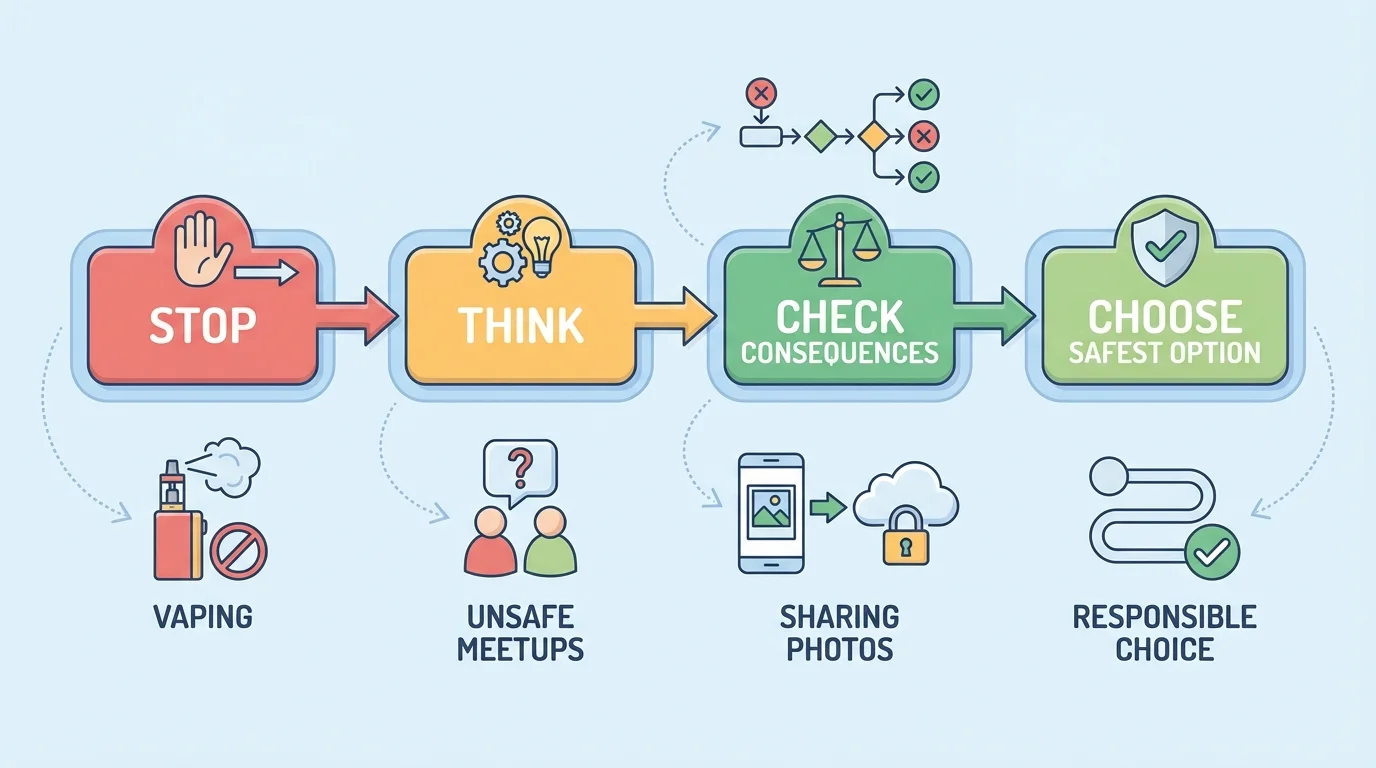
Pressure rarely announces itself clearly. It often sounds casual: "Come on, it's not a big deal," "Everyone does it," or "If you trust me, prove it." A strong response starts with a simple decision model, and [Figure 3] lays it out clearly: stop, think, check consequences, and choose the safest option.
Stop means pause long enough to interrupt the pressure. Think means identify the real risk. Check consequences means asking what could happen today, tomorrow, and later. Choose means take the safest action, even if someone else gets annoyed.
This matters in situations involving substances, dares, unsafe driving, sexual pressure, sharing passwords, sending photos, meeting online contacts in person, or going somewhere without telling anyone. Responsible choices protect both your present safety and your future opportunities.
Here are useful questions to ask yourself: Is this legal? Is this safe? Would I be okay if a trusted adult knew? Am I being rushed? Who benefits if I say yes? What is my exit plan if it goes wrong?
If you feel pressure, simple refusal lines work well: "No, I'm not doing that." "I'm heading out." "My answer is still no." "I don't share that." "I need to call home first." You do not owe a long explanation for protecting yourself.
Case study: Unsafe ride home
You are leaving an activity, and the only available ride is a teen driver who seems angry, tired, and is joking about driving fast.
Step 1: Stop and notice the risk
The risk is not just inconvenience. It is possible injury or death if the driver is reckless.
Step 2: Check consequences
Saying yes may get you home faster, but it creates serious danger. Saying no may be awkward, but awkward is safer than unsafe.
Step 3: Choose the safer option
Call a trusted adult, wait in a safe public place, or ask for another responsible ride.
The responsible choice is the one that protects your safety, not the one that avoids a few minutes of discomfort.
As with this choice process, the pause is powerful. Many unsafe decisions happen because people act before they think.
Sometimes the most important health and safety skill is noticing that something is wrong before there is proof. Warning signs can be physical, emotional, behavioral, or social.
Physical warning signs include trouble breathing, severe allergic reaction, confusion, fainting, blue or gray lips, repeated vomiting, extreme sleepiness after substance use, severe headache after a hit to the head, chest pain, or signs of heat illness such as dizziness, nausea, and no sweating in dangerous heat. These signs should never be brushed off.
Emotional and behavioral warning signs include talking about feeling trapped, giving away belongings, posting goodbye messages, sudden isolation, panic that feels unbearable, self-harm, intense hopelessness, or saying others would be better off without them. If you hear or see these signs, involve an adult or crisis support immediately.
Abuse warning signs can include fear of a specific person, unexplained injuries, extreme secrecy, being controlled through threats, pressure for sexual images, or being afraid to say no. Abuse is never the victim's fault, and help should come from safe adults and professionals, not from trying to manage the abuser alone.
"If something feels wrong, pause and protect first."
— Personal safety principle
Friends can support each other, but friends are not replacements for trained adults in a crisis. If a friend says, "Don't tell anyone," but the situation involves danger, your responsibility is to act.
Safety works better when it is planned ahead, and [Figure 4] organizes the key parts of a personal plan. In a stressful moment, people forget details. A written plan reduces that problem by giving you names, numbers, places, and steps before you need them.
Your plan should include at least three trusted adults, emergency numbers, your home address, any important medical information, safe nearby places, and a script you can send quickly by text. It should also include digital safety steps such as how to block, report, and save evidence if someone harasses or threatens you online.
A good plan also lists warning signs that tell you to get help early. For example: "If I have not slept in two nights, if I start hiding bruises, if I feel panicked every day, if someone demands private photos, or if a friend talks about suicide, I will contact an adult immediately."
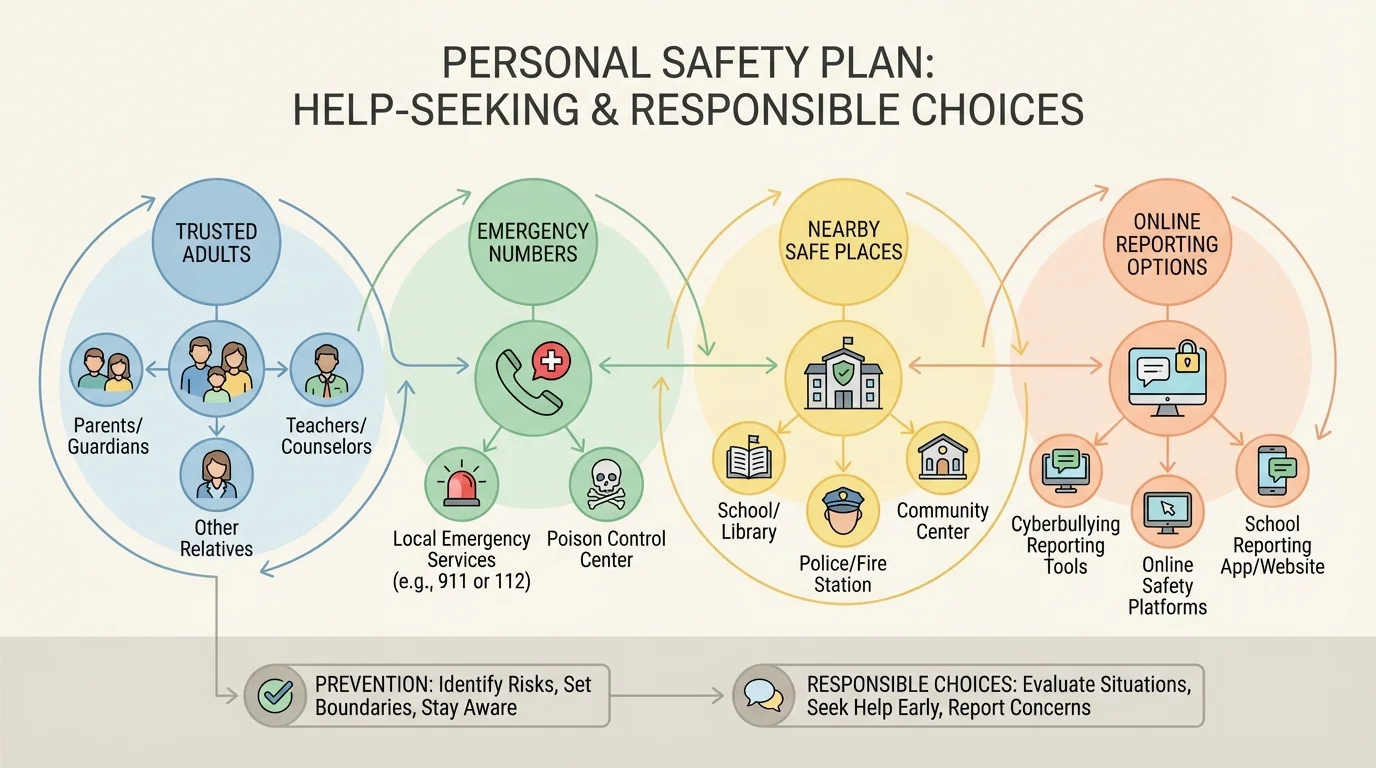
You can store this plan in your phone, but also keep a paper copy in a private, easy-to-reach place. Phones die, get lost, or may not be safe to access in every situation.
| Plan item | What to include | Why it matters |
|---|---|---|
| Trusted adults | Names and phone numbers of at least 3 adults | If one person is unavailable, you have backups |
| Emergency help | Emergency number, crisis line, local urgent care | You can act quickly under stress |
| Safe places | Nearby homes, community centers, public businesses | You know where to go if you must leave fast |
| Medical info | Allergies, medications, health conditions | Others can help you accurately |
| Digital safety steps | Block, report, screenshot, tell an adult | Online threats need documented action |
Table 2. Core parts of a practical personal safety and support plan.
Later, when you are making a real decision, your organized support map helps you act faster because you already know your contacts and backup options.
Suppose a friend messages you late at night: "I can't do this anymore." A poor response is to reply with only "Don't say that" and then go to sleep. A responsible response is to keep them talking briefly, contact a trusted adult immediately, and use crisis support if needed. Waiting until morning could be dangerous.
Suppose someone you met online wants to meet in person and says not to tell anyone because "adults overreact." That secrecy is a warning sign. The safe choice is not to meet alone, not to hide the situation, and to tell a trusted adult. People who respect you do not ask you to remove safety protections.
Suppose you feel sick during hot weather after sports in your community. You have a headache, dizziness, and nausea. A poor choice is to push through because you do not want to look weak. A safer choice is to stop activity, move to a cooler place, hydrate, alert an adult, and get medical help if symptoms worsen.
Case study: Friend shares pills
A friend offers you a pill and says it will help you relax before an event.
Step 1: Name the risk clearly
You do not know exactly what the pill is, how strong it is, or how it could affect your body.
Step 2: Remember the rule
Never take medication or substances that are not prescribed or given safely by a healthcare professional or responsible adult.
Step 3: Use a direct refusal
Say, "No, I don't take random pills," and leave the situation if needed.
The short-term social pressure is minor compared with the possible health emergency.
Good health and safety decisions are not always dramatic. Often they are quiet, firm, and practical: leaving, telling, refusing, calling, documenting, blocking, resting, or asking questions before saying yes.
Save three trusted contacts in your phone and label them clearly. Write one help-seeking text you could send in an emergency. Check your privacy settings on your main apps. Identify one safe place you could go if you needed immediate support in your community. These are small actions, but they make future safe decisions easier.
Responsibility is not about being perfect. It is about reducing risk, acting early, and choosing protection over pressure. The more you practice these habits, the more natural they become when a real situation happens.
