A lot of unsafe relationship situations do not start with obvious danger. They often start with small things that get brushed off: someone pushing for a faster answer, making you feel guilty for saying no, demanding constant replies, or acting like your comfort does not matter. That is why relationship safety is not just about avoiding extreme situations. It is about everyday choices, especially how you handle consent, communication, and boundaries.
Whether you are talking with a friend, texting someone you like, joining a group chat, or spending time with a dating partner, safety grows when people respect each other. You should feel able to speak honestly, pause when needed, and say no without being punished for it. Healthy relationships do not require mind reading. They rely on clarity.
Relationship safety means you feel respected, heard, and able to make choices without fear. Safety includes more than physical safety. It also includes emotional safety, social safety, and digital safety. In a safe relationship, you are not constantly worried about being pressured, embarrassed, tracked, or controlled.
Emotional safety means you can express feelings without being mocked or threatened. Social safety means the relationship does not isolate you from family, trusted adults, or friends. Digital safety means your privacy is respected online: no one should force you to share passwords, location, private photos, or nonstop access to your time and attention.
Relationship safety is the condition of being respected and protected in a relationship, including emotionally, physically, socially, and online.
Consent is a clear, voluntary, informed agreement to something.
A boundary is a limit you set about what you are comfortable with and how you expect to be treated.
A relationship can be unhealthy even if no one ever uses physical force. If someone constantly pressures you, ignores your limits, shares your private information, or makes you feel responsible for their reactions, that can still be unsafe. Safety is about whether both people have real choice and real respect.
Ongoing consent works like a check-in process, not a one-time pass that covers everything forever. If someone agrees to one thing, that does not mean they agree to something else. If they agreed before, that does not guarantee they agree now. A person can change their mind at any time.
[Figure 1] Real consent is clear, freely given, and specific. A real yes is not the same as silence, freezing, nervous laughter, or giving in because someone will not stop asking. If a person is scared, asleep, extremely upset, pressured, or unable to think clearly, consent is not present.
Consent also applies in non-physical ways. Before posting a photo of someone, adding them to a private group chat, sharing screenshots, hugging them, borrowing their stuff, or discussing personal details about them, it is important to ask. This matters because trust is built through repeated moments of respect, not just major decisions.
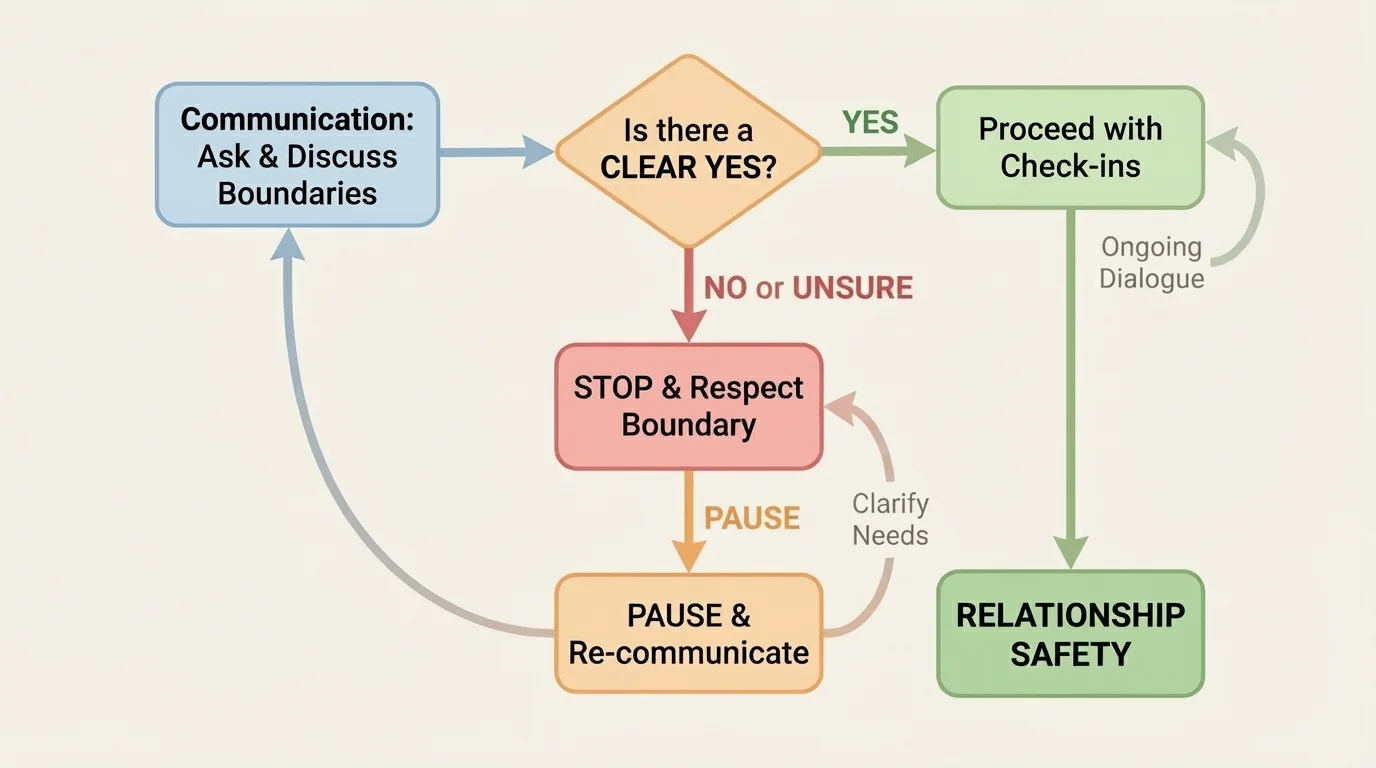
One important rule is simple: if it is not a clear yes, stop and check in. That protects both people. It prevents guessing, avoids harmful assumptions, and shows maturity. People sometimes think asking ruins the moment, but in reality, asking can make the moment safer and more comfortable because everyone knows what is happening.
Why consent supports safety
Consent protects personal choice. It lowers the chance of pressure, confusion, regret, and harm. It also creates a relationship where both people matter equally, instead of one person controlling what happens.
Here are examples of what consent sounds like in everyday life: "Are you okay with this?" "Do you want to keep going?" "Can I post this picture?" "Is this a good time to talk about something serious?" These questions are not signs of weakness. They are strong habits.
Just as important, you never owe someone a yes because they are upset, because you said yes before, because they bought you something, or because they say "if you cared, you would." That kind of pressure is not respect. It is control dressed up as emotion.
Assertive communication means speaking clearly and respectfully about what you think, need, and feel. It is different from being aggressive or rude. Aggressive communication tries to overpower someone. Passive communication hides your needs to avoid conflict. Assertive communication stays calm and honest.
In healthy relationships, people do not expect you to guess what they want all the time. They use words. They ask questions. They listen to answers. Good communication supports safety because it reduces mixed signals and makes it easier to solve problems early, before they grow into bigger issues.
A practical communication habit is the check-in. A check-in is a simple moment where you pause and ask how the other person feels. This is useful in friendships, group projects, dating relationships, and online conversations. If a chat is getting intense, if someone seems quiet, or if plans are changing, checking in can prevent misunderstandings.
Listening matters just as much as speaking. If you ask a question but ignore the answer, that is not communication. Respectful listening means you pay attention, avoid arguing someone out of their feelings, and take their words seriously. When someone tells you a limit, the safe response is not "Why are you being so dramatic?" The safe response is "Thanks for telling me. I'll respect that."
Example: Turning a vague situation into a clear one
A friend keeps video-calling late at night and gets annoyed when you do not answer.
Step 1: Name the issue clearly.
You notice the pattern: the problem is not one call. The problem is pressure and expectation.
Step 2: State your limit.
You say, "I don't answer calls late at night. Please text first, and I'll reply when I can."
Step 3: Watch the response.
If they respect it, that supports trust. If they guilt-trip you or keep pushing, that is a warning sign.
Good communication also includes tone. A message can be technically short but still respectful: "I'm not available tonight." "I need time to think." "I'm not comfortable with that." You do not need a long speech to deserve respect.
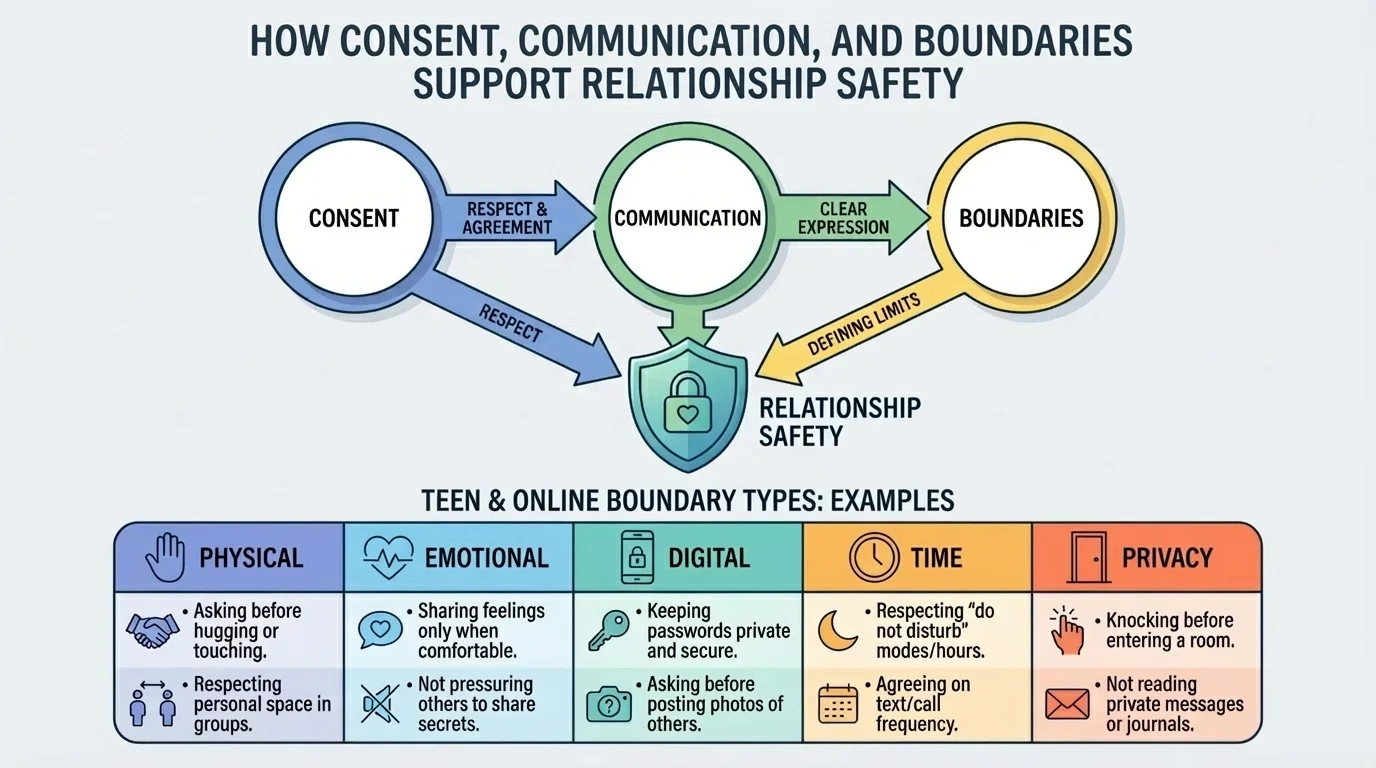
Boundaries come in several forms, as [Figure 2] illustrates, and healthy relationships make room for all of them. A boundary is not a punishment. It is information about what helps you feel safe and respected.
Some boundaries are physical, such as whether you want hugs, hand-holding, or personal space. Some are emotional, such as not wanting to share private feelings before you are ready. Some are digital, such as not sharing passwords or your live location. Some are time boundaries, such as needing to focus on family, hobbies, rest, or schoolwork without constant interruption. Some are privacy boundaries, such as not wanting your messages read or screenshots shared.
People sometimes misunderstand boundaries and think they are selfish. They are not. Boundaries help relationships last because they reduce resentment and confusion. When limits are clear, people know how to treat each other. When limits are ignored, trust starts to break down.
Healthy boundaries can sound like: "Please don't joke about that." "I'm not sharing my password." "I need a day to cool off before we talk." "Ask before posting photos of me." "I'm not comfortable being on video right now." These are normal statements, not overreactions.
Respecting someone else's boundaries matters just as much as expressing your own. If a person says no, asks for space, or says they are not ready, safety means you accept that answer. You may feel disappointed, but disappointment does not give you permission to keep pushing.
Many controlling behaviors first appear as "small" digital boundary violations, such as demanding instant replies, checking who someone follows, or insisting on passwords. These can seem minor at first, but they often reveal bigger respect problems.
Later, when you evaluate whether a relationship feels safe, the categories in [Figure 2] can help you notice which kind of boundary is being respected and which kind is being crossed.
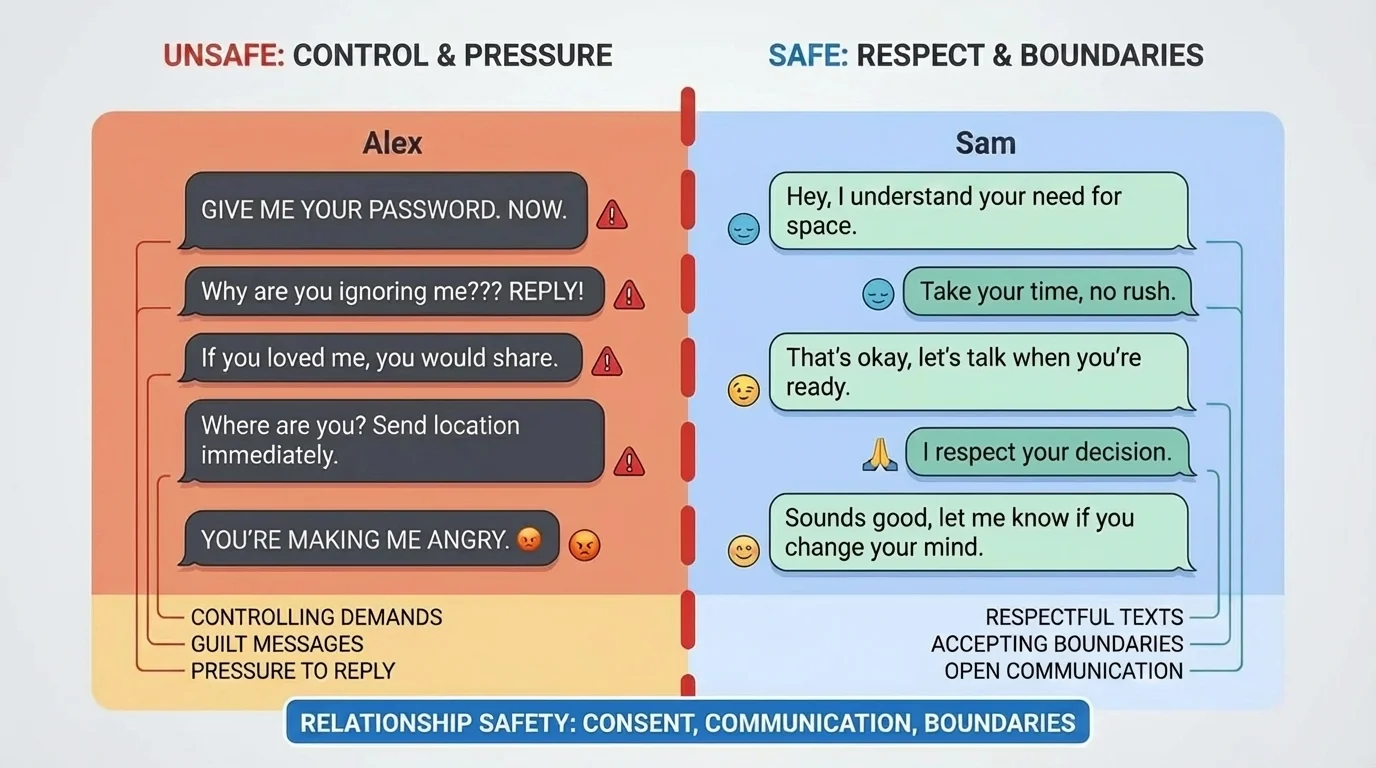
Unsafe behavior often appears in patterns, especially online, through common message habits. A single mistake can happen in any relationship. But repeated pressure, guilt, control, and disrespect are different. Those are red flags.
[Figure 3] Watch for signs like these: someone gets angry when you say no; they act like they own your time; they make you feel guilty for setting limits; they want access to your accounts; they pressure you to keep secrets from trusted adults; they insult you and then claim it was "just a joke"; they isolate you from other people; or they switch between intense affection and harsh behavior to keep you confused.
Another warning sign is manipulation. Manipulation happens when someone tries to control you indirectly instead of respecting your choices. That might sound like "If you really cared, you would do this," "Everyone else would say yes," or "You're making me act this way." These statements try to move responsibility away from the person pressuring you.
Coercion is another serious red flag. Coercion means pressuring, threatening, or wearing someone down until they give in. A yes after repeated pressure is not the same as free choice. Safety requires real freedom to refuse.
Pressure versus respect
Respect gives you room to choose. Pressure tries to remove that room. If a person keeps asking after you said no, punishes you for your answer, or makes you afraid of what will happen if you disagree, the situation is moving away from safety.
Pay attention to how your body and mind respond around someone. Do you feel constantly tense, worried about saying the wrong thing, or relieved only when they are not messaging you? Those feelings do not automatically prove danger, but they are important signals to take seriously.
The message examples in [Figure 3] show a useful pattern: respectful communication accepts limits, while unsafe communication treats limits like a challenge to defeat.
Sometimes the hardest part is not knowing what words to use in the moment. You do not need perfect wording. You need clear wording. Short statements are often best.
Try phrases like these in different situations:
If you are the one asking for something, respectful wording sounds like this: "Is this okay?" "Do you want to talk about it?" "You can say no." "Thanks for being honest." "We can stop here." These phrases build trust because they remove pressure.
Example: Responding to pressure in a text conversation
Someone keeps saying, "Why are you being like this? Just send it. You sent one before."
Step 1: Refuse clearly.
You reply, "No. I'm not sending that."
Step 2: Avoid long debates.
You do not need to prove your reason over and over. Repeating your answer is enough.
Step 3: Protect yourself.
If the pressure continues, stop replying, block the account if needed, save the messages, and tell a trusted adult.
Notice that clear communication does not always solve everything. If someone wants control more than connection, they may react badly to healthy limits. That does not mean your boundary was wrong. It often reveals why the boundary was needed.
If someone ignores your boundary once, you can restate it. If they ignore it repeatedly, take the pattern seriously. Repeated disrespect is information. It tells you the person may not be safe to trust in that area.
Step 1: Say the boundary again in a simple way. "I already said no." "Do not contact me late at night." "Stop sharing my private information."
Step 2: Change the situation if needed. Leave the chat, end the call, turn off location sharing, block the account, or stay around supportive people in public.
Step 3: Tell a trusted adult if the behavior is threatening, sexual, persistent, or makes you feel unsafe. This could be a parent, guardian, counselor, coach, older relative, or another responsible adult who takes you seriously.
Step 4: Save evidence in digital situations. Screenshots, usernames, dates, and messages can help if you need support. You do not have to handle serious pressure alone.
If a person reacts badly to your boundary, that reaction does not erase your right to have the boundary. Someone else's anger is not proof that your limit was unfair.
If there is ever a situation involving threats, stalking, blackmail, unwanted sexual behavior, or fear for your immediate safety, get help right away from a trusted adult or emergency services. Your safety matters more than protecting someone's image or avoiding awkwardness.
Safer relationships are built from habits. Ask instead of assuming. Accept answers the first time. Speak clearly. Notice patterns, not just excuses. Keep your private information private unless you truly trust the person and feel ready. Stay connected to supportive people instead of hiding relationship problems out of embarrassment.
You can also build safety by paying attention to how a person handles small limits. Do they respect your time? Do they stop when asked? Do they apologize without making excuses? Do they care about your comfort, not just what they want? Small moments often reveal the bigger pattern.
Healthy relationships are not perfect, but they are respectful. You do not have to earn basic respect by being extra easygoing, available all the time, or willing to ignore your own discomfort. The safest relationships make room for both people's voices.
"Respect is not about getting your way. It is about honoring another person's right to choose."
Try This: Before your next important text, call, or hangout, decide one boundary you want to keep clear. It might be about time, privacy, physical space, or how you want to be spoken to. Practice saying it in one calm sentence. The more you practice, the more natural it becomes.
Try This: When someone tells you a limit, respond with one respectful sentence: "Thanks for telling me," "Got it," or "I respect that." This helps you practice being a safe person for others too.
