Sometimes the biggest warning sign in a relationship is not one dramatic moment. It is a pattern: the person keeps pushing, keeps checking, keeps making you feel guilty, or keeps acting like your boundaries do not matter. A relationship can look exciting online, sound caring in messages, or seem intense in a way that people mistake for closeness. But if it leaves you stressed, afraid, trapped, or constantly managing someone else's emotions, that matters.
Healthy relationships are not perfect. People disagree, misunderstand each other, and make mistakes. What makes a relationship healthy is that both people are willing to listen, take responsibility, respect limits, and repair harm. You deserve relationships where you feel safe being honest, saying no, asking for space, and being treated like a full person, not a project to control.
At your age, relationships can include close friendships, dating, online friendships, gaming communities, youth groups, sports teams, family relationships, and group chats. The skills you use now can protect you later in jobs, roommate situations, and adult relationships. Learning to notice unhealthy patterns early can save you from confusion, stress, and real danger.
Many unhealthy relationships do not start with obvious cruelty. They often begin with extra attention, constant messaging, or someone acting like they care "so much" that they need access to your time, passwords, or location.
When unhealthy behavior is ignored, it often grows. Someone who pressures you to reply immediately today may pressure you to share private photos tomorrow. Someone who jokes about crossing your limits today may later act angry when you say no. Catching patterns early gives you more choices and more safety.
Relationships exist on a spectrum, as [Figure 1] shows. A healthy relationship supports trust, honesty, and freedom. An unhealthy relationship may include frequent disrespect, guilt, or control. An abusive relationship goes further and uses fear, threats, intimidation, or repeated violations to gain power over someone.
A pattern matters more than one isolated awkward moment. For example, if a friend forgets to reply once, that is normal. If they repeatedly ignore your messages when you disagree with them, then flood you with texts when they want something, that pattern tells you more. If a dating partner asks once whether you are free to video call, that is normal. If they demand to know who you are with, get angry when you do not answer right away, and accuse you of not caring, that is a warning sign.
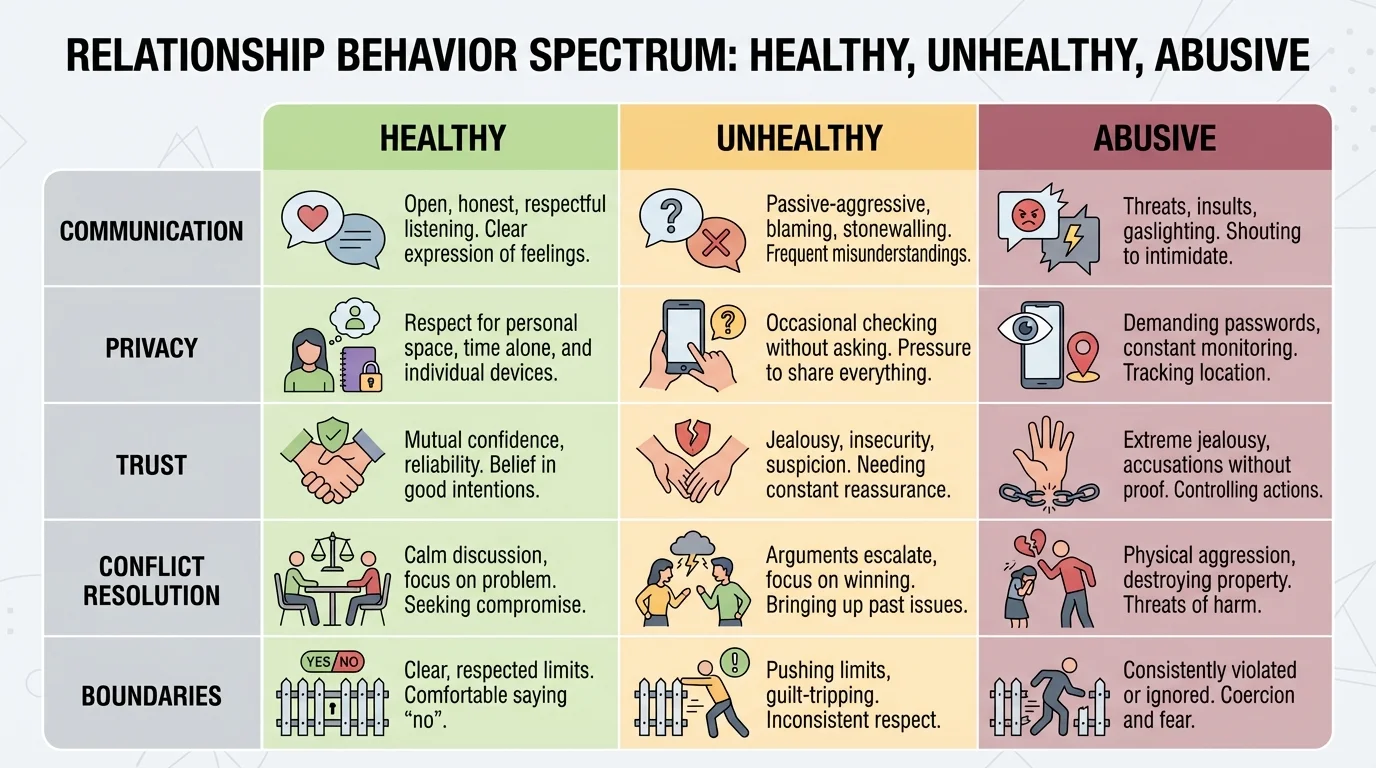
Healthy patterns often include listening, apologizing without excuses, giving space, respecting privacy, and accepting no without punishment. Unhealthy patterns often include jealousy, guilt trips, constant criticism, mixed signals, or making you feel responsible for the other person's mood. Abusive patterns can include threats, humiliation, controlling your contacts, monitoring your accounts, pressuring you sexually, or making you afraid of what will happen if you disagree.
| Area | Healthy | Unhealthy | Abusive |
|---|---|---|---|
| Communication | Honest, respectful | Frequent blame or sarcasm | Threats, intimidation, insults |
| Privacy | Respects passwords and personal space | Pushes for access | Demands access or secretly monitors |
| Conflict | Works to solve problems | Uses guilt or silent treatment | Uses fear, rage, or retaliation |
| Independence | Supports your other relationships | Gets jealous often | Tries to isolate you |
| Boundaries | Accepts no | Argues with your limits | Ignores or punishes your limits |
Table 1. Comparison of healthy, unhealthy, and abusive relationship behaviors.
This chart is not for labeling every conflict as abuse. It is for helping you notice direction. If behavior keeps moving toward more control, more fear, and less respect, take that seriously. Looking back at [Figure 1], the biggest shift happens when one person stops treating the other as an equal and starts treating them as someone to manage.
Boundary violation means crossing a limit someone has clearly set or should reasonably expect to have respected. Consent means a clear, freely given yes. Manipulation means trying to control someone through guilt, fear, pressure, deception, or emotional tricks instead of honest communication.
Not every unhealthy relationship is abusive, but every abusive relationship is unhealthy. You do not have to wait for the worst possible moment to decide something is not okay for you.
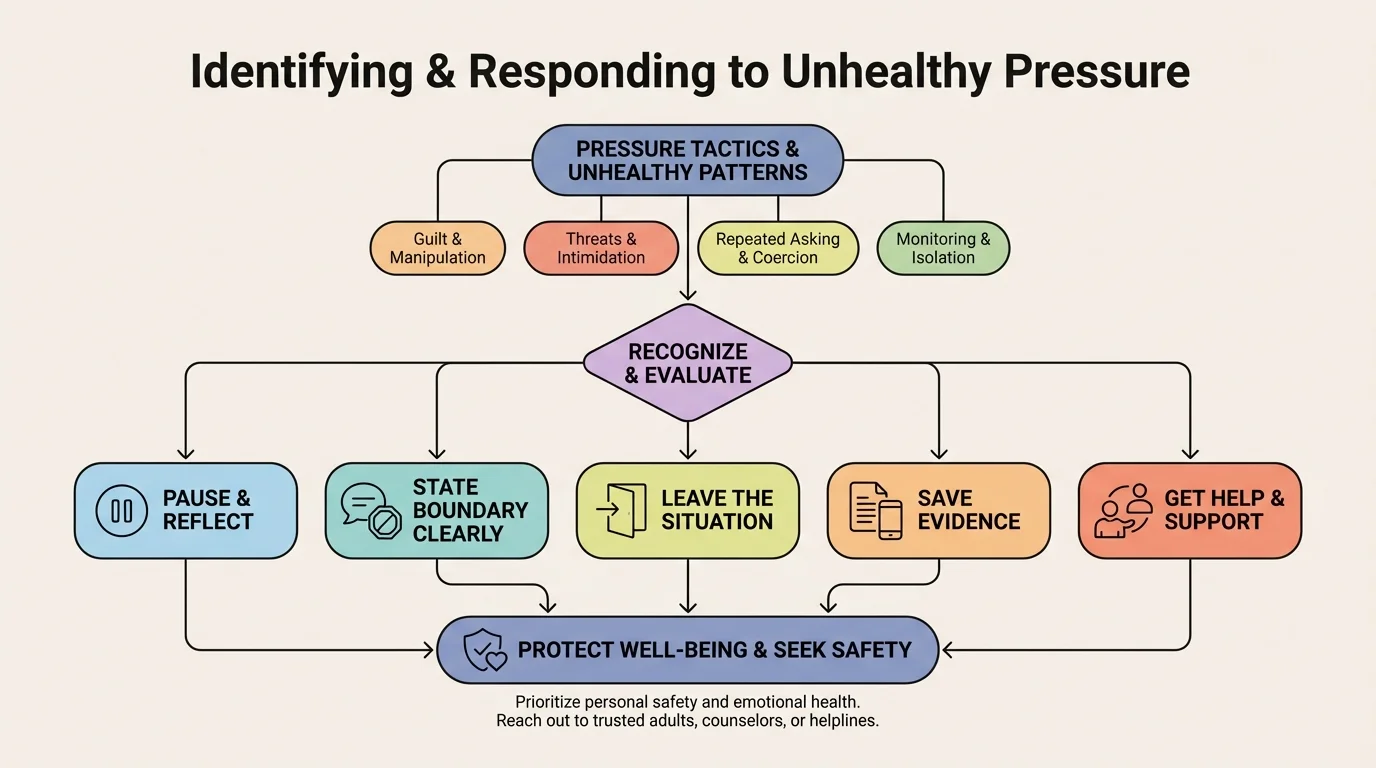
Pressure is any attempt to make you do something by wearing down your ability to choose freely. It becomes easier to spot, as [Figure 2] illustrates, when you pay attention to what happens after you say no, not just what the person asked for.
If someone respects you, a no leads to acceptance, maybe disappointment, but not punishment. If someone pressures you, a no often leads to repeated asking, guilt, anger, pouting, threats, or claims that you are "mean," "dramatic," or "too sensitive." That reaction tells you a lot.
Common pressure tactics include guilt trips such as "If you cared about me, you would," isolation such as "Your friends are bad for you, just talk to me," and monitoring such as checking your location, demanding screenshots, or asking who liked your post. Another tactic is love-bombing, which means overwhelming you with attention, praise, gifts, or intense promises very early so you feel pulled in fast and guilty about slowing down.
Digital pressure can look sneaky. Someone may spam your phone, ask for passwords "to prove trust," demand immediate replies, pressure you to send photos, keep starting new accounts after being blocked, or share private messages without your permission. A person does not need to be in the same room to cross a line.
Manipulation often creates confusion. You might hear, "I was only joking," after they insult you, or "You made me do that," after they lash out. A specific form of manipulation is gaslighting, which means trying to make you doubt your memory, feelings, or reality. For example, if someone repeatedly denies messages they sent, tells you events "never happened," or says you are crazy for noticing their behavior, that can make you question yourself.
Real-life pattern check
A person you are talking to online asks for a private photo. You say no.
Step 1: Notice the first response
If they say, "Okay, no problem," that shows respect. If they reply, "Come on, don't be boring," pressure has started.
Step 2: Watch for escalation
If they add, "I sent you one, so now you owe me," or "Everyone does it," they are trying to use guilt and social pressure.
Step 3: Evaluate safety
If they threaten to leave, spread rumors, leak private information, or message from new accounts, the situation is becoming more serious.
Step 4: Respond
Stop arguing, save evidence, block if needed, and tell a trusted adult if there are threats, blackmail, or image-based pressure.
Notice how the danger is not only the request itself. It is the pattern after your answer. That is why [Figure 2] focuses on what follows a boundary: respect or escalation.
A boundary is a limit that protects your comfort, safety, privacy, and dignity. Boundaries are not punishments. They are guidelines for how you want to be treated. They can change depending on the person, the situation, and your level of trust.
There are different kinds of boundaries, and [Figure 3] organizes them into four common categories. Physical boundaries involve touch, personal space, and your body. Emotional boundaries involve what personal feelings you want to share and how you expect people to speak to you. Digital boundaries involve phones, passwords, photos, screenshots, location sharing, and online contact. Time boundaries involve your schedule, sleep, schoolwork, hobbies, and your right not to be available all the time.
Consent applies whenever a choice affects your body, privacy, images, time, or personal information. Real consent must be clear, informed, and freely given. It is not consent if someone is scared, pressured, exhausted, tricked, or unable to decide clearly. Silence is not consent. A past yes does not mean future yes. A yes to one thing is not a yes to everything.
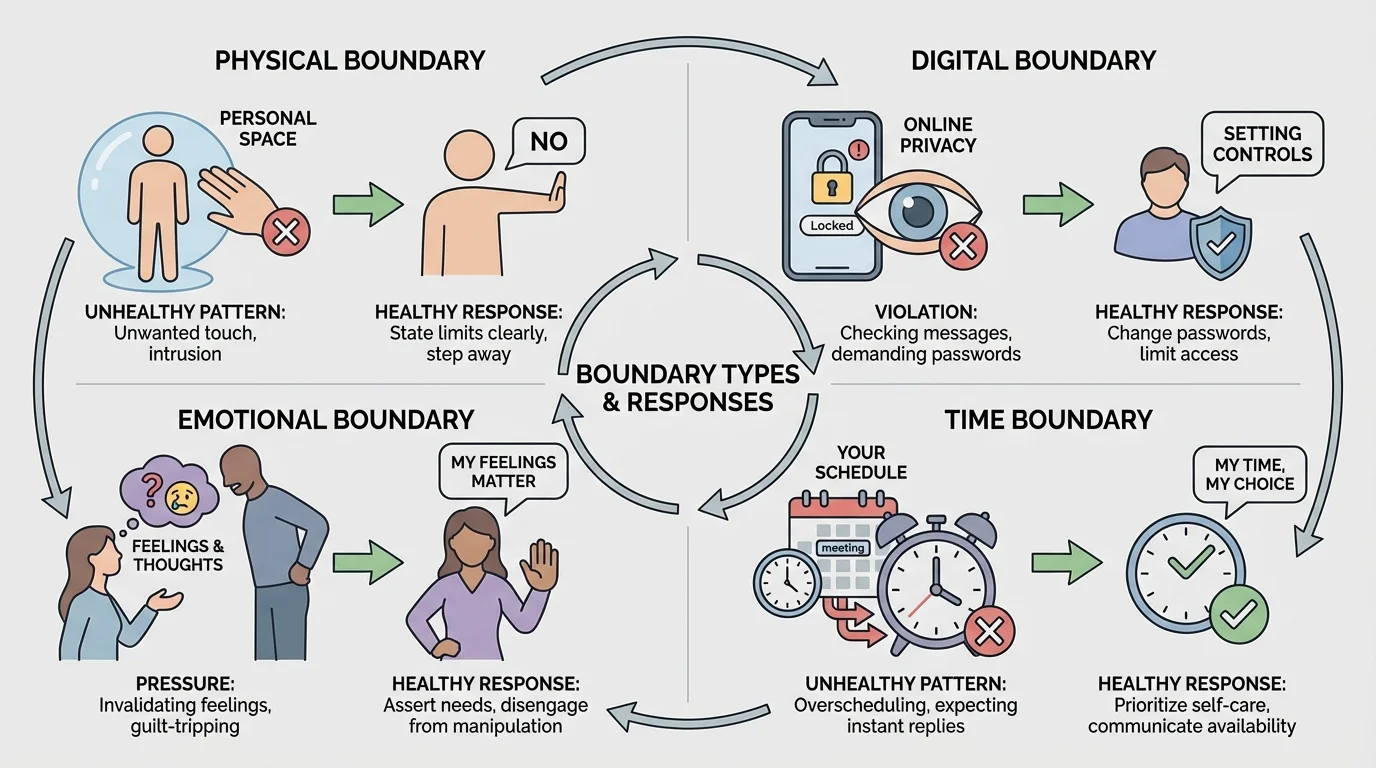
Boundary violations can be obvious or subtle. Obvious violations include unwanted touching, sharing someone's private photo, reading their messages, or threatening them for saying no. Subtle violations include teasing you after you ask someone to stop, posting about you when you asked for privacy, repeatedly interrupting your alone time, or pushing you to explain personal feelings you do not want to discuss.
People sometimes think boundaries need a long speech to count. They do not. "No." "Stop." "I'm not sharing that." "Don't post that." "I need space." "I'm logging off now." These are enough. Looking back at [Figure 3], every category of boundary can be stated simply and still deserves respect.
Boundaries protect relationships, not just people. Clear limits make relationships safer and more honest. When both people know what is okay and what is not, there is less guessing, less resentment, and less pressure. Respecting boundaries is one of the clearest signs that someone cares about your wellbeing, not just about getting what they want.
You also have a responsibility to respect other people's boundaries. If someone says they do not want to talk, do not keep messaging. If they do not want to share passwords or photos, do not push. Respect is a two-way skill.
When someone crosses a line, you do not need a perfect speech. Your goal is not to win a debate. Your goal is to protect yourself and make your boundary clear.
Step 1: Name the limit clearly. Try short statements like: "No." "I'm not okay with that." "Don't ask again." "Do not share that." "I'm leaving this chat." "I said no." You do not owe a long explanation.
Step 2: Watch their response. Respect looks like stopping, listening, and adjusting. Disrespect looks like arguing, mocking, repeating the request, or blaming you for having the boundary.
Step 3: Reduce access if needed. Mute, block, log off, leave the call, stop replying, or change privacy settings. If someone is using multiple accounts to contact you, save evidence first if it is safe to do so, then block and report.
Step 4: Get support early. You do not have to wait until you feel completely overwhelmed. If a situation feels creepy, confusing, or intense, tell a trusted adult, caregiver, coach, older sibling, mentor, or counselor.
Simple response scripts
Pressure to share a password
"Trust does not mean giving access to my accounts. I'm not sharing my password."
Repeated pressure after a no
"I already answered. Stop asking."
Friend makes fun of your boundary
"You do not have to agree, but you do have to respect it."
Need to leave quickly
"I'm ending this conversation now."
If you feel unsafe, skip the speech and focus on safety. Close the app. Leave the space. Call or text a trusted adult. If someone threatens to hurt you, release private images, stalk you, or show up where you are, that is not a normal conflict. It needs adult help right away.
A useful idea is: Do not explain more when the other person is respecting you less. Long explanations often give a manipulative person more material to argue with. Short, clear, repeatable statements work better.
"No is a complete sentence."
Sometimes people worry that setting a boundary is rude. Usually, the truly rude behavior is the one that made the boundary necessary. Being respectful does not mean being endlessly available.
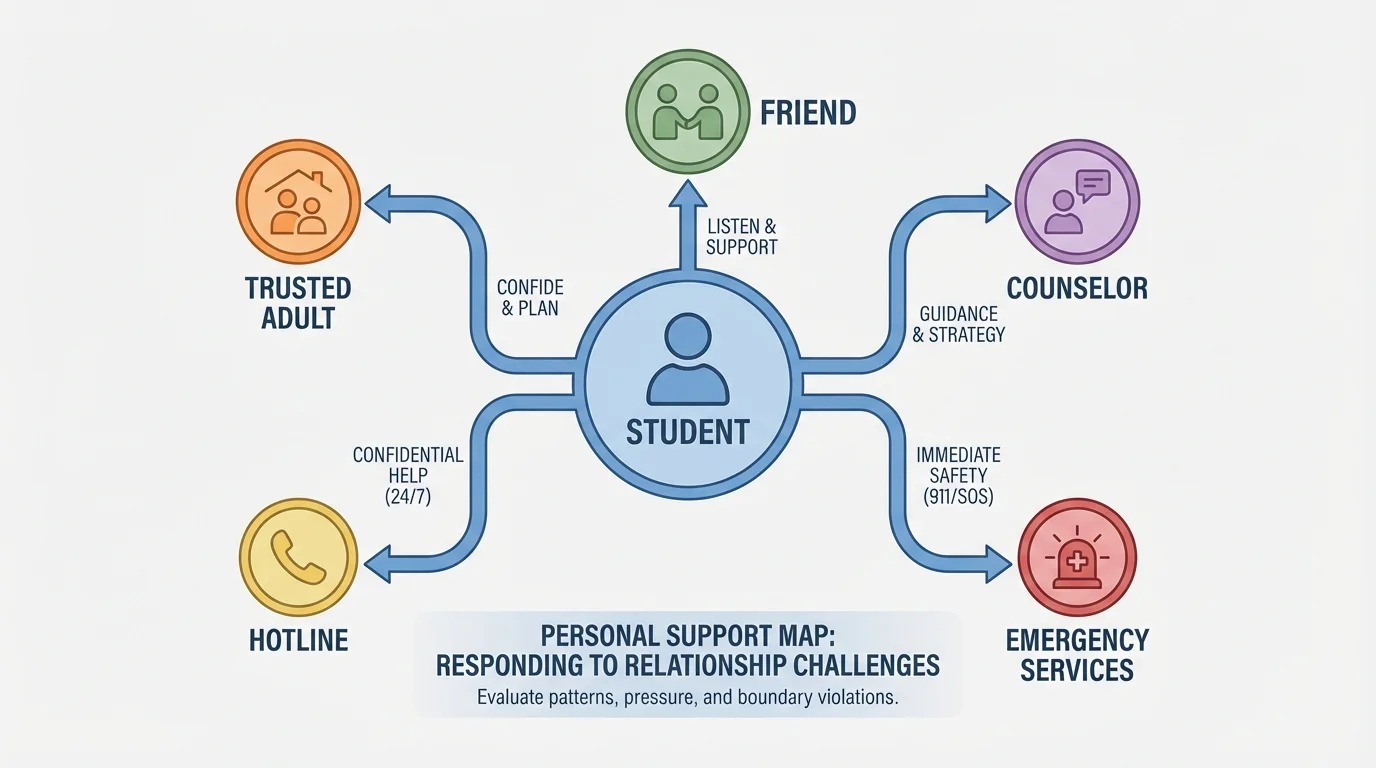
Serious boundary violations are easier to handle when you do not handle them alone. A support plan, as [Figure 4] shows, gives you people and steps to use before a situation becomes a crisis.
Choose at least three support contacts: one adult in your household or family, one adult outside your home such as a counselor, coach, youth leader, or family friend, and one friend who is calm and trustworthy. Save their numbers where you can reach them quickly. Decide what you would say: "I need help with someone who is not respecting my boundaries." You do not need a dramatic script.
Document concerning behavior when it is safe. Save screenshots, usernames, dates, times, and messages. If someone shares or threatens to share private images, creates fake accounts, stalks you online, or threatens violence, evidence can help adults and authorities respond.
Use platform tools. Report harassment, impersonation, threats, or image-based abuse. Tighten privacy settings. Turn off location sharing if someone is tracking you. Change passwords if an account may be compromised. Ask an adult for help with these steps if needed.
There are times when the right response is urgent help, not private problem-solving. If someone is threatening immediate harm, trying to force contact, showing up unexpectedly, blackmailing you, or refusing to stop after being told to stop, involve a trusted adult immediately. If there is immediate danger, contact emergency services. Looking again at [Figure 4], notice that support is strongest when it includes more than one person and more than one option.
Feeling uncomfortable is enough reason to pause and check in with yourself. You do not need courtroom-level proof to take your own safety seriously.
If the person crossing your boundaries is someone close to you, getting help can feel messy. You may worry about drama, losing the friendship, or being accused of overreacting. But protecting yourself is not overreacting. Healthy people may feel disappointed by your boundary, but they do not punish you for it.
One of the best ways to protect yourself is to practice healthy relationship habits before a problem gets big. Pay attention to how people act when they are frustrated, not just when they are charming. Watch whether they respect small boundaries. Small moments often predict bigger ones.
Ask yourself questions like: Do I feel free to say no? Can I take time away without guilt? Am I allowed privacy? Do I feel calmer after talking with this person, or more confused and tense? Do they respect my friends, family, and other commitments? These questions can help you evaluate patterns instead of getting stuck on excuses.
You can also build trust in a healthy way by communicating clearly. Say what you are comfortable with. Respect the answer you get from others. Apologize when you cross a line. If someone tells you that something hurt them, take it seriously instead of getting defensive right away.
Try This
Step 1: Write three boundaries you want to protect.
Example: "I do not share passwords." "I need offline time at night." "I do not stay in conversations where I am insulted."
Step 2: Turn each one into a short sentence.
Example: "I'm not sharing that." "I'm offline now." "If you keep insulting me, I'm leaving the chat."
Step 3: Choose two support people now.
Save their contact information and think about what you would tell them if a boundary is crossed.
Respectful relationships feel steady, not constantly stressful. You should not have to prove your loyalty by giving up privacy, sleep, friendships, comfort, or safety. If someone treats your boundaries like obstacles instead of information, that is important data about the relationship.
Trust yourself when something feels off. Then do the practical next thing: state the boundary, reduce access, save evidence if needed, and tell someone safe. Those actions are not signs of weakness. They are signs that you know your worth and are protecting it.
