A lot of relationship problems do not start with a huge dramatic moment. They start with a small choice: answering a message you are uncomfortable with, ignoring a rude joke, sharing a password, getting into a car without a plan, or staying quiet because you do not want to seem "difficult." Responsible relationship decisions are really about noticing those moments early and choosing what protects your well-being, your future, and your peace of mind.
If you are in grade 9, you are already making relationship decisions whether you call them that or not. You decide who gets your time, who earns your trust, what behavior you accept, and what you will do if something feels wrong. These choices matter in friendships, dating relationships, group chats, gaming spaces, social media, sports teams, clubs, part-time jobs, faith communities, and neighborhood activities.
Healthy relationships can help you feel respected, supported, and more confident. Unhealthy relationships can drain your energy, damage your self-respect, affect your mental health, and sometimes put your safety at risk. That is why relationship skills are not just about romance. They are life skills.
Being responsible does not mean being suspicious of everyone. It means paying attention, knowing yourself, planning ahead, and getting help when you need it. A good relationship should not require you to give up your values, hide what is happening, or feel unsafe.
Responsible relationship decisions are choices that protect your emotional, physical, and digital well-being while respecting the rights and boundaries of other people.
Consent means a clear, freely given, informed, and ongoing yes. It can be changed at any time.
Boundaries are the limits you set about what you are comfortable with and how you expect to be treated.
One of the strongest tools you have is knowing what matters to you before pressure shows up. That is where your values come in.
Your personal values are the beliefs and priorities that guide your choices. They act like a filter for decisions, as shown in [Figure 1], helping you ask: "Does this relationship match who I want to be?" Values might include honesty, respect, kindness, loyalty, privacy, safety, faith, independence, responsibility, or future goals.
If you value honesty, you may decide not to stay in a relationship where someone lies often. If you value respect, you may decide that insulting jokes, public embarrassment, or pressure are not acceptable. If you value your future, you may avoid choices that could harm your reputation, concentration, sleep, or emotional health.
Values are personal, but they should also be healthy. A value like "I never want anyone upset with me" can turn into people-pleasing. A better value is "I want to be kind without abandoning my own safety and self-respect."
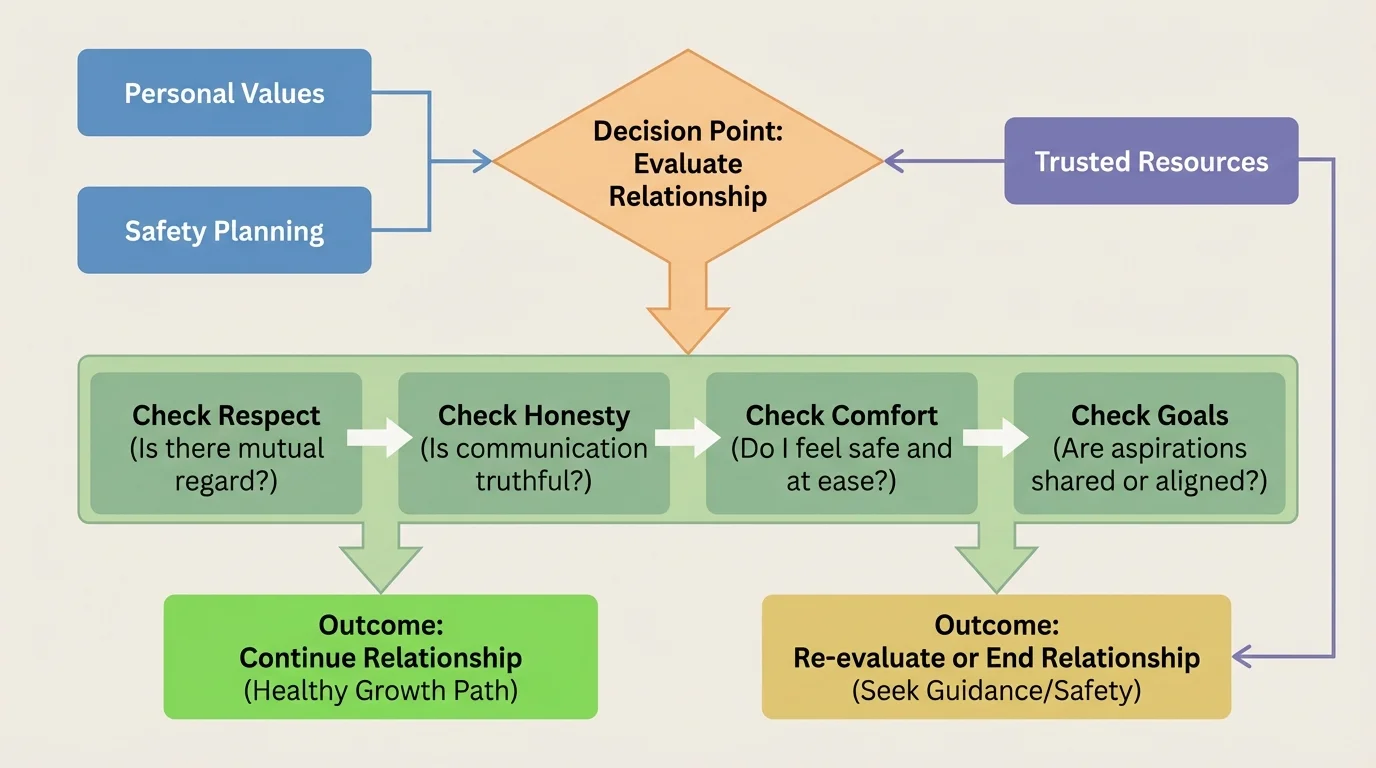
Sometimes students think values only matter in big life decisions. Actually, values show up in everyday moments. Do you answer messages immediately, even when you are exhausted? Do you share private information because someone says, "If you trust me, you would"? Do you keep talking to someone who ignores your "no"? Values help you answer these questions with more confidence.
Try This: Write down your top five relationship values. Then finish these sentence starters: "I feel respected when...," "I feel uncomfortable when...," and "A healthy relationship for me includes...." This makes your values easier to use in real time.
Your values become visible through your actions and your boundaries. A boundary is not a punishment. It is information. It tells another person what you are okay with, what you are not okay with, and what you will do to take care of yourself.
Boundaries can be emotional, physical, social, and digital. Emotional boundaries include not accepting insults, guilt trips, or nonstop demands for attention. Physical boundaries include your comfort with touch, personal space, and where you go. Social boundaries include how much time you spend together and whether you still keep up with friends and hobbies. Digital boundaries include passwords, photo sharing, location sharing, and how often someone expects a reply.
Consent matters in all kinds of interactions. It applies to physical affection, sharing personal information, posting someone's image, and involving someone in private conversations. Consent must be clear and freely chosen. Silence is not consent. Pressure is not consent. "I guess so" after repeated asking is not consent.
How respect shows up
Respect means the other person listens when you speak, accepts your boundaries without arguing you into changing them, and does not punish you for saying no. Respect also goes both ways: you are responsible for honoring other people's limits too.
Here are examples of clear boundary statements you can actually use:
"I'm not comfortable sharing that."
"Please don't joke about me like that."
"I'm ending this call now. We can talk later if you speak respectfully."
"No, I don't want to do that."
"I don't share passwords or private photos."
Notice that these are short. You do not need a long speech to set a boundary. In many situations, being direct is safer and clearer than overexplaining.
As we saw in [Figure 1], values like honesty and respect help you decide what boundaries make sense for you. If someone consistently challenges those boundaries, that tells you something important about the relationship.
Safety planning means thinking ahead so you know what to do before you feel stressed, pressured, or unsafe. It is not about expecting the worst. It is about being prepared, as [Figure 2] shows, so you have options instead of having to make rushed decisions.
A safety plan can be useful for online conversations, meeting someone in person, going to an event, ending a relationship, or dealing with someone who does not respect boundaries. Planning ahead lowers risk.
Basic parts of a strong safety plan include knowing where you are going, how you are getting there and back, who knows where you are, how to leave early if needed, and who you can contact quickly. Your phone should be charged. Your transportation plan should not depend completely on the person you are meeting. If possible, meet in a public place and let a trusted adult know the plan.
For online safety, a plan might include keeping accounts private, not sharing personal details too quickly, never sending private images, and deciding in advance what you will do if someone becomes pushy. For example, your plan might be: stop replying, save evidence, block the account, and tell a trusted adult.
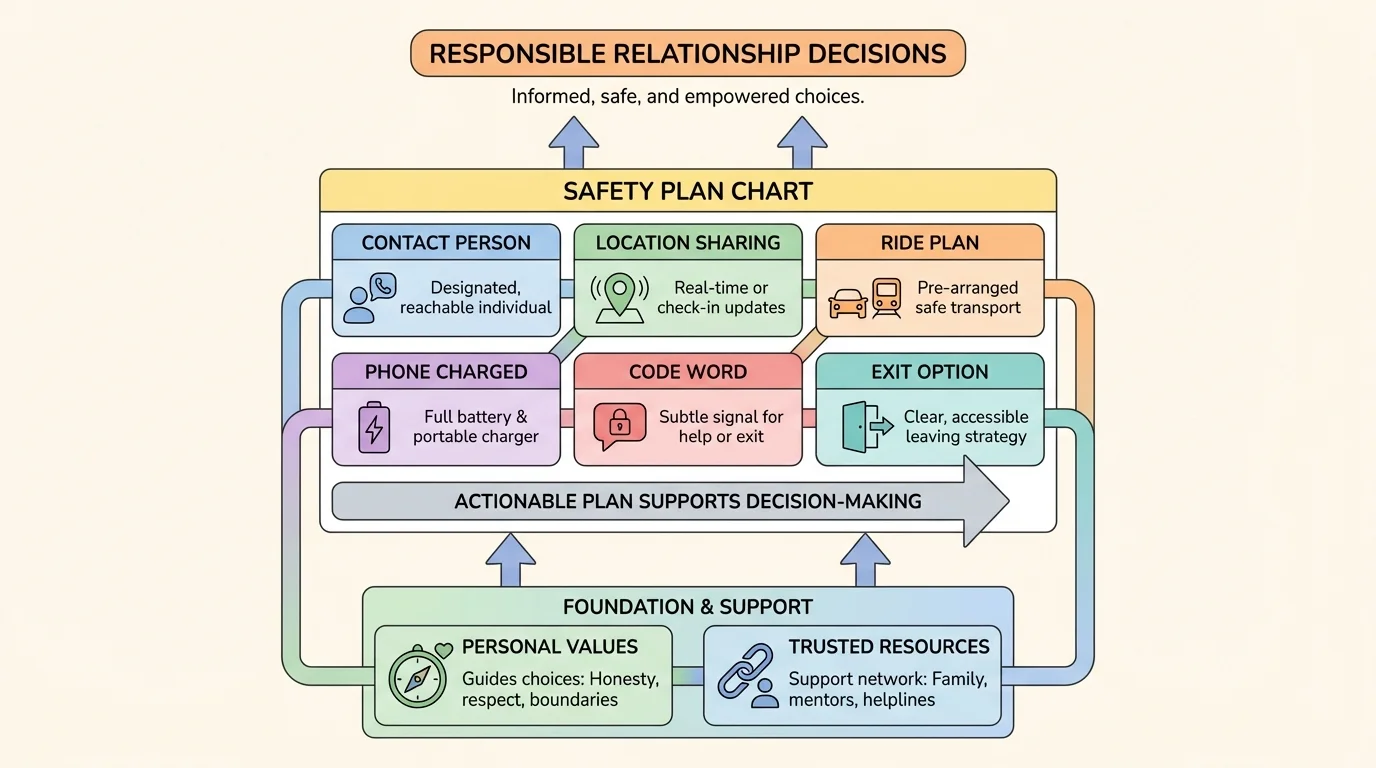
A useful tool is a code word. This is a word or phrase you agree on with a trusted adult or trusted person that means "Call me now," "Come get me," or "I need help, ask no questions right now." Code words work because they are fast and private.
Safety planning also includes emotional safety. If you know someone tends to pressure you, start arguments by text late at night, or make you feel guilty for having boundaries, you can plan when and how to communicate. For example, you might choose to respond only during the daytime, keep conversations in writing, or have another trusted person nearby when ending contact.
Example: making a quick safety plan before meeting someone
Step 1: Choose the setting.
Pick a public place where other people are around, such as a café, library event, or community activity.
Step 2: Control transportation.
Arrange your own ride there and back instead of depending fully on the other person.
Step 3: Tell someone the details.
Send the location, time, and expected end time to a trusted adult or trusted person.
Step 4: Set an exit option.
Decide ahead of time what you will say if you want to leave: "I have to go now," or "My ride is here."
Step 5: Keep communication available.
Bring a charged phone and know who you will contact if the situation changes.
Planning ahead makes it easier to leave safely and sooner if something feels off.
A smart plan does not make you rude. It makes you prepared.
Some warning signs are obvious, but others are subtle. A person does not have to seem dangerous at first to be unsafe later. Pay attention to patterns, not just apologies.
Red flags can include controlling behavior, jealousy treated as proof of love, constant checking of your location, guilt trips, intense attention used to gain control, threats to break up if you do not comply, insulting you and calling it a joke, pushing for secrecy, demanding passwords, pressuring you to send photos, isolating you from friends, or refusing to accept "no."
Manipulation happens when someone tries to control your choices through pressure, fear, guilt, confusion, or fake urgency. A manipulative message might sound like, "If you really cared, you would," or "You're overreacting," or "Don't tell anyone, they won't understand."
These behaviors matter because they can slowly change what feels normal. If disrespect keeps happening, you may start making smaller and smaller allowances for yourself. That is one reason trusted outside perspectives are so important.
People who pressure others often test boundaries in small ways first. That can make unhealthy behavior harder to spot, because each step seems minor on its own.
If a person reacts badly when you set a reasonable boundary, that reaction gives you useful information. Healthy people may feel disappointed sometimes, but they do not punish, threaten, or shame you for having limits.
You do not have to figure out every relationship problem alone. A strong support network, as [Figure 3] illustrates, gives you perspective, safety, and practical help. A trusted resource is a reliable person, service, or organization you can turn to for guidance or help.
Trusted resources may include a parent or guardian, another relative, a coach, a youth group leader, a school counselor from your online school, a healthcare provider, a licensed therapist, a community mentor, a helpline, or emergency services if there is immediate danger. The right resource depends on the situation.
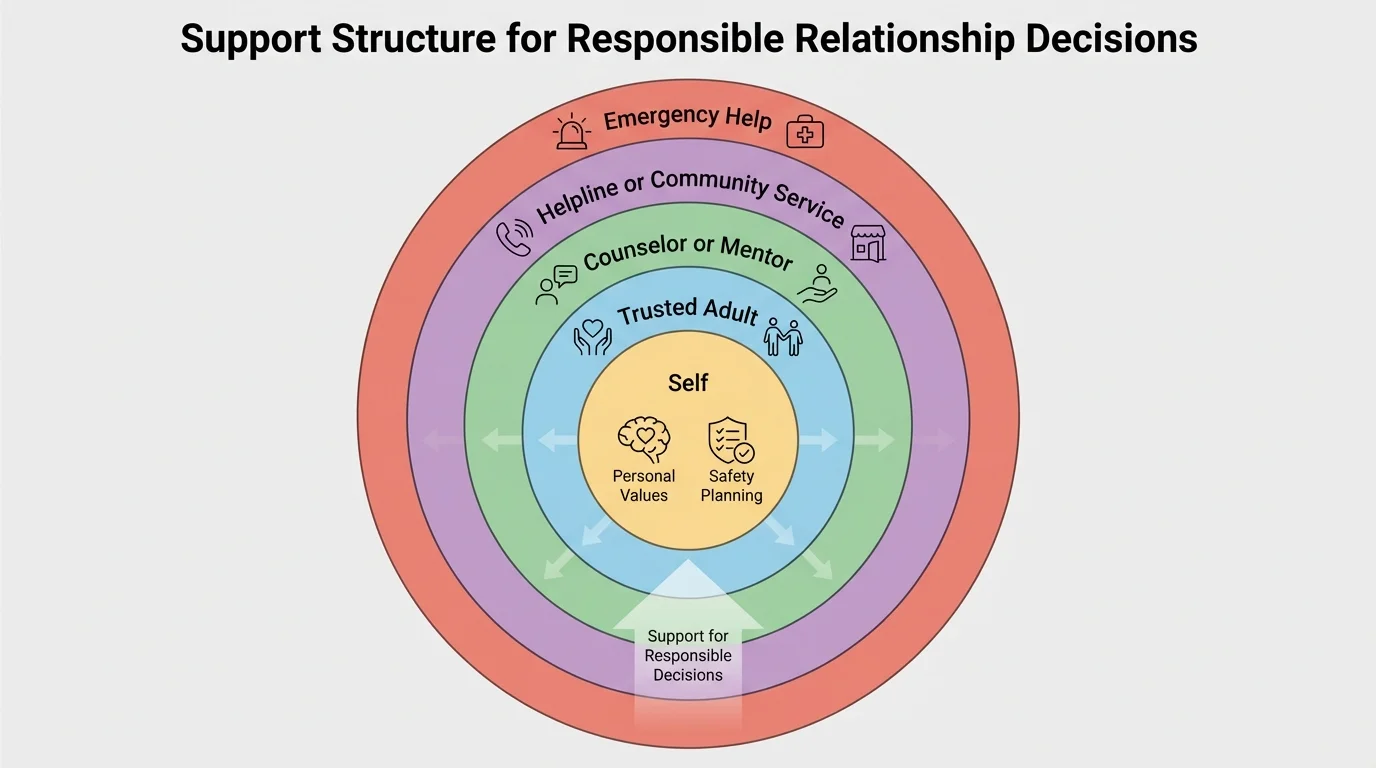
Not every adult gives equally helpful advice, so it is smart to think about why someone is trustworthy. Good trusted resources usually listen without blaming you, take safety seriously, respect privacy within legal limits, and focus on what helps you most instead of what is easiest for them.
If you need help, be clear and specific. You can say, "I need advice about a relationship," "Someone is pressuring me and I do not feel safe," or "I need help making a plan to end contact." You do not need to tell every detail right away. Start with the main concern.
Later, when you are deciding what to do next, [Figure 3] is still useful because it reminds you that support can come in levels. You might first talk to a trusted adult, then contact a counselor, and if safety becomes urgent, involve emergency help.
| Situation | Best first resource | Why |
|---|---|---|
| You feel confused about mixed signals or pressure | Trusted adult or counselor | They can help you think clearly and plan next steps |
| Someone asks for private photos or passwords | Trusted adult, counselor, or platform reporting tools | You may need both support and digital action |
| You want to end a relationship safely | Trusted adult or counselor | They can help you make a safe exit plan |
| Someone threatens you or stalks you | Trusted adult and emergency services | Immediate safety matters most |
Table 1. Common relationship situations and appropriate first sources of support.
When emotions are strong, it helps to have a repeatable process. You can use this five-part decision guide.
Step 1: Pause. If you feel rushed, pressured, flattered, scared, or guilty, do not decide immediately.
Step 2: Check your values. Ask, "Does this fit my values of respect, honesty, safety, and self-respect?"
Step 3: Check for consent and boundaries. Ask, "Am I freely choosing this? Have my boundaries or someone else's boundaries been respected?"
Step 4: Check safety. Ask, "Could this affect my physical safety, emotions, privacy, or future?"
Step 5: Use a trusted resource. If you feel unsure, ask someone reliable before moving forward.
"A healthy relationship should feel safe enough for honesty and strong enough for boundaries."
This process works for more than dating. It also helps with friendships, online interactions, parties, rides, invitations, breakups, and group drama.
Scenario one: someone you like asks for your password "to prove trust." A responsible decision is to say no. Trust is built through honesty and consistency, not account access. Sharing passwords increases the risk of privacy violations, impersonation, and control.
Scenario two: a person keeps asking for a private photo after you already said no. That is not flirting anymore. That is pressure. A responsible decision may be to stop engaging, save the messages, block the account, and tell a trusted adult.
Scenario three: you are meeting someone from a community activity for the first time outside the activity. A responsible decision is to use the kind of safety checklist shown in [Figure 2]: public location, your own transportation plan, charged phone, and someone who knows where you are.
Scenario four: a person says mean things during gaming or texting, then says you are too sensitive. That is a common way people avoid responsibility. A healthy response is to name the behavior, set a boundary, and step away if it continues.
Example: deciding whether to keep talking to someone online
Step 1: Notice the pattern.
The person is friendly one day, demanding the next, and asks personal questions very fast.
Step 2: Check values and comfort.
You value respect and privacy, and you already feel pressured.
Step 3: Set a boundary.
You reply, "I don't share personal details that quickly."
Step 4: Watch the response.
If they respect the boundary, that is useful information. If they mock you, push harder, or become angry, that is also useful information.
Step 5: Use support if needed.
If the behavior becomes intense or threatening, save evidence, block the account, and contact a trusted adult or reporting system.
Your safety and comfort matter more than seeming nice to someone who ignores your limits.
Scenario five: you want to end a relationship, but you worry the other person will react badly. If there has been pressure, control, anger, or fear, do not handle it in the most private way possible just to be "kind." Kindness does not require unsafe choices. Ask for help making a safe plan.
Digital choices are relationship choices too. The decision tree in [Figure 4] makes this clear: when someone asks for private images, passwords, or live location, the issue is not just technology. It is trust, pressure, consent, privacy, and safety.
Your digital boundaries should be as real as your in-person ones. Do not share passwords. Be careful with location sharing. Remember that screenshots can last much longer than a conversation. If someone pressures you to send something private, the safest response is usually not to send it at all.
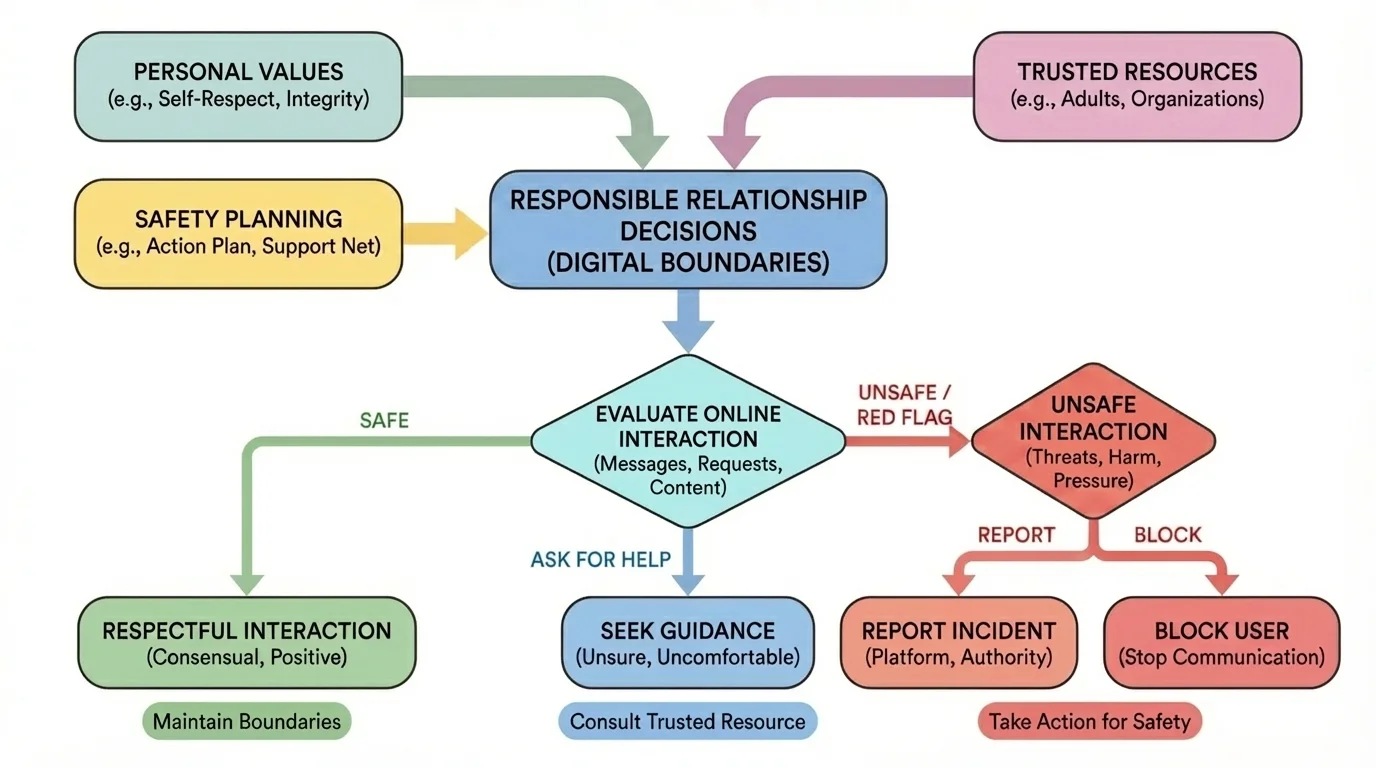
It is also wise to review privacy settings, limit who can contact you, and think before posting details that reveal where you live, where you will be, or when you are alone. If a relationship ends, you may need to update passwords, review shared access, and block or mute accounts.
Much later in a relationship, [Figure 4] still applies because pressure can appear after trust has already formed. Being familiar with your digital boundaries ahead of time helps you respond quickly instead of debating with yourself under pressure.
It can help to compare patterns clearly.
| Healthy | Unhealthy | Unsafe |
|---|---|---|
| Respects your boundaries | Tries to talk you out of boundaries | Punishes or threatens you for boundaries |
| Communicates honestly | Plays mind games | Lies to control or trap you |
| Supports your other relationships | Acts jealous or possessive | Isolates you from support |
| Accepts no | Repeatedly pressures you | Ignores no completely |
| Respects privacy | Pushes for passwords or access | Monitors, stalks, or shares private content |
Table 2. Comparison of healthy, unhealthy, and unsafe relationship behaviors.
The difference matters. An unhealthy behavior might improve if the person takes responsibility and changes. Unsafe behavior needs a stronger response, including distance, support, and sometimes emergency help.
Try This: Think about one current relationship in your life. Ask yourself: Do I feel calmer or more stressed after interacting with this person? Do I feel free to say no? Can I be honest without fear? Your answers can tell you a lot.
Responsible relationship decisions are not about being perfect. They are about paying attention, trusting what you notice, and acting in ways that protect your well-being. The strongest decisions usually come from the combination of three things: values that guide you, plans that protect you, and people or services you can trust when things get complicated.
