Being independent is not about doing everything perfectly. It is about being able to get where you need to go, show up on time, and take care of your space without someone reminding you every minute. Those skills matter whether you are heading to a sports practice, a part-time job, a volunteer event, a doctor appointment, or just trying to keep your room and shared spaces under control. When these skills are strong, life feels smoother. When they are weak, small problems pile up fast.
Think about how one mistake can create a chain reaction. If you do not check transportation ahead of time, you leave late. If you leave late, you miss an appointment or arrive stressed. If you are rushing, you might forget your charger, wallet, or water bottle. Then when you get home, dishes are still in the sink and laundry is still damp in the washer. Independent living skills help you stop that chain reaction before it starts.
Independent living skills are the everyday abilities you use to manage your life with less help from other people. They include planning, organizing, traveling safely, keeping up with responsibilities, and taking care of your home and belongings.
You do not need to wait until adulthood to start using these skills. In fact, the best time to practice is now, while the responsibilities are smaller and the stakes are lower. If you learn how to manage your day at age 14, future tasks like jobs, college, and living on your own become much easier.
Transportation plan means deciding ahead of time how you will get somewhere, how long it will take, what it will cost, and what you will do if the first plan fails. A strong transportation plan follows the same basic pattern, as [Figure 1] shows: choose the best option, check the timing, think about safety, and prepare a backup.
If you are going somewhere outside your home, start with four questions: Where am I going? What time do I need to arrive? How will I get there? What is my backup if something changes? These questions sound simple, but they prevent many common problems.
Common transportation options include walking, biking, public transit, rides from family members, carpools, and ride-share services when allowed by your family. Each option has strengths and weaknesses. Walking costs nothing, but distance and weather matter. Biking can be fast, but only if you have a safe route and proper safety gear. Public transit can be reliable, but you need to understand schedules. A ride from someone else may be convenient, but it depends on their availability and communication.
To plan a trip, first check the destination address. Next, estimate travel time. Then add a buffer. A buffer time is extra time added in case something takes longer than expected. If a bus ride usually takes 20 minutes, adding a 10-minute buffer gives you more protection against delays. Your planned travel time becomes 30 minutes. If an event begins at 4:00 p.m., aiming to arrive by 3:50 p.m. is often smarter than aiming for exactly 4:00 p.m.
Safety also matters. If you are walking or biking, use familiar, well-lit routes when possible, follow traffic rules, and let a trusted adult know where you are going. If you are using public transit, know your stop, keep your phone charged if possible, and pay attention to your surroundings instead of being fully distracted. If someone else is driving you, confirm the time clearly instead of assuming they remember.
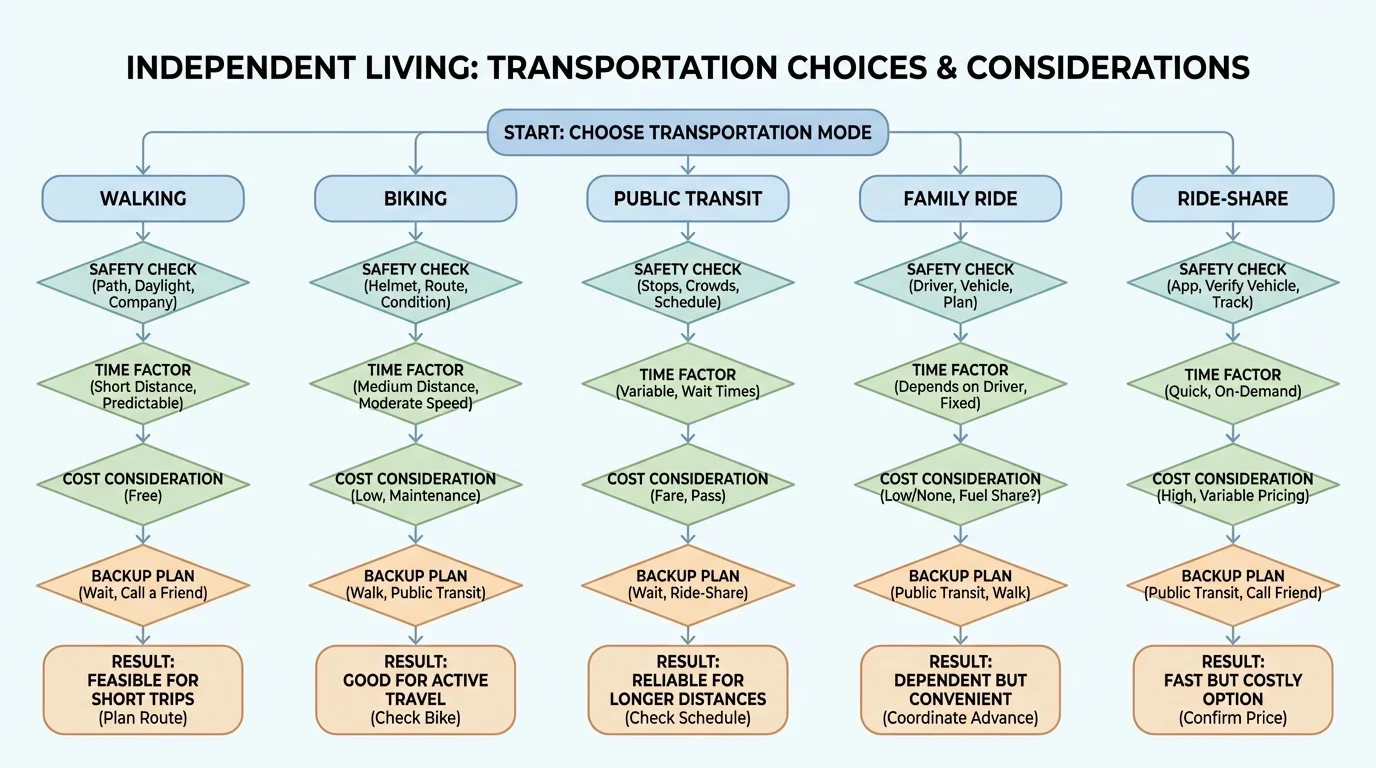
Cost can affect transportation choices too. Even small amounts add up. If one ride costs $3 and you take it 4 times, that is a total of \(3 \times 4 = 12\), so you would spend $12. If biking costs nothing but requires leaving 10 minutes earlier, you might decide the free option is worth the extra time. Independent living often means comparing convenience, money, and effort.
| Transportation Option | Best For | Possible Problem | Smart Backup |
|---|---|---|---|
| Walking | Short distances | Weather or unsafe route | Leave earlier or arrange a ride |
| Biking | Medium distances | Flat tire or rain | Lock bike and call for help |
| Public transit | Regular routes | Missed bus or delay | Catch earlier bus next time |
| Family ride | Appointments or activities | Miscommunication | Confirm by text in advance |
| Carpool | Group activities | Driver changes plans | Have another contact ready |
Table 1. Common transportation choices, their uses, likely problems, and practical backup plans.
Example: Planning a community center trip
You need to arrive at a volunteer event by 5:00 p.m. The bus ride is usually 25 minutes, and the walk to the stop is 8 minutes.
Step 1: Add the travel parts.
The base travel time is \(25 + 8 = 33\) minutes.
Step 2: Add buffer time.
Add 12 extra minutes for waiting or delays: \(33 + 12 = 45\) minutes.
Step 3: Count backward from arrival time.
If you want to arrive by 5:00 p.m., leave home by 4:15 p.m.
That plan gives you a better chance of being calm and on time.
Try This: Pick one place you go regularly, such as a sports practice, library, faith community, or store. Write down your usual route, how long it really takes, and one backup option.
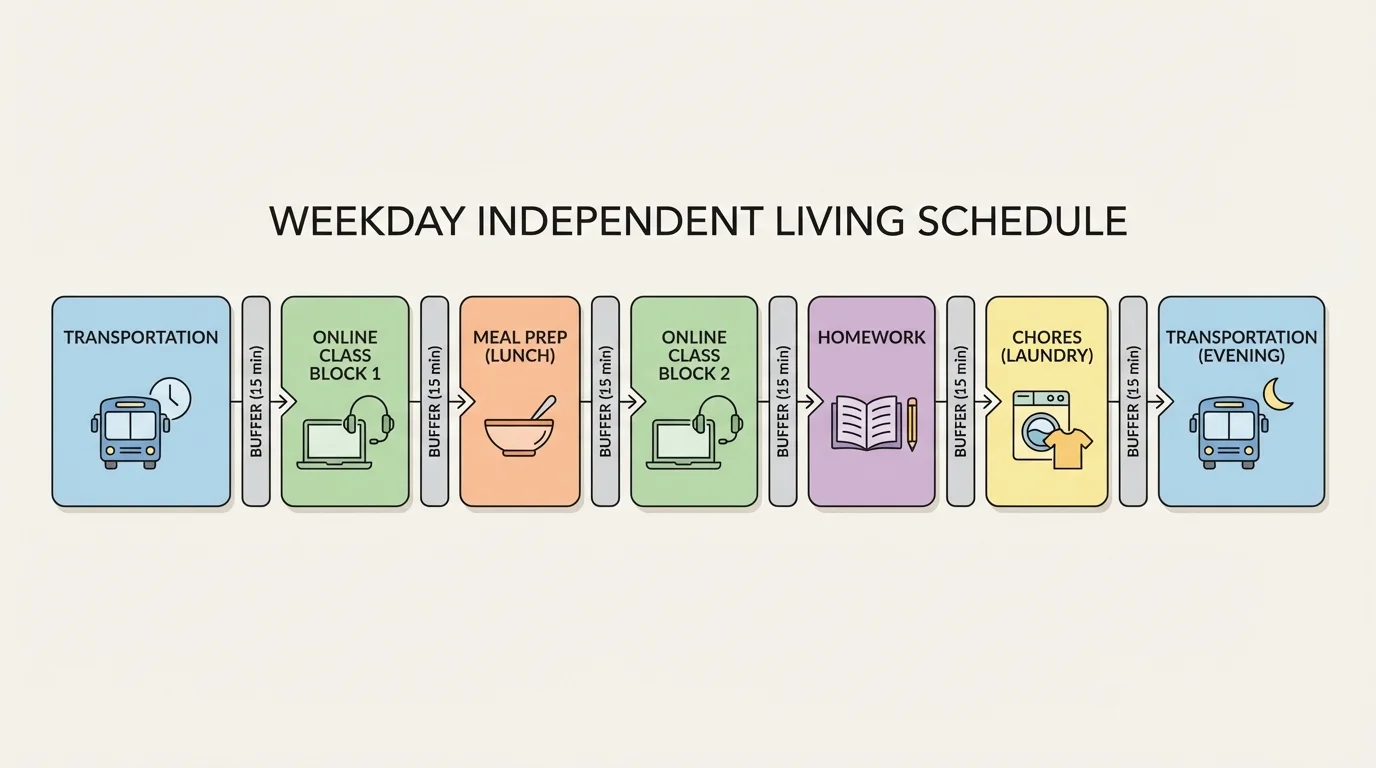
Time blocking is one of the simplest ways to take control of your day. Instead of hoping you will "fit things in," you assign blocks of time to important tasks. This makes your day easier to see, as [Figure 2] shows, and helps you notice when you are overloading yourself.
Time management is not about stuffing every minute with work. It is about deciding what matters, estimating how long things take, and leaving room for real life. Many people struggle because they plan for a perfect day instead of a realistic one.
Start with your fixed responsibilities. These are things with set times, like online classes, appointments, team practices, family commitments, or work shifts. Then add flexible tasks, such as homework, exercise, chores, showering, meal prep, and downtime. The goal is to build a day that works, not a schedule that looks impressive.
A useful rule is this: estimate the task, then add a little more time. If you think cleaning your room will take 20 minutes, it may actually take 35 once you stop to sort clothes, throw away trash, and put things back where they belong. Getting better at estimating time is part of growing independence.
Another helpful skill is prioritize. To prioritize means choosing what needs attention first. A simple way to do this is to sort tasks into three groups: must do, should do, and could do. "Must do" includes deadlines and responsibilities that affect other people. "Should do" matters but can sometimes move. "Could do" is optional.
For example, if you have an online assignment due tonight, laundry that needs folding, and a game you want to play, the assignment is probably the must do. The laundry may be a should do. The game is a could do. That does not mean fun is unimportant. It means you choose it at the right time instead of letting it take over your day.
Digital calendars, reminder apps, alarms, and paper planners can all work. The best system is the one you will actually use. Some students like color-coding. Others prefer a simple checklist. What matters is consistency. If your reminders are spread across random sticky notes, unread texts, and memory alone, things will slip through.
Why time buffers reduce stress
When every task is planned back-to-back, one delay can ruin the whole day. Buffers create breathing room. A 10- or 15-minute gap between major tasks can absorb delays, help you reset, and lower the chance of being late to the next responsibility.
Being on time also includes getting ready on time. If a video call starts at 2:00 p.m., but you still need to change clothes, refill your water, find headphones, and open the link, your real start time is earlier. Adult-style time management means accounting for preparation, not just the event itself.
When you miss deadlines often, other people may see you as unreliable. When you manage time well, people begin to trust you with more freedom. That is one of the biggest rewards of responsibility: reliability creates opportunity.
Try This: For the next two days, write down how long common tasks actually take. Compare your guess to the real time. That gap teaches you a lot.
Many home tasks feel small, but they affect daily life in a big way. A clean kitchen makes meals easier. Clean clothes save panic in the morning. Taking out trash keeps a space usable. The trick is not waiting until everything becomes a mess. Household responsibilities work better when they become routines instead of emergencies.
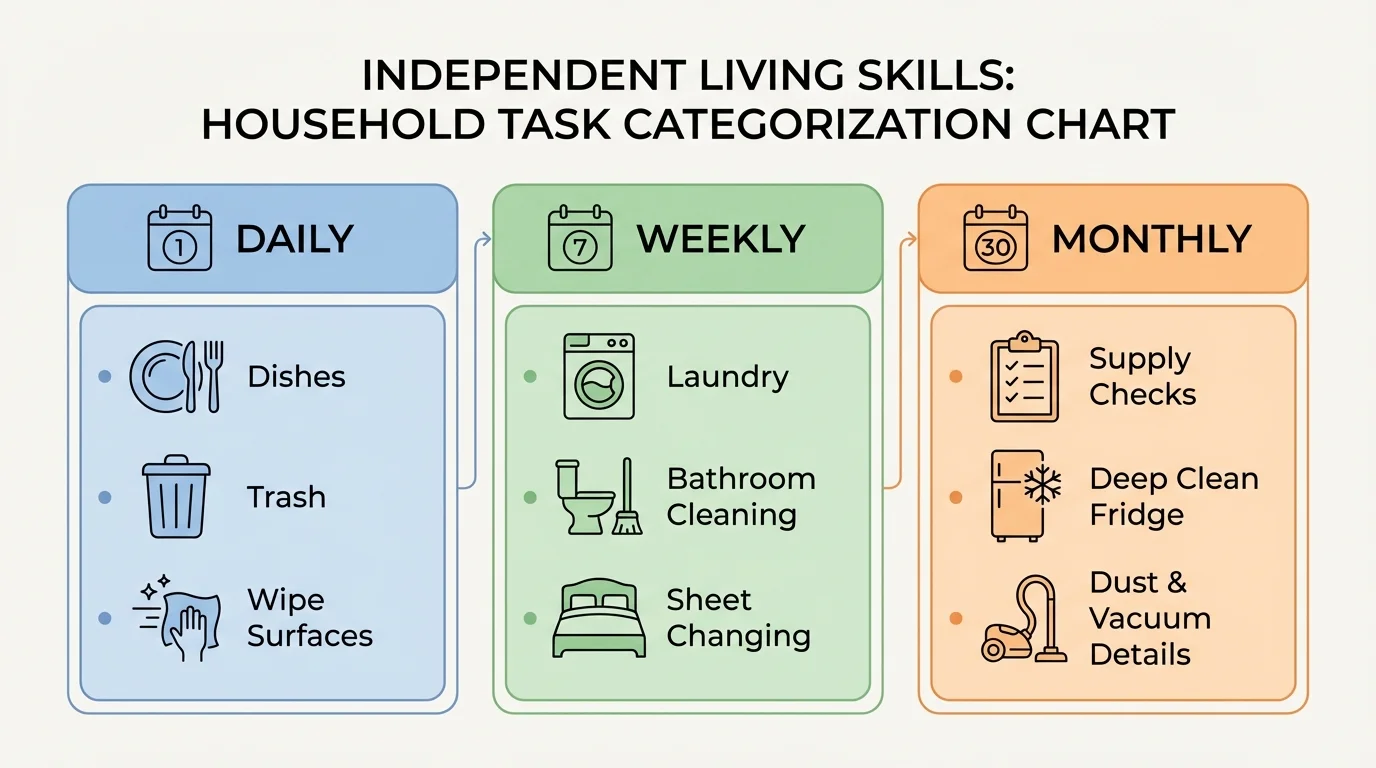
One smart system is to organize tasks by frequency, as [Figure 3] shows. Some jobs are daily, some are weekly, and some are occasional. If you treat every task like it can wait forever, your future self gets buried in work.
Routine means a repeated pattern that helps you remember what to do without making the decision from scratch every time. For example, your evening routine might include washing dishes, packing your bag, checking tomorrow's schedule, and putting dirty clothes in the hamper. A routine saves mental energy.
Daily household tasks might include making your bed, rinsing dishes, wiping a counter, feeding a pet, tidying shared spaces, and putting away clothes. Weekly tasks may include laundry, vacuuming, cleaning a bathroom, changing sheets, checking supplies, and taking out recycling. Monthly or occasional tasks could include cleaning out a backpack, organizing drawers, or checking if toiletries need to be replaced.
Laundry is a good example of a life skill with multiple steps. First, sort clothes if needed. Second, check pockets. Third, use the correct amount of detergent. Fourth, move clothes promptly so they do not smell bad. Fifth, fold or hang them soon after drying. The final step is where many people fail. Clean clothes are not really "done" if they stay in a pile for three days.
Kitchen tasks matter too, even if you are not cooking full meals yet. You should know how to wash dishes, wipe surfaces, store leftovers safely, and notice when food has expired. If you make a snack and leave crumbs, wrappers, and dirty dishes behind, someone else has to handle the result. Independence includes cleaning up your own impact.
Supplies also need attention. Running out of shampoo, toothpaste, detergent, or trash bags can create stress at the worst time. A quick weekly check can prevent this. If your detergent bottle looks low and you know there is only enough for one more load, that is the moment to mention it or add it to a shopping list.
Example: Creating a weekly household system
You want to stop forgetting chores and doing everything at the last minute.
Step 1: List the tasks you are responsible for.
Example: dishes, laundry, trash, pet care, bedroom cleanup.
Step 2: Match each task to a frequency.
Dishes may be daily. Laundry may be twice a week. Trash may be every Tuesday and Friday.
Step 3: Attach the task to a time.
For example: dishes after dinner, laundry on Wednesday evening, trash before breakfast on pickup day.
Step 4: Add one reminder system.
Use one phone reminder, checklist, or wall calendar so tasks do not depend only on memory.
This turns chores from random interruptions into a predictable routine.
If you share a home with other people, communication matters. Do not assume everyone knows your plan. If you cannot finish a task on time, say so early. If you need clarification, ask. Responsible communication is part of home life, not separate from it.
Try This: Choose one household task you already do sometimes, and decide exactly when you will do it each week. The more specific the time, the more likely it happens.
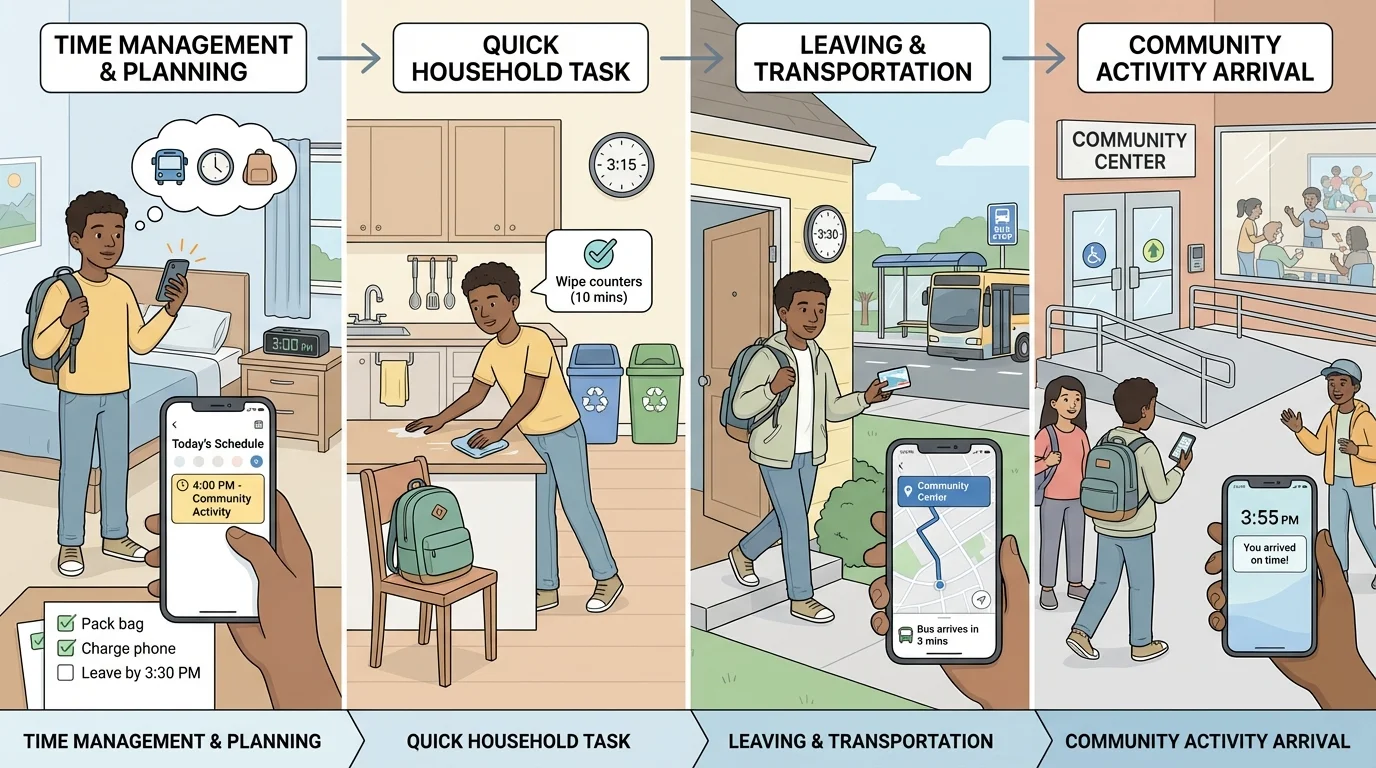
Real independence is a chain of connected choices, as [Figure 4] illustrates. You check your calendar, plan your ride, finish a home responsibility, pack what you need, leave on time, and return without creating extra problems for your future self.
Here is a realistic example. You have an evening art class at a community center. The class starts at 6:00 p.m. You also need to take out the trash before pickup and eat dinner first. A weak plan is "I'll do it all later." A strong plan is: take out the trash at 5:00 p.m., eat at 5:10 p.m., leave at 5:30 p.m., and aim to arrive by 5:50 p.m. with your supplies packed earlier in the day.
If travel time is 15 minutes and you want a 10-minute buffer, your travel block should be \(15 + 10 = 25\) minutes. That means if class begins at 6:00 p.m., you should leave by 5:35 p.m. or earlier. Small calculations like this help real life run better.
Now consider a problem scenario. You planned to get a ride, but the driver texts that they are running late. Instead of panicking, you switch to your backup. Maybe that means taking a bus, calling another approved contact, or notifying the activity leader that you may arrive a few minutes late. Having a backup plan is not pessimistic. It is practical.
The same skill applies at home. Suppose you forgot laundry until the night before you need a clean outfit. If the dryer is full or the machine is in use, you have a problem caused by poor timing. But if you did laundry on your routine day, that stress never appears. Good routines often feel boring in the moment, but they prevent chaotic moments later.
Many adults are not overwhelmed because their responsibilities are impossible. They are overwhelmed because lots of small tasks were postponed until they turned into one giant problem.
This is why independent living is not one big skill. It is a set of smaller habits working together: checking, planning, communicating, and following through. As seen earlier in [Figure 1], transportation works best when you think ahead, and the same is true for chores and scheduling.
You do not need a perfect system on day one. Start small and repeat it. One calendar habit, one transportation check, and one home routine can already make a big difference. The goal is not to become rigid. The goal is to become dependable.
A simple independence toolkit might include a calendar app, one checklist, a notes app for supplies, and a charger habit so your phone is useful when you need it. It also helps to keep frequently used items in the same place: keys, wallet, headphones, transit card, and water bottle. Looking for lost items wastes time and increases stress.
Another useful habit is a daily reset. Spend 10 minutes putting things back, checking tomorrow's schedule, and preparing what you need. If you do that each evening, mornings become easier. If you skip it repeatedly, mornings become rushed.
You can also use a "finish the loop" mindset. If you eat, wash the dish. If you change clothes, put dirty items in the hamper. If you use the last of something, write it on the shopping list. If you agree to be somewhere, confirm your transportation. Finishing the loop keeps tasks from becoming invisible clutter.
"Being responsible is often just doing small things before they become big things."
Independence grows when other people can trust your actions. When you keep track of time, take care of your responsibilities, and move through the world safely, you prove that you can handle more freedom. That trust is earned through repeated actions, not good intentions alone.
Try This: Pick one habit to practice for a week: checking tomorrow's schedule the night before, setting an alarm 15 minutes earlier, or doing one chore at the same time each day.
