People often think ethical issues only matter in huge situations, like politics, court cases, or major business scandals. But a lot of ethical decisions happen in ordinary moments: when you decide whether to give everyone credit in a group project, whether to copy an answer from a website, whether to forward a private screenshot, or whether to stay silent when someone is being treated unfairly. Those choices may seem small, but they shape your reputation, your relationships, and the kind of person you become.
At your age, you are already trusted with real responsibility. You manage deadlines, communicate online, join teams or community groups, and influence other people more than you may realize. Ethical responsibility is not about being perfect. It is about learning how to act in ways that are honest, fair, respectful, and thoughtful even when the easiest choice is not the best one.
Ethics is about deciding what is right, fair, and responsible. It helps you answer questions like: What should I do? Who could be affected? Am I being honest? Would I be okay if someone treated me this way? In real life, ethics is not only about rules. It is also about character.
Your choices affect more than one moment. If you regularly do what you say you will do, people begin to trust you. If you lie, avoid responsibility, or use others for your own benefit, trust weakens. Trust can take weeks or months to build and only seconds to damage.
Ethical responsibility means choosing actions that are honest, fair, respectful, and aware of how your decisions affect others.
Character is the pattern of values shown by your choices over time.
Responsibility means owning your actions, meeting expectations, and accepting the results of what you do or fail to do.
In an online school setting, ethics matters especially in digital spaces because messages, posts, shared files, and comments can spread quickly. A careless reply sent in ten seconds can hurt someone for a long time. On the other hand, a thoughtful message, an honest explanation, or a fair decision can make a group feel safe and respected.
Several values show up again and again in ethical situations. One is integrity, which means doing what is right even when no one is watching. Another is accountability, which means owning your choices instead of making excuses. A third is fairness, which means treating people justly and not using power in a biased way.
Respect also matters. Respect means recognizing that other people have feelings, boundaries, privacy, and dignity. Empathy helps too. When you pause and ask, "How might this affect the other person?" you are less likely to act selfishly or carelessly.
Ethics is practical, not just personal
Your values show up in visible actions: how you speak in a group chat, whether you keep a promise, whether you give credit, how you handle disagreement, and whether you admit mistakes. Ethical behavior is not only what you believe. It is what other people experience from you.
These values work together. For example, honesty without respect can become cruelty. Loyalty without integrity can become covering up harmful behavior. Confidence without accountability can become arrogance. Ethical responsibility means balancing values in a healthy way.
Leadership is not just about having a title. If you organize a study group, moderate an online community, captain a sports team outside school, run a volunteer project, or even influence a friend group, you are leading. Ethical leadership involves choice points that affect everyone in the group, as [Figure 1] illustrates. A leader sets the tone for what is acceptable.
A good leader uses influence responsibly. That means being honest, listening fairly, avoiding favoritism, and not using private information as a weapon. If someone shares something personal with you in confidence, ethical leadership means protecting that information unless safety is at risk and an adult needs to be told. It also means not taking credit for ideas that came from other people.
One major responsibility of leadership is fairness. If you only listen to your friends, excuse their mistakes, or give them the easiest roles, people notice. Fairness does not always mean treating everyone exactly the same. It means applying expectations consistently and making decisions based on what is right, not on popularity.
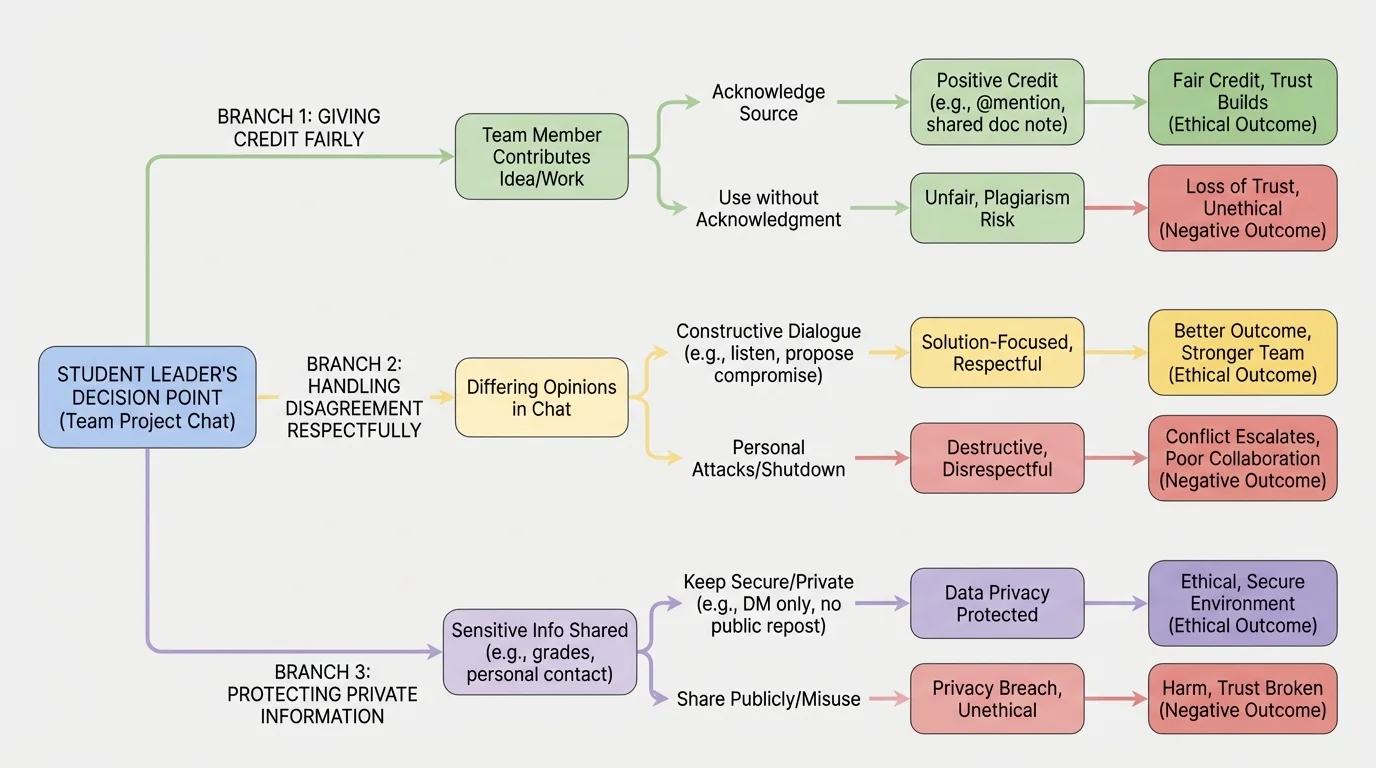
Another leadership responsibility is speaking up when something harmful is happening. If a group member is being mocked, excluded, or blamed unfairly, staying silent may protect your comfort, but it does not protect the group. Ethical leaders do not enjoy power while avoiding responsibility. They use their position to improve the environment.
Suppose you are leading a community clean-up project and two people do most of the planning, but another person presents the final results on video and acts as if they did all the work. An unethical response would be to stay quiet because conflict feels awkward. An ethical response would be to correct the record respectfully: "Thanks for presenting. I also want to make sure Maya and Jordan get credit for organizing the schedule and supplies."
Case study: Leading fairly in a digital project
You are in charge of a small online project group. One member misses a deadline, another member complains publicly, and a third sends you a private message with gossip.
Step 1: Separate facts from emotion.
Check what was actually assigned, what deadline was given, and what work has or has not been submitted.
Step 2: Protect dignity.
Do not embarrass the late member in the group chat. Contact them privately first.
Step 3: Stay fair.
Apply the same expectations to everyone, including your friends.
Step 4: Refocus the group.
Bring the conversation back to the task instead of allowing gossip to spread.
Step 5: Give accurate credit.
When the project is done, clearly recognize who contributed what.
This kind of leadership builds trust because people can predict that you will be fair and respectful.
Later, when you face a different decision about privacy or group conflict, the same leadership pattern still applies, as shown earlier in [Figure 1]. Leaders often influence not just one outcome but the habits of the whole group.
Schoolwork is not only about grades. It is also about honesty, effort, and growth. In online learning, ethical responsibility matters even more because much of your work happens without someone physically watching you. That means your character is part of your education.
One key issue is plagiarism, which means presenting someone else's words or ideas as your own. This can happen by copying from a website, using another student's assignment, or pasting AI-generated writing without permission or disclosure when your teacher expects your own work. Even if you think, "I just needed to finish quickly," it is still dishonest if the work does not honestly show your thinking.
Another issue is cheating more broadly: looking up answers on a test that is meant to be closed-note, sharing answers in a private chat during a quiz, or pretending you completed work that someone else did. These choices may bring a short-term benefit, but they weaken your skills and your self-respect. You may get the score, but you lose the learning.
Many students think dishonesty only matters if they get caught. In reality, the bigger loss is often hidden: weaker skills, more stress, and a habit of avoiding challenge instead of learning how to handle it.
Ethical schoolwork also includes using help correctly. Getting help is responsible. Misusing help is not. It is ethical to ask for clarification, review examples, use approved tools, or work with a tutor when allowed. It is unethical to have someone else complete your assignment or to disguise copied work as your own effort.
Time management is part of ethics too. That may sound surprising, but when you procrastinate heavily and then pressure others to rescue you, your lack of planning affects them. Being responsible with deadlines is not just a personal skill. It is also a way of respecting teachers, family members, and anyone depending on your contribution.
Consider the difference between these two messages. Message A: "I forgot everything. Can you send me your answers right now?" Message B: "I am behind because I managed my time badly. Can you help me understand question 3 so I can do it myself?" The second message shows honesty, responsibility, and a willingness to learn.
| Situation | Unethical choice | Ethical choice |
|---|---|---|
| Writing an essay | Copying paragraphs from a website | Using sources, then writing in your own words and giving credit |
| Using AI tools | Submitting generated work as entirely your own when not allowed | Following class rules, using tools transparently if permitted, and doing your own thinking |
| Online test | Messaging friends for answers | Completing the assessment honestly |
| Late assignment | Making excuses and blaming technology without proof | Communicating early, telling the truth, and asking for an extension respectfully if needed |
Table 1. Comparison of ethical and unethical choices in common schoolwork situations.
If you make a mistake in schoolwork ethics, repair starts with honesty. Admit what happened, accept the consequence, and ask how to do better next time. Excuses like "everyone does it" or "it was only one assignment" usually make the problem worse because they show you are still avoiding responsibility.
Your relationships with peers are full of ethical choices. You decide whether to be truthful, whether to keep confidences, whether to respect boundaries, and whether to treat people with kindness when you are upset. Being a good friend is not just about having fun together. It is also about being trustworthy.
Confidentiality matters in friendships. If a friend tells you something private, you should not post it, joke about it, or send screenshots to others. The main exception is safety. If someone is in danger, talking about self-harm, being abused, or planning to hurt someone, keeping that secret is not ethical. In that case, telling a trusted adult is the responsible action.
Boundaries matter too. Ethical friendship respects when someone says no, needs space, or does not want to share personal details. Pressuring someone to respond instantly, to send private images, or to stay in a conversation that is making them uncomfortable is not respectful.
"Character is what you do when no one is watching."
— Often quoted principle about integrity
Rumors and exclusion are also ethical issues. Forwarding gossip may feel harmless because it is "just information," but it can damage someone's reputation and mental well-being. Excluding someone on purpose to control a group or punish them socially can be deeply hurtful. Ethical behavior means refusing to treat people as entertainment or as targets.
Conflict is normal, but how you handle it matters. A responsible approach is direct, calm, and specific. Instead of posting vague insults or involving a group chat, you can say, "I felt ignored when you left me out of the planning call. Can we talk about it?" That is more respectful than attacking, ghosting, or recruiting others to take sides.
Case study: A private screenshot
A friend sends you a private message complaining about another person. Later, someone asks you to forward the screenshot.
Step 1: Pause before reacting.
Private messages are not public property just because they are on your phone.
Step 2: Consider harm.
Forwarding it could embarrass your friend, increase conflict, and make others trust you less.
Step 3: Choose a respectful response.
You can say, "That was private, so I am not sharing it."
Step 4: Encourage direct communication.
If the issue matters, suggest that the people involved talk to each other respectfully.
This protects trust without pretending the conflict does not exist.
Healthy peer ethics also includes support without enabling harm. Loyalty is valuable, but real loyalty does not mean helping a friend cheat, bullying someone with them, or defending every bad choice they make. Sometimes the most ethical thing you can do for a friend is tell the truth: "I care about you, but that was not okay."
When a situation is confusing, a clear process helps, as [Figure 2] shows. Quick reactions often create bigger problems online because once something is sent, posted, or shared, it can spread fast. A simple ethical decision-making process gives you a way to slow down and choose on purpose, as [Figure 2] shows.
Step 1: Pause. Do not decide in the heat of anger, embarrassment, or pressure. If needed, wait a few minutes before replying.
Step 2: Gather facts. What actually happened? What do you know for sure? What are you assuming?
Step 3: Check your values. Which values matter here: honesty, fairness, respect, safety, loyalty, responsibility?
Step 4: Predict impact. Who could be helped or harmed by each option? What are the short-term and long-term effects?
Step 5: Choose and review. Pick the most responsible action, then later ask: Did this solve the problem well? If not, what repair is needed?
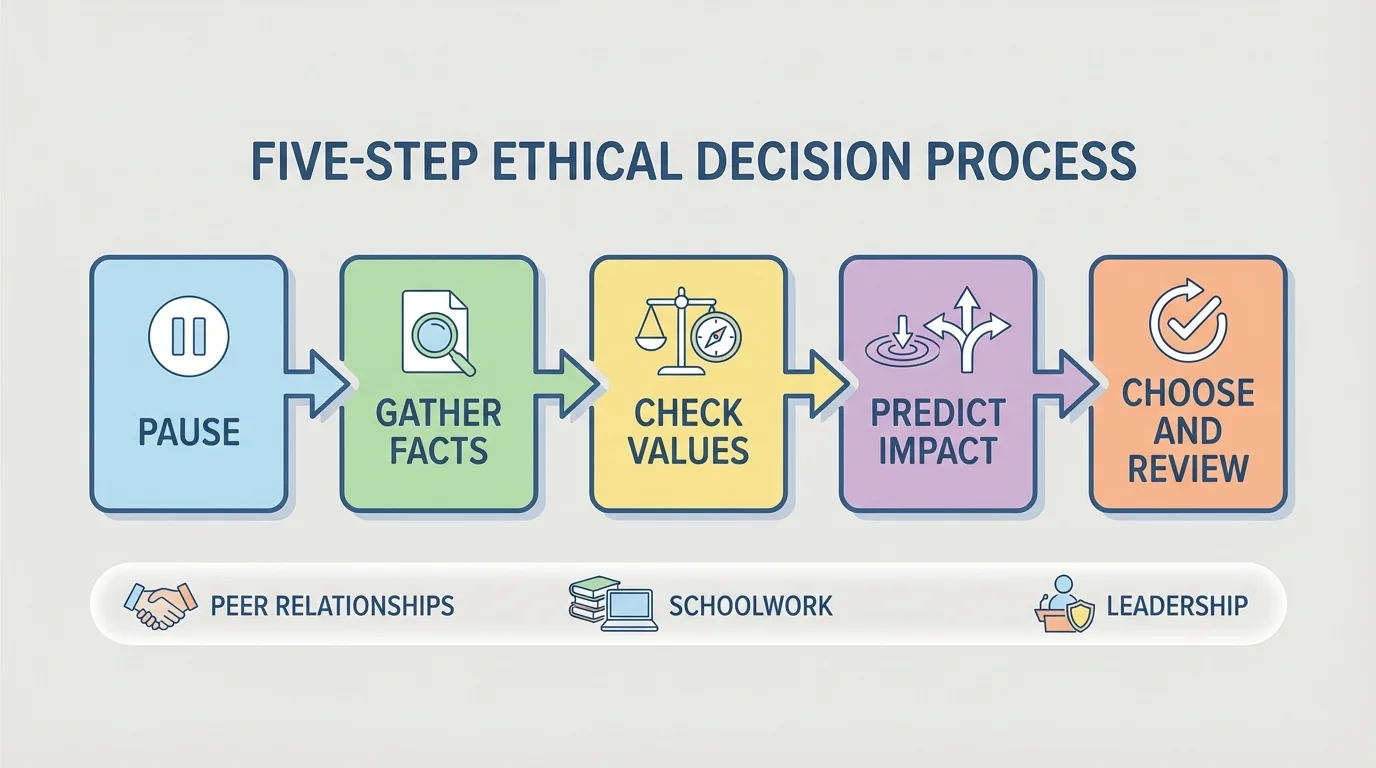
This process is useful in all three areas of life. In leadership, it prevents unfair decisions. In schoolwork, it helps you resist shortcuts that damage learning. In peer relationships, it keeps emotions from controlling your choices.
Pressure can distort judgment
People often make unethical choices for predictable reasons: fear of getting in trouble, desire to fit in, stress, jealousy, laziness, or the belief that one small action does not matter. Recognizing these pressures makes you more prepared to resist them.
You can also use a quick self-check: "Is it honest? Is it fair? Is it respectful? Would I be okay if this were posted publicly with my name on it?" If the answer is no, that is a strong warning sign. The same sequence still works in situations involving gossip, cheating, or misuse of power, just as the process in [Figure 2] applies across different contexts.
Ethical choices have real consequences. When you act responsibly, people are more likely to trust you with opportunities, leadership roles, teamwork, and friendship. When you act irresponsibly, people may become cautious, distant, or unwilling to depend on you.
Some consequences are immediate, like losing points for cheating or being removed from a group role. Others are slower and more serious, such as gaining a reputation for dishonesty, damaging a friendship, or creating a pattern where shortcuts replace growth. Habits matter because repeated choices shape identity.
Trust is built through repeated actions, not single promises. If you want people to see you as responsible, your behavior has to match your words consistently.
If you mess up, repair is possible. Start by telling the truth clearly. Name what you did without minimizing it. A real apology sounds like this: "I shared your private message without permission. That was wrong and disrespectful. I am sorry." Then make amends if possible, accept consequences, and change the behavior. "Sorry" is important, but changed behavior is what rebuilds trust.
Repair also means learning from the mistake. Ask yourself what pressure, fear, or habit led to that decision. Then build a plan to handle that pressure better next time. Growth matters more than pretending you never fail.
[Figure 3] The same core values show up across leadership, schoolwork, and peer relationships, and the figure organizes them into habits you can actually practice. A personal code of ethics is a short set of principles you choose to follow even when life gets messy.
Your code does not need fancy wording. It should be clear enough that you can remember it during real decisions. For example: "I tell the truth. I give credit fairly. I protect private information. I do my own work. I speak respectfully. I fix harm when I cause it." That kind of code can guide you in stressful moments.
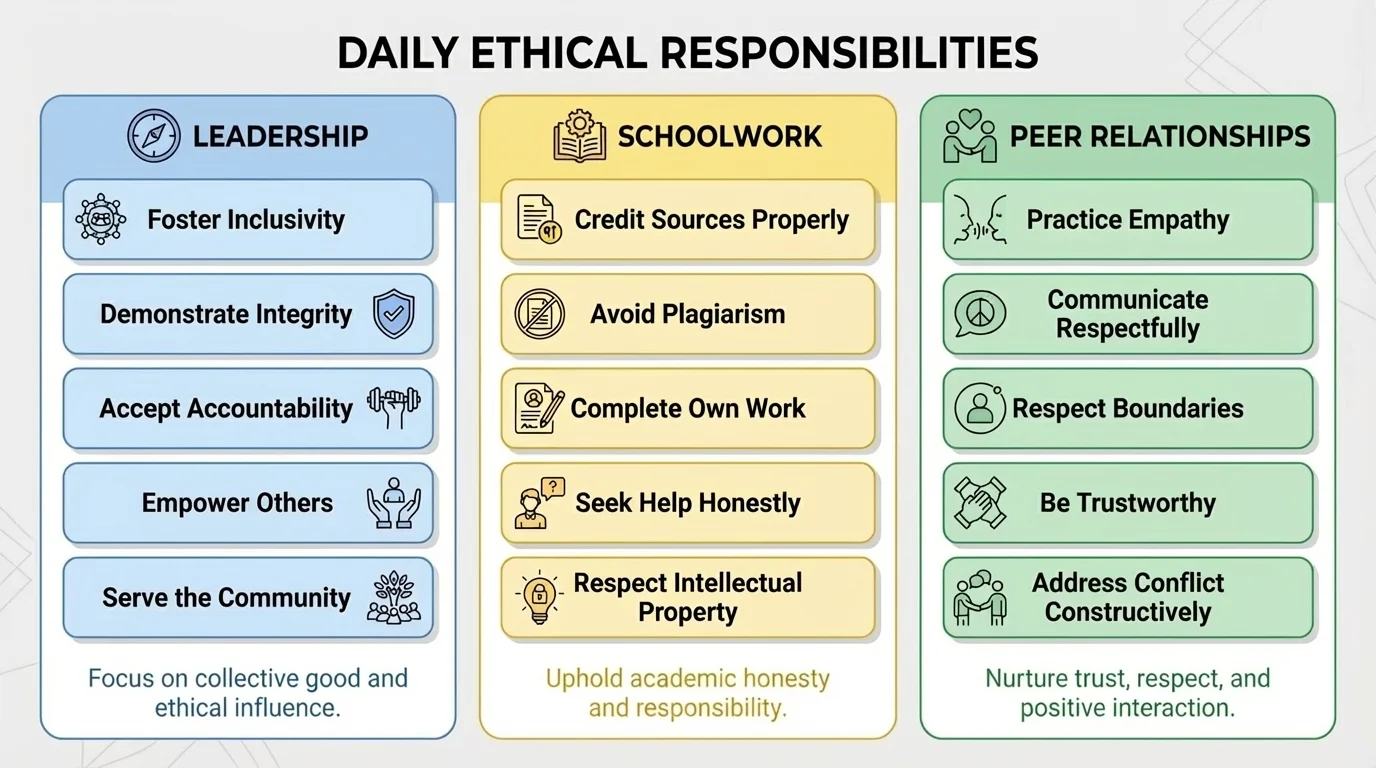
To make your code useful, turn it into habits. Answer messages respectfully. Check facts before reacting. Ask for help honestly. Keep promises or communicate early if you cannot. Refuse to share private screenshots. Credit other people's work. These habits may seem small, but they are where character grows.
Try This: Before you send a message, submit an assignment, or respond in a conflict, pause for five seconds and ask: "Is this honest, fair, and respectful?" That quick check can stop a lot of regret.
Try This: Choose one area this week where you will practice stronger ethics on purpose. Maybe it is being more honest about deadlines, giving clearer credit in group work, or refusing to join gossip.
Try This: Write a personal rule for digital life, such as "I do not forward private content without permission" or "I do not post when angry." Put it somewhere you will see it.
Over time, your habits become your reputation. And your reputation affects your future opportunities. People want to work with, rely on, and trust those who act with integrity. Ethical responsibility is not about looking perfect. It is about becoming someone others can count on.
