People often think adulthood starts with age, but in real life, people judge readiness by something else: Can they count on you? If you say you will do something, do you do it? If you make a mistake, do you admit it? If someone shares responsibility with you, do you handle it well? These questions matter in jobs, friendships, family life, volunteer work, team activities, and even in simple things like replying to messages on time.
Adult readiness is not about acting perfect or pretending you have everything figured out. It is about showing that you can handle responsibility in a steady, honest way. Three traits play a major role: trustworthiness, follow-through, and honesty. Together, they shape your reputation, your relationships, and the opportunities people are willing to give you.
At your age, people are already paying attention to your patterns. A parent may ask, "Can I trust you to finish this without reminders?" A coach, club leader, or employer may wonder whether you can manage a task independently. A friend may decide whether to tell you something personal based on whether you keep confidence and tell the truth. These moments may seem small, but they build a picture of who you are.
Being adult-ready means more than wanting freedom. It means showing you can handle freedom well. If you want more independence online, more control over your schedule, a part-time job, or leadership roles in your community, people will look for signs of reliability. They want to know whether your words and your actions match.
Trustworthiness means being dependable, safe, and worthy of confidence. Follow-through means completing what you said you would do, even when it takes effort. Honesty means being truthful in what you say and realistic about what you can actually do.
These traits are connected, but they are not identical. Someone can be honest and say, "I forgot," but still need stronger follow-through. Someone can complete tasks but lose trust if they lie about problems along the way. Real maturity comes from combining all three.
Trustworthiness is about whether people feel safe relying on you. That includes keeping private information private, using good judgment, respecting boundaries, and doing what you say you will do. Trustworthy people do not just avoid obvious wrongdoing. They also act carefully when no one is watching.
Follow-through is what turns good intentions into real results. Many people mean well. Fewer people consistently finish tasks, send updates, ask questions before problems grow, and stay committed when a task becomes boring or inconvenient. Follow-through is often the difference between seeming responsible and actually being responsible.
Honesty means telling the truth, but it also includes being truthful with yourself. If you know you do not have time to help with something, honesty means not promising what you cannot deliver. If you made an error, honesty means admitting it early instead of hiding it and making the problem worse.
When these qualities are strong, people see you as more ready for adult responsibilities. When they are weak, people may hesitate to depend on you, even if you are talented. Skill matters, but character often decides who gets trusted with real responsibility.
Trust usually does not appear all at once. It grows from repeated choices over time, as [Figure 1] shows through patterns that either strengthen or weaken confidence in someone. One honest message, one completed task, or one respectful decision may seem small, but repeated small actions create a strong reputation.
Trust is built when you are consistent. You respond when you say you will. You keep important information private. You show up prepared for online meetings or community commitments. You admit when you do not understand something instead of pretending. You return borrowed items. You handle shared responsibilities fairly.
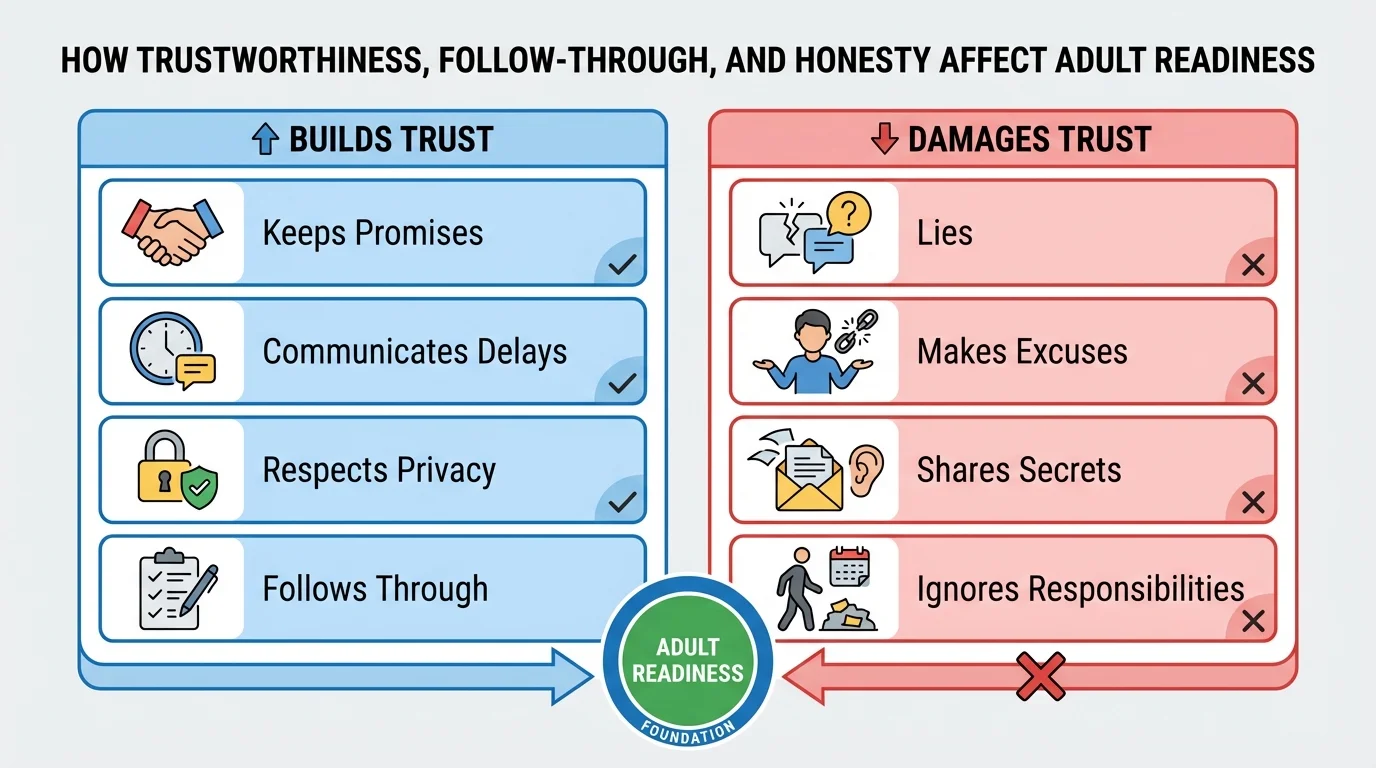
Trust is broken when someone lies, hides information, breaks promises, blames others for their own choices, or acts differently depending on who is watching. Trust can also be damaged by smaller habits: replying only when it benefits you, promising too much, disappearing when work gets hard, or sharing screenshots of private conversations without permission.
Online life makes trust even more visible. If you agree to help with a digital project and then vanish, others remember that. If you post one thing publicly but say something very different in private messages, people notice the inconsistency. If you copy someone else's work and pretend it is yours, your reputation can drop quickly. Digital actions leave traces, and adult readiness includes understanding that online behavior affects real-world trust.
As we saw in [Figure 1], trust-building behaviors usually involve consistency, honesty, and respect. Notice that most of them are not dramatic. They are simple, repeatable actions. That is good news, because it means trust can be built through everyday habits, not just major achievements.
People often lose trust faster than they gain it. A long pattern of reliability can be damaged by one serious lie, especially if the person refuses to take responsibility afterward.
That does not mean one mistake ruins everything forever. It means that repairing trust takes effort. The more serious the damage, the more consistent honesty and follow-through are needed to rebuild it.
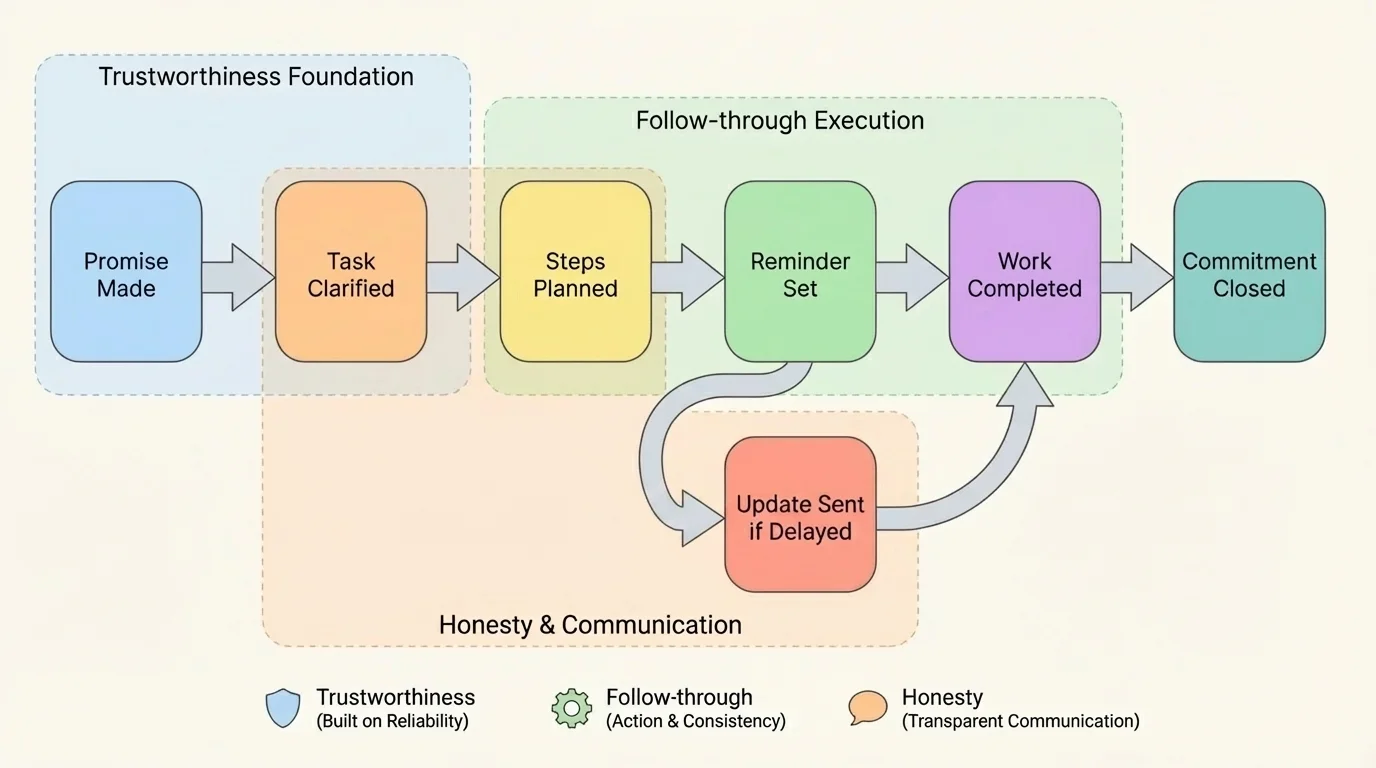
Reliable people often use a repeatable system rather than depending on memory alone, and [Figure 2] lays out a simple path from making a commitment to completing it or communicating early if something changes. Follow-through is not magic. It is a set of habits.
Think about everyday situations: finishing chores without repeated reminders, submitting online assignments by the deadline, showing up on time for a video call, preparing for a volunteer shift, practicing for a performance, or replying to a family message about plans. In each case, follow-through means you treat your commitment as real, not optional.
A practical follow-through system can be simple. First, be clear about what you agreed to do. Second, break the task into steps. Third, choose when you will do it. Fourth, set a reminder. Fifth, check your progress before the deadline. Sixth, if a problem comes up, communicate early instead of waiting until the last second.
For example, suppose you tell a neighbor you can pet-sit over the weekend. Good follow-through means confirming the times, writing them down, planning transportation, asking questions ahead of time, and checking in if anything changes. Poor follow-through means saying "sure," forgetting, then apologizing after the pet has already been left waiting. The difference is not just inconvenience. It affects whether people trust you with future responsibilities.
Example: Turning a promise into action
You agree to help your aunt organize donated clothes for a community drive on Saturday afternoon.
Step 1: Clarify the job.
Ask what time to arrive, what you should bring, and how long the task will take.
Step 2: Protect the time.
Put the commitment in your calendar and avoid scheduling something else on top of it.
Step 3: Prepare early.
Set a reminder the day before, charge your phone, and plan transportation.
Step 4: Communicate if needed.
If you are delayed, send a message as soon as you know, not after the start time.
Step 5: Finish well.
Complete the task fully and ask if any final help is needed before leaving.
This is what follow-through looks like in real life: not just agreeing, but managing the responsibility all the way to the end.
As [Figure 2] reminds us, communication is part of follow-through, not separate from it. If a problem happens and you speak up early, people may still see you as responsible. If you stay silent and let others discover the problem too late, trust drops fast.
Some people think honesty means saying every thought exactly as it comes to mind. That is not maturity. Honest people tell the truth, but they also use judgment, timing, and respect. Adult readiness includes learning how to be truthful without being cruel, defensive, or dramatic.
For example, if you forgot to complete something, honesty sounds like: "I said I would do that, and I did not. That is my mistake. I can finish it by tomorrow at 6:00." Dishonesty sounds like making excuses, blaming technology when you never started, or pretending you misunderstood when you actually ignored the task.
Honesty also means being realistic before you commit. If you already have a full week, saying "I can't take that on right now" is more mature than saying yes and failing later. Many trust problems begin before the task starts, because people overpromise to avoid disappointment in the moment. Then they create a bigger disappointment later.
Honesty includes accountability. Telling the truth matters most when the truth is uncomfortable. Accountability means you admit your part, accept the consequences, and focus on making things right instead of protecting your image.
There is also a difference between privacy and dishonesty. You do not owe everyone every detail of your life. You can set boundaries and still be truthful. For example, "I can't share personal details, but I won't be available then" is honest and respectful. Adult readiness means knowing how to protect your privacy without misleading people.
These traits affect more than personal reputation. They shape what other people are willing to trust you with. If you are known for honesty and follow-through, you may be given more freedom, stronger references, leadership chances, and important responsibilities. If you are known for excuses, broken promises, or lying, people may stop depending on you.
In work settings, employers notice whether you arrive prepared, complete tasks, and admit mistakes early. A manager can often teach a new skill, but it is much harder to teach someone to care about reliability. In families, trust affects independence. Parents and guardians are more likely to allow flexibility when they see steady judgment. In friendships, honesty and trustworthiness affect emotional safety. People want friends who are real, respectful, and dependable.
Money is another area where these traits matter. If you borrow money and repay it when promised, people see responsibility. If you borrow and avoid the topic, invent stories, or spend carelessly, trust weakens. The same pattern applies to shared plans, subscriptions, passwords, rides, and commitments involving time.
Safety matters too. If someone says they completed a task involving care, supervision, or transportation when they really did not, the result can be dangerous. Adult readiness includes understanding that dishonesty is not always just a personal issue. Sometimes it puts other people at risk.
"Character is what you do when no one is watching."
— Common ethical principle
This idea matters because many real tests of trust happen in private. No one may immediately know whether you completed your task carefully, returned the full amount, or told the complete truth. But your choices still shape who you are and what kind of adult others experience you to be.
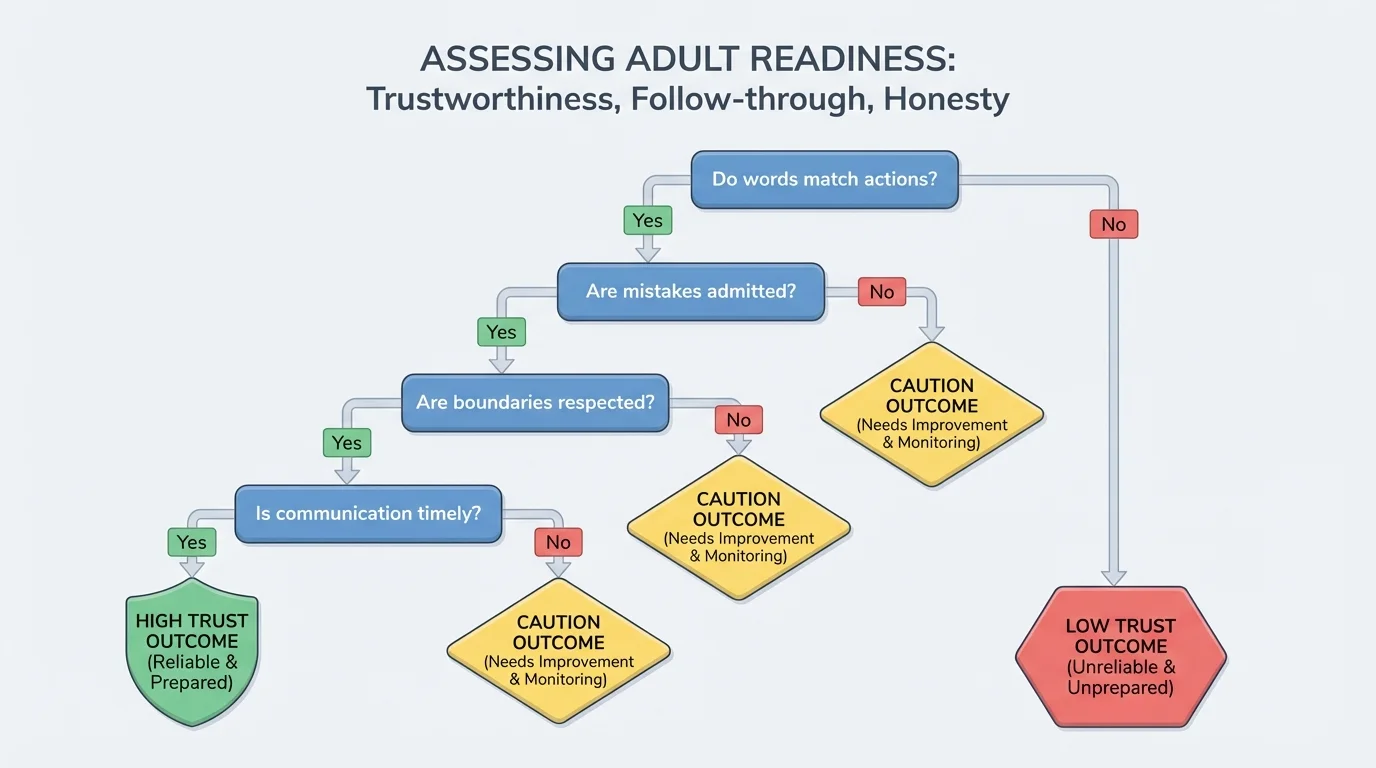
When you assess someone's reliability, it helps to use clear questions instead of going only by feelings. The decision path in [Figure 3] starts with a simple idea: compare what the person says with what the person actually does. Adult readiness involves learning to do this with yourself too.
Ask questions like these: Do their actions match their words? Do they usually tell the truth, even when it is awkward? If they cannot do something, do they communicate early? Do they respect private information and boundaries? When they make mistakes, do they repair the harm or just defend themselves? One good speech does not prove character. Patterns do.
You can use the same checklist on yourself. Do you often say "I forgot" because you are disorganized? Do you avoid hard conversations until the problem grows? Do you tell partial truths to stay out of trouble? Do you act responsible only when someone is checking? Honest self-assessment is part of growing up.
| Question | Strong sign of readiness | Warning sign |
|---|---|---|
| Do words match actions? | Usually follows through | Promises a lot, completes little |
| How are mistakes handled? | Admits, apologizes, repairs | Denies, hides, blames |
| How is private information treated? | Respects confidentiality | Shares secrets or screenshots |
| How is communication handled? | Gives updates early | Disappears or responds late |
| How consistent is behavior? | Reliable across situations | Acts differently when convenient |
Table 1. A practical checklist for assessing trustworthiness, honesty, and follow-through.
As shown by the questions in [Figure 3], trust assessment is not about being suspicious of everyone. It is about noticing patterns so you can make wise decisions. This protects your time, your energy, and your safety.
Case study: Two different responses
Both Maya and Jordan miss a deadline for a community media project.
Maya's response: She sends a message before the deadline, explains that she misjudged the time needed, apologizes, and gives a realistic new completion time. Then she meets that new deadline.
Jordan's response: He says nothing until people ask. Then he blames his device, though he had not started the work. He promises to send it "soon" but misses the next deadline too.
Maya made a mistake, but she still showed more adult readiness because she used honesty, accountability, and follow-through. Jordan damaged trust more through avoidance and dishonesty than through the missed deadline itself.
This is an important point: mistakes do not automatically prove immaturity. Refusing to own them often does.
The good news is that these qualities can grow. You do not have to be perfect to become more trustworthy. You need patterns that improve over time. Start by making fewer promises and keeping more of them. Use reminders. Write things down. Confirm details. Speak up earlier. Tell the truth faster. Practice repairing problems instead of hiding them.
If you have damaged trust, repair starts with honesty. Say what happened clearly. Do not make excuses. Acknowledge the effect on the other person. Offer a realistic plan to make it right. Then follow through consistently over time. Rebuilding trust is usually slower than breaking it, but it is possible when actions change.
Freedom and responsibility grow together. The more you show that you can manage commitments honestly and consistently, the more likely people are to trust you with independence.
A simple daily checklist can help: Did I keep my word today? If not, did I communicate early? Was I truthful, even when it was uncomfortable? Did I respect someone's privacy? Did my actions match how I want others to describe my character? These questions build self-awareness, which is a major part of maturity.
Adult readiness is not a costume, a certain age, or a confident attitude. It is the steady ability to be counted on. When you build trustworthiness, follow-through, and honesty, you become someone others can rely on in work, family, friendship, and community life. That kind of character opens doors and strengthens relationships long before anyone calls you an adult.
