A single post, comment, or choice can affect your privacy, reputation, relationships, and even your legal safety. That is why civic knowledge is not just for adults, elections, or government classes. It matters when you join an online group, speak up about a problem, apply for a part-time job, volunteer in your neighborhood, or decide whether to share a rumor. Civic life is really about how you live with other people, what rights protect you, and what responsibilities help a community work well.
As a teenager, you are already part of society in real ways. You use digital platforms, move through public spaces, rely on services, follow laws, and make choices that affect others. Understanding your rights can help you protect yourself. Understanding your responsibilities can help you earn trust. Understanding the law can help you avoid problems before they start.
Civic rights are protections and freedoms people have in society, such as fair treatment, safety, and the ability to express ideas within legal limits.
Civic responsibilities are actions people are expected to take to help their communities function well, such as respecting others, following laws, and contributing in constructive ways.
Legal awareness means understanding basic laws, rules, rights, and consequences so you can make safer and smarter decisions.
One important truth runs through all three ideas: rights, responsibilities, and legal awareness are connected. If you want your voice respected, you also need to respect other people's rights. If you want privacy, you should not invade someone else's privacy. If you want protection from harm, you should avoid causing harm. Civic life is not only about what you are allowed to do; it is also about what kind of person you choose to be.
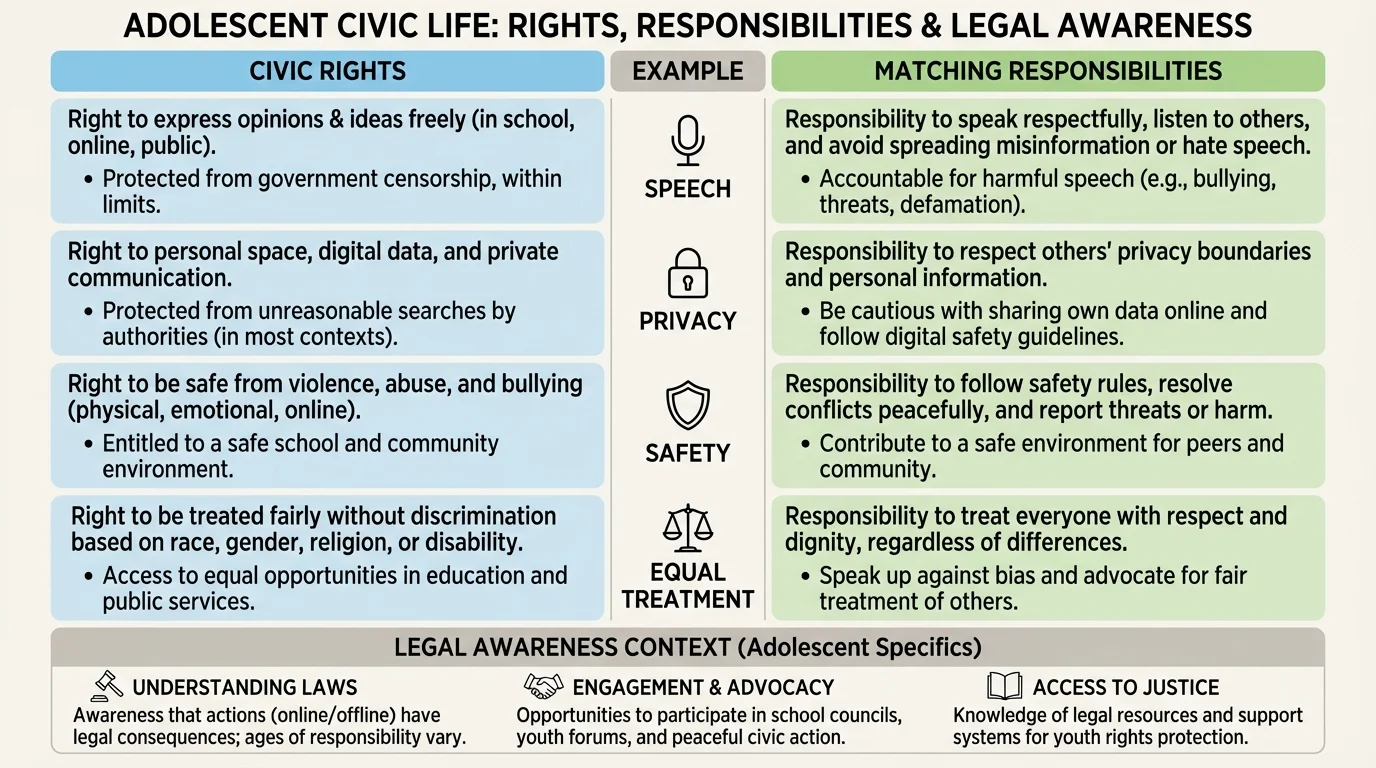
You have important rights as a young person, and [Figure 1] shows an important pattern: each right works best when it is matched with a responsibility. You may not control every decision in your life yet, but you still have protections that matter. These include the right to be treated with dignity, the right to personal safety, the right to learn, the right to express opinions in appropriate ways, and the right to seek help when something feels wrong.
Some rights are easy to recognize. If someone threatens you online, spreads private photos, impersonates you, or pressures you into unsafe behavior, that can violate your rights to safety, privacy, and fair treatment. If a group excludes or harasses someone because of identity, appearance, disability, religion, or background, that raises concerns about equality and respect. Rights are not unlimited, though. Free expression does not mean you can threaten people, lie to harm them, or harass them.
In daily life, your rights often appear in ordinary situations. You have a right to ask questions before joining an activity. You have a right to say no to sharing personal information that is not necessary. You have a right to report unsafe conduct. You have a right to access emergency help if needed. You also have a right to understand rules that affect you, whether they come from a website, a workplace, a team, a club, or a local law.
Knowing your rights helps you recognize warning signs. For example, if someone says, "If you don't send me your password, I'll tell everyone your secret," that is not normal conflict. It may involve coercion, digital abuse, or blackmail. If a stranger online asks for your home address, school schedule, or private images, you do not owe them that information. Protecting your rights often starts with a simple move: pause, do not respond impulsively, save evidence, and tell a trusted adult or appropriate authority.
Rights also matter in group settings. If you join a volunteer project or youth program, you should be told expectations clearly. If rules are enforced unfairly, you can ask respectful questions. Fair treatment does not always mean every person gets the exact same result; it means people are treated by consistent standards and with basic dignity. That idea becomes even clearer when you compare rights and responsibilities, as shown earlier in [Figure 1].
Responsibilities are the actions that make community life safer, fairer, and more trustworthy. They include following laws, being honest, respecting boundaries, speaking truthfully, using technology responsibly, and helping prevent harm when you can. This is not about being perfect. It is about being aware that your choices affect other people.
One major responsibility is digital citizenship. That means acting responsibly when you text, post, comment, stream, or share content. A responsible digital citizen checks facts before reposting, avoids spreading rumors, respects privacy, gives credit for other people's work, and refuses to join online harassment. Even if something seems like a joke, it can still harm someone's mental health, social life, or safety.
Another responsibility is respecting consent. Consent means clear permission. If a friend sends you a private message or photo, that does not mean you have permission to share it. If someone says no, stays silent, or seems pressured, that is not real agreement. Respecting consent matters in conversations, photos, personal space, and digital sharing.
Rights and responsibilities are a two-way street
A healthy community depends on a balance between rights and responsibilities. Your rights protect you, but your responsibilities help protect everyone else. When people use rights without responsibility, trust breaks down. When people carry responsibilities without knowing their rights, they may be taken advantage of. Strong civic behavior needs both.
Responsibilities also include being a good witness when something goes wrong. If you see bullying, threats, scams, or dangerous dares, doing nothing can let the problem grow. That does not mean you should put yourself in danger. It means you should choose a safe response: document what happened if appropriate, block or report harmful content, and tell a trusted adult, moderator, organization leader, or emergency service when needed.
Think about the difference between responsible and irresponsible choices. If you hear a rumor about someone in an online group and forward it without checking, you could damage a real person's reputation in seconds. If you stop, verify, and refuse to share unconfirmed claims, you help prevent harm. The result may feel small in the moment, but that is how a healthy community is built.
[Figure 2] illustrates that civic action usually follows a process, not a random burst of emotion. Civic engagement means taking part in improving your community. That can happen through volunteering, helping with a neighborhood project, joining a youth advisory group, supporting a cause online in a truthful way, attending a public event with family, or speaking respectfully to decision-makers about issues you care about.
You do not need to wait until adulthood to contribute. If a park is littered, you can organize a cleanup with permission and adult support. If younger kids in your area need homework help or reading buddies, you can volunteer through a library or community center. If you care about animal welfare, mental health, or road safety, you can research local organizations and ask how youth can help. Civic engagement is practical when it solves real problems, not when it just creates noise.
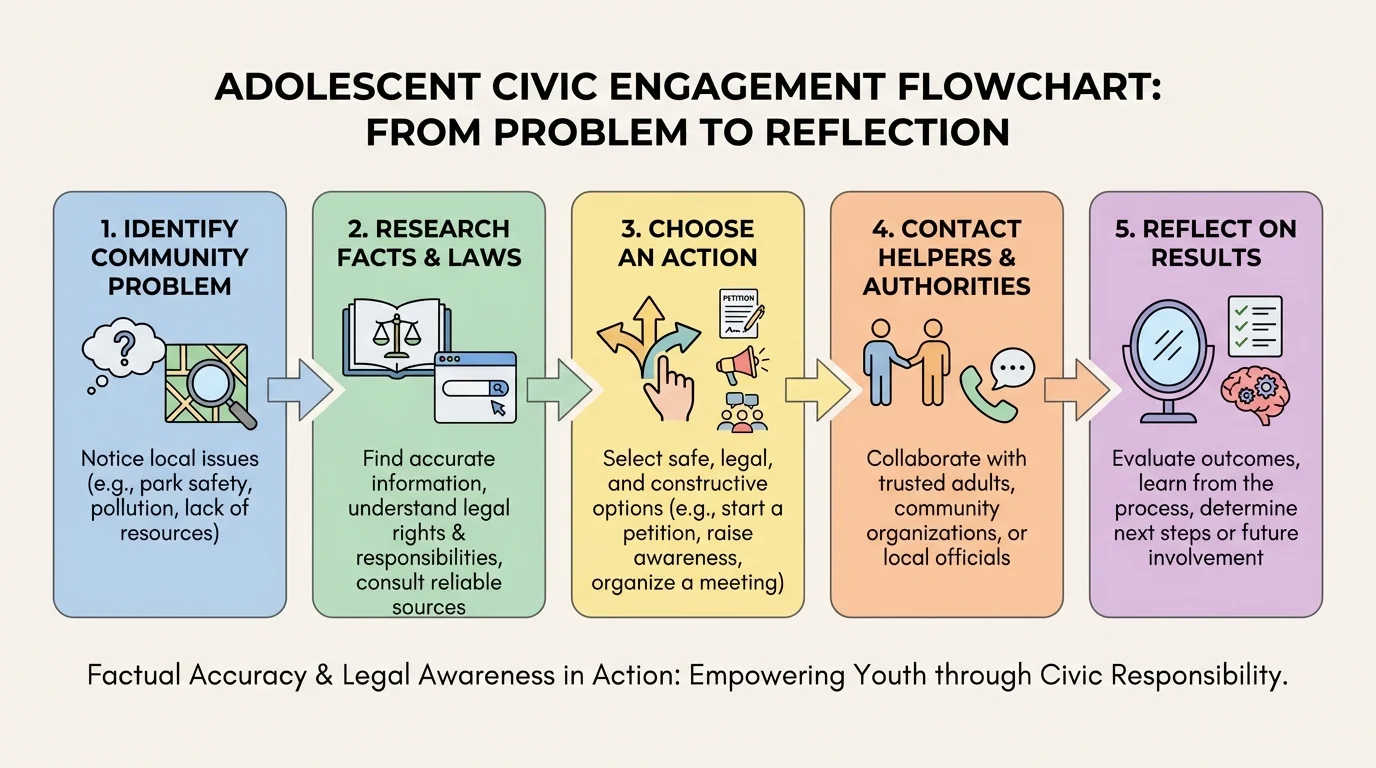
Here is a simple way to act responsibly. Step 1: Notice a real issue. Step 2: Gather accurate information. Step 3: Ask what action is legal, safe, and useful. Step 4: Work with trusted adults or organizations when needed. Step 5: Reflect on whether your action actually helped. This process matters because passion without facts can create new problems.
Online advocacy needs special care. Sharing a hashtag or reposting a video can spread awareness, but it can also spread false claims. Before posting, ask: Who created this? Is there evidence? Is the source reliable? Could this post expose someone's private information? Could it unfairly accuse someone? Responsible civic action includes checking before clicking.
Case study: turning concern into action
A teen notices that many older neighbors struggle to understand online scam messages.
Step 1: Define the problem clearly.
The issue is not just "technology is confusing." The issue is that people may lose money or private information because they cannot identify scam signs.
Step 2: Choose a safe, realistic action.
The teen asks a local library whether a short digital safety workshop for families and seniors could be offered online.
Step 3: Prepare accurate information.
The teen gathers examples from trusted consumer protection websites and creates a short checklist: never share passwords, verify links, ignore urgent money requests, and report suspicious accounts.
Step 4: Work with support.
An adult librarian reviews the materials to make sure the advice is accurate and appropriate.
This is civic engagement because it identifies a community problem and responds in a constructive, lawful, and helpful way.
Civic engagement also means understanding that disagreement is normal. You will not always agree with friends, family members, or people online. A responsible citizen does not need to be silent, but must communicate respectfully, use evidence, and avoid personal attacks. Strong communities do not require identical opinions; they require people who can disagree without causing unnecessary harm.
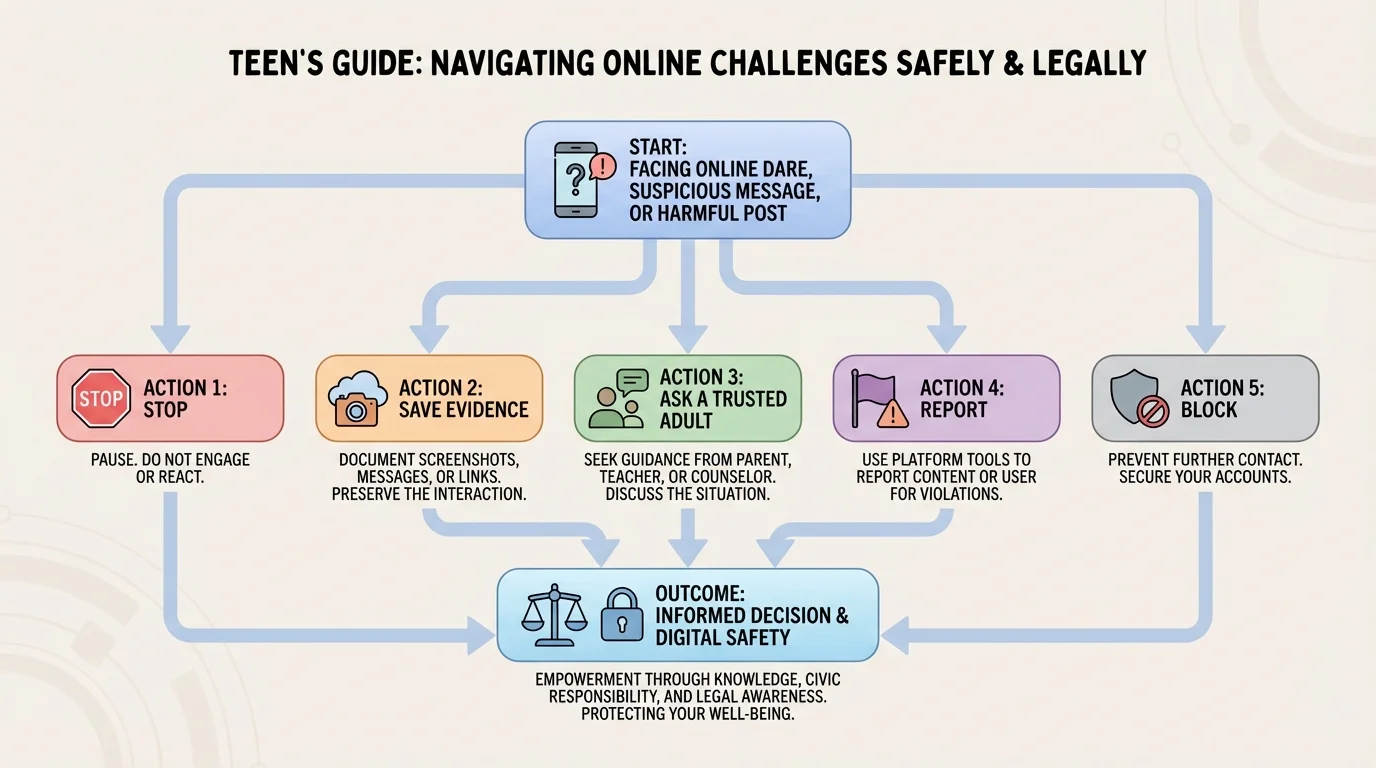
[Figure 3] Many problems start when people assume, "It's online, so it doesn't count," or "We're young, so there are no real consequences." Legal awareness helps you avoid those mistakes. [Figure 3] presents a useful decision path: stop, check safety, consider legality, save evidence, and ask for help when needed. Laws vary by place, but some areas are commonly important for teenagers almost everywhere.
One area is harassment and threats. Repeated cruel messages, doxxing, stalking behavior, fake accounts used to humiliate someone, or threats of violence can become serious legal matters. Another area is theft and property damage. Taking items that are not yours, using someone else's account without permission, or destroying property are not harmless pranks. They can lead to school, platform, family, community, or legal consequences.
A third area is privacy. Recording someone without permission, sharing private information, spreading intimate images, or forwarding screenshots from confidential conversations can violate trust and sometimes the law. Privacy issues are especially serious when they involve minors. A fourth area is fraud and scams. If someone asks you to receive money, forward gift card numbers, share verification codes, or "help" with a suspicious account, step back immediately.
Legal awareness is also about understanding the difference between a rule and a law. A platform may ban certain content even if it is not illegal. A club or workplace may have policies about behavior, attendance, or communication. Breaking a rule may not lead to court, but it can still lead to removal, lost opportunities, or a damaged reputation. Rules matter because they shape real consequences in your daily life.
If you are unsure whether something is legal, that uncertainty itself is a warning sign. Slow down. Do not sign, send, post, or agree until you understand the situation better. Ask a parent, guardian, counselor, program leader, employer, or another trusted adult. If there is immediate danger, contact emergency help. Asking questions early is usually much easier than fixing damage later.
| Situation | Safer civic response | Possible consequence if ignored |
|---|---|---|
| A friend asks you to post someone's address | Refuse, report if needed, protect privacy | Fear, harassment, possible legal trouble |
| You receive a threatening message | Do not reply, save evidence, tell a trusted adult, report | Escalation of harm or lost evidence |
| A group chat shares a fake rumor | Do not forward it, ask for evidence, stop the spread | Damage to someone's reputation |
| You are asked for a password or code | Do not share it, verify with a trusted source | Account theft or fraud |
| You see vandalism or dangerous behavior | Leave the area if unsafe, report to an adult or authority | Injury, property damage, being linked to the event |
Table 1. Common adolescent civic and legal situations, safer responses, and likely consequences.
The decision tree in [Figure 3] is especially helpful when emotions are high. Fear, embarrassment, anger, and peer pressure can make bad choices feel urgent. A pause protects you. Saving screenshots, recording dates and times, and telling a trusted adult can turn a chaotic moment into a manageable one.
When a situation gets confusing, use a simple filter: Is it safe? Is it respectful? Is it legal? Is it truthful? Would I be okay with a trusted adult seeing this choice? If the answer to any of those is no, stop and rethink. That filter is not perfect, but it catches many problems before they grow.
Here is a practical guide for peer pressure. Step 1: Name what is being asked. Step 2: Identify the risk to safety, privacy, reputation, or legality. Step 3: Say no clearly and briefly. Step 4: Leave the chat, call, or place if needed. Step 5: Tell a trusted adult when the risk is serious. You do not need a dramatic speech. A calm response like "I'm not doing that" is often enough.
Scenario: a harmful online dare
A group encourages you to create a fake account to embarrass someone.
Step 1: Recognize the issue.
This is not harmless entertainment. It involves deception, harassment, and possible platform or legal consequences.
Step 2: Refuse without debate.
You can say, "No. I'm not getting involved in that."
Step 3: Protect yourself.
Leave the chat if the pressure continues. Save evidence if the behavior becomes threatening.
Step 4: Report and get help.
If someone is being targeted, tell a trusted adult or use the platform's reporting tools.
This response protects your rights, respects the other person's rights, and reduces your legal risk.
Another decision tool is to separate conflict from harm. Conflict is disagreement. Harm is behavior that threatens safety, dignity, privacy, or property. Not every disagreement needs adult intervention, but harm often does. Learning this difference helps you respond proportionally instead of overreacting or underreacting.
Documentation can matter too. If a serious issue happens online, screenshots, usernames, dates, and message records may help adults or authorities understand what occurred. Do not edit the evidence in misleading ways. Accuracy matters. Honest reporting is part of civic responsibility.
Many people think deleting a post erases the problem, but screenshots, backups, and forwarded copies often remain. That is one reason careful posting matters so much.
If you interact with security staff, police, employers, or program leaders, stay calm and respectful. Ask what is happening. Do not lie or invent details. If you are confused, say so. If the situation is serious, ask to contact a parent or guardian. Legal awareness is not about trying to sound like a lawyer. It is about staying truthful, calm, and careful.
The habits you build now shape your future opportunities. People remember whether you are trustworthy, respectful, and responsible. A reputation for honesty and good judgment can help when you apply for jobs, volunteer roles, leadership positions, internships, or recommendation letters. A reputation for reckless posting, cruelty, dishonesty, or rule-breaking can close doors you have not even seen yet.
Civic engagement also builds confidence. When you help solve a problem, you start to see that communities are not just things adults run in the distance. They are made of people making choices every day. You become one of those people. The process shown earlier in [Figure 2] applies not just to service projects but to future leadership: notice, learn, act responsibly, and reflect.
Legal awareness supports your future too. Understanding contracts, rules, rights, reporting systems, and consequences will matter when you work, travel, drive, vote, rent housing, or use financial services. The basic skills start now: read before agreeing, ask before acting, verify before sharing, and speak up before harm grows.
"Good citizenship is not a single big moment. It is a pattern of everyday choices."
You do not need to know every law to make wise choices. What you do need is a strong habit of pausing, thinking, and acting with respect for yourself and others. When you understand your rights, carry your responsibilities, and stay legally aware, you are not just avoiding trouble. You are building character, trust, and the ability to make a real difference.
