A broken sidewalk, unsafe traffic near an apartment complex, long waits at a health clinic, or harmful content spreading online may seem like separate problems. They are not. They are all examples of issues that affect groups of people, which means they are public issues. The important part is this: public issues do not change only because someone in power notices them. They often change because regular people speak up, organize, share evidence, and keep showing that the problem matters.
You do not need to be old enough to vote to make a difference. Communities are shaped every day by people who answer surveys, report problems, volunteer, attend online meetings, post useful information, support local groups, or contact decision-makers. When people participate, leaders get a clearer picture of what is happening. When people advocate, they push for a response instead of hoping one appears on its own.
If no one reports a dangerous crossing, city leaders may assume it is fine. If no one explains that a public library's schedule makes it hard for teens and working families to use the library, the schedule may stay the same. On the other hand, when a group gathers stories, shares facts, and asks clearly for a solution, the issue becomes harder to ignore. That is why civic engagement is a practical life skill, not just a government topic.
Public issue means a problem or concern that affects many people or the well-being of a community. Community participation is taking part in actions that help identify, discuss, or solve shared problems. Advocacy is actively supporting a cause or solution by speaking up, raising awareness, and encouraging action. A stakeholder is a person or group affected by the issue or involved in decisions about it.
These ideas show up in ordinary life. If your neighborhood park is full of trash, people who use the park are stakeholders. So are sanitation workers, local officials, nearby families, and community groups. Solving the issue may require both participation, such as a cleanup effort, and advocacy, such as asking for more trash bins or more frequent pickup.
Some problems are private, and some are public. If one person loses their headphones, that is private. If many people cannot safely walk to a bus stop because a street has no crosswalk, that is public. Public issues usually affect shared spaces, services, safety, health, fairness, or access. They can be local, like potholes or park safety, or larger, like clean water, housing costs, or internet access.
To evaluate how participation and advocacy influence public issues, you need to ask a few smart questions: Who is affected? Who has the power to act? What evidence shows the issue is real? What action is most likely to help? These questions keep you focused on results instead of just emotion.
Public issues are rarely simple. One problem may have several causes. For example, a lack of recycling bins could be connected to funding, planning, and low public awareness. That means strong civic action usually combines more than one strategy. People may educate the public, collect examples, and ask officials for specific changes at the same time.
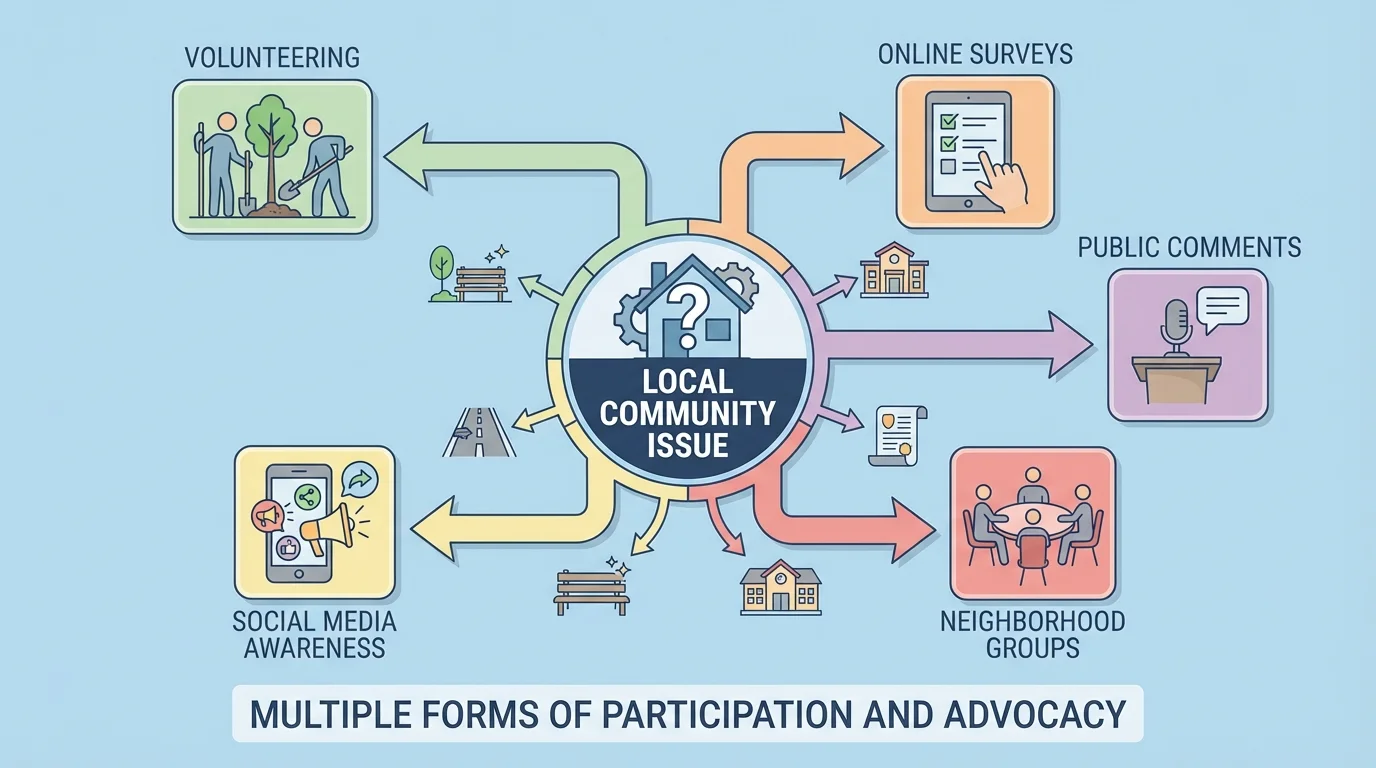
Civic engagement includes everyday actions that help a community function better, and it can take many forms, as [Figure 1] shows through one issue branching into several kinds of action. You might complete a town survey online, join a neighborhood cleanup, help a food pantry, attend a virtual community meeting, report a broken streetlight, or support a youth advisory group. Participation is not always dramatic. Often, it is small, steady, and useful.
One strength of participation is that it gives leaders information they may not already have. A local department may not know that a bus stop lacks shade unless riders mention it repeatedly. A recreation center may not realize families need later hours unless people respond to surveys or share their experiences. Participation turns private frustration into public evidence.
Another strength is that participation builds trust and connection. When people work together, they are more likely to understand different needs and support realistic solutions. A community garden project, for example, does more than grow food. It can also strengthen relationships, teach responsibility, and show leaders that residents are willing to help maintain shared spaces.
Participation also has limits. Cleaning a park once is helpful, but it may not solve why trash builds up in the first place. Reporting one problem is useful, but it may not create long-term change unless others report similar concerns too. This is where participation often needs advocacy.
Many community changes start with small acts that seem almost too simple, like repeated complaint reports, a short survey, or a few photos documenting a problem over time. Decision-makers often respond more quickly when people provide specific, organized evidence instead of only general frustration.
You can think of participation as helping the community show the problem clearly. It creates visibility, proof, and momentum. Without that foundation, advocacy can sound emotional but unsupported.
Advocacy goes a step further than participation. It is not just joining in; it is pushing for a change. Advocacy can include starting an awareness campaign, contacting a city council member, writing a respectful email to a department, starting a petition, speaking during a public comment period online, or sharing stories that help others understand why the issue matters.
Good advocacy is usually specific. Saying "Do better" is weak because it gives no clear path. Saying "Please add a marked crosswalk and flashing signal near the community center because families cross there daily and near misses have been recorded" is much stronger. Specific advocacy gives decision-makers something they can actually consider.
Advocacy also works by shaping public attention. If many people begin discussing a problem online, local media may cover it. Once more people know about it, officials often feel more pressure to respond. This does not mean online attention solves everything. It means visibility can move an issue from ignored to urgent.
Participation and advocacy work best together. Participation gathers information, builds relationships, and shows that people care. Advocacy uses that foundation to ask for change clearly and publicly. If you advocate without facts, your message may be ignored. If you participate without advocating, the root problem may stay in place.
Advocacy can be individual or collective. One person can report a problem or send an email, but a group often has more influence. That is because groups can combine stories, divide tasks, and show that the issue affects more than one person. This is sometimes called a coalition, a partnership of people or organizations working toward the same goal.
[Figure 2] Change often happens through a chain reaction that can move concern from a noticed problem to a real response. A person notices an issue. Several people share similar experiences. The problem gets documented with photos, stories, or survey results. Community members speak up. More people pay attention. Leaders realize the issue matters to the public. A department studies it, adjusts a rule, changes a service, or proposes a policy.
Some influence is direct. For example, residents email the parks department asking for more lights, and the department installs them. Some influence is indirect. For example, a youth group posts data about unsafe roads, local news covers the issue, and then transportation officials schedule a review. The path is longer, but the public pressure still matters.
Community action can influence several kinds of outcomes: services, rules, budgets, public awareness, and behavior. A campaign about littering may not change a law, but it may change behavior. A petition about library hours may not succeed immediately, but it may influence future planning. A volunteer drive may not end poverty, but it can meet urgent needs while larger solutions are discussed.
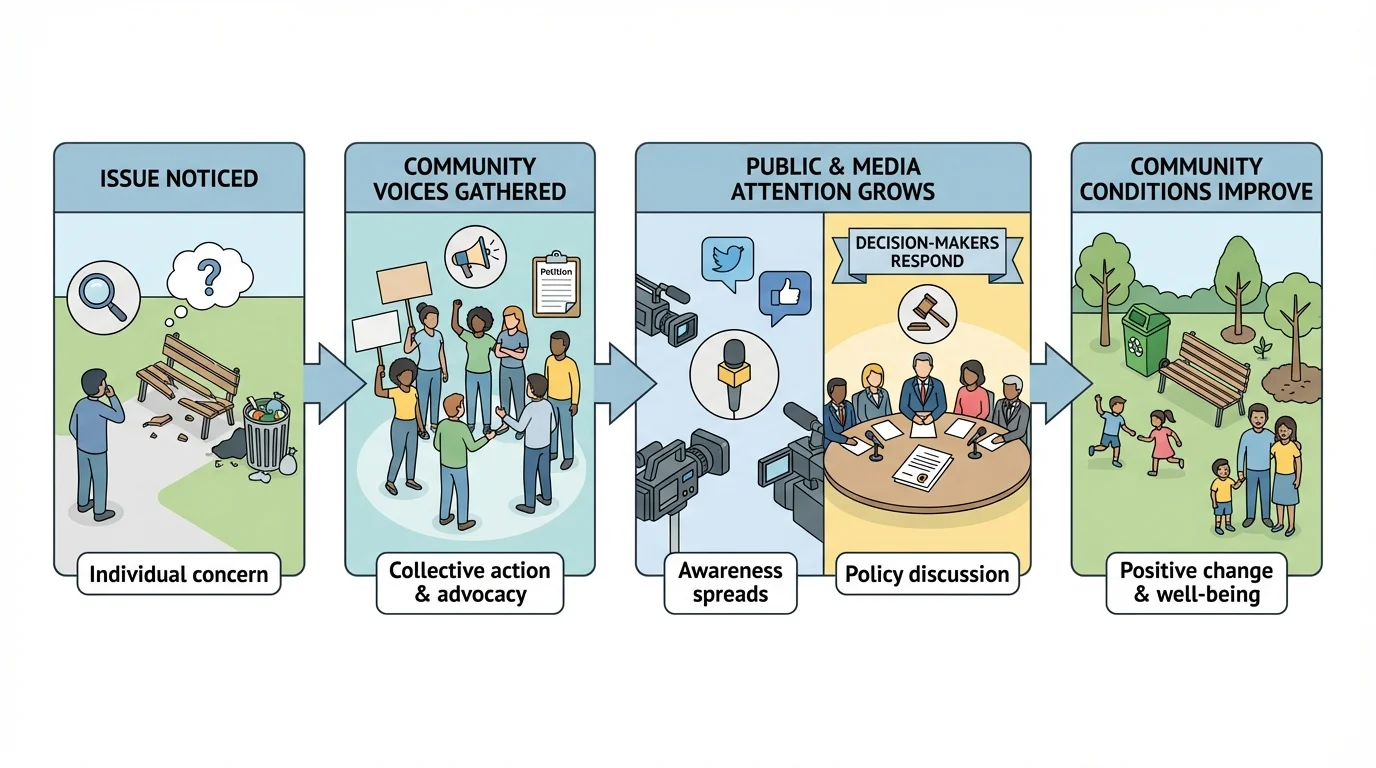
This is why evaluating impact means looking beyond one final win or loss. Sometimes the result is immediate action. Sometimes the result is more attention, more evidence, or stronger networks for future work. Those are still meaningful outcomes.
Think back to the multiple-action pattern in [Figure 1]. One report alone might be ignored, but reports plus volunteer efforts plus public comments create a stronger case. Public issues often shift when many small actions connect.
Not every campaign works equally well. Effective advocacy usually includes a clear goal, reliable information, respectful communication, and persistence. If the goal is too vague, people may support it emotionally but not know what to do. If the facts are weak, opponents can dismiss it. If the tone is insulting, decision-makers may stop listening.
Strong advocacy often follows this pattern: define the problem, gather evidence, identify the right audience, make a specific request, and follow up. For example, if a teen group wants better lighting in a public basketball area, they might collect photos, note the times when the area becomes unsafe, ask neighbors for input, and send a short message to the parks department requesting lights or maintenance.
Timing matters too. Officials are more likely to listen when a budget is being reviewed, when public comments are being accepted, or when a department is already discussing related topics. Persistence matters because many issues are not solved after one message. Respectful follow-up can keep an issue visible without becoming harmful or aggressive.
Case study: advocating for safer walking routes
A student notices that families cross a busy road near a community center without a safe marked crossing.
Step 1: Gather evidence
The student and family members take photos from public areas, note busy times, and collect comments from neighbors who use the route.
Step 2: Identify who can act
They find the local transportation department and the public comment email listed on the city website.
Step 3: Make a specific request
They ask for a crosswalk review, clearer signage, and traffic-calming measures instead of sending only a general complaint.
Step 4: Build support
More residents send similar messages and attend an online community meeting.
Step 5: Track results
The issue is added to a review list. Even before construction begins, the group has moved the problem into the official decision process.
This is effective because it combines evidence, participation, and advocacy.
Another key factor is credibility. If you exaggerate, share false claims, or repost unverified information, people may stop trusting your message. This is especially important online, where misinformation can spread fast.
Misinformation can damage a cause even when the original goal is good. Before reposting a claim, check whether it comes from a reliable source. Look for official statements, local reporting, or direct evidence. If you make a mistake, correct it quickly. Being accurate is part of being responsible.
Privacy matters too. If you share stories or photos, make sure you are not exposing someone's personal information without permission. Posting a picture of a public pothole is different from posting someone's address, face, or personal details. Responsible advocacy protects people while addressing the issue.
Legal awareness matters because not every action is allowed everywhere. Peaceful public action, online comments, reporting systems, and volunteering are common and often appropriate, but trespassing, harassment, threats, vandalism, or doxxing are never acceptable ways to support a cause. A good goal does not make harmful behavior okay.
It is also important to understand limits. Some issues involve budget shortages, legal rules, or long approval processes. That does not mean advocacy failed. It means change may take time, more evidence, or a different strategy. Evaluating influence honestly means noticing both progress and obstacles.
Responsible communication still matters when you care deeply. Clear facts, calm language, and respect for other people's rights make your message stronger, not weaker.
Finally, not every issue needs the same response. If a family needs immediate food support, volunteering or donating may help faster than a long campaign. If a service is unfair over time, advocacy may be more useful. Many public issues need both immediate help and long-term change.
Effective civic action works best when you follow a sequence of decisions, and [Figure 3] lays out a practical path from concern to action. This keeps you from jumping straight into posting or arguing before you know what the real problem is.
Step 1: Choose one issue. Pick something specific and real. "The world has problems" is too broad. "The local park has broken lights" or "our area needs better access to recycling bins" is focused enough to act on.
Step 2: Learn the facts. Find out what is already known. Who is affected? How often does it happen? Is anyone already working on it? Reliable facts keep your effort grounded.
Step 3: Set a realistic goal. Your goal should be clear and measurable. "Raise awareness" can be part of a plan, but a stronger goal is "get the parks department to inspect broken lights this month."
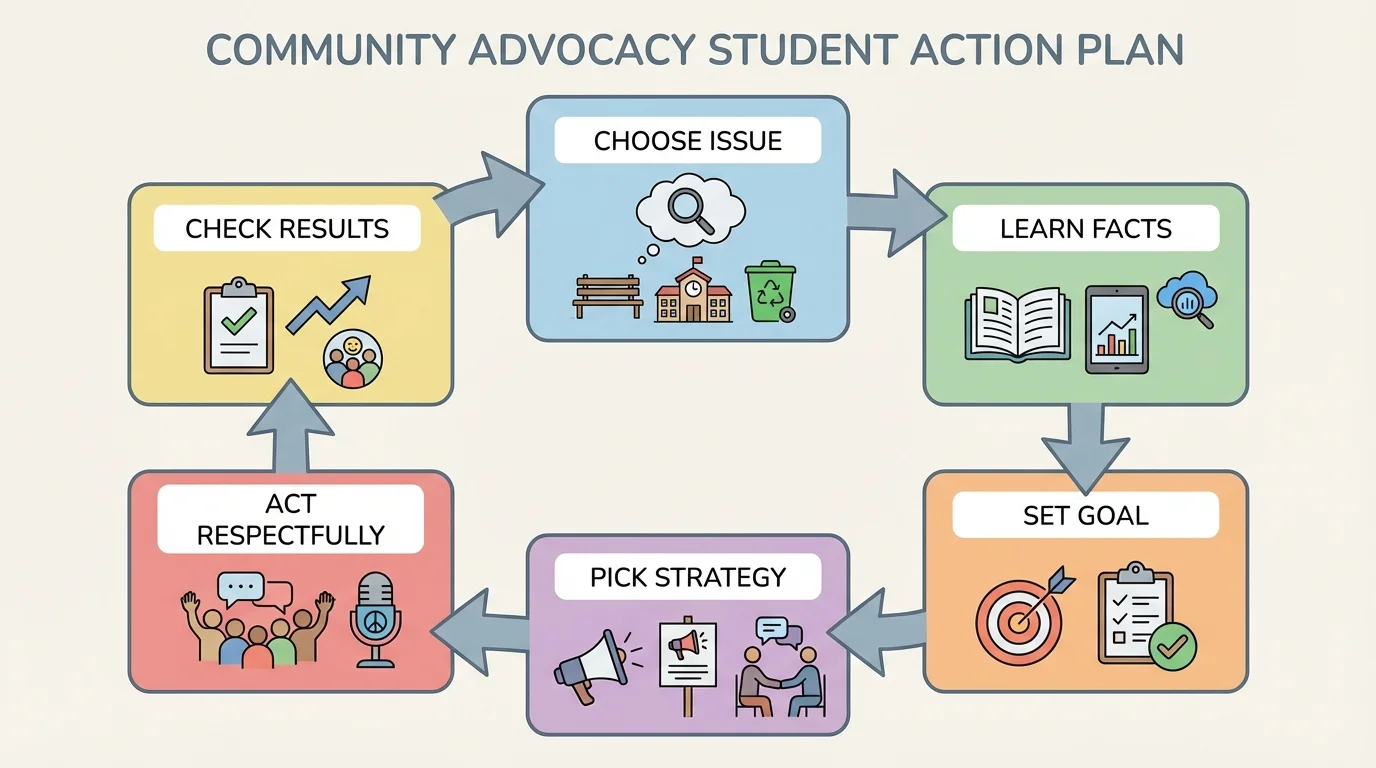
Step 4: Pick the best strategy. If the issue needs immediate help, volunteer or organize support. If the issue needs a rule or service change, contact decision-makers, join a local group, or create a respectful awareness campaign.
Step 5: Communicate clearly. Keep your message short, factual, and specific. Say what the issue is, who it affects, and what action you are requesting.
Step 6: Work with others. If possible, join people already involved. A group often has more time, knowledge, and influence than one person acting alone.
Step 7: Review the results. Did anyone respond? Was the issue studied? Did awareness increase? Did conditions improve? As we saw in [Figure 2], influence can happen in stages, so checking progress matters.
A teen notices repeated bullying in a community gaming server connected to a local youth program. Participation might mean reporting incidents, helping write better community guidelines, and supporting targets of harassment. Advocacy might mean asking program leaders to create clearer moderation rules and safer reporting systems. The issue is public because it affects the well-being of many users in a shared space.
Another student sees that the local library closes before many working families can visit. Participation could include answering library surveys and collecting comments from residents. Advocacy could include writing to the library board and asking for one later evening each week. Even if the board cannot change hours immediately, the request may shape future planning.
In another case, residents are upset about litter around an apartment area. Participation might include cleanup events and reporting overflowing bins. Advocacy might focus on asking property managers or local officials to add more bins and improve collection schedules. Looking back at [Figure 1], you can see why combining several forms of action usually works better than relying on only one.
These examples show an important idea: community participation often helps manage the present, while advocacy often helps improve the future. Both matter.
When deciding what to do, match the strategy to the problem. If people need urgent support, direct service may matter most. If the issue keeps repeating, long-term advocacy may be necessary. If leaders say they need proof, gather evidence. If they already know the problem but are moving slowly, public attention and follow-up may help.
| Situation | Useful Participation | Useful Advocacy |
|---|---|---|
| Unsafe traffic area | Report incidents, attend meetings, collect observations | Request crosswalks, signage, or traffic review |
| Park litter | Cleanup events, report overflow, organize volunteers | Ask for more bins or schedule changes |
| Limited library access | Complete surveys, gather user feedback | Request extended hours or pilot schedule changes |
| Harmful online community behavior | Report issues, support targets, suggest rules | Push for stronger moderation and safer systems |
Table 1. Comparison of participation and advocacy strategies for common public issues.
Sometimes the best evaluation question is not "Did we win right away?" but "Did our actions move the issue forward?" If the answer is yes, then participation and advocacy have already had influence. Public issues often change slowly, but they usually do not change at all unless people stay involved.
"The most common way people give up their power is by thinking they do not have any."
— Alice Walker
Your voice is strongest when it is informed, respectful, and connected to action. You do not need to solve every problem. But you can learn to notice issues, understand who is affected, choose a smart response, and help push your community toward something better.
