A lot of people think independence suddenly appears when you get older, get a job, or start college. It does not. Independence grows from small choices you make now: replying to an email, remembering a deadline, asking for help before a problem gets worse, and keeping track of your own responsibilities. Those skills may seem simple, but they are the difference between feeling prepared and feeling constantly behind.
If you learn these habits in grade 9, you give yourself a major advantage. Whether your future includes college, technical training, work, military service, entrepreneurship, or something you have not even discovered yet, the same core skills matter: responsibility, communication, planning, and follow-through. These are not just "school skills." They are life skills.
Right now, you are already making choices that affect your future. When you manage your time well, adults learn they can trust you. When you communicate clearly, problems get solved faster. When you plan ahead, you have more options later. On the other hand, when you wait until the last minute, ignore messages, or stay silent when you need support, opportunities can close quickly.
Think about two students in an online course. Both are capable. One notices confusion early, messages the teacher, updates a calendar, and finishes tasks on time. The other gets stuck, says nothing, forgets due dates, and hopes things will work out. The first student is practicing habits that lead to independence. The second student is leaving important parts of life to chance.
Independence means being able to manage your responsibilities, make informed choices, and take action without needing constant reminders. Self-advocacy means understanding your needs and speaking up respectfully to get support, clarification, or access. Future planning means thinking ahead about goals and taking practical steps now to prepare for them.
These three ideas connect. The more independent you become, the better you can speak up for yourself. The better you can self-advocate, the easier it is to make good plans and get support for your future.
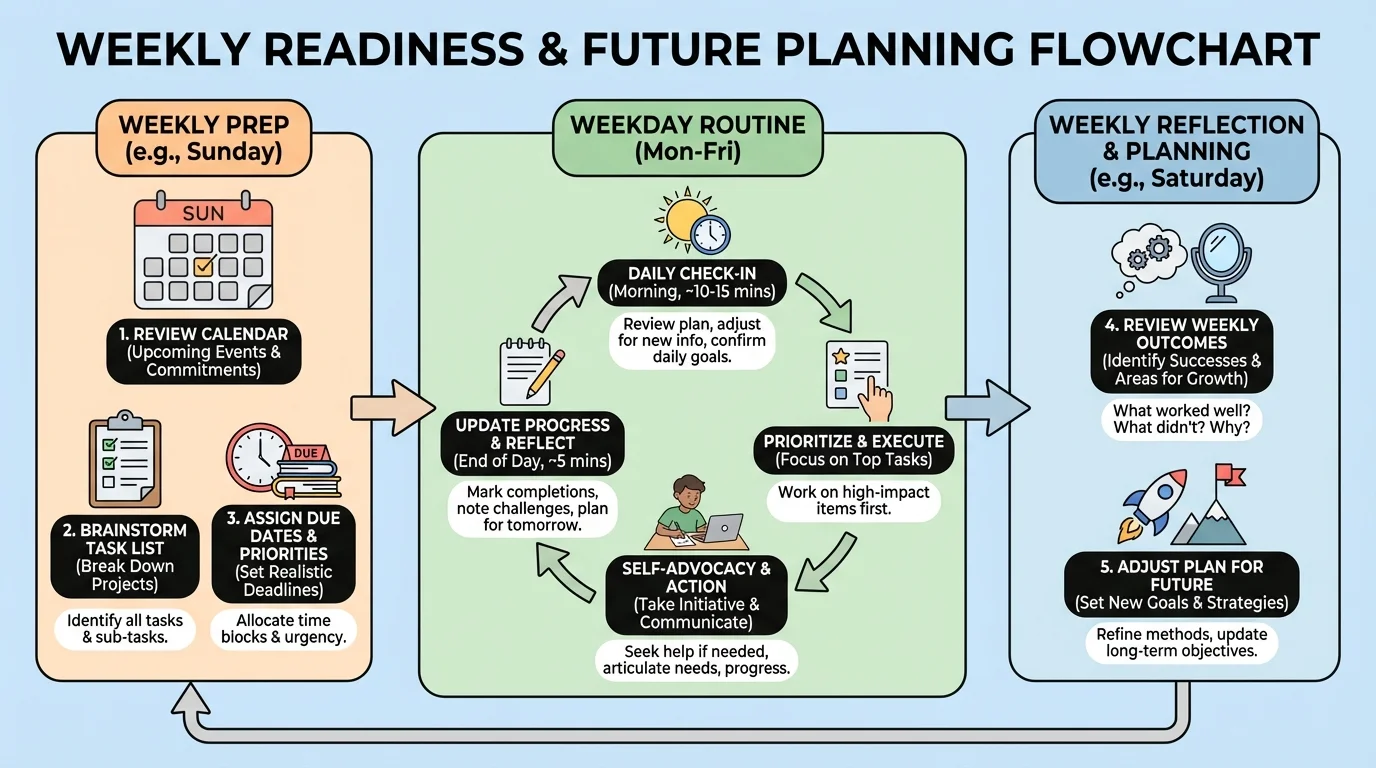
Routine is one of the strongest tools for independence. A simple weekly system, as shown in [Figure 1], helps you see what needs to be done, when it is due, and what should happen first. Independence is not doing everything alone; it is knowing how to manage what is yours.
Start with the basics: wake-up time, coursework, chores, exercise, meals, family responsibilities, and personal goals. If your week is unplanned, it fills up with distractions. If your week has structure, you have a better chance of finishing what matters. You do not need a perfect system. You need one you will actually use.
A practical independence system includes four parts:
For example, if you have a science assignment due Thursday, a club meeting online Wednesday evening, and a family responsibility Friday afternoon, put all of those in one place. Then break the assignment into smaller parts: research on Monday, outline on Tuesday, draft on Wednesday, final check on Thursday. That is how big tasks become manageable.
Responsibility also includes things people do not always notice right away: charging your device, checking your internet connection before a live session, keeping passwords secure, and reading directions fully before starting. These actions may seem minor, but they affect how dependable you are.
Another part of independence is doing what needs to be done even when you do not feel like it. Motivation changes from day to day. Responsibility means using habits instead of waiting for the perfect mood. A strong question to ask yourself is: What is the next right step? That question keeps you moving.
Example: Turning a stressful week into a workable plan
You have three assignments, one virtual appointment, and chores at home. Instead of saying "I have too much to do," you can organize it.
Step 1: List everything in one place.
Write down all tasks, appointments, and responsibilities.
Step 2: Mark what is due first.
Put the earliest deadlines and fixed-time events at the top.
Step 3: Break large tasks into smaller actions.
For example: open assignment, read directions, gather materials, complete first section, revise, submit.
Step 4: Match tasks to realistic times.
Do not schedule five hours of work in a one-hour block.
Step 5: Review at the end of the day.
Move unfinished tasks forward instead of pretending they disappeared.
This turns stress into a plan, and a plan is easier to act on.
When you use a system like the one in [Figure 1], you are practicing a skill that will matter in college, training programs, jobs, and adult life. People who manage themselves well are trusted with more freedom.
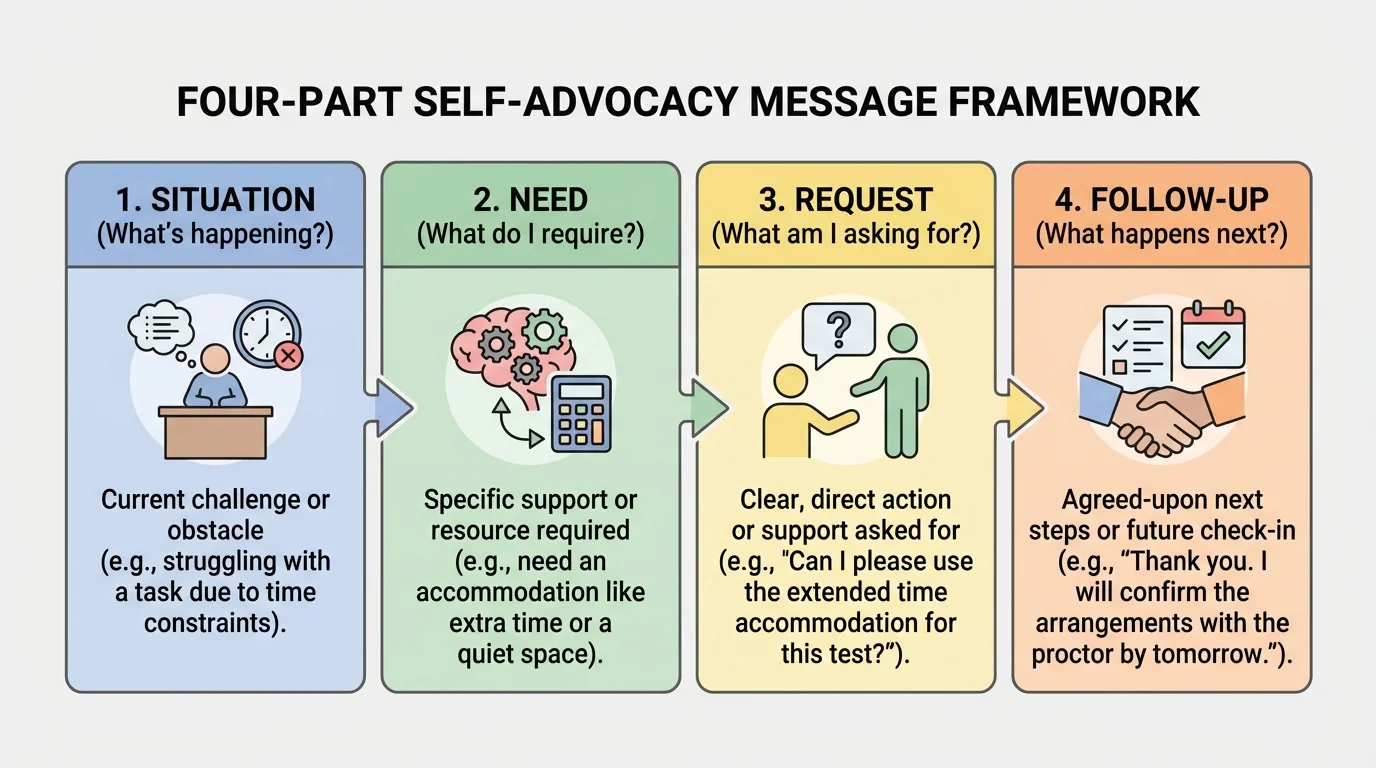
Self-advocacy does not mean demanding your way. It means understanding what is happening, knowing what you need, and communicating clearly and respectfully. As shown in [Figure 2], a simple message structure can make asking for help much less stressful.
Many students stay silent because they worry about sounding weak, annoying, or unprepared. But asking for clarification early is usually a sign of maturity. It shows that you are paying attention and trying to solve a problem before it grows.
Good self-advocacy usually includes four parts:
Here is a strong example of an online message: "Hello, I reviewed the assignment directions and I am confused about the second part. I understand the topic, but I am not sure what format you want. Could you clarify whether I should write a paragraph or make a slide? Once I know the format, I can finish it today." That message is clear, respectful, and specific, and the four-part structure is summarized in Figure 2.
Compare that to a weak message: "I do not get this." The second message gives almost no useful information. If you want useful help, ask useful questions.
Self-advocacy also includes knowing your rights and responsibilities. If you need extra time, a quieter workspace, written directions, or another type of support, you should be able to explain what helps you learn best. At the same time, you still have the responsibility to try, communicate early, and follow through.
The difference between excuses and advocacy
An excuse avoids responsibility: "I could not do it, so I gave up." Advocacy accepts responsibility while asking for support: "I started the task, got stuck on a specific step, and I need clarification so I can complete it." The second response is much stronger because it shows effort, awareness, and action.
Self-advocacy matters outside school too. You might need to ask a coach about expectations, tell a doctor about symptoms, explain your availability to an employer, or set a boundary with a friend online. In each situation, the goal is the same: be honest, calm, clear, and respectful.
If speaking up feels hard, use this sentence starter: "I understand ___, but I need help with ___ so I can ___." That pattern works in many situations. As you grow older, people will expect you to explain your needs more directly. Practicing now makes that much easier.
Independent people do not always make perfect choices. They make thoughtful ones. That means slowing down enough to consider options, consequences, and next steps.
A useful decision-making method is:
Suppose your internet stops working before a live class. Panic does not help. A better response is to define the problem, contact the teacher or support person, use a backup device if possible, check for a recording, and ask for any missed directions. That is problem-solving.
Consequence is an important word here. A consequence is the result of an action or choice. Some consequences are immediate, like losing points for late work. Others are long-term, like gaining a reputation for being dependable or unreliable. Your choices build patterns, and patterns build your future.
Employers and colleges often care as much about reliability, communication, and follow-through as they do about talent. A person with strong habits is easier to trust than a person with strong potential but weak follow-through.
One powerful habit is learning to pause before reacting. If you are upset, embarrassed, or frustrated, do not send the first message that comes to mind. Read it again. Remove blame. State facts. Ask for what you need. Calm communication protects relationships and solves problems faster.
Independence does not mean doing life alone. Strong, independent people know how to use support wisely. Your support system may include family members, teachers, counselors, coaches, mentors, employers, faith leaders, tutors, or leaders in community programs.
Think of your support system as a team with different strengths. One person might help you with planning. Another may give career advice. Another may encourage you when you feel stuck. Knowing who to contact for different needs is a real-life skill.
Community connections matter because they help you learn how the world works beyond your home. Volunteering, joining a club, taking lessons, participating in local events, or helping with a community project can build responsibility and confidence. These experiences also help you discover your interests.
Your online presence is part of this too. How you write messages, comment in digital spaces, and present yourself on social media can affect opportunities. Being respectful online, avoiding harmful posts, and thinking before sharing are part of future readiness. Digital choices create real-world impressions.
| Situation | Unprepared Response | Ready Response |
|---|---|---|
| Missed a deadline | Ignore messages and hope it is forgotten | Send a respectful message, explain briefly, ask about next steps, and make a catch-up plan |
| Confused by directions | Wait until the last minute | Ask a specific question early |
| Interested in a career | Do nothing and just wonder about it | Research it, talk to an adult, and look for a related activity |
| Feeling overwhelmed | Quit everything at once | Prioritize, ask for support, and do one next step |
Table 1. Comparison of unprepared and ready responses in common real-life situations.
Notice that the ready response is rarely dramatic. It is usually simple, honest, and proactive. That is what maturity looks like in everyday life.
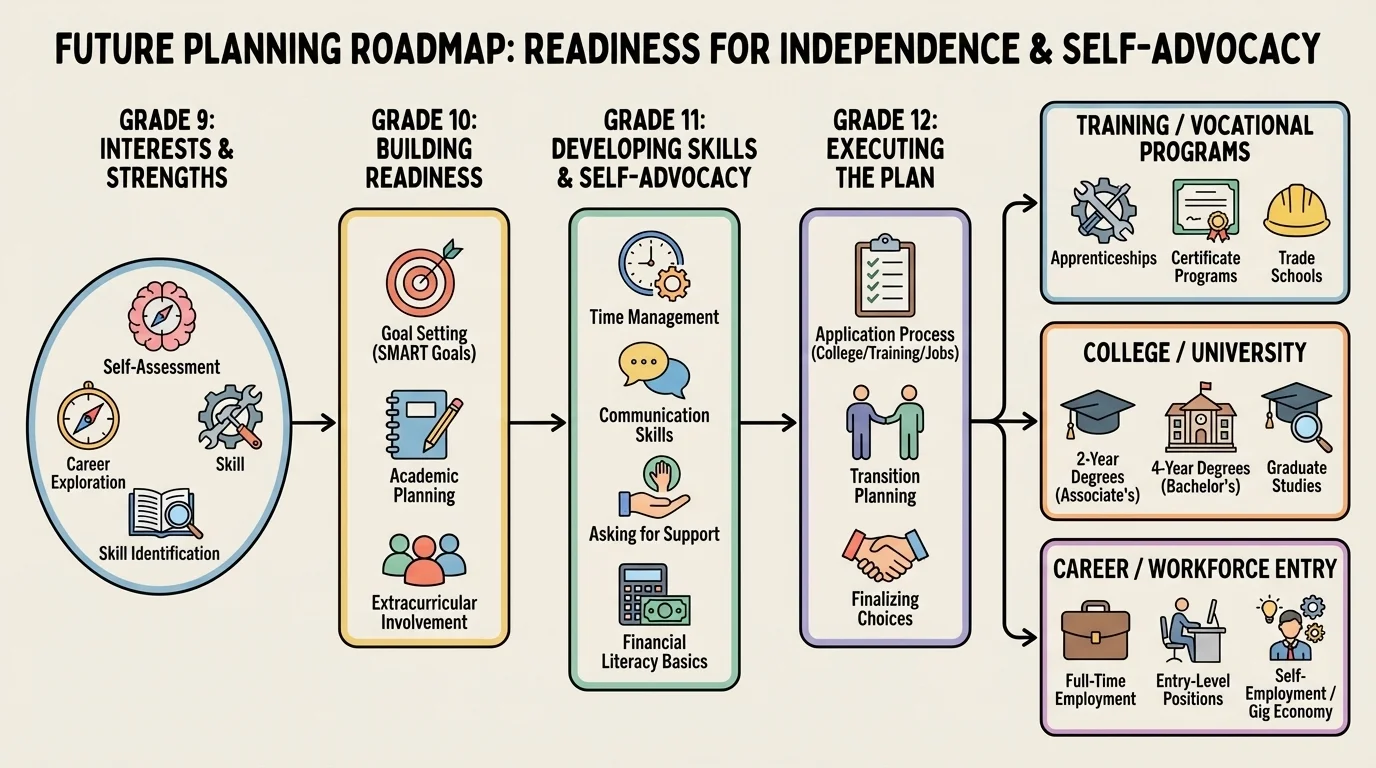
Post-secondary planning means thinking about what comes after high school and preparing in stages, not all at once. A roadmap like the one in [Figure 3] works because big goals become smaller steps you can actually take.
You do not need your whole future figured out in grade 9. Very few people do. What you do need is a growing sense of your strengths, interests, values, and options. Future planning is less about having one perfect answer and more about staying curious, prepared, and flexible.
Start by asking yourself practical questions:
Then begin exploring. Watch career videos, read about training programs, learn what different jobs involve, and talk to adults about their paths. Some careers require a four-year college. Others involve community college, apprenticeships, technical schools, certifications, military training, or direct entry into work with on-the-job learning.
Future readiness also means understanding that choices have requirements. If a program needs strong writing, math, attendance, or organization, then those are not random school demands. They are practice for later expectations. The habits you build now become evidence that you can handle more responsibility later.
A smart future plan includes short-term, medium-term, and long-term goals. Short-term goals might be checking grades weekly or improving email habits. Medium-term goals might be joining an activity related to your interests or building a simple resume. Long-term goals might include graduating, applying to a program, or getting a part-time job.
Example: Turning a future goal into present actions
Suppose you think you might want to work in health care, technology, education, or skilled trades, but you are not sure which path fits best.
Step 1: Identify interests.
Write down what kinds of tasks you enjoy, such as helping people, solving technical problems, building things, or organizing information.
Step 2: Explore options.
Research at least a few careers that match those interests and notice what education or training they require.
Step 3: Build matching skills now.
If you are interested in technology, practice digital organization and problem-solving. If you are interested in health care, build communication and responsibility.
Step 4: Track your progress.
Keep notes on what excites you, what seems difficult, and what you want to learn more about.
This approach helps you move from vague ideas to informed choices.
As you saw in [Figure 3], planning ahead does not lock you into one future. It gives you direction while leaving room to adjust. Good planning is flexible, not rigid.
Readiness depends on systems, not memory alone. If you rely on "I will remember," important details will eventually slip. Personal systems reduce stress because they do the remembering for you.
Useful systems include:
These systems make a big difference later. College applications, job forms, scholarships, volunteer opportunities, and training programs often require documents, deadlines, and communication. Being organized saves time and prevents avoidable mistakes.
"The future depends on what you do today."
— Mahatma Gandhi
That quote matters because future success is rarely built in one dramatic moment. It is built through repeated actions: reading instructions carefully, turning things in on time, asking thoughtful questions, and staying consistent.
No matter how responsible you are, mistakes will happen. You may forget something, miss a deadline, misunderstand directions, or feel overwhelmed. What matters most is how you respond next.
A strong recovery plan has three parts: own it, communicate, adjust. First, admit the mistake without hiding or blaming. Second, contact the right person respectfully and explain the situation briefly. Third, make a plan so it does not keep happening.
For example: "I missed the deadline because I tracked it incorrectly in my calendar. I am sorry. I have completed the work now and would like to know if I can still submit it. I have also updated my planning system so I do not repeat this mistake." That kind of response shows accountability.
Think back to any time you improved at something difficult. Growth probably did not happen because everything was easy. It happened because you noticed mistakes, adjusted, and kept going. Readiness skills work the same way.
Being flexible is part of independence too. Sometimes your first plan will not work. That does not mean you failed. It means you need a new strategy.
Confidence is not pretending you have everything figured out. Real confidence comes from knowing you can handle challenges, ask questions, solve problems, and keep learning. Every time you plan ahead, communicate clearly, or follow through on a responsibility, you strengthen that confidence.
You do not become ready for the future all at once. You become ready by practicing readiness. You build it in your schedule, in your messages, in your decisions, and in how you recover from setbacks. These habits make you more capable now and more prepared for whatever comes next.
Start small, but start seriously. Check your calendar. Organize your files. Ask one clear question when you need help. Track one goal for the week. Those actions may look ordinary, but they are exactly how independence grows.
