Some people work hard every day and still end up moving in the wrong direction. That happens when a goal looks impressive but does not actually fit the person's life. A goal is not just something you want. It is something you choose to work toward on purpose. The strongest goals match who you are, what you are responsible for, and where you want your life to go.
Even now, you are already making choices that shape your future. You may be deciding how to use your time, what activities matter most, how seriously to take school, how to manage your health, or how to build trust with family and other people. A goal that aligns well can help you feel focused and confident. A goal that does not align can create stress, guilt, and burnout.
Goal alignment means making sure your goals fit your personal values, your responsibilities, and your future plans.
Values are the principles and priorities that matter most to you, such as honesty, growth, family, health, creativity, or service.
Responsibilities are the duties and commitments you need to follow through on, such as schoolwork, family tasks, caring for your health, or keeping promises.
Future plans are the longer-term directions you may be aiming toward, such as a job, college, training program, independent living, or a certain lifestyle.
When these three parts work together, your goals feel more solid. You do not have to guess whether a goal is "good enough." You can test it. Ask: Does this fit what matters to me? Does it work with my actual life? Does it help me move toward the future I want?
A goal can fail for two very different reasons. First, it may be too vague. Second, it may be clear but still be the wrong fit. For example, "I want to become popular online" is a goal idea, but it may clash with your value of privacy, your responsibility to complete coursework, or your future plan to build a strong portfolio in a different area. Even if you work hard, the goal may pull you away from what really matters.
On the other hand, a goal like "I will improve my time management so I submit my assignments on time and still have energy for family responsibilities and exercise" fits much better. It connects to values like responsibility and health. It respects your schedule. It also supports future plans because learning to manage time now helps with jobs, college, and adult life later.
Aligned goals help you make decisions faster. If a new opportunity appears, you can ask whether it supports or distracts from your direction. That saves time and lowers stress. Instead of chasing every exciting option, you build a life that makes sense for you.
Many adults change goals not because they are lazy, but because they finally notice a mismatch. A goal can sound impressive from the outside and still be a poor fit for the person living it every day.
That is why goal setting is not about copying what friends, influencers, or relatives think you should want. Advice can help, but your goals need to be grounded in your own life.
Your values act like a compass, and [Figure 1] shows how one value can lead to different goal choices. If you skip this step, you may choose goals based only on pressure, trends, or fear of falling behind. That can leave you feeling unmotivated, even when you technically succeed.
To find your values, think about moments when you felt proud, calm, or deeply satisfied. What was happening? Maybe you were helping a younger sibling, finishing a hard assignment, creating music, staying consistent with exercise, or speaking honestly in a difficult conversation. Those moments reveal what matters to you.
Common values for teenagers include independence, loyalty, family, creativity, kindness, achievement, health, faith, learning, fairness, and service. You do not need a long list. In fact, choosing your top three to five values is more useful than listing twenty.
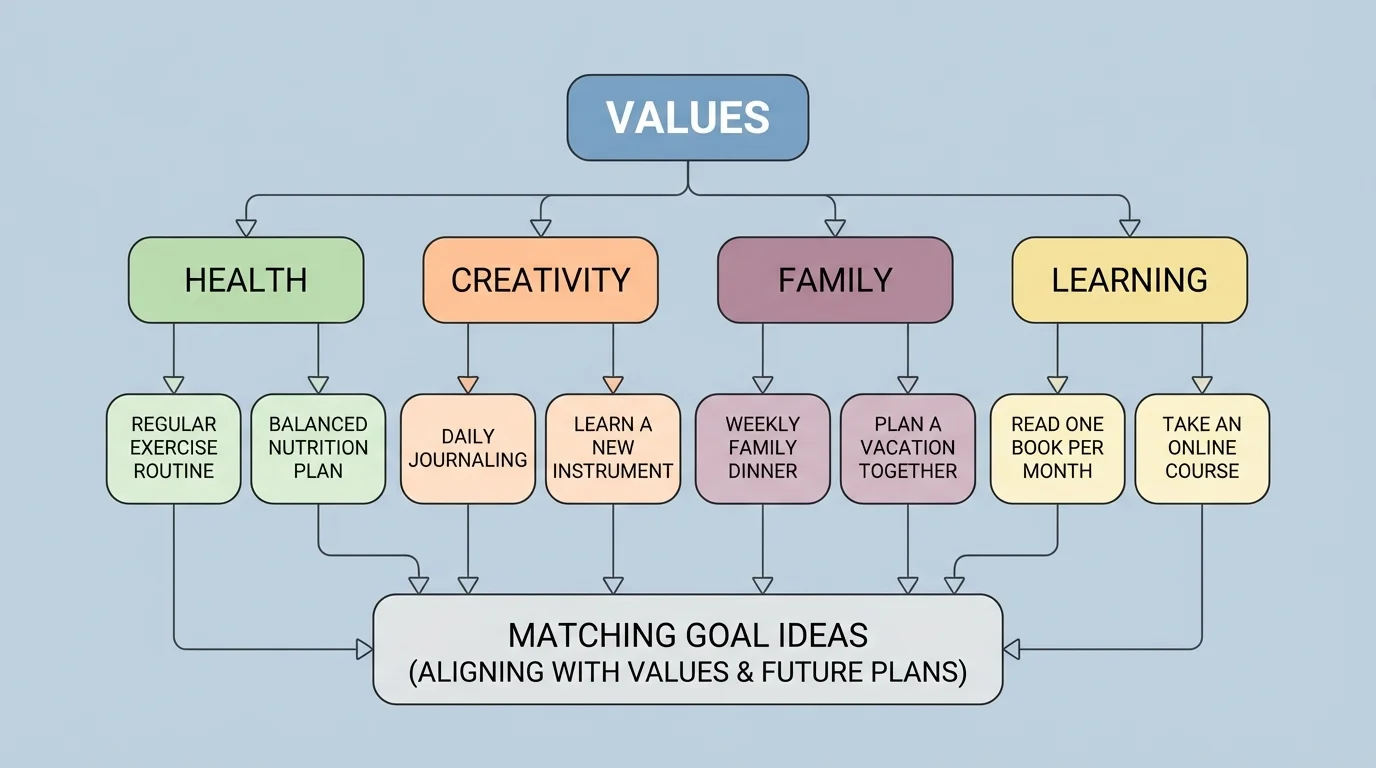
Here is how values shape goals. If you value health, a matching goal might be cooking one simple healthy lunch three times a week or going for a 20-minute walk five days a week. If you value creativity, a matching goal might be posting one original art piece or song draft online each month. If you value family, a matching goal might be helping with a regular household task without being reminded.
Values also help when two goals sound equally good. Suppose you can either spend two hours scrolling through content about careers or spend those two hours building one real skill, such as video editing, coding, or writing. If one of your values is growth, the skill-building choice likely fits better.
Be honest here. Your real values are shown more by your actions than by what sounds nice. If you say you value learning but avoid effort every time work gets hard, that is useful information. It does not mean you failed. It means your goals may need to include better systems, smaller steps, or stronger motivation.
Values are not the same as goals. A value is an ongoing direction. A goal is a specific target. For example, "health" is a value. "Sleep at least 8 hours on school nights for the next 3 weeks" is a goal. Values give meaning. Goals give structure.
Once you know your values, your goals become easier to defend. If someone questions why you are spending time on a certain habit or project, you can explain it clearly: it supports something important in your life.
A good goal should challenge you, but it should also respect your responsibilities. This is where many people get stuck. They set goals as if they have unlimited energy, unlimited time, and no other duties. Real life does not work that way.
Your responsibilities might include completing online coursework, helping around the house, caring for siblings, attending appointments, participating in community activities, managing your own hygiene and sleep, or keeping commitments you already made. These responsibilities are not obstacles to "real" goals. They are part of your real life, so they must be part of your planning.
For example, suppose you want to start a small online business selling handmade items. That might be exciting and useful. But if you ignore school deadlines, stop helping at home, and stay up too late packing orders, the goal is not aligned. The goal itself is not bad. The way it fits into your life is the problem.
A more aligned version might be: "I will test one product idea this month by making two sample items on weekends after finishing my schoolwork." That version still moves you forward, but it does not pretend you are free every hour of every day.
Responsibilities also include responsibility to yourself. That means sleep, nutrition, exercise, rest, and mental health matter. A goal that destroys your health is not a successful goal, even if you achieve it. Pushing yourself sometimes is part of growth. Constant exhaustion is not.
| Type of responsibility | Examples | How it affects your goal |
|---|---|---|
| School | Assignments, studying, deadlines | You need time blocks and realistic pacing |
| Home | Chores, sibling care, family tasks | Your goal schedule must fit around these duties |
| Personal health | Sleep, meals, exercise, stress management | Your goal should not depend on unhealthy habits |
| Community | Volunteering, faith activities, clubs, sports | Your goal may need coordination with existing commitments |
Table 1. Common responsibilities that should be considered when setting a realistic and aligned goal.
When you plan honestly, you are not "lowering your standards." You are increasing your chance of actually following through.
Your goals should not only fit today. They should also support the direction you want tomorrow. Your future plans do not need to be fully decided. At this stage of life, you may still be exploring. That is normal. You do not need a perfect five-year plan to make smart choices now.
Instead, think in broad directions. Do you want to become more independent? Build job skills? Prepare for college or training? Save money? Improve communication? Contribute to your community? These broad plans can guide your smaller goals.
For example, if you think you may want a job that involves technology, a helpful goal might be learning one digital skill consistently over the next two months. If you want to be more independent as you get older, a smart goal might be managing your own weekly schedule, tracking due dates, or learning basic cooking.
Future planning also means understanding trade-offs. Time spent on one goal cannot be spent on another. If a goal does not support your likely future and also does not match your values, it may not deserve much of your time.
"Your future is built by what you do repeatedly, not by what you say you care about once."
Sometimes a short-term goal is worthwhile even if it is not directly connected to a career. For example, improving communication with family, becoming more organized, or learning to handle stress all help in nearly every future path. These are life skills, not "extra" skills.
As you saw earlier in [Figure 1], one value can lead to several possible goals. Future plans help you choose which of those goals matters most right now.
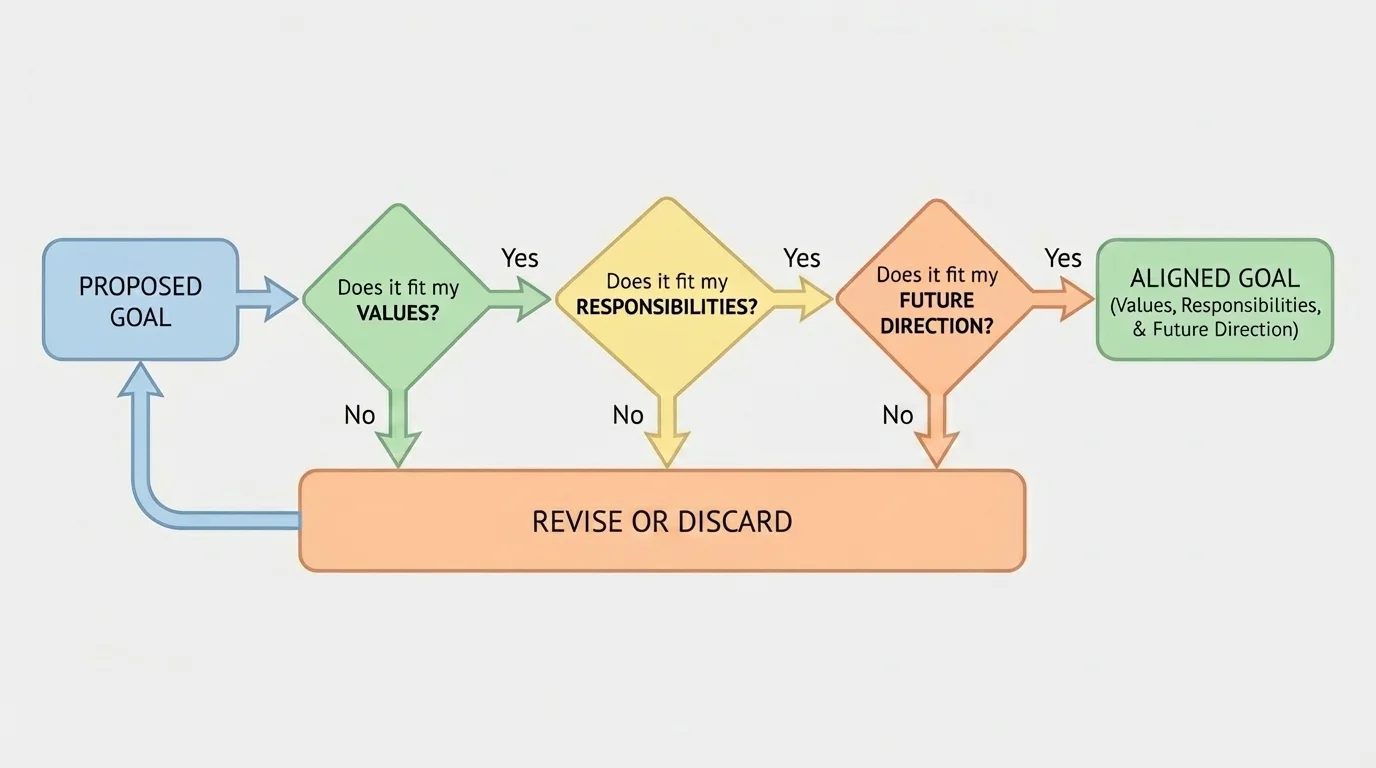
A practical way to create an aligned goal is to run it through three checks. First: does it fit your values? Second: does it respect your responsibilities? Third: does it move you toward a future you care about?
If a goal passes all three checks, it is probably strong. If it fails one, pause and revise it. You do not always need to throw the whole goal away. Often you just need to shrink it, change the timeline, or choose a better method.
[Figure 2] Use this step-by-step process:
Creating an aligned goal
Step 1: Name one value.
Example: You value health.
Step 2: Name one real responsibility.
Example: You need to complete online assignments and help cook dinner twice a week.
Step 3: Name one future direction.
Example: You want to become more self-disciplined and independent.
Step 4: Write a goal that fits all three.
Example: "For the next 4 weeks, I will prepare a simple breakfast for myself before logging in to school on weekdays and go to bed by the same time each night."
Step 5: Check whether it is realistic.
If waking up earlier is difficult, adjust the bedtime first or prepare breakfast items the night before.
This goal works because it supports health, fits daily responsibilities, and builds independence.
Notice what this process avoids. It avoids goals based only on mood, pressure, or comparison. It also avoids goals that sound impressive but do not fit your actual life.
One useful test is to finish this sentence: "This goal matters because..." If your answer clearly connects to values, responsibilities, and future direction, you likely have a solid reason. If your answer is mostly "because other people expect it" or "because it looks good," that is a warning sign.
Even a meaningful goal will fail without a plan. The key is to turn a big idea into small actions. Big goals often feel exciting at first and overwhelming later. Small actions are less dramatic, but they are what actually move you forward.
Suppose your goal is to improve your grades. That is too broad by itself. Make it more actionable: "I will study math for 25 minutes on Monday, Wednesday, and Friday, and I will check my assignment list every school day at 4:00 p.m." Now you know what to do and when to do it.
[Figure 3] Actionable goals usually include four parts: what you will do, how often, when, and how you will track it. For example, "I will read 10 pages of a career-related book every Saturday morning and write down one thing I learned."
Balance matters just as much as action. If your schedule is packed from morning to night, your goal may collapse after a few days. Leave room for rest, family needs, and unexpected problems. A goal should stretch you, not trap you.
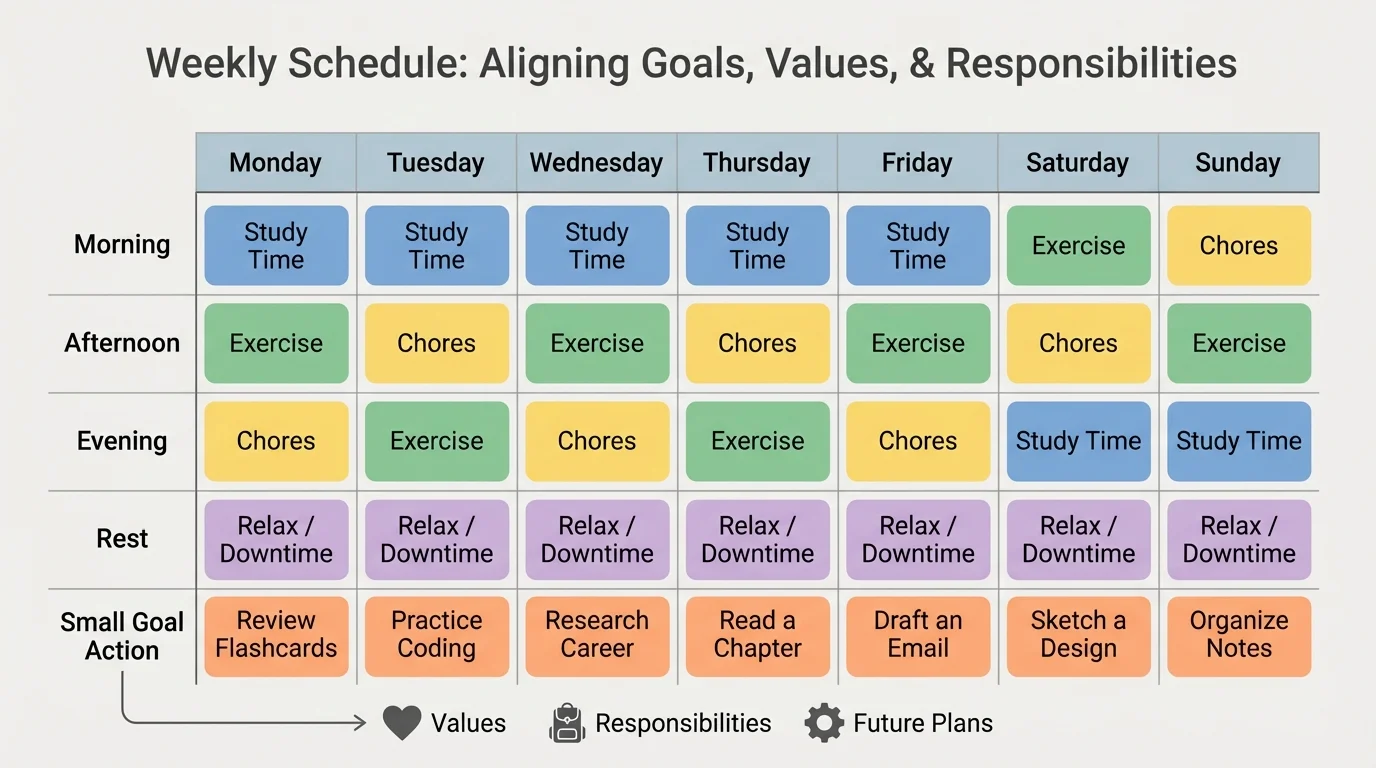
A simple planning method is the weekly check. At the start of the week, list your top responsibilities first. Then add one or two goal actions. If your week already looks full, reduce the goal action instead of pretending you can do everything. For example, doing one practice session is better than planning five and completing none.
Another helpful idea is priority. A priority is what deserves attention first because it matters most right now. You may care about many things at once, but not everything can be first. Choosing a priority is not rejecting all other goals forever. It is deciding what leads for now.
As shown in [Figure 3], a balanced plan includes both progress and recovery. Students often underestimate how much consistency matters. Doing a small action four times is usually more powerful than doing a huge action once.
When a goal feels too large, break it into the next visible action. "Get fit" becomes "walk for 20 minutes after lunch." "Prepare for a future career" becomes "watch one tutorial and practice one skill this weekend."
If needed, use simple numbers to check your time. For example, if you have about \(2\) free hours on a weekday and you already need \(1\) hour for assignments and \(30\) minutes for chores, that leaves about \(30\) minutes for a goal action because \(2 - 1 - 0.5 = 0.5\) hours. Planning this way helps you avoid overcommitting.
Sometimes your goals, values, and responsibilities do not line up perfectly. That does not mean you are failing. It means you need to make choices. For example, you may value achievement but also need rest. You may want to earn money, but schoolwork may need to come first. You may want to help everyone, but also need boundaries.
[Figure 4] When conflict shows up, ask which choice best matches your deeper values, not just your current emotions. If you are deciding whether to stay up late finishing a personal project or get enough sleep before an important day, your value of discipline might actually support going to bed on time.
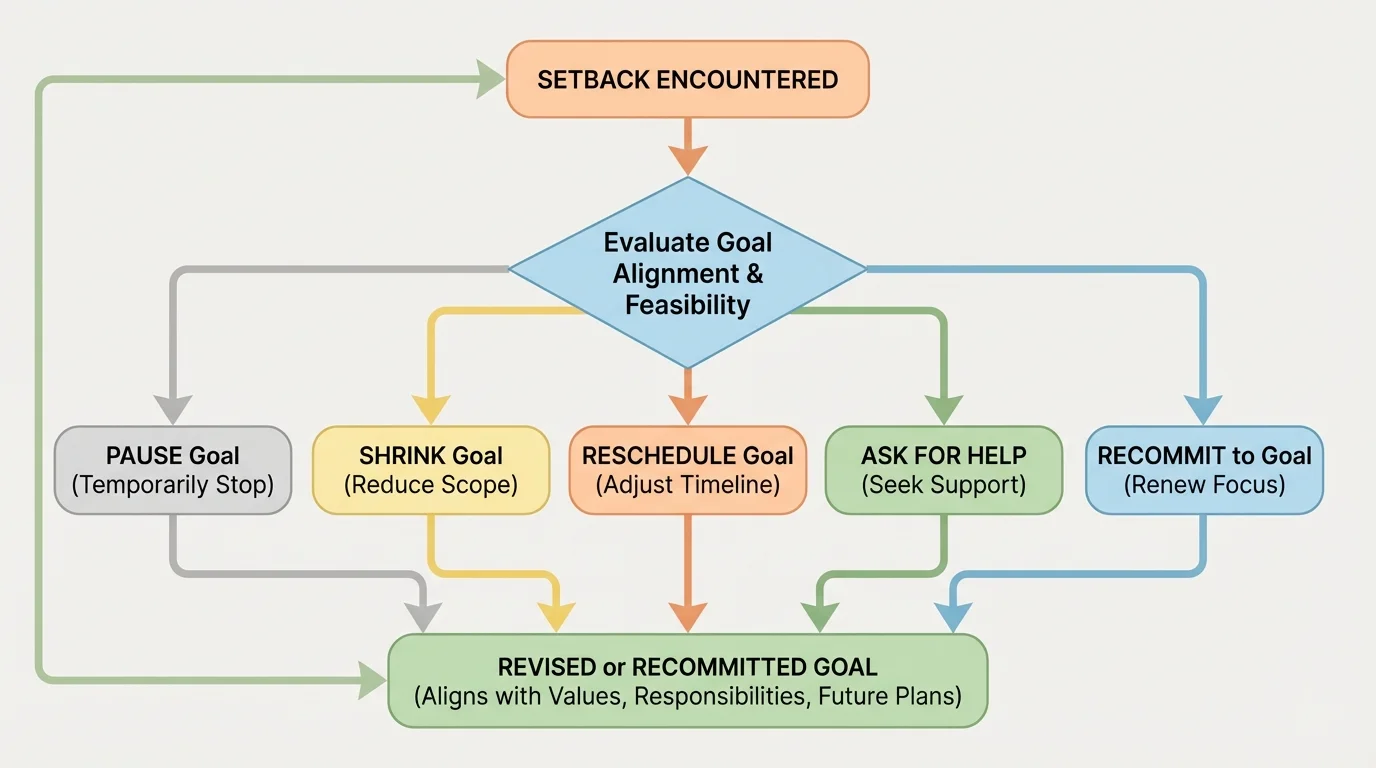
Setbacks are normal. You may miss a week, get overwhelmed, or realize you set the wrong goal. The important skill is adjustment. You can pause, shrink, reschedule, ask for help, or restart. Restarting is not the same as starting over from zero. You still learned something.
Here are healthy ways to respond to setbacks:
Pause and diagnose. Ask what actually went wrong. Was the goal too big? Did you forget to plan? Did another responsibility become urgent?
Shrink the goal. If your plan was 30 minutes a day and you did nothing, try 10 minutes four days a week instead.
Reschedule honestly. A goal may be good but poorly timed.
Ask for support. Talk with a parent, guardian, mentor, counselor, coach, or trusted adult if the goal involves major stress or a difficult decision.
Keep your reason visible. Re-read why the goal matters. This reconnects effort to purpose.
Much later, when you look back, you will probably care less about whether your path was perfect and more about whether it was honest and sustainable. That is why the adjustment model in [Figure 4] matters so much.
Aligned goals look different for different people. Here are a few realistic examples for your age.
Example 1: School and stress
A student wants straight A grades in every subject, but they are already stressed, behind on sleep, and managing family responsibilities.
Step 1: Check values.
The student values learning and responsibility, but also health.
Step 2: Check responsibilities.
They have coursework, chores, and limited energy.
Step 3: Revise the goal.
Instead of "perfect grades in everything," the student chooses: "For the next 6 weeks, I will submit all assignments on time and raise my lowest class by improving one study habit."
This version is more realistic and still supports future success.
That goal is strong because it focuses on controllable actions, not perfection. It respects the student's life instead of ignoring it.
Example 2: Earning money
A student wants extra money for personal expenses and future savings.
Step 1: Identify values and future plans.
The student values independence and wants to become financially responsible.
Step 2: Consider responsibilities.
School and home duties still come first.
Step 3: Create a balanced goal.
"I will offer one small service each weekend, such as pet sitting, yard help, or digital design, and I will save half of what I earn."
This goal builds work habits without taking over the student's week.
Notice that the goal is not just "make money." It is connected to independence, self-management, and future readiness.
Example 3: Community and character
A student cares about helping others but keeps forgetting commitments.
Step 1: Identify the mismatch.
The value is service, but the current habit is inconsistency.
Step 2: Build a practical goal.
"For the next month, I will volunteer online or in my community for 1 hour each Saturday and set a reminder the night before."
Step 3: Track follow-through.
The student records each completed hour in a notes app or planner.
This goal turns a value into a dependable action.
In each example, the best goal is not the biggest one. It is the one most likely to improve real life over time.
A goal should not stay untouched forever. Your life changes. Responsibilities shift. Interests grow. Sometimes your understanding of yourself becomes clearer. That is why regular review matters.
Every week or two, ask yourself a few questions: Is this goal still connected to my values? Is it realistic with my current responsibilities? Is it helping me move toward the kind of future I want? What is working? What needs to change?
You can also look for signs of a mismatch. Warning signs include constant dread, repeated avoidance, conflict with important duties, loss of sleep, or feeling like the goal belongs to someone else. One hard week is not proof of a problem. But a repeated pattern deserves attention.
A strong review does not mean judging yourself harshly. It means collecting useful information. Maybe the goal is right but the timing is wrong. Maybe the goal is right but the method is weak. Maybe the goal was never truly yours. All of that is valuable to know.
As you grow older, goal setting becomes less about proving yourself and more about building a life that fits. That includes your character, your relationships, your health, your work, and your hopes for the future. Goals are tools. They should serve your life, not control it.
