Have you ever heard the teacher say something, and then suddenly you are not sure what to do next? That happens to lots of children. Your brain is busy, and sometimes it wants to look at toys, wiggle, or think about something else. The good news is that focusing is a skill. You can practice it, and it can get stronger every day.
Attention means your brain is looking, listening, and thinking about the thing that matters right now. When your teacher gives directions on a video lesson, focusing helps you know when to listen, what to do, and when to begin. If you listen carefully, your work feels easier. If you miss the directions, you may feel confused or upset.
Focusing means keeping your eyes, ears, body, and brain on the job you are doing right now. Directions are the words that tell you what to do. Task means the job or activity you are working on.
Focusing does not mean you must be perfectly still all the time. It means you are trying to stay with the teacher or the task. Sometimes you may need to sit up, take a breath, or put your hands in your lap so your body can help your brain listen.
Before learning starts, it helps to make a small plan. A ready body and a ready space make focusing easier, as [Figure 1] shows. Try to sit where you can see the screen well. Keep only the things you need nearby, like paper, crayons, or a pencil. Put other toys away until learning time is done.
Your body can help you listen. Put your feet on the floor or rest them still. Keep your hands quiet until it is time to use them. Point your face toward the screen so your eyes and ears are ready. If you are holding a toy, it may try to steal your attention.
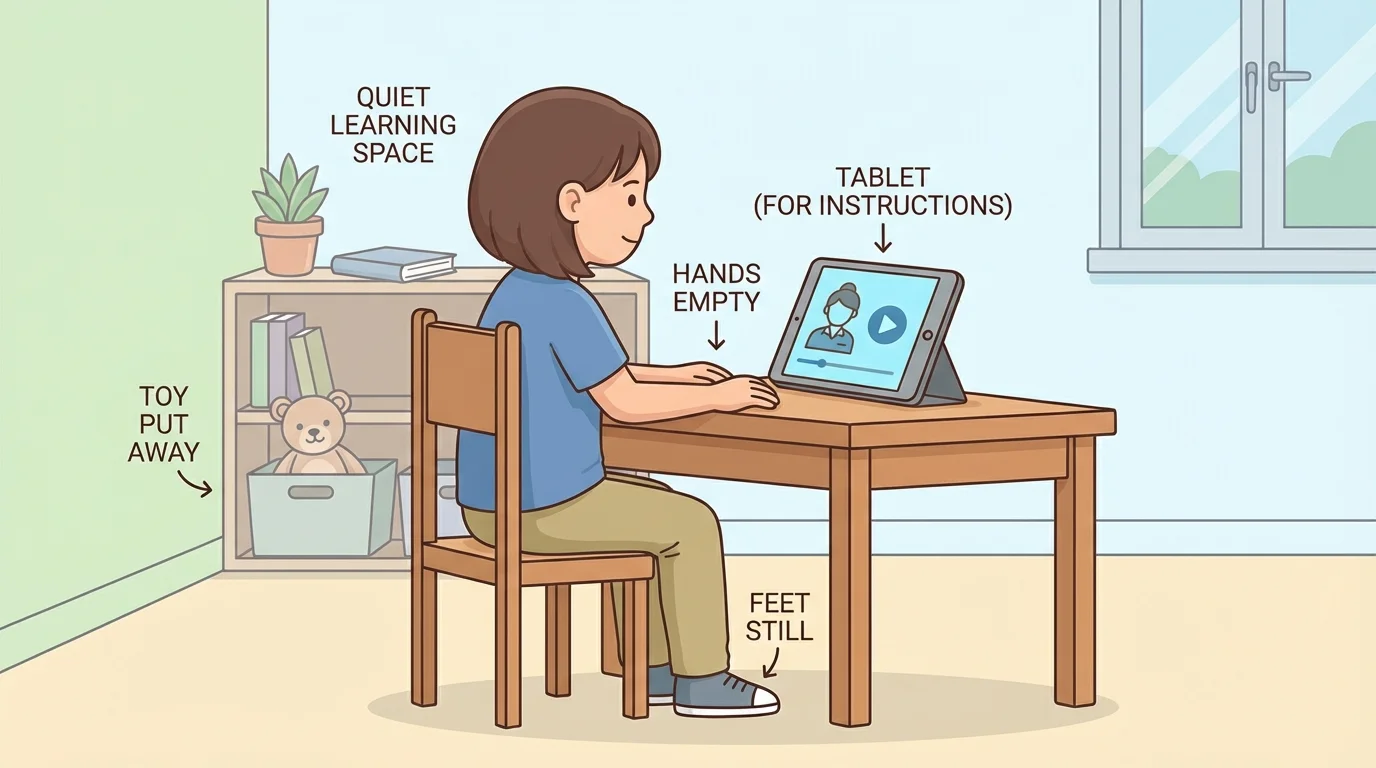
You can remember this simple ready check: eyes looking, ears listening, hands calm, body still. When you do this before directions begin, you are more likely to know the next step.
Your brain pays attention better when your learning space is calm and simple. Even small distractions, like a favorite toy in your hand, can make listening harder.
If the room is noisy, ask for help finding a quieter spot. If you need a drink or a tissue, get it before the lesson starts. Small problems can pull your attention away, so getting ready first helps you stay with the teacher.
When the teacher starts speaking, use a simple routine to help your brain know what to do, as [Figure 2] illustrates. First, stop your hands. Next, look at the screen. Then, keep your mouth quiet. Last, listen all the way to the end before you begin.
Sometimes children start the activity too soon because they hear only part of the directions. Waiting is important. If the teacher says, "Get your paper, draw a big circle, and then color it blue," you need to hear all the parts. Listening to the whole message helps you do the job the right way.
You can also listen for special clue words like first, next, last, stop, and show me. These words tell you what order to follow. If you miss a clue word, the activity may feel tricky.
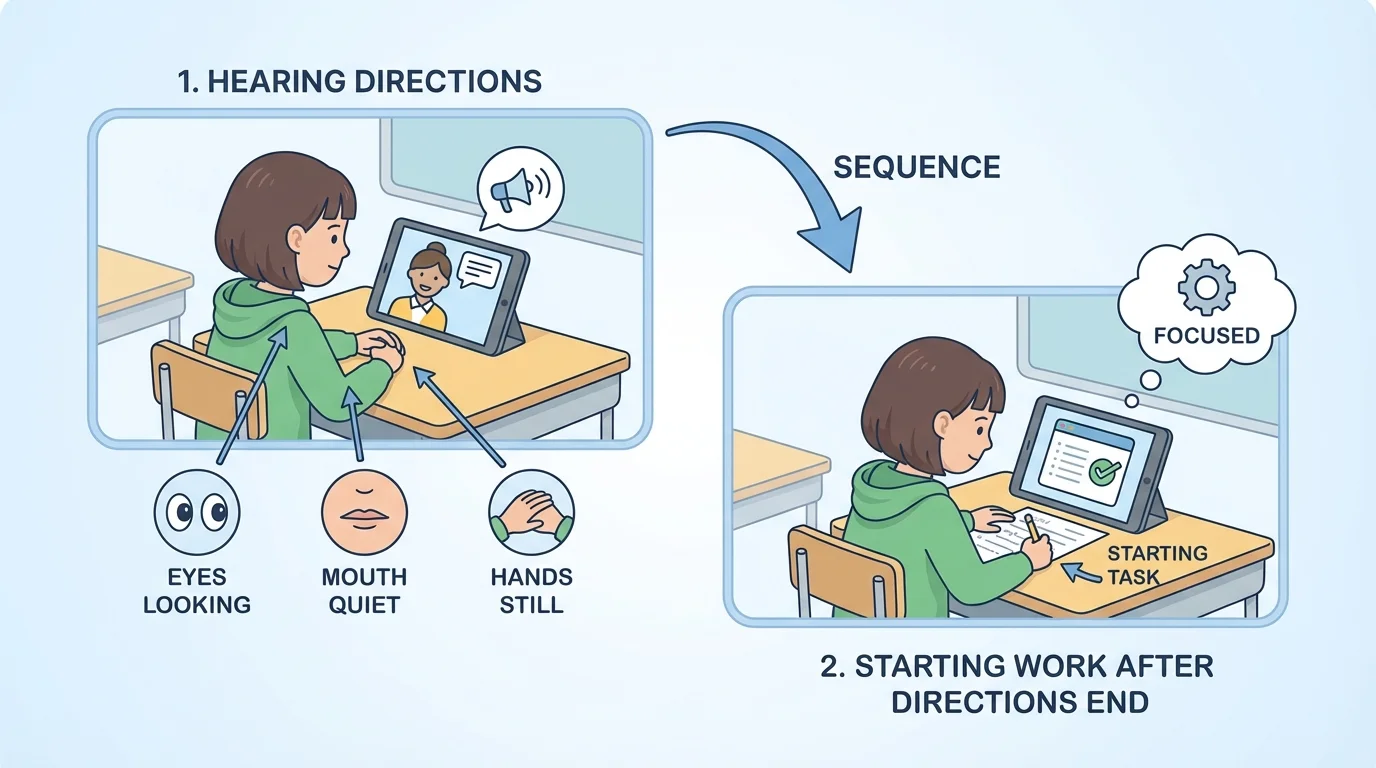
If you are not sure what the teacher said, do not guess right away. Pause and listen for the directions again. If needed, ask for help in a calm way, such as, "Can you say that again, please?" Asking helps you get back on track.
Example: Following online directions
Step 1: The teacher says, "Pick up the red crayon."
You listen and wait.
Step 2: The teacher says, "Draw one heart."
You still listen and do not rush ahead.
Step 3: The teacher says, "Now color the heart."
You begin the task after hearing all the directions.
Because you listened to the end, you knew exactly what to do.
Later, when you are working by yourself, the same listening routine still helps. The careful waiting you saw earlier in [Figure 2] is useful any time someone gives directions on a screen or in an audio lesson.
After the directions are finished, it is time to stay with the job. Start with the first step only. If the task has more than one part, do one part, then the next. Thinking about all the steps at once can make a small job feel too big.
Distraction means something pulls your attention away from what you are supposed to do. A pet walking by, a toy on the table, or another tab on the device can be a distraction. When you notice one, gently bring your eyes and brain back to the task.
One-step-at-a-time thinking helps your brain stay calm. Instead of saying, "I have so much to do," tell yourself, "I do this step now." Then do the next step after that. Small steps are easier to follow and finish.
You can use simple self-talk: listen, do, check. Listen to the direction. Do the step. Check if you finished it. Then move on. This keeps you from skipping parts or forgetting what comes next.
When you finish a step, look back at your work. Did you use the right item? Did you do the part the teacher asked for? A quick check can fix tiny mistakes before they become bigger problems.
Everybody loses focus sometimes. Your thoughts may float to a snack, a game, or something outside the window. That is normal. What matters is knowing how to refocus. Refocus means bringing your attention back to the teacher or the task.
As [Figure 3] shows, try a tiny reset. Take one slow breath. Put your hands in your lap. Look back at the screen or your paper. Then ask yourself, "What is happening right now?" This helps your brain return to the important job.
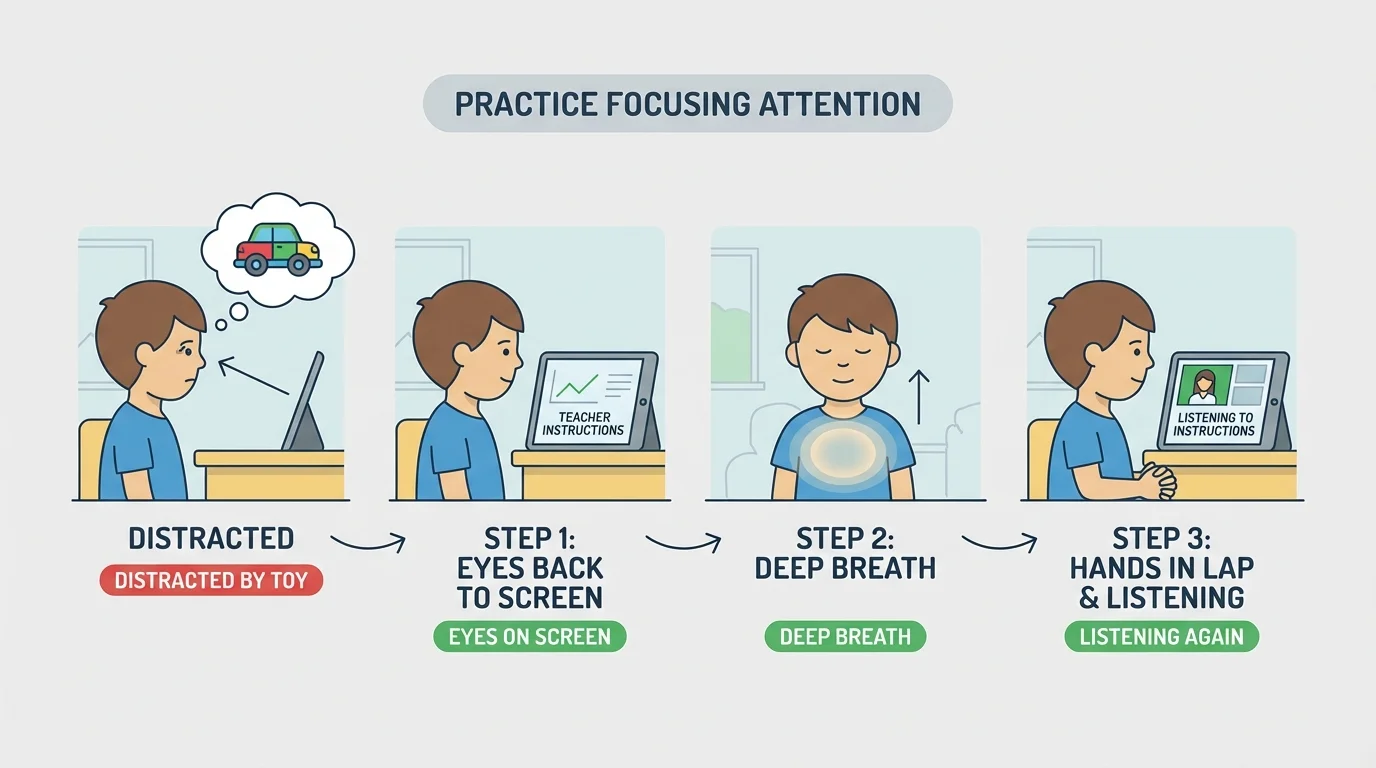
If you still feel lost, listen for a familiar word or watch what the teacher is doing. You can also ask for help. Getting help is not giving up. It is a smart way to get your attention and learning back on track.
"Stop, look, listen, and then do."
— A helpful focus reminder
The reset steps from [Figure 3] work outside of lessons too. You can use them during story time, while cleaning up toys, or when an adult gives you directions at home.
You do not practice focusing only during schoolwork. You can practice when someone says, "Please put your shoes by the door," or "First wash your hands, then sit for lunch." Listening in daily life helps this skill grow stronger.
Here are some easy ways to build strong focus: look at the person or screen, keep your hands calm, listen to the whole direction, do one step at a time, and ask for help if you need it. The more you practice, the easier it becomes.
You already know how to follow simple rules and take turns. Focusing uses those same helpful skills: waiting, listening, and doing the next right thing.
Try This: Before your next lesson, whisper to yourself, "Eyes looking. Ears listening. Hands calm." Then use the same words when the teacher starts talking. Small reminders can help your brain remember what to do.
Try This: If you get distracted during a task, do a tiny reset: one breath, eyes back, hands still, listen again. These quick steps help you return without feeling upset.
