Have you ever had a day where someone helped you right when you needed it? Maybe a grown-up fixed your computer, read you a story, or helped clean up a mess. Many jobs are all about helping. These jobs make learning easier, keep places safe, and help people in the community every day.
A job is work a person does to help others and earn money. Some jobs help you learn. Some jobs help a school stay organized. Some jobs help the whole town or neighborhood. When people do their jobs well, life works more smoothly.
If no one helped, many things would be hard. Your online lesson might not start. Books might not be easy to find. Trash might pile up. People might not get help when they are sick or hurt. Jobs matter because people matter.
Helper jobs are jobs people do to take care of others, solve problems, and keep places working well. A helper can teach, fix, clean, protect, deliver, or care for people.
You can learn to identify a job by asking, Who does this person help? and What do they do? Those two questions make the job easier to understand.
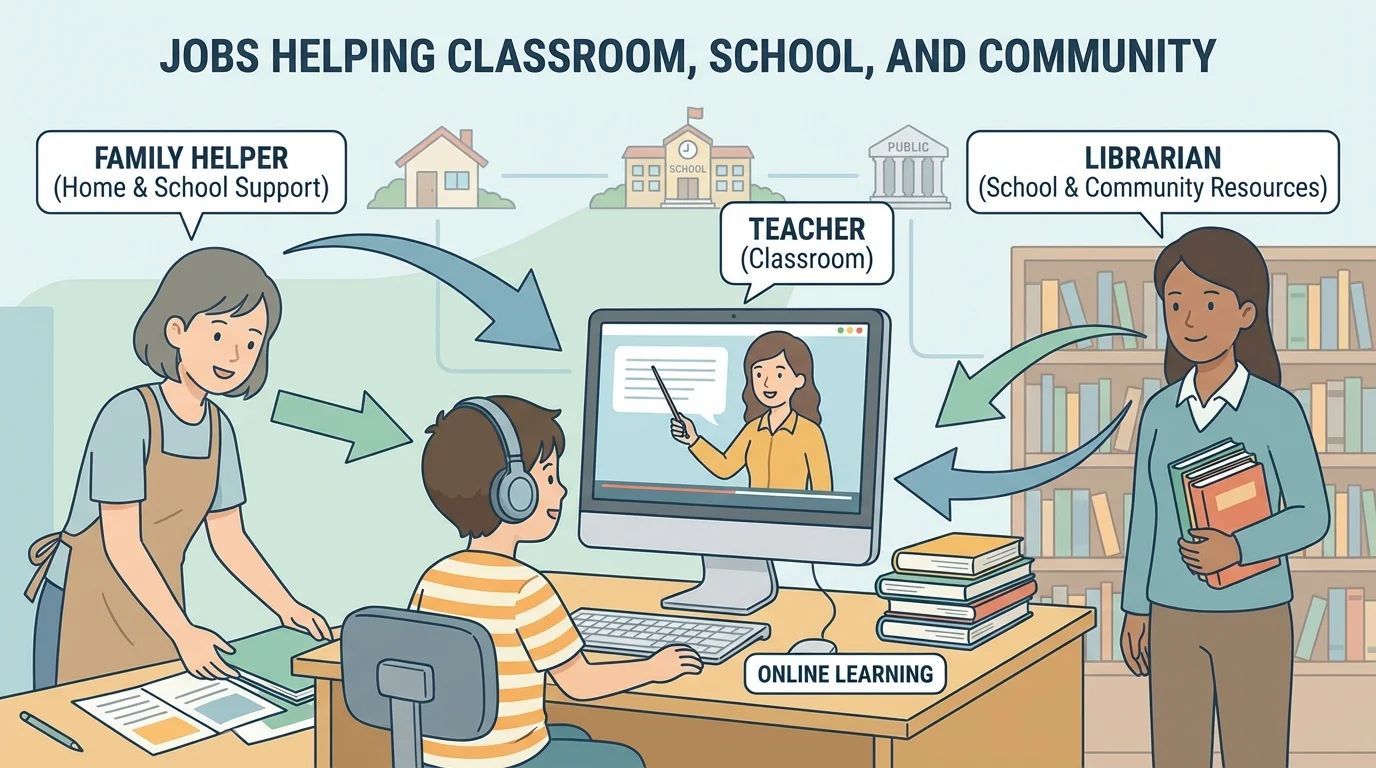
When you learn online, different people help from different places, as shown in [Figure 1]. A teacher helps you learn new things, explains directions, and answers questions. A family member or caregiver may help you log in, find supplies, or stay on schedule.
Another important helper is a librarian. A librarian helps people find books and information. Even if you use digital books, a librarian helps you choose stories and learn new facts. A technical support specialist fixes devices or internet problems so learning can continue.
These jobs are important because they solve problems. If your screen freezes, a technology helper can help. If you do not know which book to read, a librarian can help. If you are confused about directions, your teacher can help.
You can also be a helper during online learning. You can put your supplies in one place, listen carefully, and ask politely for help. That makes learning work better for you and for the adults helping you.
Some librarians help children online by choosing e-books, reading stories on video, and showing families how to borrow books from home.
When you think about the helpers in [Figure 1], notice that each person has a different job, but they all support learning.
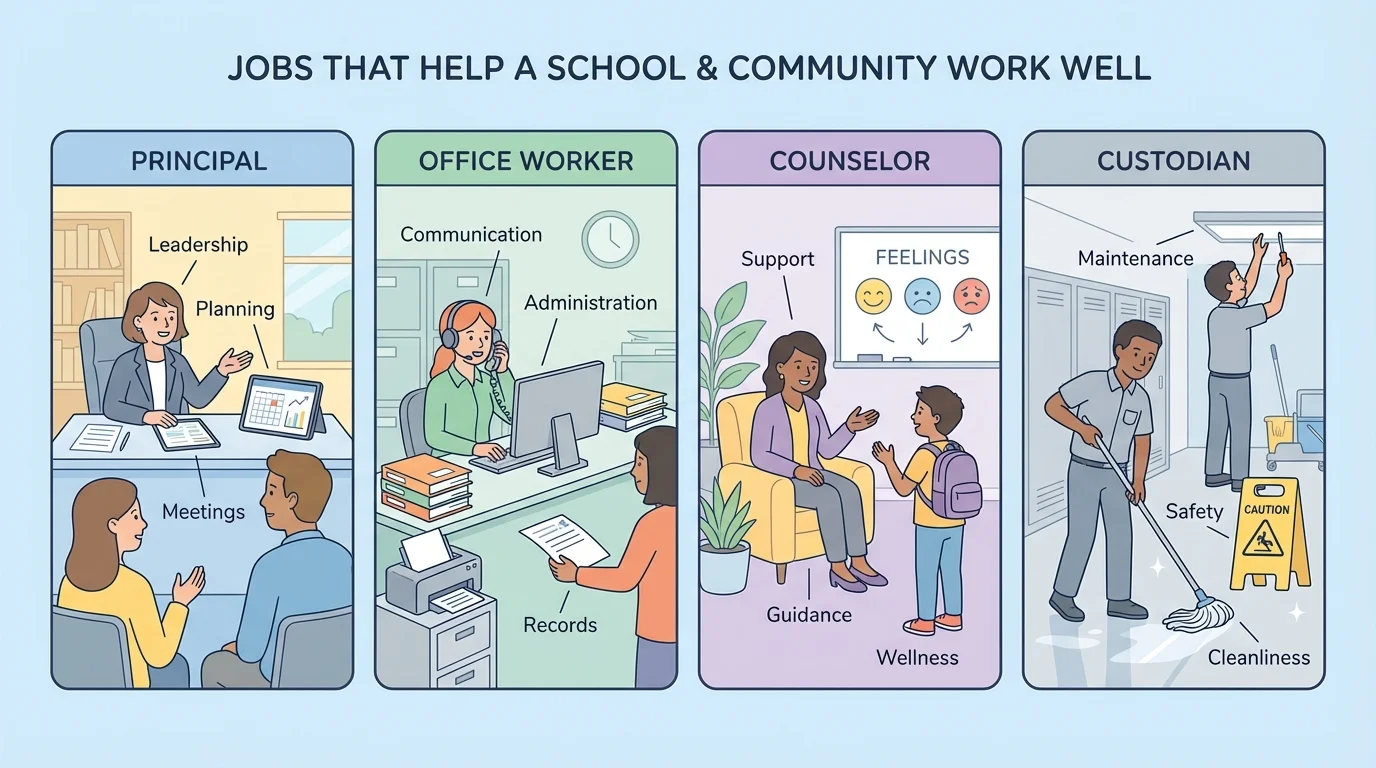
A school also has many adults working behind the scenes, and [Figure 2] illustrates how each one helps in a different way. A principal helps lead the school. The principal makes sure the school is organized and that children and teachers get support.
A counselor helps children with feelings, worries, and problem-solving. An office worker answers messages, keeps information organized, and helps families get what they need. A custodian cleans and takes care of the building and tools people use.
Even in online school, these jobs still matter. Someone organizes schedules. Someone helps families with questions. Someone keeps learning systems running. Someone helps children feel safe and supported.
| Job | What the person does | Why it helps |
|---|---|---|
| Principal | Leads and makes plans | Helps the school stay organized |
| Counselor | Helps with feelings and problems | Supports children and families |
| Office worker | Sends messages and keeps records | Helps information stay clear |
| Custodian | Cleans and fixes things | Keeps spaces safe and ready |
Table 1. Jobs that help a school work well and the main way each one helps.
If these jobs were not done, school would feel confusing. Messages might get lost. People might not know where to get help. Spaces and tools might not be ready to use. That is why every job matters.
Example: Identifying a school helper
You feel worried before your online class and need help talking about your feelings.
Step 1: Think about the problem.
You need someone who helps with feelings and worries.
Step 2: Match the problem to the job.
A counselor helps children talk about feelings and solve problems.
Step 3: Name the helper.
The counselor is the best person to help.
This is how you identify a job by what the person does.
Later, when you remember the different helpers in [Figure 2], it becomes easier to tell which adult leads, which adult cleans, and which adult helps with feelings.
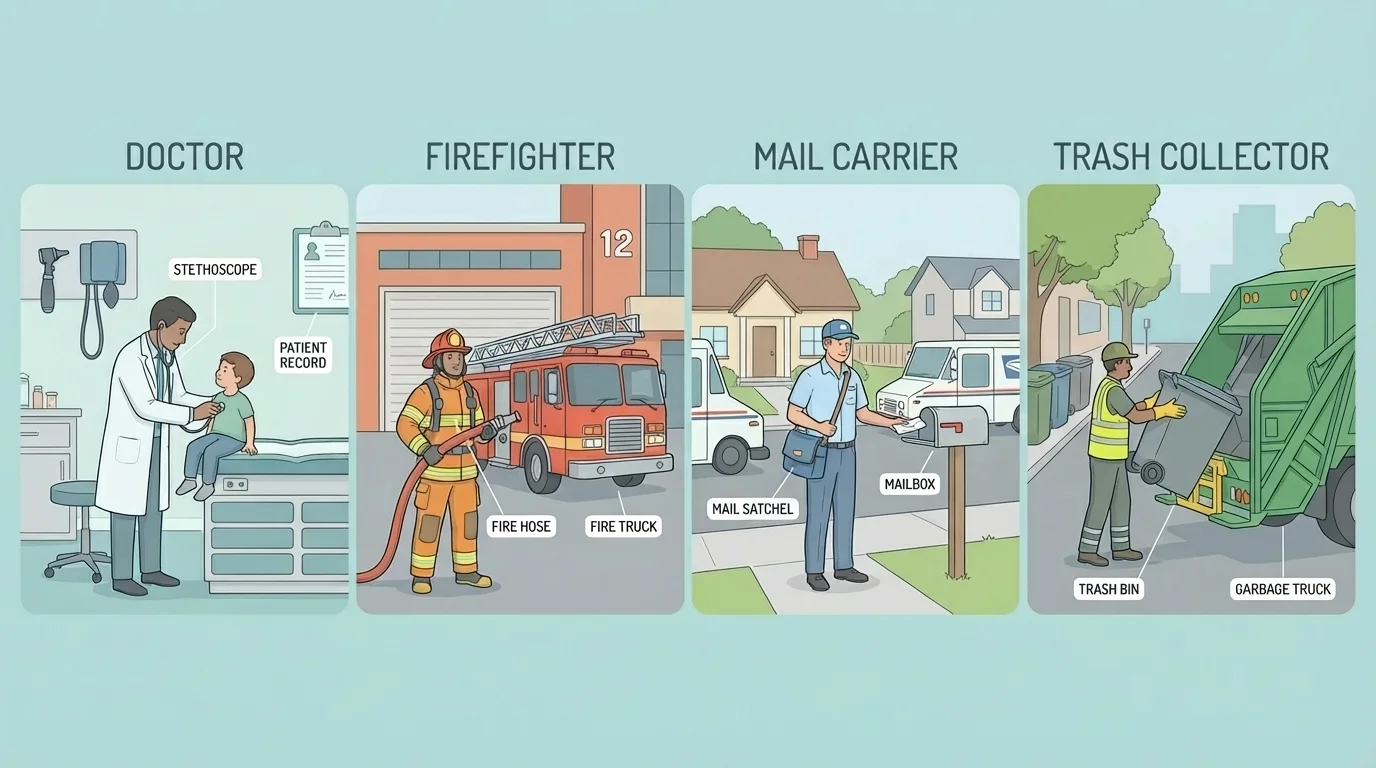
Your community is the group of people who live and work near you. Community helpers keep people safe, healthy, and connected, as shown in [Figure 3]. These are some important jobs you may see often.
A doctor or nurse helps people when they are sick. A firefighter helps during fires and emergencies. A police officer helps keep people safe. A mail carrier brings letters and packages. A trash collector takes away garbage so places stay clean.
Other community helpers are bus drivers, crossing guards, farmers, store workers, and animal shelter workers. Each one has a job that helps daily life work better.
Think about what happens when these jobs are done well. People get medicine. Homes stay safer. Mail arrives. Streets stay cleaner. Food gets to stores. Pets can be cared for. Communities work best when people help one another.
You can often identify a community helper by the problem they solve. If there is a fire, a firefighter helps. If someone is sick, a doctor or nurse helps. If trash needs to be removed, a trash collector helps.
One big idea
Different jobs may look different, but they all connect. A healthy, safe, organized community needs many kinds of helpers working together.
The neighborhood scene in [Figure 3] shows that no single person does everything. Many helpers share the work.
Here is a simple way to figure out what a job is. First, look at what the person is doing. Next, ask who is being helped. Then, name the problem being solved. This helps you identify the job and why it matters.
For example, if a person is delivering letters, helping homes get messages, and bringing packages, that job is a mail carrier. If a person is cleaning, fixing, and making a place ready to use, that job may be a custodian.
You already know how to notice helpers in your own life. A grown-up who cooks helps your family eat. A person who fixes the internet helps you get online. Naming the job is just the next step.
When you use this thinking, jobs become easier to understand. You stop guessing by clothes or tools only, and you start noticing the real help the person gives.
You are not an adult worker yet, but you can practice being helpful. You can be a cleanup helper, pet helper, table setter, plant waterer, or book organizer. These small jobs teach responsibility.
Try This: Today, look around your home and name one helper job you can do. Maybe you put crayons away, carry socks to the laundry basket, or help feed a pet. When you help, you make your own little community work better.
Try This: When you meet a helper in your community, say what job they do and how they help. You might say, "The mail carrier brings our letters," or "The librarian helps us find books."
Learning about jobs helps you understand the world. It also helps you see that your actions matter. Helpful people make places kinder, safer, cleaner, and easier to use.
