Your body, your space, and your feelings matter. Other people matter too. That means everyone should be treated with care. No one should poke, grab, tease, or look at private body parts. No one should make you keep an unsafe secret. You deserve to feel safe at home, on a video call, and when you are out in your community.
Privacy means some things are just for you. Respect means being kind with words and actions. Safety means being protected from harm. A boundary is a rule about what feels okay and what does not feel okay.
Private body parts are the parts covered by a swimsuit. These parts are not for other people to look at or touch, except when a trusted adult is helping keep you clean, healthy, or safe.
You can remember one very important rule: your body belongs to you. You can say no to touches that hurt, scare you, or make you feel confused. You can also listen when another person says no. That is how people show respect.
Some things are private, as [Figure 1] shows. Private things can be your body, the bathroom, changing clothes, and personal information like your full name, home address, or a picture someone wants to share. Before someone takes your photo or shares it on a video call, they should ask.
If you are using a computer or tablet for online school, a grown-up can help you protect your privacy. It is okay to ask, "Can my camera stay off?" or "Do not share my picture." It is also okay to close the bathroom door or ask for space when you are changing clothes.
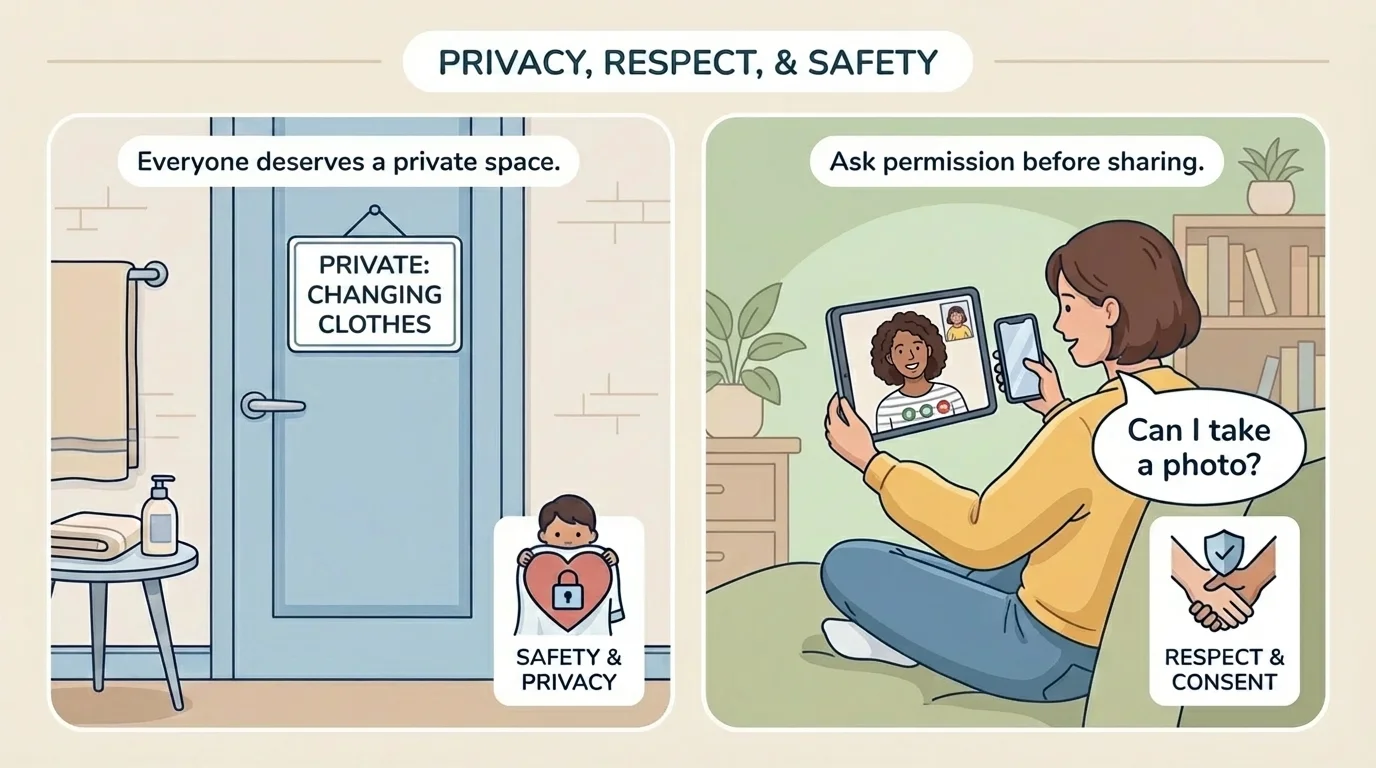
Privacy is not about being rude. It is about caring for your body and space. When your brother, sister, friend, or cousin wants privacy, you can respect that too by knocking, waiting, and asking first.
What privacy can sound like
Step 1: Use a clear voice.
Say, "I need privacy."
Step 2: Ask for the action you need.
Say, "Please knock first," or "Please do not share my picture."
Step 3: Get help if the person does not listen.
Tell a trusted adult right away.
When people respect privacy, everyone feels calmer and safer. When people do not respect privacy, someone may feel scared, embarrassed, or upset.
Respect looks simple, but it is powerful. It means using gentle hands, kind words and careful listening. If a person says, "Stop," "No," or "I do not like that," respectful people stop.
You show respect when you keep your hands to yourself, ask before hugging, and do not laugh at someone's body or feelings. You also show respect online by not sending mean messages, not taking screenshots without permission, and not sharing someone else's private information.
Respect goes both ways. You deserve respect from children and adults, and other people deserve respect from you. Respecting boundaries helps everyone feel safe and cared for.
Sometimes a person may want a high-five, and sometimes they may not. Both choices are okay. You can ask, "Do you want a hug, a high-five, or a wave?" That gives the other person a choice.
Your body can give you clues when something is wrong. You might feel a tummy ache, a fast heartbeat, tears, or a strong urge to get away. Those clues matter. When something feels wrong, you can use three strong safety actions, as [Figure 2] shows: say no, move away, and tell a trusted adult.
Unsafe secrets are secrets about touching, body parts, scary talk, or something that makes you feel bad inside. Surprises, like a birthday gift, are different because they become happy truths later. Unsafe secrets should be told to a trusted adult right away.
A trusted adult may be a parent, grandparent, caregiver, coach, club leader, or another grown-up who helps keep you safe. If the first adult does not understand, tell another trusted adult. Keep telling until someone helps.
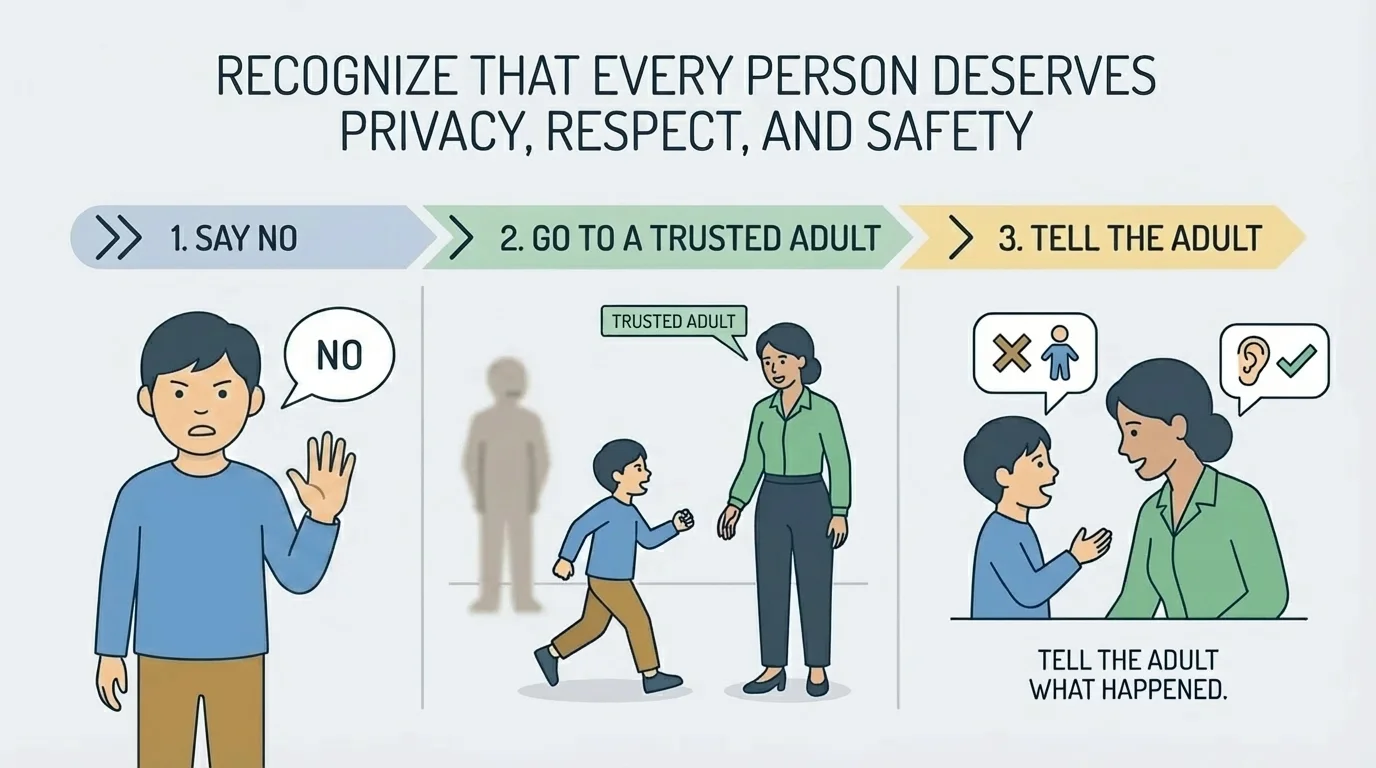
You are never in trouble for telling about an unsafe touch, unsafe secret, or something scary. Even if someone says, "Do not tell," you should still tell. Safe adults want to help you.
Your voice is a safety tool. Short, strong words like "No," "Stop," and "I need help" are easy to say and easy for adults to hear.
Later, when you think again about the three safety actions in [Figure 2], remember that you do not need to be perfectly polite when you are protecting yourself. Clear and safe is more important.
Sometimes children know something feels bad but do not know what to say. You can practice simple safety words in your mind so they are ready when you need them.
Step 1: Say a clear word. You can say, "No," "Stop," or "I do not like that."
Step 2: Move to a safer place. Go near a trusted adult, a family member, or another safe helper.
Step 3: Tell what happened. You can say, "He would not stop," "She took my picture," or "That made me feel scared."
Step 4: Keep telling until you get help. If one person is busy or does not understand, tell another trusted adult.
"My body belongs to me."
These words are not mean. They are strong and safe. You can use them if someone wants a hug, tickles too much, pulls at your clothes, or asks you to keep a scary secret.
Privacy and safety matter in many places. At home, you can ask for privacy in the bathroom or while changing clothes. On a screen, you can ask before sharing your name, your photo, or your room. In the community, you can stay close to your trusted adult and speak up if someone makes you uncomfortable.
During online learning or a video chat, as [Figure 3] shows, a grown-up can help choose safe settings. It is smart to ask before clicking on cameras, microphones, or chat buttons. It is also smart not to talk privately online with people you do not know in real life.
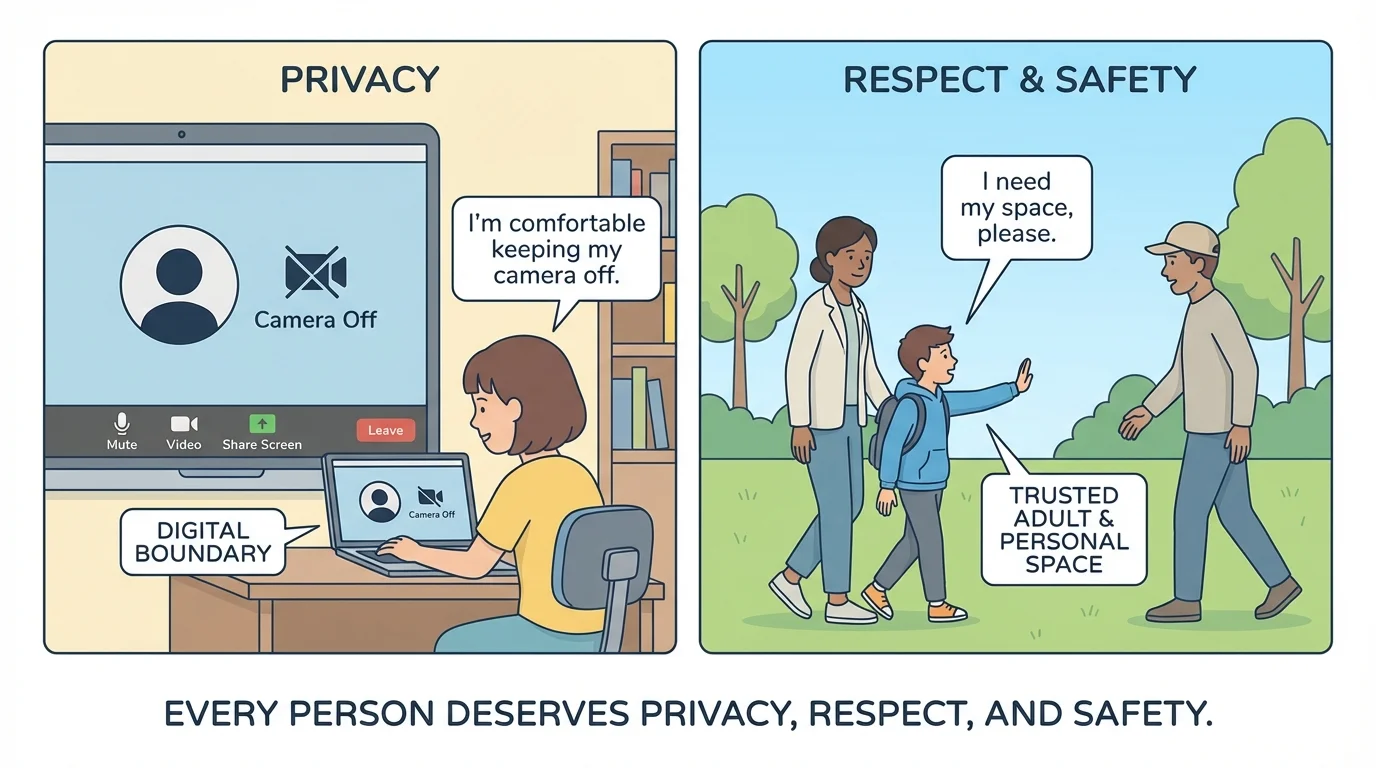
If a neighbor, family friend, older child, or even an adult does something that feels wrong, the safety rules stay the same. Say no, move away, and tell a trusted adult. The rules do not change because of who the person is.
Back in the privacy examples from [Figure 1], asking first is an important habit. It helps with photos, hugs, entering a room, and talking about someone else's body or personal information.
| Situation | Safe choice |
|---|---|
| Someone wants a hug | Ask first and listen to the answer |
| Someone opens the bathroom door | Say, "I need privacy," and tell a trusted adult if needed |
| Someone shares your picture | Tell them to stop and tell a trusted adult |
| Someone says keep a touching secret | Tell a trusted adult right away |
| You feel scared or confused | Move away and get help |
Table 1. Everyday situations and safe choices that protect privacy, respect, and safety.
Every person deserves privacy, respect, and safety. That includes you every day, everywhere.
