Have you ever wanted to hide a mess, grab the first turn, or say, "It wasn't me," even when it was? That happens to lots of people. Doing the right thing is not always easy, but every time you practice it, you grow stronger inside.
Doing the right thing means making a good choice, even when you do not feel like it. It means being kind, being honest, being safe, and taking care of your part. That is called responsibility.
Sometimes the right thing is simple: put your cup in the sink, use gentle hands, or tell the truth. Sometimes it feels harder: admit you spilled the water, give back something that is not yours, or wait for your turn.
Doing the right thing means choosing what is kind, honest, fair, and safe. Even if the choice feels hard, it helps you and other people.
When you do the right thing, people can trust you. Trust means others feel safe believing your words and choices.
Good choices can feel hard for many reasons. You might feel scared about getting in trouble. You might feel mad and want to shout. You might want something right now and not want to wait.
Sometimes other people make poor choices, and you may want to copy them. If someone in a game says, "Take an extra turn," or a child says, "Don't tell," your body may feel pulled in two directions.
That pulled feeling is normal. Feelings are real, but feelings do not have to be the boss. You can feel upset and still choose what is right.
Your brain gets stronger at making good choices when you practice them again and again. Small choices today help build strong habits for later.
A choice is something you decide to do. Every day gives you many little choices, and little choices matter.
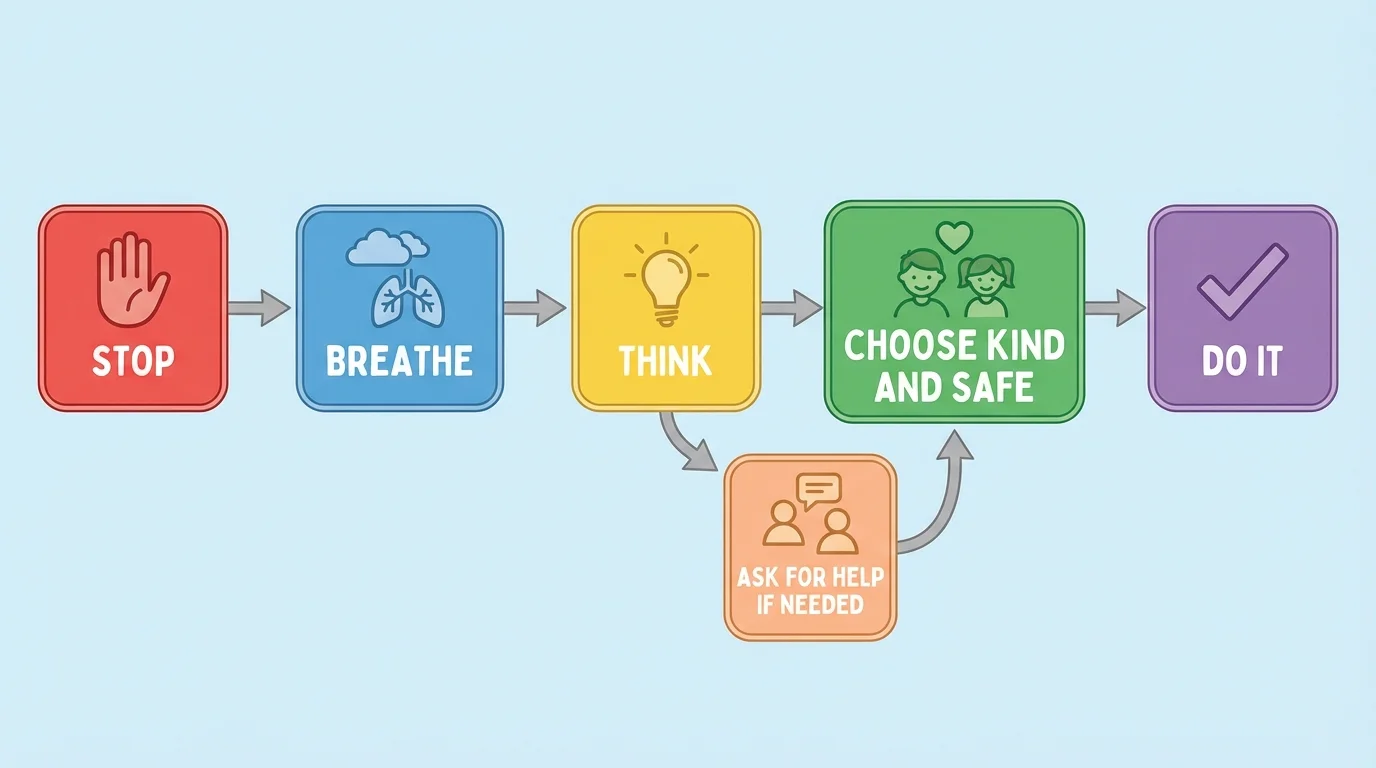
When a moment feels tricky, use this simple routine, as [Figure 1] shows: stop, breathe, think, choose, and do it. If you still feel unsure, ask a grown-up for help.
Step 1: Stop. Pause your body. Do not grab, yell, hide, or click send too fast.
Step 2: Breathe. Take one slow breath in and one slow breath out. A calm body helps a calm choice.
Step 3: Think. Ask: "Is it kind?" "Is it honest?" "Is it safe?" "Would I want someone to do this to me?"
Step 4: Choose. Pick the action that helps, not hurts.
Step 5: Do it. Even if it feels hard, use brave action.
Step 6: Tell or ask. If someone could get hurt, or if you do not know what to do, tell a trusted grown-up.
Example: You broke a crayon and want to hide it
Step 1: Stop and breathe.
Do not push the broken crayon under the table.
Step 2: Think.
Hiding it is not honest. Telling the truth is hard, but right.
Step 3: Choose and do.
Say, "I broke the crayon. I need help."
This choice shows honesty, which means telling the truth.
If your heart beats fast when you do the right thing, that does not mean you are doing it wrong. It means you are being brave. Brave does not always mean "not scared." Brave often means "I will do what is right while I feel scared."
Everyday moments, like the ones in [Figure 2], are the best times to practice. You do not need a big problem. Small moments help you learn.
At home, doing the right thing can mean putting toys away, feeding a pet when it is your job, or wiping up water you spilled. If you say you will help, then help.
When talking online with family or friends, doing the right thing can mean using kind words, waiting for your turn to talk on a video call, and not sending mean messages. It also means asking a grown-up before sharing pictures or personal information online.
During games, it can mean following the rules, not cheating, and saying "good game" even if you lose. Being fair means everyone gets a fair turn and follows the same rules.
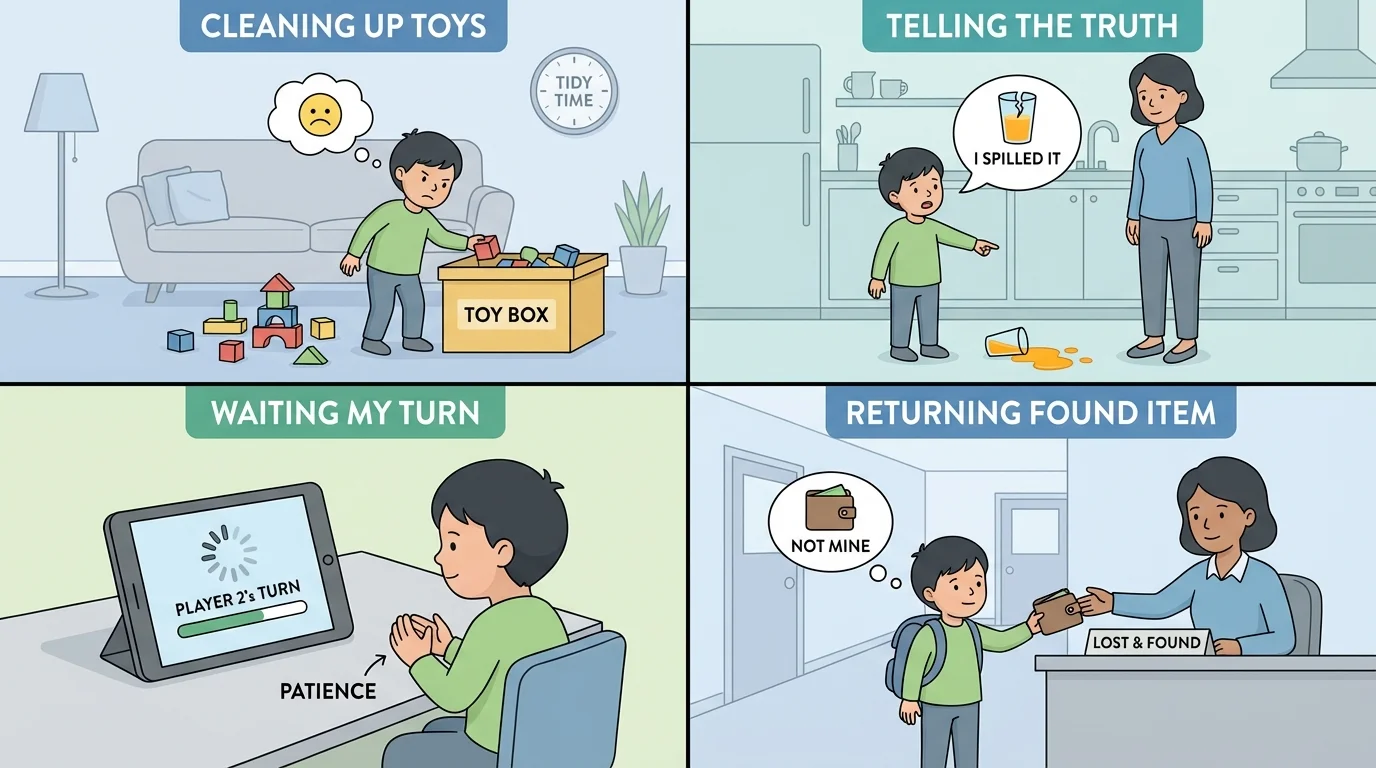
In your neighborhood or community, it can mean returning something you found, speaking kindly to others, and helping clean up after an activity. These are ways to care for your community, the group of people around you.
| Situation | Hard Choice | Right Choice |
|---|---|---|
| You spilled juice | Hide it | Tell and clean it up |
| You want the first turn | Push ahead | Wait and take turns |
| You lost a game | Cheat or yell | Use calm words |
| You found a toy | Keep it | Give it back |
Table 1. Everyday situations showing a hard choice and the right choice.
These examples all connect back to the same path we saw in [Figure 1]: stop, breathe, think, choose, and do the good action.
Everybody makes mistakes. Doing the right thing does not mean being perfect. It means fixing things when you can.
If you make a poor choice, try this: tell the truth, say you are sorry, and help repair the problem. That is called making things right.
Fixing a mistake helps character grow. When you admit a mistake and try to repair it, you learn that one poor choice does not have to become many poor choices. Telling the truth quickly often makes a problem smaller.
For example, if you knock over blocks in anger, you can say, "I am sorry. I was upset. I will help build them again." If you send an unkind message, you can ask a grown-up to help you send a kind apology.
An apology is when you say sorry and mean it. A real apology also tries to help fix the hurt.
"The right thing is not always the easy thing."
If someone else made the first mistake, you are still in charge of your own actions. Another person's poor choice does not make your poor choice right.
Each good choice is like a tiny practice step. One step may feel small, but many steps build character. Character is the kind of person you are becoming.
Strong character grows when you are kind, honest, fair, and helpful again and again. People begin to trust you more. You begin to trust yourself more, too.
Try this today: pick one hard-right thing. Maybe put away your toys before playing something new, tell the truth about a small mistake, or wait calmly for your turn. One small brave choice matters.
Tomorrow, do it again. The more you practice, the more doing the right thing starts to feel natural.
