Have you ever stacked blocks, and then, crash—they all fall down? That can feel surprising and even a little hard. But here is something important: everybody makes mistakes. When something goes wrong, you can stop, calm your body, and start again.
A mistake is something that does not go the way you meant it to. You might put a puzzle piece in the wrong spot, spill a crayon box, or say the wrong answer during online learning time. A mistake does not mean you are bad. It means you are learning.
Mistake means doing something in a way that does not work the first time. Try again means you start one more time. Calm means your body and feelings are getting quieter and steadier.
When you start again, you help your brain and body practice being strong. That is called resilience. Resilience means you can keep going after something feels hard.
After an oops, you may feel mad, sad, shy, or frustrated. Frustrated means you want something to work, but it is not working yet. Your face may get tight. Your hands may grab hard. You may want to cry or yell.
Those feelings are okay. Feelings are real, but they do not have to boss you around. You can notice them and then help yourself feel better.
Your body gives clues. A fast breath, a frown, loud voice, or stomping feet can be clues that you need a pause. When you notice the clues early, it is easier to calm down and begin again.
You can say, "I feel mad," or "I feel sad." When you name the feeling, a grown-up can help, and you can help yourself too.
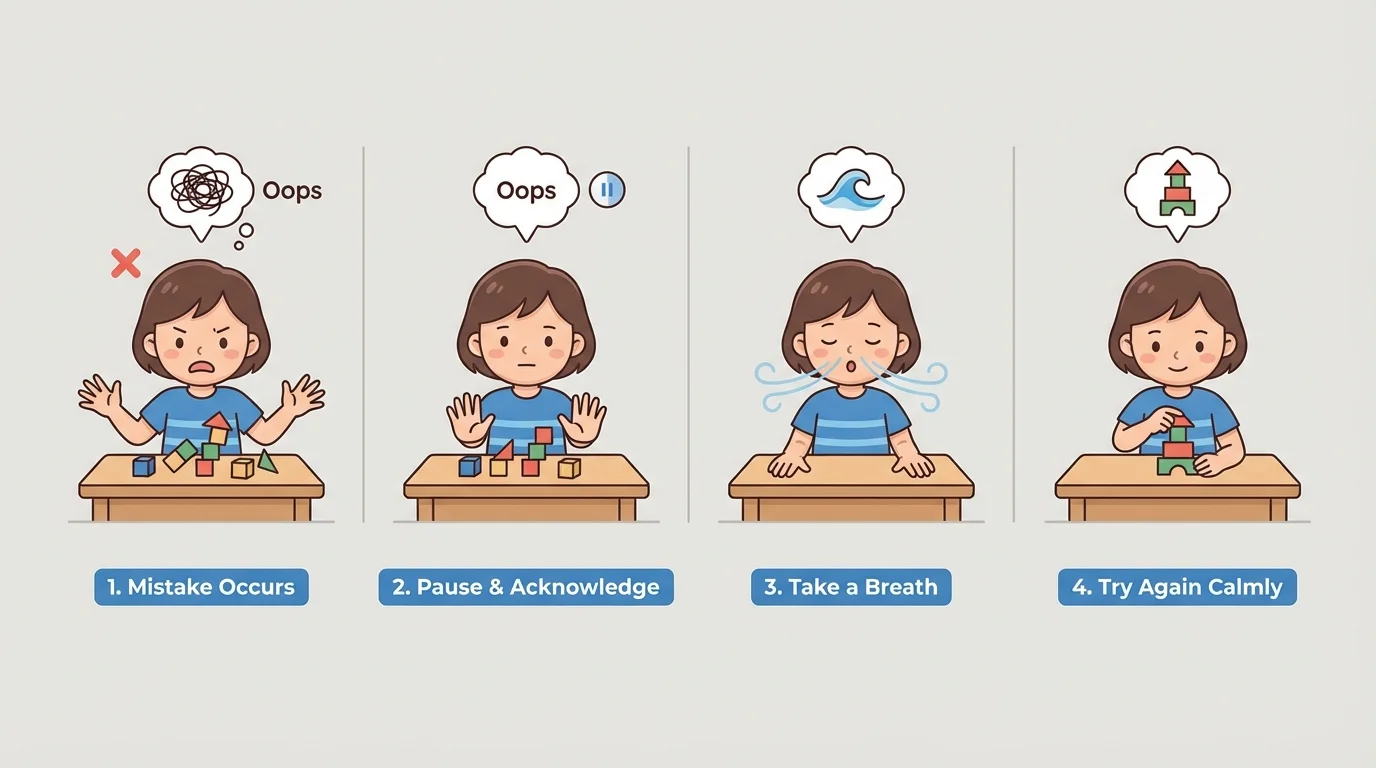
When an oops happens, use this easy plan, as [Figure 1] shows: stop your hands, take a big breath, say "oops," and try one more time. These little steps help you move from upset to ready.
Step 1: Pause. Make your body still.
Step 2: Breathe in and out slowly.
Step 3: Say, "Oops. I can try again."
Step 4: Start again, or ask for help.
If it still feels too hard, you can take a tiny break. Drink water, hug a pillow, or sit with a grown-up. Then come back when your body is calmer.
Starting again does not have to be fast. Slow is okay. Calm is helpful. Trying again is the brave part.
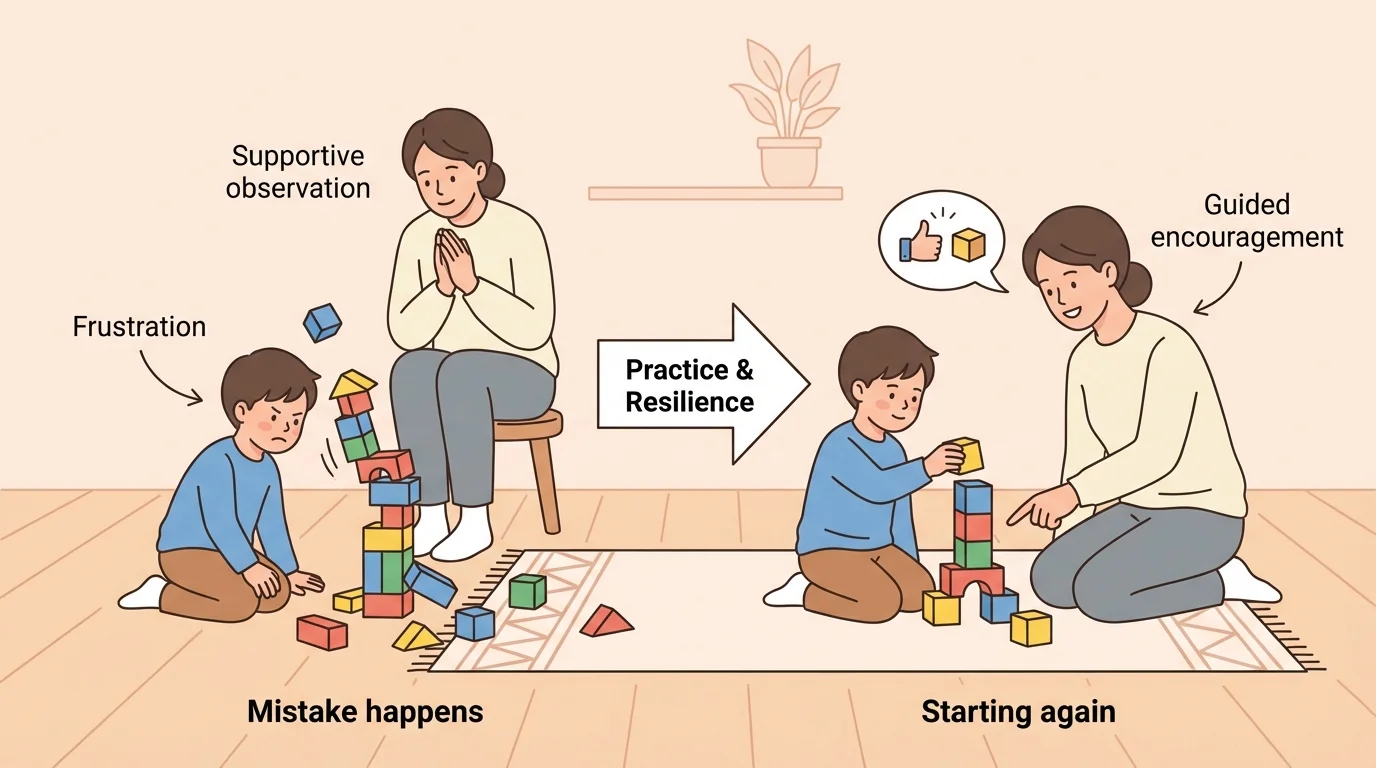
Play gives you many chances to practice, and [Figure 2] illustrates a very common one: something falls, breaks apart, or does not work the first time. That does not mean play is over. It means you get another turn.
If your block tower falls, you can pause, breathe, and build the bottom again. If your drawing line goes the wrong way, you can get a new paper or keep drawing. If a puzzle piece does not fit, you can turn it and try another spot.
Sometimes you may play a game with your brother, sister, or a friend on a video call, or with a grown-up at home. If you lose or make a mistake, you can say, "My turn again later," or "I want to try one more time." That is good self-management, which means taking care of your actions and feelings.
Example: The tower falls
Step 1: The blocks fall down.
Step 2: The child feels upset and stops moving for a moment.
Step 3: The child takes a deep breath and says, "Oops. I can build again."
Step 4: The child starts with a strong bottom row.
The mistake becomes a new start.
Later, when another toy problem happens, you can remember the same idea from [Figure 2]: falling down is not the end of the game.
Learning at home also has oops moments. During a song, story, or video lesson, you may say the wrong word, click the wrong thing, or forget what to do next. The calm restart routine in [Figure 3] works here too.
If a teacher on a screen asks a question and your answer is not right, you can listen again and try again. If you forget the next counting number, you can pause and ask, "Can you say it again?" If you miss a direction, you can say, "Please help me." Asking for help is smart.
At home, a grown-up may help you restart by saying, "Take a breath," or "Let's try one more time." You are not in trouble just because learning feels hard for a moment.
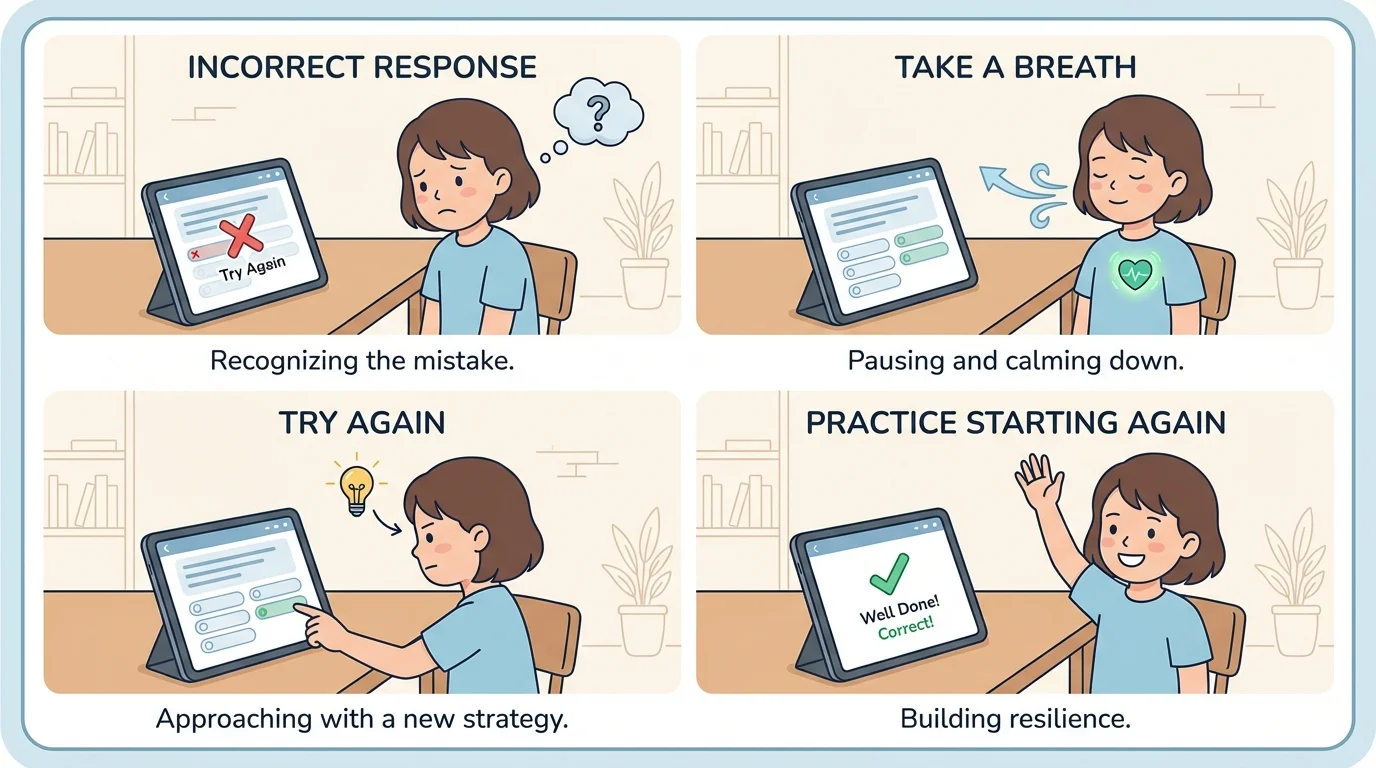
As you keep practicing, the scene in [Figure 3] becomes more familiar: a small mistake, a calm body, and a new try.
The words you say matter. Kind words help your heart feel safe. You can say, "It's okay," "I'm still learning," "I can try again," or "Please help me." This kind of inner talking is called self-talk.
"Oops means I am learning."
You can use kind words with other people too. If a friend on a video call makes a mistake in a game, you can say, "That's okay," or "Try again." Kindness helps everyone feel brave enough to keep going.
Every time you stop, breathe, and start again, you are building strength inside. You are learning to handle hard feelings and keep going. That is a big life skill.
Your brain grows when you practice new things, even when they feel tricky at first. Trying again helps your brain learn what to do next time.
When you do not start again, play can stop quickly, and learning can feel scary. When you do start again, you get another chance to build, draw, sing, listen, answer, or play. That is how little steps turn into big growth.
Next time an oops happens, remember: pause, breathe, use kind words, and try again. You do not need to be perfect. You just need to begin again.
