Friends can have little problems, even when they like each other. Maybe two people want the same toy. Maybe someone talks too loud on a video call. Maybe a friend grabs something before asking. The good news is this: small problems can often get better when you use calm, simple words.
A small friendship problem is a little upset between friends. It is not a big danger. It is something like, "I was using that," or "I do not like that." These little problems happen at home, at the park, during a playgroup, or while talking online with family friends.
Friendship problem means a small problem between friends that can often be fixed by talking kindly.
Kind words are gentle words that help people feel safe and heard.
When you use words, you help the other person know what you need. If you grab, yell, or cry without words, the problem can grow. If you speak simply, the problem can get smaller.
You do not need long sentences. Short words work well. You can say: "My turn, please." "I am sad." "I do not like that." "Can I have it when you are done?" "Please stop." "Let's share." "I want a turn."
These words help with communication. That means using words, listening, and taking turns talking. Good communication helps friends understand each other.
Short words are strong words
When you are upset, simple words are easier to say. A short sentence like "Please stop" is clear. A clear message helps the other person know what to do next.
[Figure 1] You can also name a feeling. You might say, "I am mad," "I am sad," or "I am not ready." Naming a feeling helps your friend know what is happening inside you.
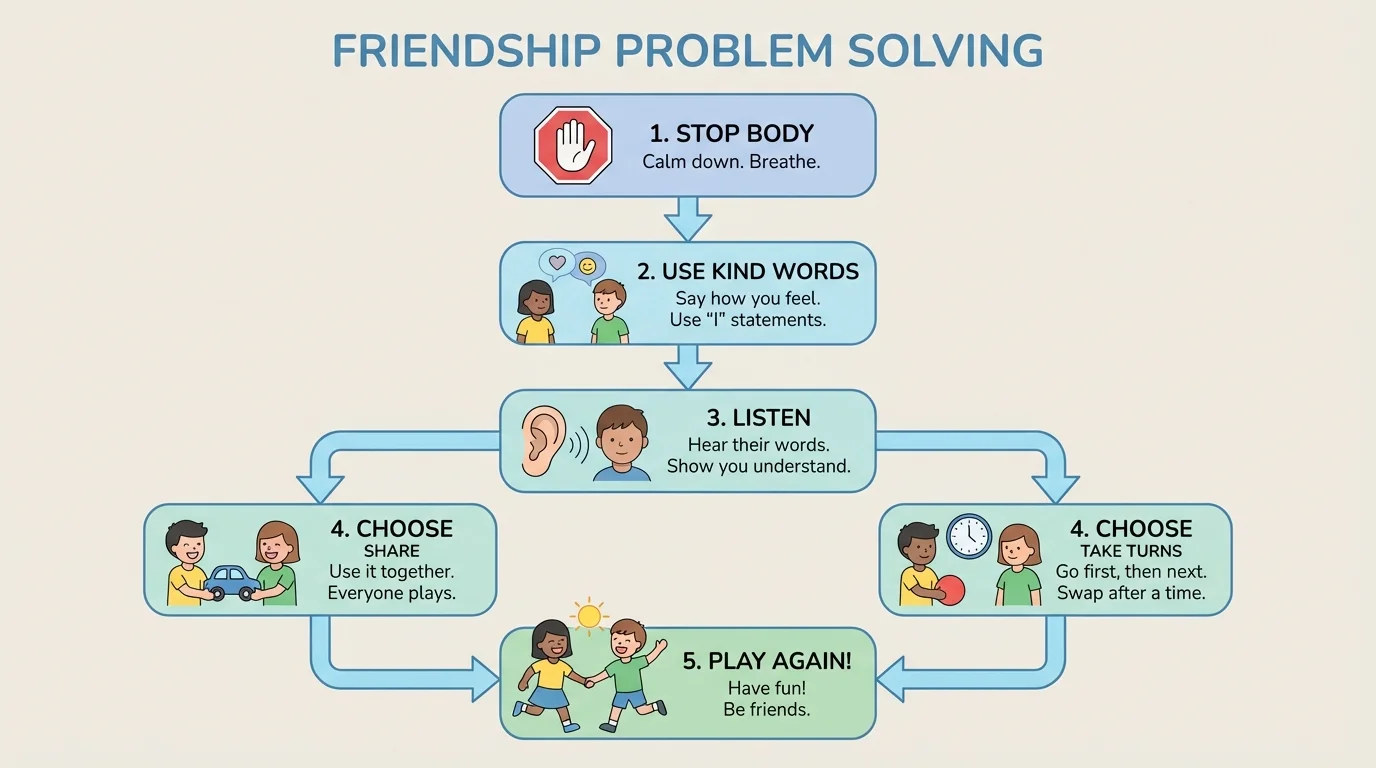
Small problems are easier to solve when you do one step at a time. You do not have to fix everything at once. Just stay calm and try one small step.
Step 1: Stop your body. Keep hands gentle. Take a breath.
Step 2: Say the problem with simple words. "I was using that." "Please do not push."
Step 3: Listen. Your friend may say, "I want a turn."
Step 4: Pick a small plan. Share, trade, wait, or take turns.
Step 5: Try again with a calm voice.
If the first words do not work, you can try again. Sometimes your friend did not understand. Repeating your words calmly can help: "Please stop." "I want a turn next." "Can we share?"
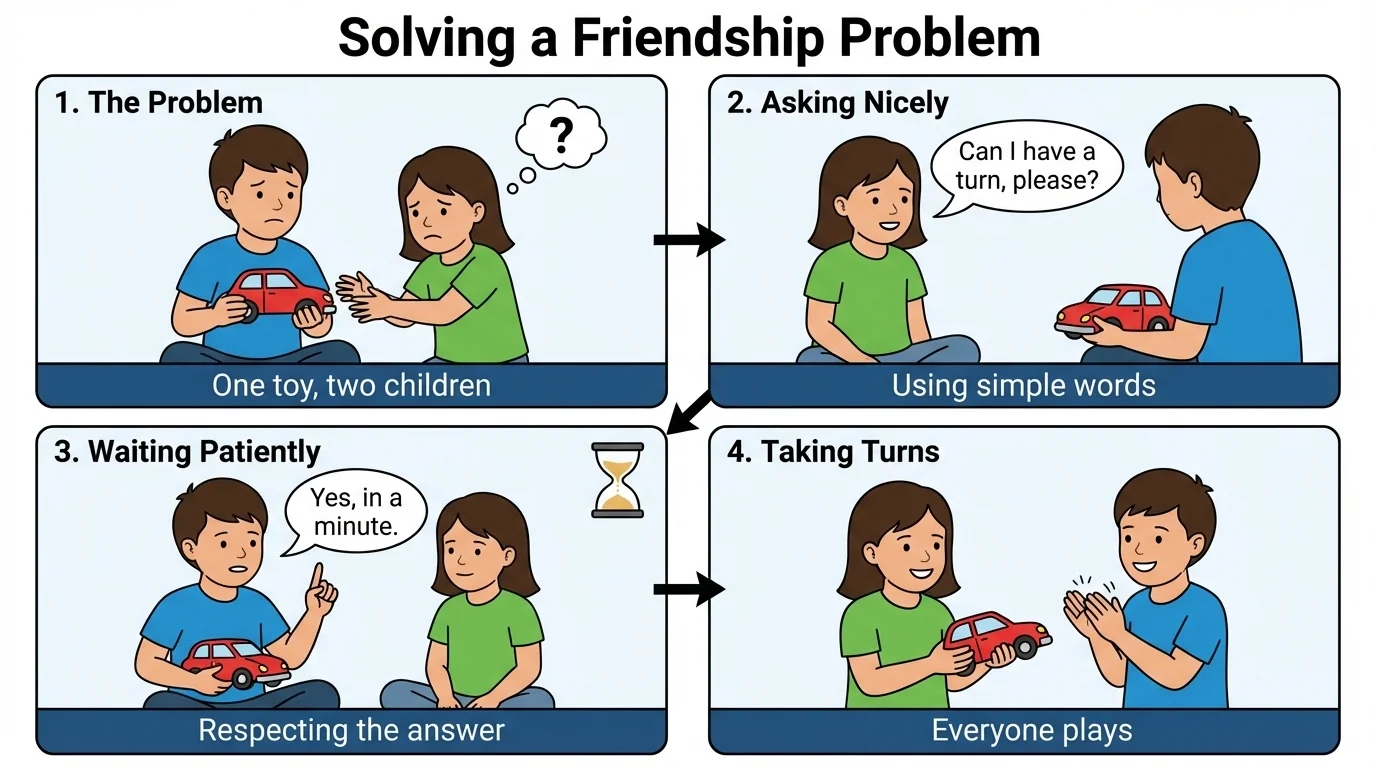
Example: One toy, two friends
Step 1: One child holds the toy. The other child wants it too.
Step 2: The waiting child says, "My turn, please."
Step 3: The first child says, "Okay, when I am done."
Step 4: They take turns, and the problem gets smaller.
When friends use simple words, they can keep playing. When they hit, scream, or grab, play often stops. Kind words help friendship feel safe.
Real moments are easier to understand when you see them in action, and [Figure 2] illustrates a turn-taking problem with one toy. Many little problems are about waiting, sharing, and using a calm voice.
If someone takes your crayons, you can say, "I am using these." If someone talks over you on a video call, you can say, "My turn to talk." If a friend stands too close, you can say, "Please give me space." If a friend is too loud, you can say, "Too loud for me."
Sometimes both friends want the same thing right now. Then a tiny plan can help: one person first, one person next. As we saw in [Figure 1], choosing a small plan after listening helps the problem move forward.
You can use simple words online too. If a friend on a video chat keeps interrupting, say, "Please let me finish." If you do not want to play a game right now, say, "Not now. Later, please." These words are part of conflict resolution. Conflict means a disagreement or problem between people.
Young children learn friendship skills little by little. Every calm sentence you use helps your brain practice what to say next time.
You do not have to be perfect. Sometimes you may forget your words. That is okay. You can stop, breathe, and try again.
Some problems are too big to fix alone. Ask a grown-up for help if someone hurts you, scares you, will not stop, breaks an important rule, or says something unsafe online. A trusted grown-up can help keep everyone safe.
This is part of boundary setting. A boundary is a clear line that tells what is okay and what is not okay. You can say, "Stop." "I do not like that." "I need help."
"Use kind words, strong words, and true words."
If a friend says sorry, you can accept it. If you hurt someone, you can say, "I am sorry." Then try the kind action too: give space, return the toy, or use a softer voice.
Practice one short sentence today. You can try: "My turn, please." Or: "Please stop." Or: "Can we share?" Say it slowly and calmly. Short words are easier to remember.
You can also practice listening. When your friend talks, stop talking, look at them, and listen carefully. Good listening helps you know what to do next. Listening is part of being a kind friend.
